Sarah Palin and John McCain’s 2008 Vice Presidential Selection: Strategic Gamble and Political Legacy
John McCain’s choice of Alaska Governor Sarah Palin as his vice presidential running mate on August 29, 2008, remains one of the most unexpected and consequential decisions in modern American political history. Designed to reenergize t...
John McCain’s choice of Alaska Governor Sarah Palin as his vice presidential running mate on August 29, 2008, remains one of the most unexpected and consequential decisions in modern American political history. Designed to reenergize the Republican base and counter Democratic momentum, the selection altered the 2008 presidential race and fundamentally reshaped the ideological trajectory of the Republican Party.
Contents
The 2008 Political Landscape and McCain’s Campaign Challenge
Heading into the late summer of 2008, Arizona Senator John McCain faced an uphill political battle. President George W. Bush’s second term was concluding amidst deep public dissatisfaction driven by the protracted war in Iraq, an unstable domestic economy, and the early stages of what would become the 2007–2008 global financial crisis. As the Republican nominee, McCain needed to distance himself from the outgoing administration while consolidating support across a divided conservative movement.
McCain had built a national reputation over decades as a "maverick"—a independent-minded reformist willing to buck party leadership on key issues like campaign finance, immigration reform, and climate policy. However, this reputation created friction with the party’s traditional base, particularly evangelical Christians and social conservatives, who viewed McCain with skepticism.
Simultaneously, the Democratic Party had nominated Illinois Senator Barack Obama following a historic primary race against former First Lady Hillary Clinton. Obama’s campaign generated unprecedented enthusiasm, drawing massive crowds and out-raising the McCain campaign in grassroots financial donations. Following the Democratic National Convention in late August 2008, Obama held a consistent lead in national public opinion polling.
To turn the race around, McCain’s senior campaign strategists—including campaign manager Rick Davis and chief political strategist Steve Schmidt—argued that traditional candidate choices would fail to disrupt Obama's momentum. The campaign determined it needed a high-risk, high-reward selection that would simultaneously accomplish three strategic objectives:
- Unite the conservative base by offering a candidate with strong social and fiscal conservative credentials.
- Appeal to disaffected voters, particularly suburban women and voters disappointed by Clinton's primary loss.
- Reinforce an outsider message aimed at challenging political norms in Washington, D.C.
The Vetting Process: Shortlists and Strategic Pivot
The vice presidential search was managed by veteran Washington attorney A.B. Culvahouse Jr., who conducted background checks and candidate interviews during the spring and summer of 2008. Culvahouse's team examined several prominent Republican leaders, developing a narrow list of potential choices representing distinct political strategies.
The Initial Shortlist
McCain’s personal preference was Connecticut Senator Joe Lieberman, a former Democrat turned independent who had been Al Gore’s running mate in 2000. McCain and Lieberman shared a close friendship and aligned on foreign policy matters. McCain believed a cross-party "unity ticket" would embody his maverick brand and appeal to moderate independent voters. However, senior campaign strategists and congressional leaders warned McCain that Lieberman’s pro-choice stance on abortion rights and liberal voting record on domestic issues would spark an open floor revolt at the Republican National Convention.
Another leading candidate was former Pennsylvania Governor Tom Ridge, a moderate Republican who had served as the first Secretary of Homeland Security. Like Lieberman, Ridge held pro-choice views that made his nomination politically untenable for social conservatives.
The conventional, low-risk options included:
Mitt Romney: The former Governor of Massachusetts and McCain's primary rival held deep economic expertise and executive experience, though personal friction between the two men and concerns over conservative enthusiasm persisted.
Tim Pawlenty: The Governor of Minnesota offered executive experience from a Midwestern swing state and possessed a low-key political style that posed little downside risk.
McCain VP Selection Decision
- Traditional/Conventional Options
- Tim Pawlenty
- Mitt Romney
- High-Risk/Disruptive Path
- Sarah Palin
- Traditional/Conventional Options
The Turn to Sarah Palin
As the August convention approached, McCain’s team pivoted toward Governor Sarah Palin. Elected as Alaska’s first female governor in 2006, Palin was a political newcomer with impressive initial approval ratings in her home state. She had built a reputation fighting political corruption within the state Republican establishment, taking on oil company tax structures, and cutting state spending.
Palin satisfied the strategic checklist: she was a staunch anti-abortion conservative, a lifetime member of the National Rifle Association (NRA), a female governor with executive experience, and an outsider from outside the Washington establishment.
However, the vetting period for Palin was exceptionally brief compared to traditional presidential campaigns. Culvahouse and his team conducted an intensive late-stage review over a few days in late August, reviewing financial records and state legislative files. On August 27, 2008, Palin flew secretly to Sedona, Arizona, where she met with McCain at his ranch. Impressed by her reformist background and executive experience, McCain formally offered her the position on August 28.
Comparison of Vice Presidential Shortlist Candidates
The following table summarizes the primary candidates considered by the McCain campaign during the final selection phase in August 2008:
| Candidate | Office Held (in 2008) | Strategic Strengths | Major Vulnerabilities / Risk Factors | Selection Outcome |
|---|---|---|---|---|
| Sarah Palin | Governor of Alaska | Executive experience, high approval ratings, outsider image, strong appeal to evangelical base. | Brief national profile, limited foreign policy exposure, condensed background check. | Selected |
| Joe Lieberman | U.S. Senator (I-CT) | Cross-party appeal, national security alignment, strong moderate credentials. | Pro-choice record, opposition from conservative activists, risk of convention floor fight. | Eliminated late in process |
| Tim Pawlenty | Governor of Minnesota | Executive experience in a Midwestern swing state, steady political temperament. | Perceived as low-energy; unlikely to fundamentally alter national polling dynamics. | Passed over |
| Mitt Romney | Former Governor (MA) | Deep business background, economic policy expertise, strong fundraising capacity. | Primary battle friction with McCain, perceived flip-flops on social issues. | Passed over |
| Tom Ridge | Former Governor (PA) | Executive experience, national security credentials, appeal in key battleground state. | Pro-choice stance, opposition from social conservative advocacy groups. | Eliminated early in process |
The Public Announcement and Immediate Aftermath
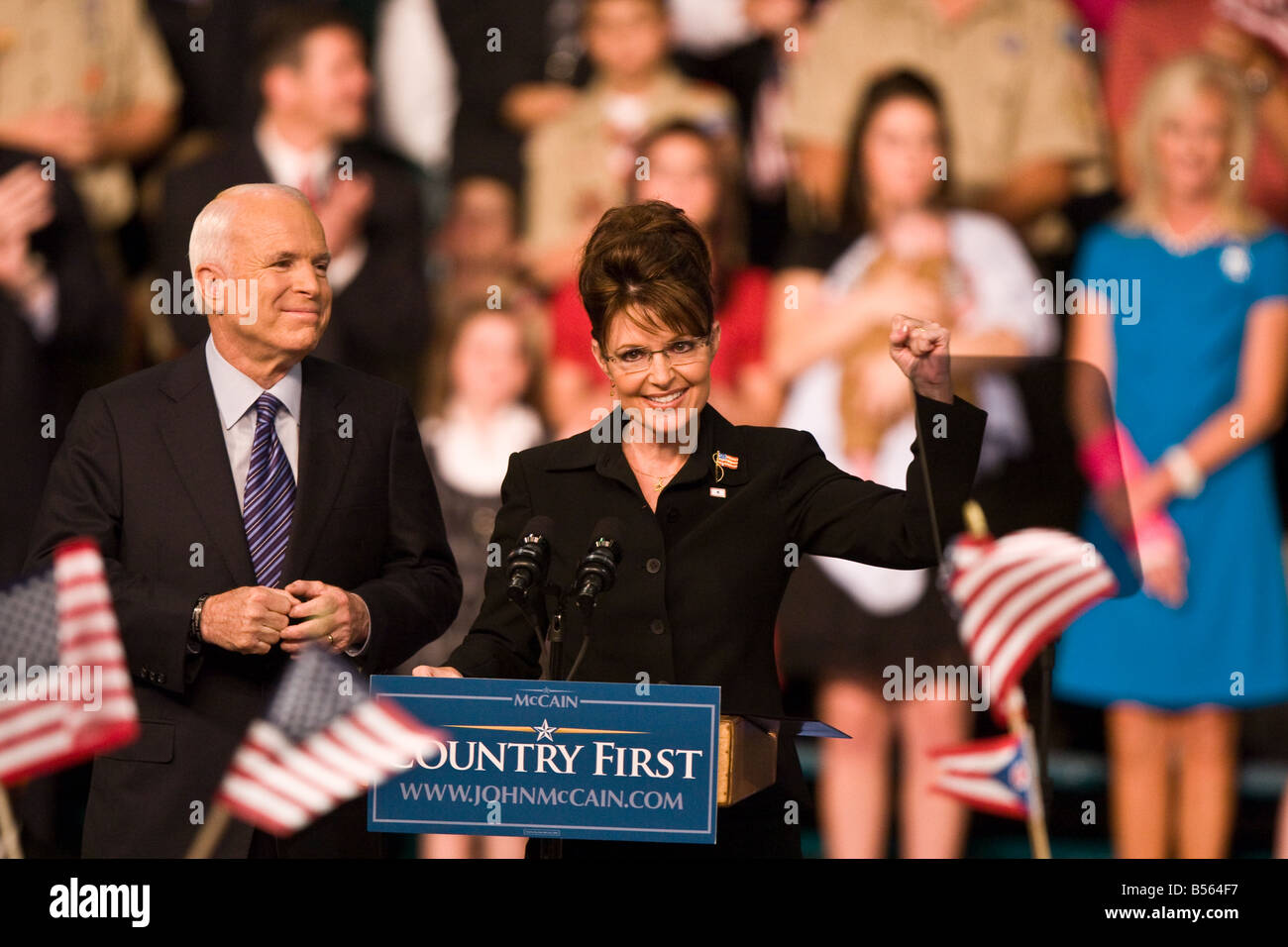
On August 29, 2008, at a rally in Dayton, Ohio, John McCain introduced Sarah Palin as his vice presidential running mate before a crowd of more than 15,000 supporters. The announcement caught media outlets and political operatives across the country almost entirely by surprise.
Palin’s debut speech highlighted her background as a mayor and governor, framed her as a self-described "soccer mom," and emphasized her independence from Washington political interests. She made direct appeals to female voters, explicitly referencing Hillary Clinton's primary run and the remaining "cracks" in the political glass ceiling.
The 2008 Convention Surge
Five days later, on September 3, 2008, Palin delivered her vice presidential acceptance speech at the Republican National Convention in Minneapolis-St. Paul. Written with campaign advisor Matthew Scully, the address drew an estimated television audience of nearly 37 million viewers.
Palin used the platform to contrast her small-town executive experience with Obama's career as a community organizer, famously quipping: "I guess a small-town mayor is sort of like a 'community organizer,' except that you have actual responsibilities." She described herself as a "pit bull with lipstick" and attacked media critics and Washington elites.
- August 29, 2008: Public Announcement in Dayton, Ohio
- Sept 3, 2008: RNC Acceptance Speech (37M Viewers)
- Mid-Sept 2008: Polling Surge (McCain Takes Brief Lead)
- Late Sept 2008: Unscripted Media Interviews & Vetting Controversies
- Oct 2, 2008: VP Debate with Joe Biden in St. Louis
The speech delivered an immediate political return:
- Polling Lead: The McCain-Palin ticket pulled ahead of Obama-Biden in several national tracking polls during early September 2008.
- Fundraising Surge: The campaign raised over $10 million in the 24 hours following the convention address.
- Base Activation: Grassroots conservative groups, Christian advocacy organizations, and local Republican organizations mobilized with heightened enthusiasm.
Media Scrutiny, Vetting Controversies, and Campaign Friction
The surge in support was met by intense national news coverage. Because Palin had not operated on the national political stage prior to August 2008, national news organizations descended on Alaska to investigate her record as Mayor of Wasilla and Governor of Alaska.
Key Controversies and Vetting Challenges
- "Troopergate" Investigation: An ongoing investigation by the Alaska Legislature examined whether Palin had abused her power as governor by firing State Public Safety Commissioner Walt Monegan, who had refused to terminate an Alaskan state trooper involved in a bitter divorce with Palin’s sister. In October 2008, an independent investigator appointed by the state legislature concluded that Palin had violated state ethics laws by allowing personal interests to influence official actions, though a separate state personnel board later cleared her of legal wrongdoing.
- Foreign Policy Preparedness: National commentators questioned Palin's readiness to assume the presidency if necessary. When asked about her foreign policy credentials, her references to Alaska's proximity to Russia were widely scrutinized.
- High-Stakes Media Interviews: In mid-September, Palin agreed to a series of one-on-one television interviews intended to establish her policy competence.
- An interview with ABC News’s Charles Gibson highlighted unfamiliarity with the "Bush Doctrine" of preemptive military action.
- A multi-day CBS News interview conducted by Katie Couric drew wide criticism when Palin was unable to name specific newspapers or magazines she regularly read to stay informed on world events.
Excerpts from these broadcast interviews were heavily replayed on news networks and parodied on programs like NBC's Saturday Night Live, where actress Tina Fey delivered widely watched impersonations of Palin.
Internal Campaign Dynamics
Tensions rapidly developed between Palin’s personal staff and McCain’s national headquarters in Arlington, Virginia. Senior campaign advisors, including Steve Schmidt and Nicolle Wallace, expressed frustration with Palin's prep sessions for interviews and debates. Conversely, Palin and her loyalists believed national staffers were mishandling her image, forcing her into overly scripted appearances, and failing to defend her against personal attacks.
These internal disagreements spilled into public view after the campaign, detailing disputes over clothes purchases made for Palin by the Republican National Committee and contrasting strategies on how aggressively to attack Barack Obama over his personal associations.
The Vice Presidential Debate and Electoral Conclusion
On October 2, 2008, Palin met Democratic vice presidential nominee Joe Biden for their sole debate at Washington University in St. Louis, moderated by PBS journalist Gwen Ifill.
Aware of the pressure following her broadcast interviews, Palin adopted a direct, informal style, speaking past the moderator directly to television viewers. She opened the debate by asking Biden, "Can I call you Joe?"
While Biden relied on traditional foreign policy arguments and legislative detail, Palin focused on domestic energy production ("drill, baby, drill"), middle-class tax policies, and populist critiques of Wall Street. Though instant polls indicated viewers felt Biden won the debate on points and policy expertise, Palin exceeded low media expectations, avoiding major missteps and stabilizing her standing among core Republican voters.
| Date | Key 2008 Vice Presidential Milestones |
|---|---|
| August 29, 2008 | McCain selects Palin; introduced in Dayton, Ohio |
| September 3, 2008 | Keynote RNC speech delivered in St. Louis |
| Sept 24-25, 2008 | Broadcast of CBS News interview with Katie Couric |
| October 2, 2008 | Vice Presidential Debate against Joe Biden |
| November 4, 2008 | General Election: Obama-Biden defeats McCain-Palin |
However, broader economic events overwhelmed campaign tactics. The collapse of Lehman Brothers in mid-September triggered an acute panic across financial markets. McCain’s decision to temporarily suspend his campaign to return to Washington for bail-out negotiations created public uncertainty about his management style.
On November 4, 2008, the Obama-Biden ticket won the presidency decisively, securing 365 electoral votes to McCain’s 173 and winning the national popular vote by a margin of 52.9% to 45.7%.
Long-Term Impact on American Political Dynamics
Although the McCain-Palin ticket was defeated, the selection of Sarah Palin marked a major turning point in modern American political history, accelerating changes in party coalitions and campaign strategy.
Shift Toward Populism
Palin’s political style—characterized by explicit anti-establishment rhetoric, distrust of mainstream media institutions, and reliance on cultural identity—prefigured the rise of the Tea Party movement in 2009 and 2010. She demonstrated that an outsider candidate could bypass traditional media gatekeepers to build an intense, passionate personal follower base among grassroots voters.
Political scientists and historians frequently trace the modern populist realignment within the Republican Party directly back to Palin’s 2008 campaign. Her focus on elite condescension toward working-class Americans provided a template for subsequent conservative movements over the following decades.
Evolution of Candidate Vetting Standards
The fast-tracked vetting process that led to Palin's selection caused both major political parties to reform their vice presidential selection protocols:
- Extended Timelines: Campaigns now initiate background checks, financial audits, and interview transcripts months earlier in the primary calendar.
- Comprehensive Media Drills: Potential running mates are subjected to extensive mock media interviews designed to test policy depth under intense national scrutiny.
- Digital and Social Audits: Vetting teams systematically review digital histories, local legislative votes, and past broadcast recordings to eliminate unexpected disclosures.
Frequently Asked Questions
Why did John McCain choose Sarah Palin instead of Joe Lieberman?
John McCain preferred Connecticut Senator Joe Lieberman to highlight bipartisan collaboration. However, key advisors warned him that Lieberman’s pro-choice stance on abortion rights and liberal record on domestic issues would cause a walkout by conservative delegates at the Republican National Convention. Palin was selected to unify the conservative base while maintaining an outsider reform brand.
When was Sarah Palin officially announced as the VP candidate?
Sarah Palin was announced as John McCain’s vice presidential candidate on August 29, 2008, during a campaign rally in Dayton, Ohio.
Who conducted the vetting for McCain’s 2008 VP search?
The vice presidential vetting process was directed by A.B. Culvahouse Jr., a former White House Counsel under President Ronald Reagan and a veteran Washington attorney.
What was "Troopergate"?
"Troopergate" was an ethics investigation by the Alaska Legislature examining whether Governor Sarah Palin improperly used her executive authority to dismiss State Public Safety Commissioner Walt Monegan after he refused to fire an Alaskan state trooper involved in a personal family dispute with Palin's family. The legislative report concluded she abused her authority, though she was cleared of criminal wrongdoing.
How did the selection affect polling in the 2008 election?
The selection produced an immediate bump in public support, allowing the McCain-Palin ticket to briefly lead Barack Obama and Joe Biden in national polls during early September 2008. However, this lead eroded following media interviews and the onset of the September 2008 global financial crisis.
Practical Takeaways for Political Analysis and Campaign History
When evaluating the historical lessons of the 2008 vice presidential selection, analysts and campaign strategists focus on three core principles:
- Strategic Balance vs. Risk: Disruptive, non-traditional running mate choices can reshape polling dynamics, but they introduce operational risks if background vetting and media preparations are compressed.
- Coalition Alignment: A vice presidential candidate must align with key ideological factions of a political party to ensure grassroots voter mobilization and campaign volunteer turnout.
- External Environment Dominance: Major macro-events—such as sudden economic crises or international shifts—exert a greater influence on electoral outcomes than individual vice presidential selection choices.
For researchers analyzing modern presidential campaign strategies, official archival documentation and primary campaign records are accessible through the John McCain Papers at the University of Arizona Libraries and historical resources curated by the U.S. Senate Historical Office.
Image Gallery