How Cheap Auto Insurance in Minneapolis Is Calculated: A Deep Dive into Rate Formulas
Cheap auto insurance in Minneapolis is calculated using actuarial risk formulas that combine Minnesota legal mandates, local territory risk statistics, vehicle metrics, and driver risk profiles. Insurance carriers multiply a base rate...
Cheap auto insurance in Minneapolis is calculated using actuarial risk formulas that combine Minnesota legal mandates, local territory risk statistics, vehicle metrics, and driver risk profiles. Insurance carriers multiply a base rate by risk factors—including your ZIP code's theft and accident rates, credit-based insurance score, driving record, and selected coverage levels—to set your final premium.
Contents
Disclaimer: Insurance laws, regulatory guidelines, and individual underwriting practices vary by state and carrier. The information provided below reflects Minnesota statutory minimums and general insurance underwriting principles as of 2026. Consult a licensed insurance agent or the Minnesota Department of Commerce for advice on specific policy coverage.
The Actuarial Formula: How Auto Insurance Rates Are Generated
Insurance companies do not set premiums arbitrarily. Instead, actuaries build predictive statistical models designed to estimate the probability that a policyholder will file a claim during a given coverage period and calculate the expected dollar cost of that claim.
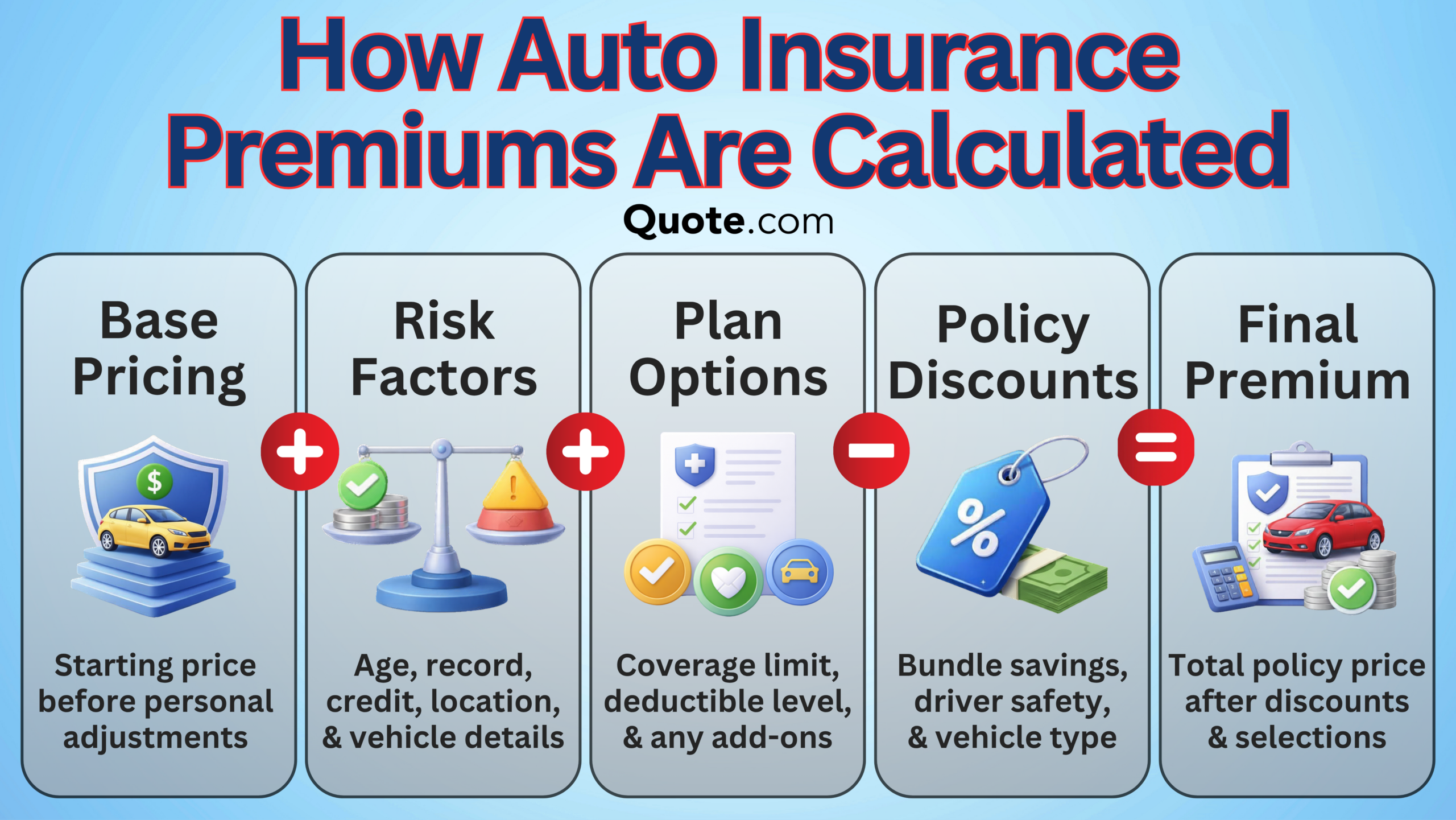
To determine the final cost of a policy—even a budget or "cheap" auto insurance policy—underwriters use a mathematical algorithm that follows this basic structure:
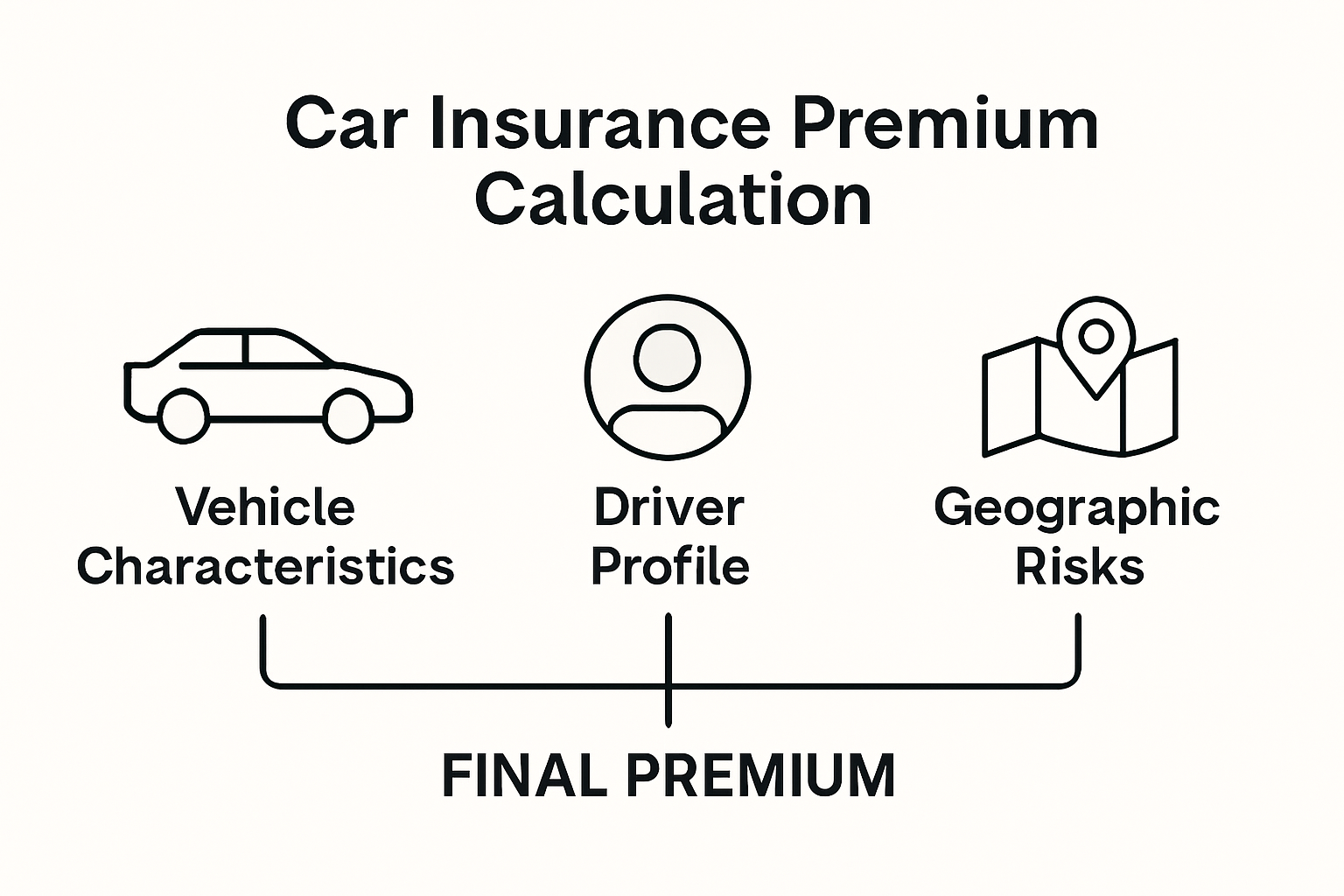
$$\text{Final Premium} = (\text{Base Rate} \times \text{Territory Factor} \times \text{Driver Risk Multipliers} \times \text{Vehicle Multipliers}) - \text{Applicable Discounts}$$
1. The Base Rate
The base rate serves as the foundation of the pricing structure. Actuaries establish base rates for each coverage type (e.g., bodily injury liability, property damage liability, personal injury protection, collision, and comprehensive) across a broad geographic region. This figure represents the baseline cost required to cover expected losses, administrative overhead, state regulatory assessments, and the insurer’s target profit margin.
2. Risk Multipliers
Once the base rate is set, the carrier applies a series of decimal multipliers (rating factors) based on specific risk traits. A multiplier below 1.0 (e.g., 0.85) reduces the baseline premium, acting as a discount. A multiplier above 1.0 (e.g., 1.45) increases the premium due to elevated statistical risk.
3. Loss Ratios and Frequency vs. Severity
Actuaries constantly adjust these multipliers based on two core data metrics:
- Claim Frequency: How often accidents or claims occur within a specific subgroup or geographic area.
- Claim Severity: The average financial cost of claims when they do occur.
In dense urban environments like Minneapolis, higher claim frequency due to traffic density combined with seasonal claim severity (due to winter weather conditions) elevates the baseline multipliers compared to rural Minnesota communities.
Minnesota Legal Mandates That Establish the Baseline Price
You cannot calculate the cost of cheap auto insurance in Minneapolis without accounting for state-mandated coverage minimums. Under the Minnesota No-Fault Automobile Insurance Act, Minnesota is a mandatory no-fault insurance state. This designation fundamentally alters the baseline calculation for low-cost policies compared to tort-based insurance states.
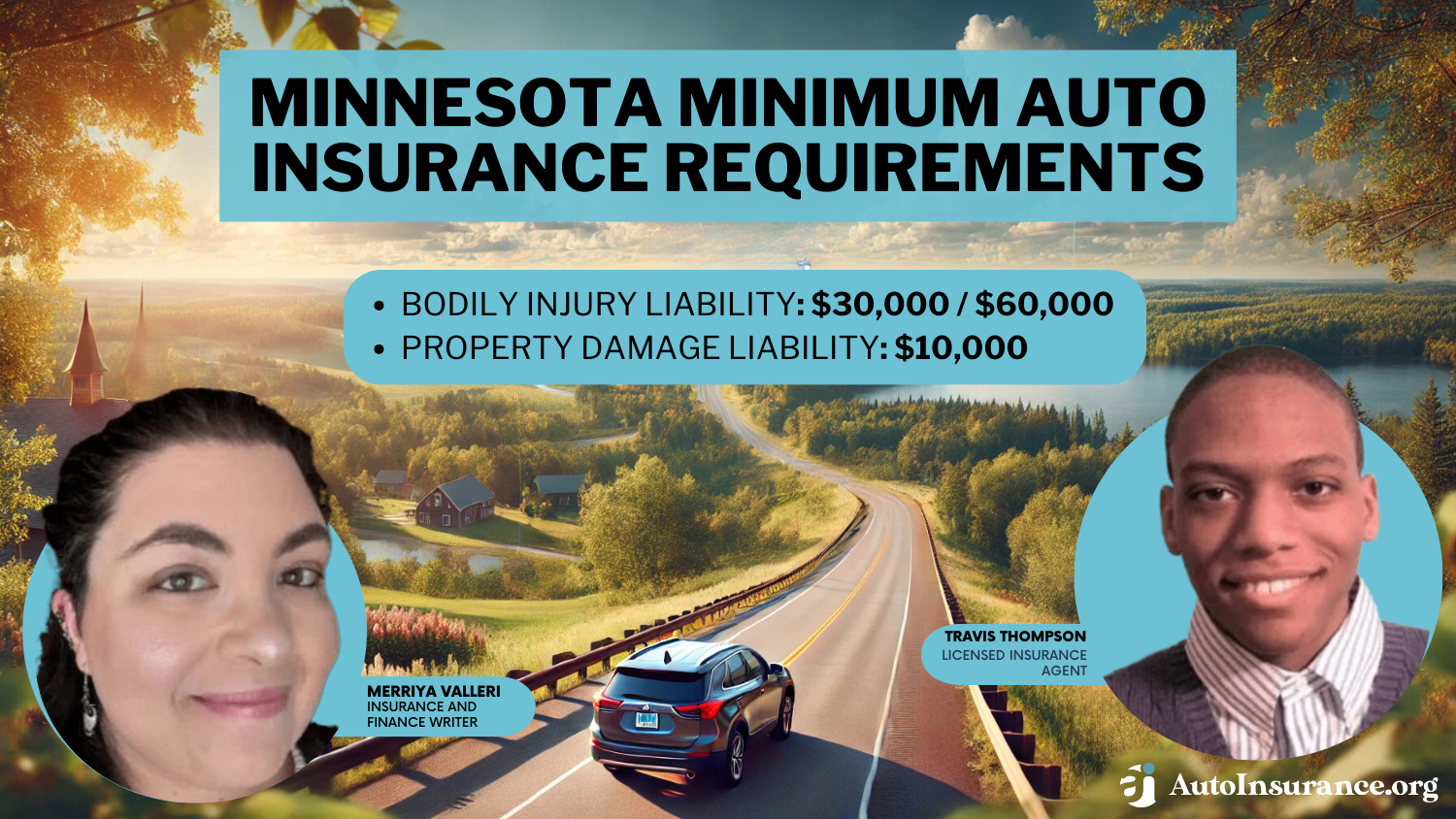
To legally operate a motor vehicle in Minneapolis in 2026, an auto insurance policy must include four mandatory coverages:
| Minnesota Mandatory Auto Coverages | Limits |
|---|---|
| 1. Personal Injury Protection (PIP) | $40,000 per person |
| - Medical Expenses | $20,000 limit |
| - Non-Medical (Wages/Services) | $20,000 limit |
| 2. Bodily Injury Liability | $30,000 per person$60,000 per accident |
| 3. Property Damage Liability | $10,000 per accident |
| 4. Uninsured/Underinsured Motorist | $25,000 per person (UM) / $50,000 per accident$25,000 per person (UIM) / $50,000 per accident |
Personal Injury Protection (PIP)
Under Minnesota Statute § 65B.44, PIP pays for medical treatment, lost wages, and essential replacement services for you and your passengers after an accident, regardless of who caused the collision. The mandatory minimum PIP coverage is $40,000 per person, divided into:
- $20,000 reserved strictly for medical expenses.
- $20,000 designated for non-medical expenses, including lost income and household replacement services.
Because PIP pays out regardless of fault, medical inflation and healthcare utilization in the Twin Cities metro area directly increase the base cost of PIP in Minneapolis policy calculations.
Liability Coverage (30/60/10)
If you are found at fault for an accident that exceeds the statutory no-fault injury threshold of the other party, liability coverage protects your assets. Minnesota law requires minimum limits of:
- $30,000 for bodily injury to one person in a single accident.
- $60,000 for total bodily injury claims across multiple people in a single accident.
- $10,000 for property damage per accident.
Selecting these exact statutory minimum limits generates the lowest possible liability premium tier. However, because $10,000 in property damage can easily be exceeded in a multi-vehicle collision or an incident involving a modern vehicle, pricing out slightly higher limits (such as 50/100/50) often yields better financial protection for only a modest increase in the monthly rate calculation.
Uninsured and Underinsured Motorist Coverage (UM/UIM)
Minnesota mandates that every policy include uninsured motorist (UM) and underinsured motorist (UIM) protection to cover bodily injuries when an at-fault driver either has no insurance or carries insufficient limits. The statutory minimum limits are $25,000 per person / $50,000 per accident for UM and $25,000 per person / $50,000 per accident for UIM.
Hyper-Local Minneapolis Rating Factors
When insurers calculate premiums for Minneapolis residents, they do not view the city as a uniform market. Rates fluctuate across neighborhoods and corridors based on localized historical data compiled by the Minnesota Department of Commerce.
1. ZIP Code Territory Multipliers
Insurance carriers divide Minneapolis into distinct rating territories using 5-digit ZIP codes. Actuaries analyze historical claims filed within each ZIP code to adjust territory factors:
- High-Density Inner City ZIP Codes (e.g., 55404, 55408, 55411): These areas often exhibit higher population density, increased street parking, higher reported vehicle vandalism, and greater traffic congestion. As a result, territory multipliers for comprehensive and collision coverage in these zones are adjusted upward.
- Residential Outer Neighborhood ZIP Codes (e.g., 55410, 55419): Neighborhoods with off-street garages, lower commuter traffic density, and lower reported theft statistics generally receive lower rating multipliers, resulting in cheaper baseline insurance quotes.
2. Vehicle Theft and Vandalism Statistics
Comprehensive insurance calculations rely heavily on local crime statistics. Minneapolis has experienced fluctuations in property crime, specifically catalytic converter thefts and targeted vehicle thefts (such as specific Hyundai and Kia models lacking engine immobilizers). Actuaries reflect these localized loss patterns directly in the comprehensive coverage portion of your rate. If your vehicle model aligns with local theft trends in Hennepin County, your comprehensive multiplier rises.
3. Traffic Density and Commute Corridors
Daily transit along major Minneapolis transit arteries—such as the Interstate 94, Interstate 35W, Highway 62 (Cross Town), and Interstate 394 interchanges—statistically increases your exposure to collisions. Underwriters evaluate your reported annual mileage and daily work commute distance. Commuting during peak rush hours through high-collision interchanges results in a higher risk rating than driving primarily outside peak hours or working remotely.
4. Severe Winter Weather Impact
Minneapolis experiences severe winter driving conditions, including black ice, prolonged sub-zero temperatures, freezing rain, and heavy snowfall. Insurance companies factor seasonal weather risks into their local rate algorithms:
- Collision Claims: Slips on icy roads, multi-car pileups on winter highways, and collisions with snowplows elevate regional claim frequency from November through April.
- Comprehensive Claims: Falling tree limbs from heavy snow, hail damage from summer severe thunderstorms, and windshield cracking due to extreme temperature swings directly impact comprehensive rating pools.
Individual Driver Profile Variables
While legal minimums and local geographic factors establish the baseline, your personal profile determines where your final quote falls within an insurer’s pricing matrix.
Driver Profile Rating Matrix
- Credit-Based Score
- High Score: Discount Applied
- Low Score: Surcharge Applied
- Motor Vehicle Record
- Clean MVR: Preferred Tier
- Violations: Standard/Non-Std
- Coverage History
- Continuous: Stable Rates
- Coverage Gap: High Risk Penalty
Credit-Based Insurance Scores (CBIS)
In Minnesota, state regulations allow insurance companies to use credit-based insurance scores to calculate auto insurance premiums. A Credit-Based Insurance Score is not identical to a traditional FICO credit score used by mortgage or loan lenders; instead, it focuses on credit history metrics that actuaries have correlated with insurance loss potential.
- How it affects the calculation: Carriers group policyholders into credit tiers (e.g., Excellent, Good, Average, Below Average). Drivers with excellent insurance credit scores receive significant discounts on their base rates. Conversely, a poor insurance credit score can increase your calculated premium by 50% to 100% or more, even with a completely clean driving record.
- Key factors in CBIS: Payment history, outstanding debt relative to available credit, length of credit history, and pursuit of new credit accounts.
Driving History and Motor Vehicle Records (MVR)
Your driving record over the past three to five years is one of the heaviest weighted multipliers in the calculation:
- Moving Violations: Speeding tickets, failure to yield, or red-light violations add points to your driver profile, raising your risk multiplier for a mandatory three-year period.
- At-Fault Accidents: In Minnesota's no-fault system, while your own PIP pays medical costs initially, at-fault determinations still affect your liability rating tier. An at-fault collision will trigger an accident surcharge that typically remains on your rate calculation for 36 to 60 months.
- Major Violations (DWI/DUI): A conviction for Driving While Impaired (DWI) under Minnesota Statute § 169A dramatically increases auto insurance premiums. It pushes the driver into non-standard risk tiers, requiring high-risk underwriting and often mandatory state insurance verification filings (such as an SR-22 certification).
Age, Gender, and Marital Status
Actuarial tables demonstrate distinct statistical risk profiles across demographics:
- Age: Drivers under age 25, particularly teenagers, have significantly higher accident rates per mile driven. Consequently, their base rate multipliers are elevated. Rates generally stabilize between ages 30 and 65 before slightly increasing for senior drivers due to physical vulnerability in collisions.
- Gender and Marital Status: Single, young male drivers statistically file more severe claims than young female drivers, leading to higher baseline rates for young males. Married drivers of any age statistically experience lower claim frequencies, earning a modest rate reduction.
Insurance History and Continuous Coverage
Insurance algorithms reward stability. Carriers evaluate whether you have maintained continuous auto insurance coverage without lapses:
- Coverage Lapses: If your policy cancels due to non-payment or you experience a gap in coverage over 30 days, underwriters categorize you as a higher-risk applicant upon re-application.
- Prior Transfer Limits: Carrying higher liability limits with your previous insurer (e.g., 100/300/50 instead of state minimums) signals responsible financial management, placing you in a more favorable rating tier even if you switch to a cheaper policy option later.
Vehicle-Specific Calculation Factors
The specific vehicle you choose to insure in Minneapolis directly controls the collision, comprehensive, and property damage portions of your calculated premium.
| Vehicle Rating Parameter | How Actuaries Evaluate It | Impact on Premium Calculation |
|---|---|---|
| Vehicle Value & Purchase Price | Actual Cash Value (ACV) and replacement cost of parts. | Higher vehicle value increases comprehensive and collision base premiums. |
| Safety Ratings & Crashworthiness | National Highway Traffic Safety Administration (NHTSA) crash test ratings. | High safety scores reduce PIP and medical payment premiums. |
| Advanced Driver Assistance Systems (ADAS) | Presence of automatic emergency braking, lane keep assist, and blind-spot monitors. | Reduces collision frequency risk; may increase repair cost severity per incident. |
| Repair Cost Complexity | Cost of specialized parts, lightweight aluminum, and sensor recalibration. | High repair complexity increases collision calculation rates. |
| Theft Index & Model History | National Insurance Crime Bureau (NICB) and local Minneapolis theft tracking. | High-theft models receive elevated comprehensive multipliers. |
Comparing Rate Calculation Structures in Minneapolis
To visualize how these individual pricing elements combine, consider three hypothetical driver profiles operating in Minneapolis. The table below illustrates how changing specific risk multipliers alters the final calculated monthly premium for basic vs. full coverage policies.
| Driver Risk Profile | Territory / ZIP | Credit & Driving Record | Selected Coverage Level | Primary Calculation Drivers | Relative Cost Tier |
|---|---|---|---|---|---|
| Profile A: Low-Risk Driver | 55410 (Fulton / Armatage) | Excellent Credit, Clean MVR | State Minimum (30/60/10 + PIP) | Minimum limits, low-theft ZIP, favorable credit discount applied. | Lowest Premium Tier |
| Profile B: Moderate-Risk Driver | 55408 (Uptown / Whittier) | Average Credit, 1 Speeding Ticket | Full Coverage ($500 Comprehensive/Collision Deductibles) | Urban density ZIP multiplier, single violation surcharge, comprehensive theft risk. | Moderate Premium Tier |
| Profile C: High-Risk Driver | 55404 (Phillips / Elliot Park) | Poor Credit, 1 At-Fault Accident | Full Coverage ($250 Deductibles) | High-loss ZIP code, prior claim surcharge, poor credit multiplier, low deductibles. | Highest Premium Tier |
Actionable Strategies to Lower Your Calculated Auto Insurance Rate
Because auto insurance calculations rely on deterministic risk formulas, adjusting specific parameters in the calculation directly lowers your premium.
1. Optimize Your Coverage Structure and Deductibles
- Adjust Deductibles: Raising your collision and comprehensive deductibles from $250 or $500 to $1,000 lowers the policy's comprehensive and collision premium calculation. By assuming more initial out-of-pocket risk, you decrease the carrier's expected payout pool.
- Evaluate Older Vehicles: If your vehicle's Actual Cash Value (ACV) is low (e.g., valued under $3,000 to $4,000), carrying comprehensive and collision coverage may no longer be cost-effective. Dropping physical damage coverages leaves only the state-mandated liability, PIP, and UM/UIM coverages, significantly reducing your calculated rate.
2. Improve Credit-Based Insurance Scores
Because Minnesota allows credit scoring in rate setting, taking steps to improve your credit rating directly impacts your next renewal calculation:
- Pay down high revolving credit card balances to lower your credit utilization ratio.
- Ensure all bill payments are made on time.
- Review your credit reports annually for errors and dispute inaccurate negative entries.
3. Enroll in State-Approved Defensive Driving Courses
Under Minnesota law, drivers aged 55 and older who complete an approved 8-hour defensive driving course are legally entitled to a mandatory insurance discount (typically 10%) on their auto insurance policies for three years. Check course requirements through certified providers such as the Minnesota Safety Council.
4. Leverage Telematics and Usage-Based Insurance (UBI)
Many modern carriers offer usage-based insurance programs via smartphone apps or OBD-II telematics devices. These programs track real-time driving habits, including:
- Total annual mileage driven in Minneapolis.
- Hard braking and sudden acceleration events.
- Late-night driving frequencies (typically between 12:00 AM and 4:00 AM).
- Cornering speeds and mobile phone manipulation while driving.
If you drive infrequently, maintain low annual mileage, and avoid peak-hour commute hazards, UBI programs replace general demographic risk multipliers with your actual driving data, lowering your monthly premium calculation.
5. Bundle Policies and Claim Available Discounts
Insurance algorithms apply multi-policy discounts when you bundle your auto policy with renters, homeowners, or condo insurance through the same carrier. Additional calculation discounts include:
- Multi-Vehicle Discount: Insuring more than one vehicle on the same policy.
- Paperless & Automatic Payment: Opting for electronic billing and recurring ACH bank transfers removes small administrative processing fees from each billing cycle.
Frequently Asked Questions
Why are auto insurance rates higher in Minneapolis than in suburban Minnesota?
Minneapolis insurance rates are generally higher than rural or suburban Minnesota communities because of higher population density, increased traffic volume on major highways, higher historical rates of vehicle theft and vandalism, and a higher statistical frequency of low-speed urban collisions.
Can Minnesota insurance companies increase your rate after an accident that wasn't your fault?
Under Minnesota rules, insurance companies generally cannot apply an at-fault premium surcharge if you were completely free of fault in a collision. However, filing multiple non-fault claims (such as comprehensive claims for windshield damage or towing requests) can still impact your overall policy tier or remove claim-free discounts upon renewal.
Does your credit score affect your auto insurance cost in Minneapolis?
Yes. Minnesota law permits insurance companies to evaluate credit-based insurance scores (CBIS) when calculating premiums. Actuarial data shows a correlation between credit management and insurance claim frequency. Maintaining a strong credit history lowers your calculated risk multiplier.
What is the minimum auto insurance required by law in Minneapolis?
To legally drive in Minneapolis, your policy must meet Minnesota's statutory minimum limits: Personal Injury Protection ($40,000 per person), Bodily Injury Liability ($30,000 per person / $60,000 per accident), Property Damage Liability ($10,000 per accident), and Uninsured/Underinsured Motorist coverage ($25,000 per person / $50,000 per accident).
How does winter driving in Minneapolis affect insurance calculations?
Winter conditions in Minneapolis increase localized claim frequency due to snowstorms, icy road conditions, and freezing weather hazards. Insurance companies build these predictable seasonal claims into the baseline territory rating factors for Hennepin County, keeping regional rates higher than in states with milder winter weather.
Next Steps for Minneapolis Drivers
To secure the cheapest possible auto insurance rate in Minneapolis while maintaining adequate legal and financial protection:
- Gather Your Policy Declarations Page: Review your current coverages, deductibles, and line-item costs to set a clear baseline.
- Pull Your Driver History: Verify that your Minnesota Motor Vehicle Record (MVR) accurately reflects your driving history and that any past violations older than three to five years have fallen off your record.
- Compare Quotes Across Multiple Carriers: Because every insurance company uses a proprietary rating algorithm, the same Minneapolis driver profile can receive wildly different rates from different carriers. Obtain independent quotes from at least three competing insurers annually.
- Audit Your Annual Mileage: If your driving habits have changed—such as shifting to remote work or utilizing Metro Transit—ensure your policy reflects your actual reduced annual mileage to instantly lower your calculation tier.
Image Gallery