Understanding the Europe Index for Global Investors: A Comprehensive Guide
Understanding the Europe index requires examining key benchmarks such as the STOXX Europe 600, Euro Stoxx 50, and MSCI Europe, which track public equities across Developed Europe. For global investors, these indices offer direct exposu...
Understanding the Europe index requires examining key benchmarks such as the STOXX Europe 600, Euro Stoxx 50, and MSCI Europe, which track public equities across Developed Europe. For global investors, these indices offer direct exposure to leading multinational export companies, defensive dividend yields, unique sector allocations, and international currency dynamics.
Contents
Core European Benchmark Equity Indices Explained
Global investors looking to allocate capital to European equities face a choice among several major market indices. Unlike the U.S. stock market—where the S&P 500 serves as the indisputable primary benchmark—European equity markets are fragmented across multiple sovereign exchanges, currencies, and index providers. Identifying the right benchmark depends on whether an investor seeks broad regional exposure, concentrated blue-chip performance, or Eurozone-specific assets.
1. STOXX Europe 600
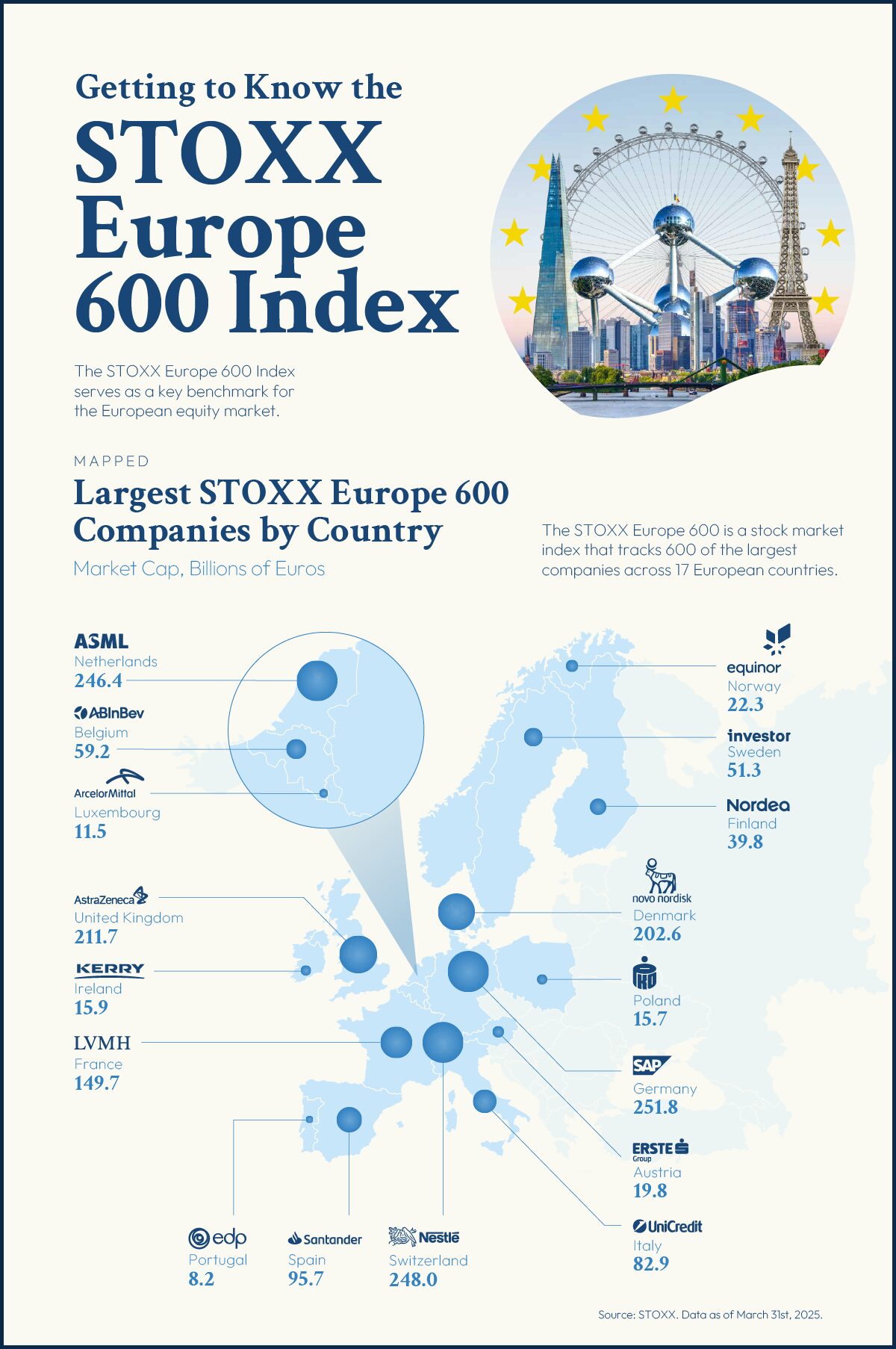
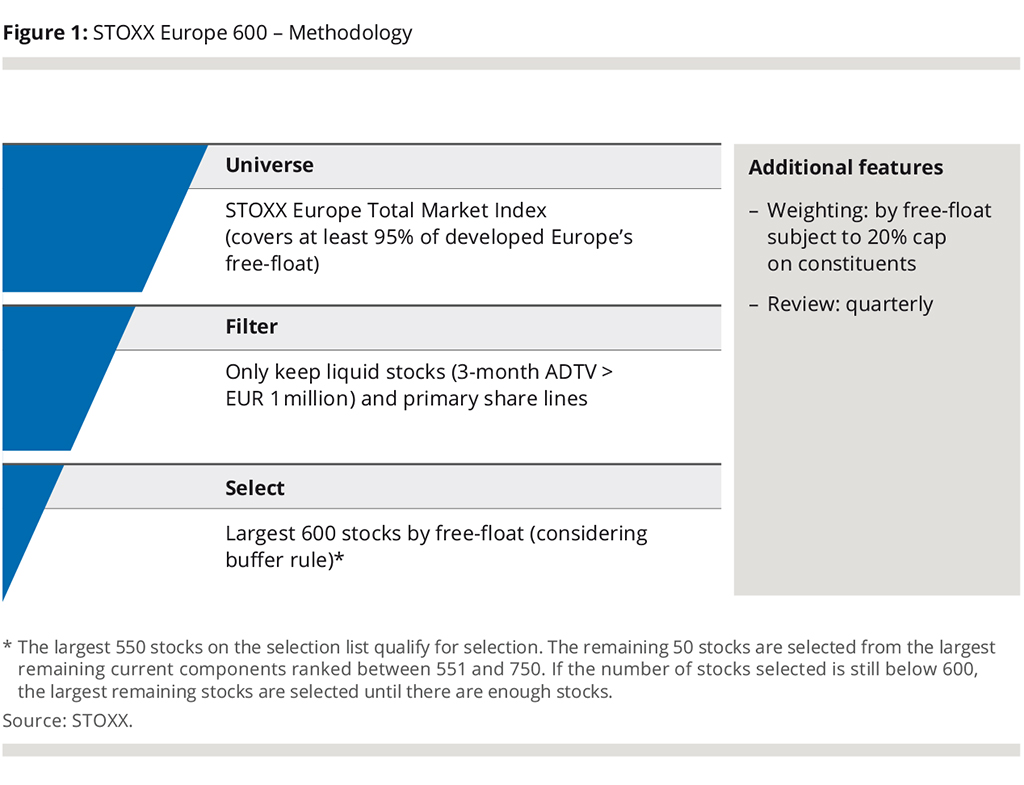
The STOXX Europe 600 is widely regarded by institutional portfolio managers as the most comprehensive benchmark for Developed Europe. Maintained by STOXX Ltd. (a subsidiary of Deutsche Börse Group), the index tracks 600 large, mid, and small-cap companies across 17 European countries.
Its geographic footprint includes both Eurozone member states (such as France, Germany, and the Netherlands) and non-Eurozone economies (such as the United Kingdom, Switzerland, Denmark, Sweden, and Norway). Because it spans multiple market capitalization tiers, the STOXX Europe 600 provides a balanced representation of domestic European demand alongside multinational revenue generators. Detailed methodology and weighting criteria are documented directly by STOXX Index Indices.
2. Euro Stoxx 50
The Euro Stoxx 50 represents Europe's primary mega-cap blue-chip index. It consists of 50 market-leading equities from 8 Eurozone countries: Belgium, Finland, France, Germany, Ireland, Italy, the Netherlands, and Spain.
Because it excludes non-Eurozone giants—such as Swiss healthcare leaders Roche and Novartis or UK-listed shell or AstraZeneca—the Euro Stoxx 50 is strictly tied to the macroeconomic environment and regulatory policy of the single-currency bloc. It is heavily weighted toward luxury goods conglomerates, industrial engineering, banking, and consumer goods.
3. MSCI Europe Index
The MSCI Europe Index is a market-capitalization-weighted index designed to measure the equity market performance of developed markets in Europe. Maintained by MSCI Inc., it covers approximately 85% of the free float-adjusted market capitalization across 15 developed market countries. Institutional asset managers frequently use the MSCI Europe Index as the underlying benchmark for international mutual funds and exchange-traded funds (ETFs). Index specifications and sector weighting methodologies can be reviewed via MSCI Index Metrics.
4. FTSE Developed Europe Index
Calculated by FTSE Russell, the FTSE Developed Europe Index encompasses large and mid-cap securities across European developed markets. It aligns closely with the MSCI Europe Index in coverage, serving as the target benchmark for major passive investment vehicles, including Vanguard’s international equity funds.
- DEVELOPED EUROPE EQUITIES
- EUROZONE ONLY (Single Currency)
- Euro Stoxx 50 (50 Blue-Chip Firms)
- BROAD DEVELOPED (Multi-Currency)
- STOXX Europe 600
- MSCI Europe Index
- EUROZONE ONLY (Single Currency)
Sector Composition: Europe vs. United States Markets
A primary reason global investors incorporate European indices into a broader portfolio is to achieve structural sector diversification. The composition of major European stock indices differs sharply from major U.S. benchmarks like the S&P 500 or Nasdaq 100.
| Financial Parameter / Sector Weight | STOXX Europe 600 (Typical Allocation) | S&P 500 Index (Typical Allocation) | Portfolio Implication for Global Investors |
|---|---|---|---|
| Information Technology | ~7% – 10% | ~30% – 32% | Europe is less vulnerable to tech valuation compressions; U.S. offers higher secular growth. |
| Financials | ~17% – 20% | ~12% – 14% | European indices gain greater net interest margin sensitivity during elevated rate regimes. |
| Healthcare & Pharmaceuticals | ~14% – 16% | ~11% – 13% | High concentration of global defensive pharmaceutical giants in Switzerland and the UK. |
| Industrials & Materials | ~18% – 22% | ~8% – 10% | European indices carry higher cyclical sensitivity to global capital expenditure cycles. |
| Consumer Staples & Luxury | ~12% – 15% | ~6% – 7% | Heavy exposure to global high-end retail brands and consumer fast-moving goods. |
| Average Dividend Yield | ~3.0% – 3.8% | ~1.3% – 1.6% | European equities offer higher baseline income distribution to equity holders. |
Industrial Heavyweights and Luxury Dominance
While U.S. equity indices are dominated by mega-cap technology firms, European indices are anchored by industrial capital goods, luxury brands, specialty chemicals, and healthcare. European blue chips such as ASML Holding (semiconductor equipment), LVMH Moët Hennessy Louis Vuitton (luxury items), SAP (enterprise software), Novo Nordisk (pharmaceuticals), and Nestlé (consumer goods) occupy top positions in European indices.
Consequently, European benchmarks often trade at lower price-to-earnings (P/E) multiples compared to U.S. indices, reflecting a heavier concentration of traditional value sectors rather than high-growth software and internet platform businesses.
Currency Dynamics and Dividend Yield Considerations
Investing in European stock indices exposes international investors to foreign currency movements and distinct corporate capital return policies. Understanding these mechanics is essential for accurate risk management and performance attribution.
Currency Exposure: Euro, British Pound, and Swiss Franc
When an investor purchases an unhedged Europe index fund denominated in U.S. Dollars (USD), total returns are driven by two components:
- Local Equity Price Return: The price appreciation or depreciation of underlying stocks on their home exchanges (e.g., Euronext Paris, Frankfurt Stock Exchange, SIX Swiss Exchange, London Stock Exchange).
- Currency Exchange Movement: The fluctuation of underlying currencies—primarily the Euro (EUR), British Pound (GBP), and Swiss Franc (CHF)—against the investor's home currency.
If European stocks rise but the Euro depreciates against the USD, unhedged dollar-denominated returns will be reduced. Conversely, a strengthening Euro acts as an additional tailwind for USD-based investors. Many asset managers provide currency-hedged ETFs, which use forward currency contracts to eliminate foreign exchange volatility, isolating pure equity returns.
Income Profile and Corporate Dividend Culture
European corporate governance historically prioritizes dividend payouts over share buybacks compared to American corporate management. Many European blue-chip companies distribute a substantial share of earnings as cash dividends.
As a result, major European indices historically yield between 3.0% and 3.8% annually, compared to under 1.6% for the S&P 500. For global income-oriented investors, European index vehicles offer a regular cash flow component, though European dividends are often paid annually or semi-annually rather than quarterly.
Access Pathways for Global Investors
Global retail and institutional investors can gain exposure to European equity indices through several vehicle structures, depending on geographic location, tax residency, and account permissions.
- GLOBAL ACCESS VEHICLES
- U.S.-LISTED ETFs (e.g., VGK, EZU, FEZ)
- Best for US/Non-EU retail accounts
- UCITS ETFs (Physical/Synthetic)
- Standard for European & Global offshore
- AMERICAN DEPOSITARY RECEIPTS (ADRs)
- Direct holding of single blue-chip
- U.S.-LISTED ETFs (e.g., VGK, EZU, FEZ)
1. Cross-Border Exchange-Traded Funds (ETFs)
The most liquid and cost-effective mechanism for gaining European index exposure is through passive ETFs:
- U.S.-Domiciled ETFs: Investors trading on American brokerages can use U.S.-listed funds such as the Vanguard FTSE Europe ETF (Ticker: VGK), the iShares MSCI Eurozone ETF (Ticker: EZU), or the SPDR EURO STOXX 50 ETF (Ticker: FEZ). These funds trade in USD during regular U.S. market hours.
- UCITS ETFs: Investors based in Europe, Asia, Latin America, or the Middle East often utilize Undertakings for Collective Investment in Transferable Securities (UCITS) compliant ETFs listed in London, Frankfurt, or Zurich. Examples include the iShares Core STOXX Europe 600 UCITS ETF or the Xtrackers Euro Stoxx 50 UCITS ETF.
2. American Depositary Receipts (ADRs)
For investors who wish to target individual European market leaders within an index rather than holding the entire basket, American Depositary Receipts (ADRs) provide a viable path. Issued by depositary banks, ADRs represent shares of non-U.S. companies trading on American exchanges. Broad investor guidance on foreign equities and ADR mechanics is available via the U.S. Securities and Exchange Commission Investor Guidance.
3. Index Futures and Options
Institutional traders and sophisticated investors often use derivative contracts for tactical asset allocation or hedging. The Eurex Exchange trades highly liquid futures and options contracts based on the Euro Stoxx 50 (Ticker: FESX) and STOXX Europe 600 (Ticker: FXXP). These contracts allow investors to adjust regional market exposure rapidly without liquidating underlying stock holdings.
Tax Implications and Regulatory Considerations
Cross-border equity investing introduces distinct tax rules and regulatory frameworks that impact net investment returns.
Foreign Withholding Taxes on Dividends
European sovereign nations levy varying foreign withholding taxes (WHT) on dividends paid to non-resident investors. Dividend withholding tax rates vary considerably across European jurisdictions:
- France: Standard WHT rates on dividends typically range around 12.8% to 25%, depending on tax treaties.
- Germany: Base WHT is 26.375% (including the solidarity surcharge), though treaty reductions may apply.
- Switzerland: Imposes a 35% statutory withholding tax, which non-resident investors must reclaim partially or fully under double taxation treaties (DTT).
- United Kingdom: Generally levies a 0% dividend withholding tax on distributions paid to foreign equity holders.
Taxpayers in countries with broad bilateral tax treaties can often claim a credit against domestic tax obligations for taxes withheld abroad. U.S. tax filers, for example, rely on Foreign Tax Credit rules outlined by the Internal Revenue Service Tax Guidelines.
The UCITS Regulatory Framework
For global investors utilizing European funds, the UCITS framework provides investor protection mandates, including fund asset segregation, strict liquidity requirements, and borrowing restrictions. UCITS-compliant funds are distributed worldwide, offering offshore investors tax-efficient, non-U.S. domiciled fund structures that avoid U.S. estate tax liability for non-U.S. residents.
Frequently Asked Questions
What is the difference between the Euro Stoxx 50 and the STOXX Europe 600?
The Euro Stoxx 50 is a narrow blue-chip index tracking 50 mega-cap companies located exclusively within Eurozone member countries. The STOXX Europe 600 is a broad benchmark containing 600 large, mid, and small-cap companies across 17 European nations, including non-Eurozone markets like the UK, Switzerland, Sweden, and Denmark.
How does currency fluctuation affect a European index investment?
If an investor holds an unhedged dollar-denominated European index fund, total returns depend on both equity performance and currency exchange movements. When the Euro or local European currencies appreciate relative to the U.S. Dollar, dollar-denominated returns increase. If European currencies depreciate against the dollar, unhedged returns decline.
Are dividends from European index ETFs taxed differently?
Yes. European countries levy withholding taxes on corporate dividends at source before distributions are paid to fund vehicles or foreign individuals. Depending on the investor’s tax residency and applicable double taxation treaties, portion of these withheld foreign taxes may be recovered or claimed as a foreign tax credit on annual tax returns.
Why do European stock indices generally have lower P/E ratios than U.S. indices?
European stock indices contain higher weightings in traditional sectors such as industrials, financials, materials, and consumer staples, while maintaining significantly lower weightings in high-growth technology platforms. Traditional value and cyclical sectors typically command lower price-to-earnings valuations than secular growth technology companies.
Practical Action Plan for Global Investors
To build and maintain an effective allocation to European equities, investors should follow a clear operational process:
- Select the Benchmark Scope: Determine whether your strategy requires Eurozone-only exposure (Euro Stoxx 50) to play economic cycles within the single-currency bloc, or broader Developed Europe coverage (STOXX Europe 600 or MSCI Europe) for broader geographic diversification.
- Evaluate Currency Hedging Needs: Choose between unhedged funds (to capture upside from potential European currency appreciation) and currency-hedged funds (if you anticipate foreign currency weakness against your home currency).
- Optimize Fund Domicile for Taxes: Non-U.S. investors should favor Ireland-domiciled UCITS ETFs to reduce U.S. dividend withholding taxes and avoid U.S. estate tax exposure. U.S.-based investors typically benefit from U.S.-registered ETFs (e.g., VGK or EZU) to simplify domestic tax reporting.
- Monitor Sector Tilts: Balance European index holdings alongside domestic positions to prevent over-concentration in specific global sectors like financials or industrial capital equipment.
Disclaimer: This guide is provided for educational and informational purposes only and does not constitute individual financial, investment, legal, or tax advice. Investors should consult qualified financial advisors and accounting professionals to evaluate specific jurisdictional requirements before executing international investment strategies.
Image Gallery