The Most Valuable Soccer Team in the World: Financial Analysis and Rankings
Real Madrid currently stands as the most valuable soccer team in the world, boasting an enterprise valuation of approximately $6.6 billion. Driven by unparalleled success in the UEFA Champions League, expansive commercial partnerships,...
Real Madrid currently stands as the most valuable soccer team in the world, boasting an enterprise valuation of approximately $6.6 billion. Driven by unparalleled success in the UEFA Champions League, expansive commercial partnerships, and the multi-use transformation of the renovated Santiago Bernabéu Stadium, Real Madrid edges out top rivals Manchester United, FC Barcelona, and Manchester City in total economic value.
Contents
Defining Club Valuation: How Enterprise Value Is Calculated in Global Football
Evaluating the financial worth of a professional soccer club requires looking beyond simple annual revenues or squad market values. Financial institutions, independent audit firms, and media outlets such as Forbes and Football Benchmark measure a club’s financial stature using Enterprise Value (EV). Enterprise value represents the total theoretical cost to acquire the entire franchise, accounting for equity value, outstanding long-term debt, and liquid financial reserves.
Enterprise Value = Market Equity Value + Total Debt - Cash & Cash Equivalents
Financial analysts evaluate several core metrics when determining where a club sits on the global valuation spectrum:
- Commercial Revenue: Income generated through shirt sponsorships, kit supply contracts, regional partnerships, corporate hospitality, and licensing.
- Broadcasting Rights: Media rights distributions from domestic league contracts (e.g., Premier League, La Liga) and international club competitions like the UEFA Champions League.
- Matchday & Venue Receipts: Ticket sales, premium seating revenue, concessions, stadium tours, and non-football events hosted at the venue year-round.
- Brand Equity & International Reach: Fanbase size, digital engagement, brand strength, and the ability to monetize audiences across Asia, North America, and the Middle East.
- Fixed Assets & Stadium Ownership: Direct ownership of state-of-the-art stadium facilities and training complexes, which significantly inflate balance sheet asset values compared to clubs leasing municipality-owned grounds.
While player transfer values dictate the short-term squad valuation on platforms like Transfermarkt, player assets amortize over their contract terms and fluctuate based on age, form, and injury risks. Consequently, stable off-pitch revenue engines and owned infrastructure carry far greater weight in enterprise valuation models.
The Rankings: World’s Most Valuable Soccer Clubs
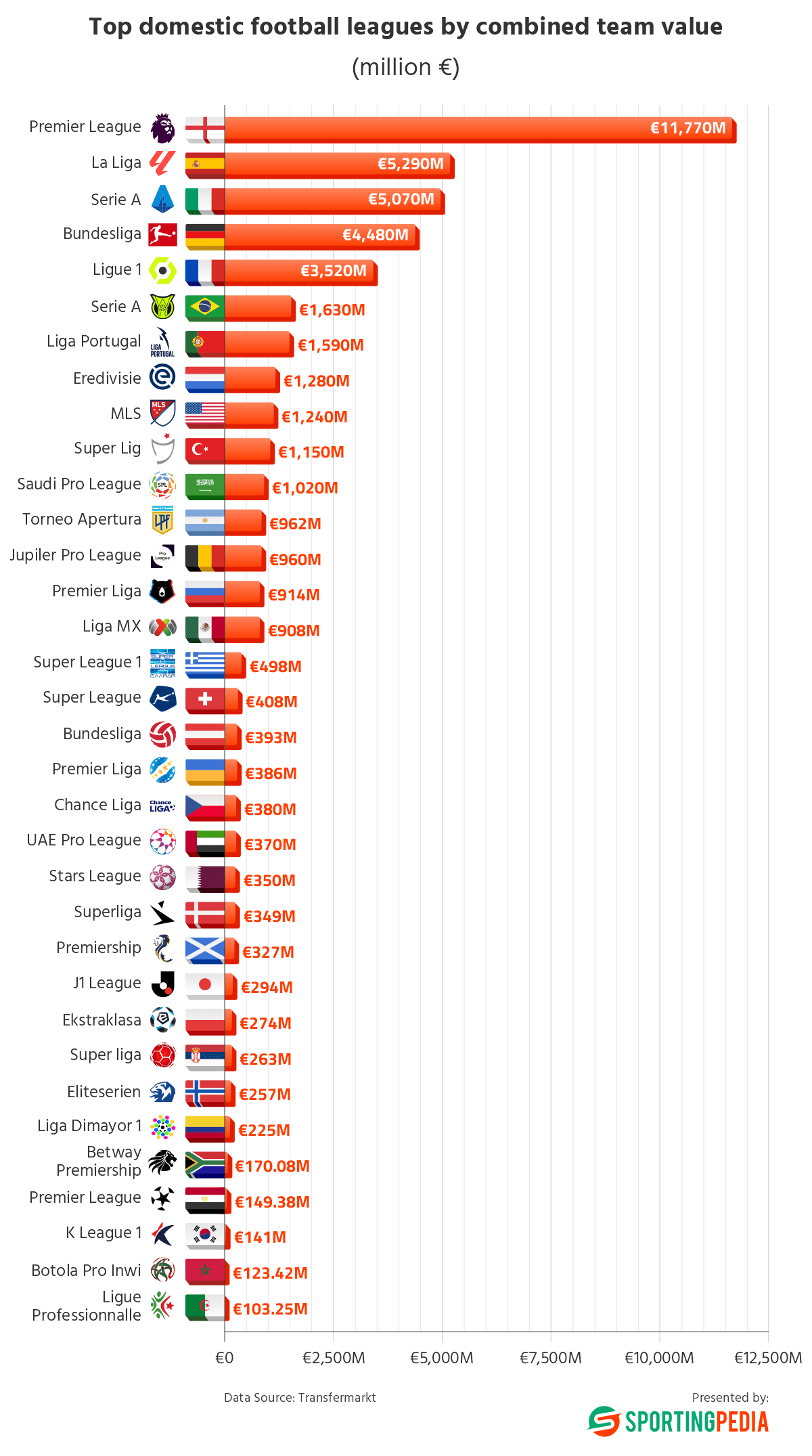
The upper echelon of global football finance is dominated by elite clubs from the English Premier League and Spain's La Liga, supplemented by top-tier brand powerhouses from Germany and France.
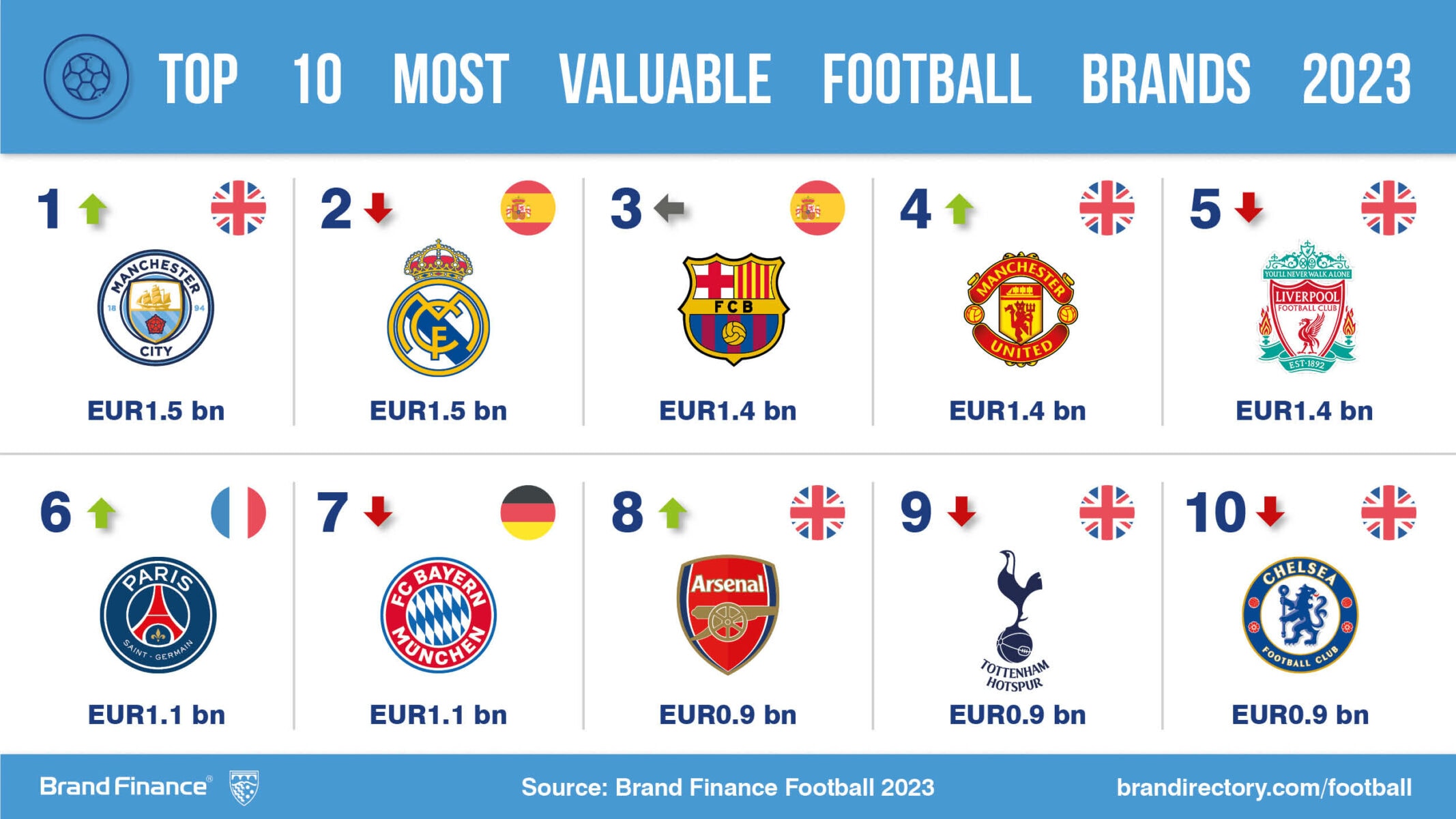
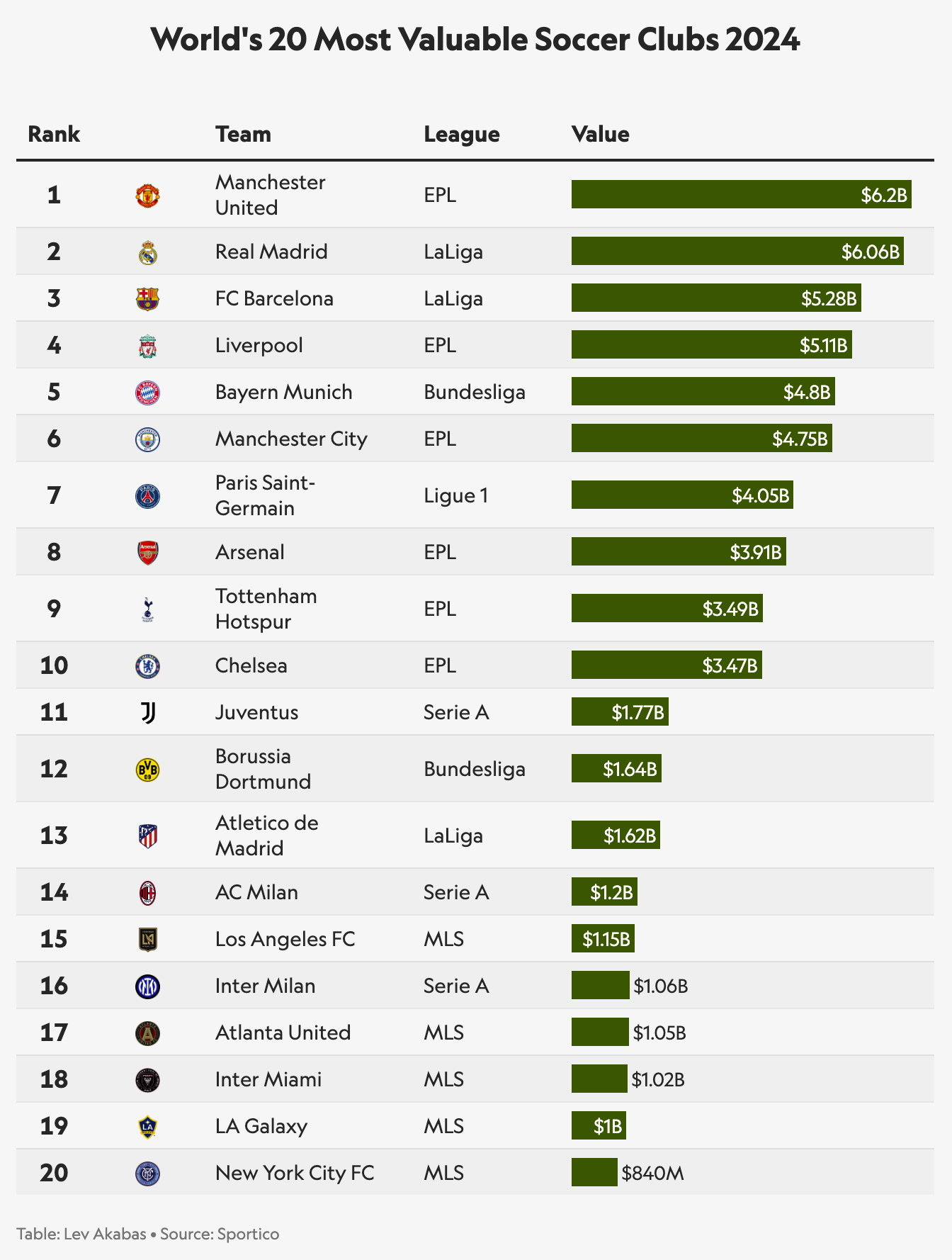
The following table summarizes the global rankings, enterprise valuations, annual revenues, and financial profiles of the world's most valuable soccer clubs based on aggregated reporting from Forbes Sports Money and global financial analyses.
| Rank | Club | Country | Enterprise Value (USD Billions) | Annual Revenue (USD Millions) | Primary Stadium Status |
|---|---|---|---|---|---|
| 1 | Real Madrid | Spain | $6.60 B | $873 M | Fully Owned & Modernized |
| 2 | Manchester United | England | $6.55 B | $785 M | Fully Owned (Old Trafford) |
| 3 | FC Barcelona | Spain | $5.60 B | $800 M | Fully Owned (Espai Barça Redevelopment) |
| 4 | Liverpool FC | England | $5.37 B | $719 M | Fully Owned (Anfield) |
| 5 | Manchester City | England | $5.10 B | $825 M | Municipal Lease (Etihad Stadium) |
| 6 | Bayern Munich | Germany | $5.00 B | $784 M | Fully Owned (Allianz Arena) |
| 7 | Paris Saint-Germain | France | $4.40 B | $754 M | Lease (Parc des Princes) |
| 8 | Tottenham Hotspur | England | $3.20 B | $632 M | Fully Owned (Tottenham Hotspur Stadium) |
| 9 | Chelsea FC | England | $3.13 B | $589 M | Fully Owned (Stamford Bridge) |
| 10 | Arsenal FC | England | $2.60 B | $560 M | Fully Owned (Emirates Stadium) |
Core Economic Engines Elevating Real Madrid and Top Franchises
Understanding why Real Madrid maintains its position at the top of world football finance requires analyzing the structural business mechanics that set elite clubs apart from secondary competitors.
Global Football Value Drivers:
- Infrastructure & Non-Matchday
- Global Brand & Merchandising
- UEFA Competition Media & Prizes
1. Stadium Modernization and Year-Round Commercialization
Real Madrid’s multi-year, multi-hundred-million-dollar renovation of the Santiago Bernabéu Stadium serves as a financial blueprint for modern football clubs. By integrating a retractable pitch and retractable roof, the venue transacts 365 days a year, hosting NFL international games, high-profile music concerts, corporate conventions, and esports tournaments. This transformation transitions the venue from a bi-weekly matchday stadium into a year-round cash-generating asset, offsetting domestic wage inflation and expanding non-football gross margins.
In contrast, clubs like AC Milan, Inter Milan, or Roma, which rely on publicly owned municipal facilities, face severe ceiling caps on matchday revenues due to limited premium seating options, inadequate corporate hospitality infrastructure, and lack of non-matchday event monetization.
2. Shirt Sponsorships and Equipment Supplier Deals
Elite European clubs command record-breaking commercial agreements. Kit manufacturers (such as Adidas and Nike) and main shirt sponsors (such as Emirates, Spotify, or Etihad Airways) invest hundreds of millions annually for global exposure.
- Real Madrid: Secures top-tier valuation through its long-term partnership with Adidas (worth over $120 million annually) paired with primary shirt sponsorship from Fly Emirates and sleeve sponsorships.
- Manchester United: Maintains strong valuation resilience despite erratic domestic sporting performance due to long-standing global commercial licensing agreements and high-value kit partnerships.
3. UEFA Champions League Performance Distributions
Winning or consistently reaching the final stages of the UEFA Champions League provides a dual financial boost: direct performance prize money and lucrative media market pool allocations.
Under UEFA’s distribution model, top performers absorb performance bonuses, broadcasting shares, and coefficient payouts that routinely total between $110 million and $150 million per season for a champion. This continuous inflow creates a virtuous financial cycle: high prize money supports elite player recruitment, which yields further sporting success and commands elevated sponsorship rates.
Operational Challenges and Valuation Risks in Elite Soccer
While total valuations continue an upward trajectory across the elite tier, soccer clubs operate under distinct structural and financial risks that differentiate them from North American sports franchises (like the NFL or NBA).
Financial Sustainability Regulations and Cost Caps
The financial health of European clubs is governed by regulations aimed at preventing unmanageable debt accumulation and competitive distortion. UEFA’s Financial Sustainability Regulations (FSR) introduce a strict Squad Cost Rule, limiting club spending on player wages, transfers, and agent fees to a designated percentage of total club revenues (scaling down to 70%).
Clubs that breach these thresholds face severe administrative penalties, including:
- Fines and prize money withholding.
- Squad size restrictions in European competitions.
- Potential deduction of points in domestic league play (as witnessed in the English Premier League).
High Wage-to-Revenue Ratios
Soccer remains a talent-driven market where top players command astronomical salaries and sign-on bonuses. If a club fails to manage its wage bill relative to operating revenues, operational cash flows turn negative quickly.
Barcelona’s financial crisis in the early 2020s illustrated how wage inflation, combined with short-term debt and macroeconomic disruptions, can severely impair equity valuation, forcing structural debt restructurings and the monetization of long-term media assets (commonly referred to as "financial levers").
Competitive Volatility and Relegation Risk
Unlike closed North American leagues operating under franchise systems without relegation, European football relies on an open pyramid. Missing out on UEFA Champions League qualification represents an immediate direct revenue loss of $50 million to $100+ million for a top club, impacting immediate cash flow and multi-year valuation metrics. For mid-tier clubs, domestic relegation down to lower divisions causes broadcasting revenue contractions exceeding 70%.
Private Equity and Investment Models Shaping Club Values
The ownership landscape of high-valuation soccer clubs has shifted significantly away from traditional local benefactors toward institutional capital and global private equity firms.
Private Equity Capital Models:
- Minority Capital Partnerships
- Direct minority stakes (e.g., Arctos, RedBird) providing liquidity without operational control.
- Multi-Club Ownership (MCO)
- Holding group owning stakes in multiple clubs across regions to optimize scouting & scouting costs.
Institutional Investment and Private Equity
Private equity funds—such as RedBird Capital Partners, Arctos Partners, and Sixth Street—have acquired minority or controlling stakes in major European clubs. These institutional investors bring disciplined corporate governance, stadium development experience, and media monetization strategies aimed at driving revenue multiples higher prior to eventual liquidity events.
Multi-Club Ownership (MCO) Networks
Structures such as the City Football Group (CFG)—anchored by flagship club Manchester City alongside stakes in Girona FC, New York City FC, and Melbourne City FC—represent a major strategic evolution. Multi-club networks allow organizations to:
- Share scouting networks and global data analytics tools.
- Optimize player development by loaning prospects across subsidiary clubs within different regulatory jurisdictions.
- Cross-promote international commercial sponsorships over broader global geographic footprints.
Frequently Asked Questions
What is the main difference between annual revenue and team valuation?
Annual revenue represents the total gross income a club generates within a single financial year through matchday sales, broadcast distribution, and commercial sponsorships. Team valuation (Enterprise Value) measures the total economic worth of the entire club as a business enterprise, combining revenue multiples, brand strength, physical asset ownership (like stadiums), cash balances, and structural debt obligations.
Why do Premier League clubs dominate the list of most valuable teams?
The English Premier League commands vastly higher domestic and international television broadcasting rights deals compared to other European leagues. This broad financial base ensures that even mid-table Premier League clubs generate total revenues that rival top-tier European teams, supporting higher base enterprise valuations across the division.
Does player market value directly count toward a club's total financial valuation?
No, individual player market values listed on transfer sites are not directly added to a club's enterprise value. In formal accounting, player registrations are treated as intangible assets that are amortized over the length of their contracts. While a talent-rich squad enhances competitive success and club revenue potential, total enterprise value focuses on balance sheet equity, stadium infrastructure, cash reserves, and recurring commercial income.
How does stadium ownership affect a soccer team's market value?
Owning a modern, multipurpose stadium significantly boosts enterprise value. Direct ownership adds valuable real estate to the balance sheet, gives the club full control over matchday revenues, and allows for non-football commercial monetization (such as concerts, corporate events, and non-soccer sporting events). Clubs leasing municipality-owned venues lose significant secondary revenues and carry lower asset valuations.
Are soccer teams more valuable than NFL or NBA franchises?
On average, top NFL and NBA franchises hold higher enterprise valuations than elite European soccer teams. While global soccer clubs enjoy larger international fanbases, American franchises benefit from closed-league systems (no relegation risk), collective bargaining agreements, strict cost-containment measures (salary caps), and highly lucrative domestic broadcast arrangements, resulting in higher operational profitability margins.
Strategic Summary for Investors and Analysts
Evaluating the world’s most valuable soccer team requires tracking enterprise value metrics alongside operational execution. For sports executives, corporate sponsors, and institutional investors, monitoring key metrics provides clear signals regarding a club's long-term enterprise valuation trajectory:
- Monitor Stadium Utilization: Evaluate whether clubs are expanding non-matchday commercial events, corporate hospitality capacity, and multi-use venue conversion to optimize physical real estate.
- Analyze Squad Cost Ratios: Ensure player salary expenditures and amortized transfer fees remain under UEFA's 70% squad cost ceiling to avoid administrative sanctions and cash-flow strain.
- Track Commercial Diversification: Assess a club's capacity to sign regional partners across growing international sports markets (specifically North America, East Asia, and the Middle East) to reduce reliance on domestic broadcasting rights cycles.
By maintaining high sporting performance alongside disciplined venue monetization and strict wage controls, clubs like Real Madrid and Manchester United continue to set benchmark enterprise valuations across international sports economics.
Image Gallery