How Missouri Workers' Compensation Handles PTSD Claims
In Missouri, workers' compensation covers Post-Traumatic Stress Disorder (PTSD), but the legal requirements depend heavily on the worker's job classification and how the psychological trauma occurred. General employees must typically p...
In Missouri, workers' compensation covers Post-Traumatic Stress Disorder (PTSD), but the legal requirements depend heavily on the worker's job classification and how the psychological trauma occurred. General employees must typically prove their PTSD resulted from a physical injury or stems from extraordinary, unusual workplace stress. However, under Missouri Revised Statutes § 287.067, qualifying first responders receive specialized legal protections that allow PTSD to be treated as an occupational disease without requiring an accompanying physical injury.
Contents
Understanding Missouri's Legal Framework for PTSD
Workers' compensation in Missouri is governed by Chapter 287 of the Missouri Revised Statutes (RSMo) and administered by the Missouri Division of Workers' Compensation. Historically, psychological injuries were strictly limited under state law to prevent fraudulent or exaggerated claims. Over time, statutory amendments and administrative case law have established distinct pathways for injured employees seeking benefits for mental conditions like Post-Traumatic Stress Disorder (PTSD).
Under Missouri law, psychological conditions fall into two broad categories:
- Physical-Mental Claims: Psychological conditions (such as depression, anxiety, or PTSD) that develop directly as a consequence of a compensable physical injury suffered on the job.
- Mental-Mental Claims: Psychological conditions that develop due to workplace mental or emotional stress without an accompanying physical injury.
Understanding which category applies to a claim is critical, as the legal burden of proof and statutory hurdles vary significantly between the two.
General Workers: Physical-Mental vs. Mental-Mental Standards
For the vast majority of Missouri employees working in private business, manufacturing, retail, or standard office environments, obtaining workers' compensation benefits for PTSD requires meeting rigorous statutory definitions under RSMo § 287.120.8.
General Worker PTSD Claim (RSMo): Is there an accompanying physical injury?
- YES (Physical-Mental)
- PTSD must stem from physical injury or accident.
- Standard causation rules apply (prevailing factor).
- NO (Mental-Mental)
- Must prove workplace stress was "unusual and extraordinary."
- Measured against normal working conditions of the same job.
Physical-Mental Claims
When a worker suffers a severe physical injury—such as an industrial explosion causing severe burns, an amputation, or a high-impact motor vehicle collision—the resulting psychological trauma is analyzed as a physical-mental claim.
To succeed in a physical-mental claim:
- The primary physical injury must be accepted as compensable under Missouri workers' compensation law.
- The employee must demonstrate through competent medical evidence that the physical injury or the traumatic accident was the prevailing factor causing the PTSD.
- The mental condition must be formally diagnosed by a licensed psychiatrist or psychologist.
Because the psychological injury stems from an indisputable physical event, insurance carriers face a higher standard when attempting to deny the claim outright, though they frequently dispute the severity or medical causation of the mental diagnosis.
Mental-Mental Claims
When a non-first-responder worker experiences PTSD without suffering a direct physical body injury (for example, witnessing a violent workplace crime or surviving a bank robbery without physical impact), Missouri law imposes an exceptionally high legal hurdle.
Under RSMo § 287.120.8, mental stress is not considered an compensable work-related injury unless the employee demonstrates by objective medical findings that the mental stress was unusual and extraordinary.
- The Objective Standard: The stress must be measured against the ordinary, customary conditions of the specific employment. It is not evaluated based on how an average member of the general public would react, but how an average employee performing that exact same job would react.
- Routine Workplace Stress Excluded: Normal disciplinary actions, performance evaluations, work transfers, scheduling disputes, terminations, or routine operational pressures do not meet the statutory definition of extraordinary stress under Missouri law.
First Responders and RSMo § 287.067
Recognizing the intense psychological strain inherent in emergency services, the Missouri General Assembly modified the legal standard for first responders through legislation amending RSMo § 287.067. This statutory update established key protections designed to streamline workers' compensation access for emergency personnel diagnosed with PTSD.
Who Qualifies as a First Responder?
Under Missouri law, the specialized PTSD standard applies to specific categories of active personnel, including:
- Paid and volunteer firefighters
- Commissioned law enforcement officers
- Emergency Medical Technicians (EMTs) and Paramedics
- Public safety dispatchers and emergency telecommunicators (depending on specific municipal and state employer structures)
The First Responder Standard for PTSD
Under RSMo § 287.067.6, PTSD diagnosed in a qualifying first responder is recognized as an occupational disease resulting from work-related stress.
Key aspects of this statutory standard include:
- No Physical Injury Required: First responders do not need to suffer a concurrent physical injury to file a compensable PTSD claim.
- Job Stress Standard: The psychological trauma must arise out of and in the course of employment, resulting from exposure to traumatic events encountered within the line of duty (such as severe accidents, line-of-duty deaths, mass casualty events, or violence against children).
- Diagnosis Requirement: The diagnosis of PTSD must be rendered by a licensed psychiatrist or psychologist in accordance with the criteria set forth in the most recent edition of the Diagnostic and Statistical Manual of Mental Disorders (DSM-5-TR).
While this statute significantly eases the burden compared to standard "mental-mental" claims, first responders must still follow strict notice deadlines and provide clear medical proof connecting their diagnosis to their professional service.
Key Differences: General Workers vs. First Responders
The legal requirements, evidentiary standards, and claim structures for PTSD differ substantially depending on whether the claimant is a general employee or a recognized first responder.
| Feature / Standard | General Missouri Employees | Eligible First Responders (RSMo § 287.067) |
|---|---|---|
| Physical Injury Required? | Yes (for standard claims) OR must meet high mental-mental standard. | No. PTSD is treated as an occupational disease. |
| Stress Threshold | Must be "unusual and extraordinary" relative to ordinary job duties. | Stress must arise directly from line-of-duty traumatic events. |
| Statutory Classification | Personal Injury by Accident or Mental Injury (RSMo § 287.120). | Occupational Disease (RSMo § 287.067). |
| Diagnosis Provider | Licensed Psychiatrist or Psychologist. | Licensed Psychiatrist or Psychologist. |
| Diagnostic Framework | DSM criteria + proof of prevailing factor causation. | DSM-5 / DSM-5-TR criteria linked to duty exposure. |
| Employer Defenses | Pre-existing stress, routine job pressure, lack of physical trauma. | Notice timeline disputes, non-work-related stressors, pre-existing conditions. |
Required Evidence and Clinical Diagnosis
Filing a successful PTSD claim in Missouri relies almost entirely on the quality and clarity of medical and factual evidence. Psychological claims face intense scrutiny from workers' compensation insurers and administrative law judges.
Medical Criteria (DSM-5)
To establish a compensable claim, the medical record must reflect a formal diagnosis of Post-Traumatic Stress Disorder under the guidelines of the Diagnostic and Statistical Manual of Mental Disorders. The reporting clinician must explicitly document:
- Exposure to Actual or Threatened Event: Direct exposure, witnessing in person, or learning of traumatic events occurring to others in a professional capacity.
- Intrusive Symptoms: Flashbacks, distressing dreams, or intense psychological reactivity to traumatic reminders.
- Avoidance Behavior: Persistent avoidance of distressing memories, thoughts, feelings, or external reminders associated with the workplace event.
- Negative Alterations in Cognition and Mood: Persistent negative emotional states, detachment from others, or inability to experience positive emotions.
- Alterations in Arousal and Reactivity: Hypervigilance, exaggerated startle response, sleep disturbances, or irritable outbursts.
- Duration and Functional Impairment: Symptoms lasting longer than one month that cause clinically significant distress or impairment in social or occupational functioning.
Establishing the "Prevailing Factor"
Under Missouri workers' compensation law, the work event or occupational exposure must be the prevailing factor causing both the medical condition and the resulting disability or need for treatment.
A medical report stating merely that work stress "contributed to" or "aggravated" PTSD is often insufficient. The evaluating psychiatrist or psychologist must state within a reasonable degree of medical certainty that work exposure was the primary, predominant cause of the PTSD diagnosis over all other life stressors.
Steps to File a PTSD Workers' Compensation Claim in Missouri
Filing a workers' compensation claim for PTSD involves formal administrative procedures managed through the employer, their insurance carrier, and the state government.
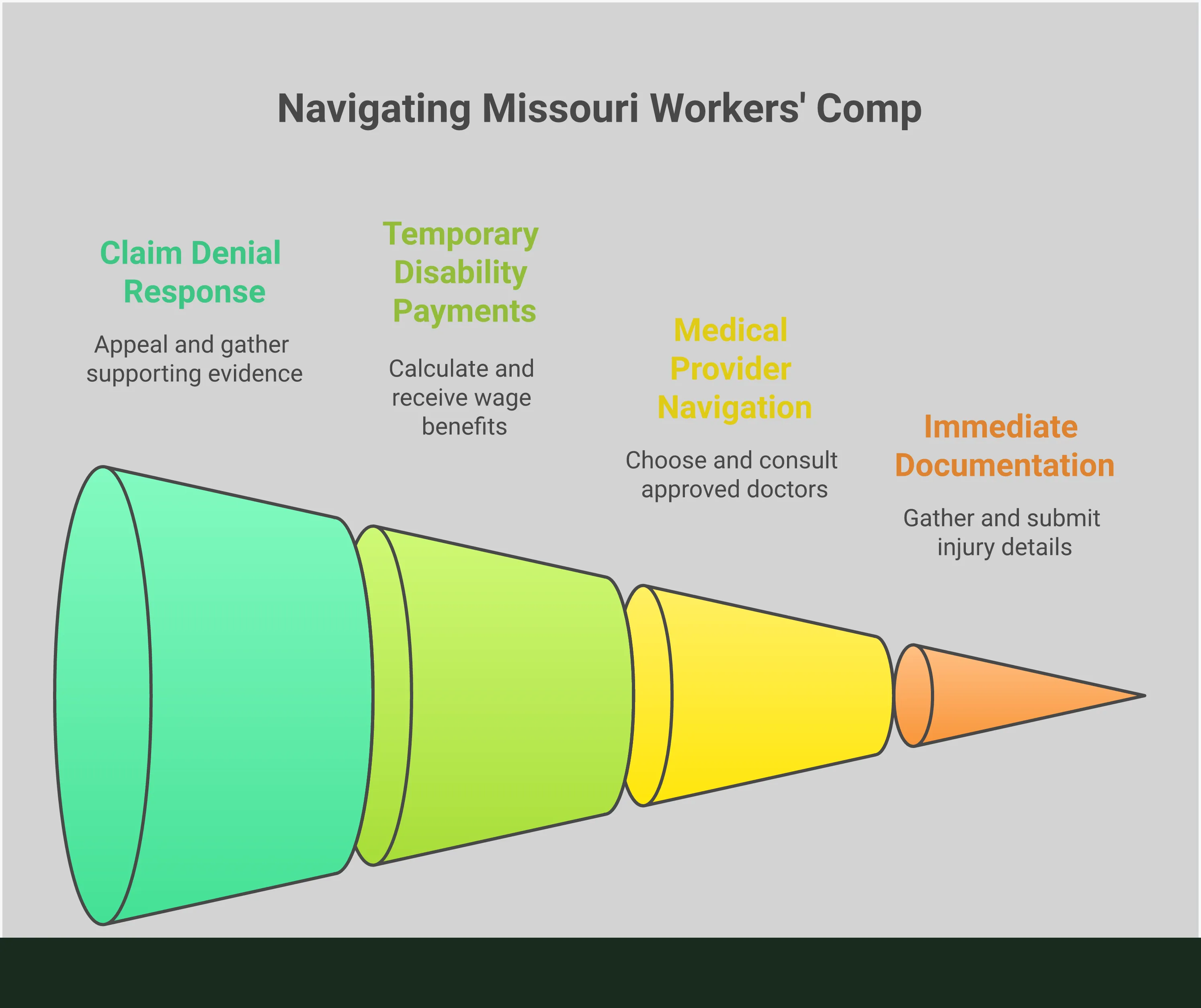
- STEP 1: Provide Written Notice to Employer (Within 30 days of incident or diagnosis)
- STEP 2: Seek Medical Treatment (Must use employer/insurer-authorized medical providers)
- STEP 3: File Formal Claim for Compensation (Form WC-14 filed with Missouri DWC within statute)
- STEP 4: Case Resolution or Adjudication (Settlement negotiation, mediation, or formal hearing)
1. Provide Written Notice to the Employer
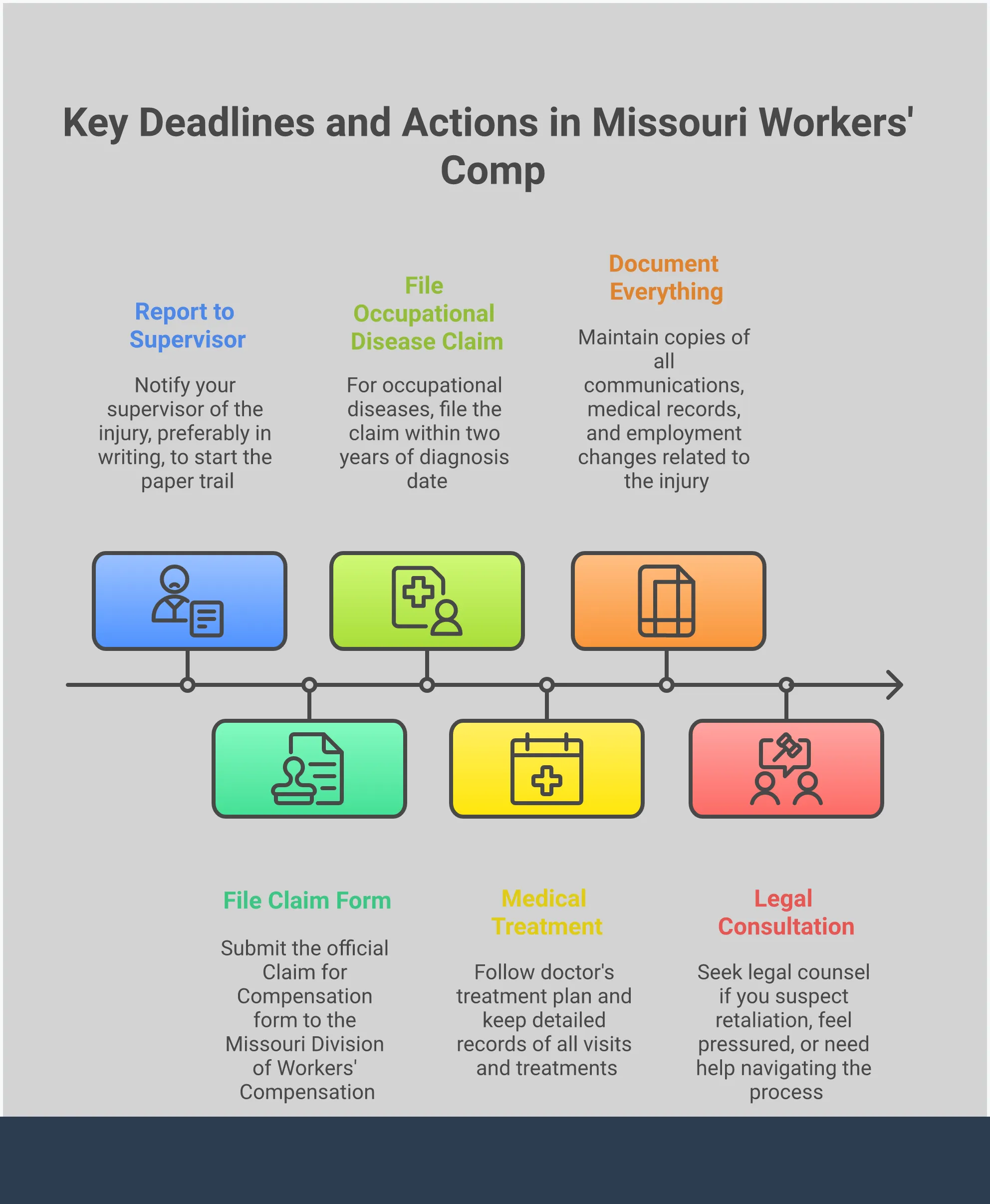
Under RSMo § 287.420, an injured worker must give written notice of the injury to the employer within 30 days of the accident. For occupational diseases like first-responder PTSD, notice must generally be provided within 30 days of the date the employee is diagnosed and informed by a physician that the mental condition is work-related.
- Format: The notice should be in writing, specifying the time, place, nature of the traumatic event, and resulting symptoms.
- Critical Note: Verbal notification to a supervisor is frequently disputed. Always retain a physical or digital copy of signed written notice.
2. Seek Employer-Authorized Medical Care
Under Missouri law, the employer (or their insurance carrier) has the legal right to select the treating medical providers.
- Seeking treatment from a personal therapist or family physician without prior approval from the insurer can result in those medical bills being non-reimbursable under workers' comp.
- Request an immediate referral to a qualified, licensed psychiatrist or clinical psychologist specializing in trauma.
3. File a Formal Claim for Compensation
Reporting an injury to an employer does not automatically open a formal case with the state. To protect legal rights, the employee must file a Claim for Compensation (Form WC-14) directly with the Missouri Division of Workers' Compensation.
- Statute of Limitations: Generally, a formal claim must be filed within two years of the date of injury, the date of diagnosis (for occupational diseases), or the last payment of benefits/medical care. In certain circumstances where the employer failed to file required reports, this deadline extends to three years.
Available Benefits for Covered PTSD Claims
If a PTSD claim is accepted by the insurer or awarded by an Administrative Law Judge (ALJ), the injured worker is entitled to specific statutory benefits under Missouri law.
Medical Treatment
The employer/insurer must cover 100% of reasonable and necessary medical care required to cure and relieve the effects of the PTSD. This includes:
- Psychotherapy and specialized trauma counseling (e.g., EMDR, Cognitive Processing Therapy)
- Prescribed psychiatric medications
- Inpatient psychiatric stabilization (if required)
- Transportation costs to and from medical appointments
Temporary Total Disability (TTD)
If an authorized psychiatrist places the employee off work entirely while undergoing treatment, the employee is entitled to TTD benefits.
- Rate: TTD is calculated at 66 2/3% of the employee’s average weekly wage (AWW), subject to statutory state maximums updated annually by the state.
- Duration: Benefits continue until the worker is released to return to work or reaches Maximum Medical Improvement (MMI).
Permanent Disability Benefits
Once treatment reaches MMI—meaning the condition has stabilized and further major recovery is not expected—the employee is evaluated for permanent functional impairment:
- Permanent Partial Disability (PPD): If the worker can return to employment but suffers lasting psychological impairment, a settlement or award is calculated based on the assigned body percentage of disability.
- Permanent Total Disability (PTD): If the psychological trauma is so severe that the worker is rendered completely unable to perform any reasonable or gainful employment in the open labor market, they may qualify for weekly weekly PTD benefits for life.
Common Challenges and Contested Issues
Insurance carriers routinely contest psychological claims due to their subjective nature and potential long-term financial liability. Common defense strategies include:
1. Attributing PTSD to Pre-Existing Factors
Insurers frequently request years of prior medical, military, and personal records to argue that the worker's PTSD stems from childhood trauma, prior military deployments, non-work personal stress, or pre-existing anxiety disorders.
2. Disputing the "Unusual and Extraordinary" Standard
For non-first responders, insurers will argue that the event causing the mental stress was routine for the industry. For instance, an insurer might argue that a retail manager dealing with an aggressive customer experienced standard workplace stress rather than an extraordinary event.
3. Delays and Denial of Authorized Care
Because insurers control medical choices, they may assign an evaluator who concludes that the employee has simple burnout or a temporary adjustment disorder rather than clinical PTSD, leading to a claim denial.
Frequently Asked Questions
Can I choose my own therapist or psychiatrist for a Missouri workers' comp PTSD claim?
No. Under Missouri law, the employer and their workers' compensation insurance carrier have the right to select the treating medical providers. If you seek treatment from a doctor without insurance authorization, the insurer is generally not required to pay for those medical bills unless an Administrative Law Judge orders otherwise.
What if I had pre-existing PTSD or anxiety before the workplace event occurred?
Having a pre-existing mental health condition does not automatically disqualify you from receiving benefits. Under Missouri law, if a workplace event or traumatic incident aggravates or accelerates a pre-existing condition, it may still be compensable if the work incident is proven to be the prevailing factor driving the current need for medical treatment and resulting disability.
How long does a Missouri first responder have to report PTSD?
A first responder must provide written notice to their employer within 30 days of receiving a formal diagnosis from a licensed psychiatrist or psychologist stating that their PTSD is attributable to their professional service. The formal Claim for Compensation must be filed with the Missouri Division of Workers' Compensation within two years of that diagnosis or the last benefit payment.
Does Missouri workers' comp pay for wage loss if PTSD forces me to take time off work?
Yes. If an authorized treating physician certifies that you are temporarily unable to work due to your work-related PTSD, you are entitled to Temporary Total Disability (TTD) benefits. These benefits equal two-thirds of your average weekly wage, up to the statutory state maximum cap.
Can an employer fire a worker for filing a PTSD workers' compensation claim in Missouri?
No. RSMo § 287.780 explicitly prohibits employers from discharging or discriminating against an employee for exercising their rights under the Missouri Workers' Compensation Law. Retaliatory termination creates grounds for an independent civil lawsuit against the employer.
Strategic Next Steps for Injured Workers
Navigating a PTSD claim through the Missouri workers' compensation system requires adherence to statutory deadlines and thorough medical documentation. If you or a family member are suffering from work-related psychological trauma, consider taking the following immediate actions:
- Document the Traumatic Event: Keep detailed personal records of the date, time, witnesses, and circumstances surrounding the workplace incident or duty exposures.
- Submit Written Notice Immediately: Send formal written notice to your employer or HR department specifying that you have suffered a work-related psychological injury. Request immediate medical evaluation through their approved workers' comp network.
- Obtain Clinical Support: Seek emergency mental health intervention or crisis counseling if experiencing severe distress. Inform healthcare providers that the condition is related to job duties.
- Consult Legal Representation: Because mental health claims—especially mental-mental and first-responder occupational disease claims—face high evidentiary hurdles, consulting an attorney experienced in Missouri workers' compensation law can help protect statutory rights and preserve necessary evidence.
Disclaimer: This article provides general legal information regarding Missouri workers' compensation laws and statutes. It does not constitute formal legal advice or create an attorney-client relationship. Individuals seeking legal guidance regarding a specific claim should consult a qualified attorney licensed in the State of Missouri.
EDITORIAL CATEGORY METADATA:
Image Gallery