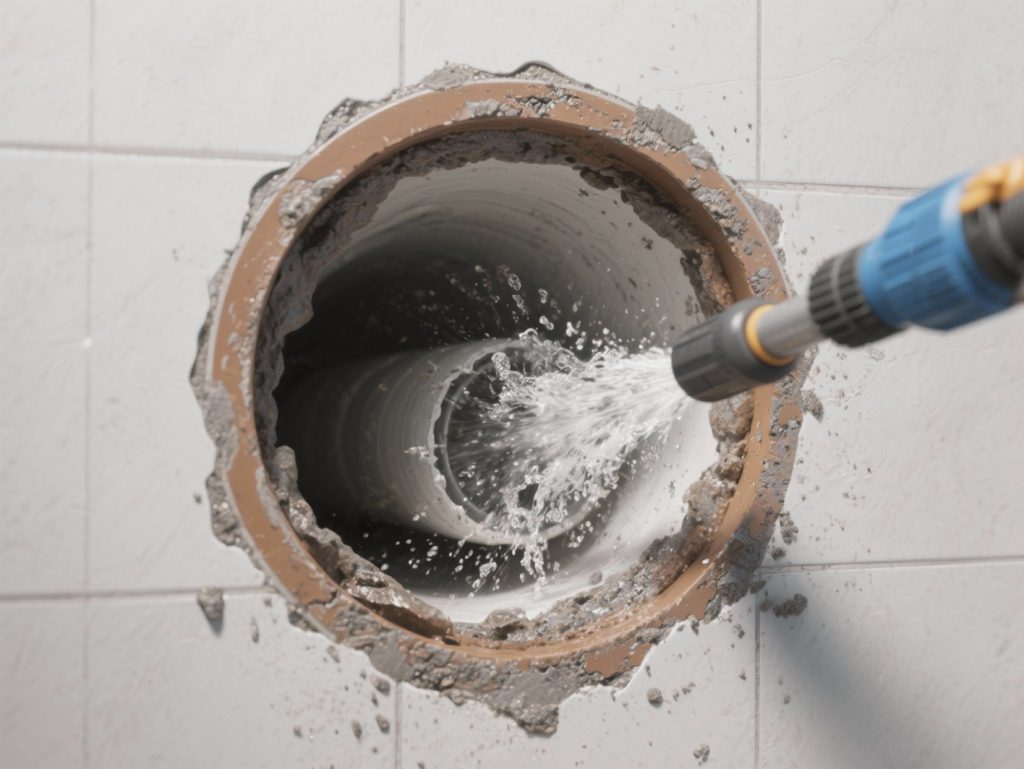
Why the Best Hydro Jet Drain Cleaning Equipment Is Not What You Expect
The best hydro jet drain cleaning equipment is not defined by peak pressure ratings or massive engine horsepower. Superior performance relies on high water volume (GPM), fluid dynamics, precision nozzle engineering, and system portabil...
The best hydro jet drain cleaning equipment is not defined by peak pressure ratings or massive engine horsepower. Superior performance relies on high water volume (GPM), fluid dynamics, precision nozzle engineering, and system portability. High volume flushes debris effectively, while specialized nozzles convert hydraulic energy into self-propulsion and thorough wall-to-wall scouring without damaging infrastructure.
Contents
The Raw Power Myth: Why Gallons Per Minute (GPM) Trumps PSI
A common misconception among plumbing professionals and facility managers is that higher pressure (measured in pounds per square inch, or PSI) automatically translates to superior drain cleaning. Marketing materials often highlight 4,000 PSI or 5,000 PSI ratings to signal power. However, in professional drain cleaning and pipe rehabilitation, Gallons Per Minute (GPM) is the primary metric that determines actual cleaning effectiveness.
Hydro jetting relies on two distinct mechanical forces: shearing force and flushing force. Pressure creates the shearing force needed to cut through solid blockages such as grease build-up, ice, or soft root intrusion. Water flow (volume) provides the mass and kinetic energy necessary to carry cleared solids down the pipe to the main municipal sewer collector.
$$\text{Mass Flow Rate } (\dot{m}) = \rho \cdot Q$$
Where $\rho$ represents fluid density and $Q$ represents volumetric flow rate (GPM). Without sufficient volume, high pressure merely drills a narrow hole through a blockage without removing the surrounding mass, leading to rapid re-clogging.
| System Type | Performance Characteristics |
|---|---|
| LOW GPM / HIGH PSI (Pressure Washer Conversion) | Narrow penetration hole; leaves heavy sludge |
| HIGH GPM / BALANCED PSI (Professional Hydro Jetter) | Full 360° wall scour; complete solids flush |
When high PSI is paired with low GPM—such as a 4,000 PSI consumer pressure washer pumping only 2.5 GPM—the hydraulic energy dissipates within inches of leaving the nozzle orifice. Conversely, a professional system operating at 3,000 PSI with 9 to 12 GPM delivers substantial momentum. This high volume scrubs the full interior diameter of a pipe, emulsifies thick fats, and pushes gravel, heavy sludge, and scale out of the system.
The Risk of Over-Pressurization
Excessive pressure without adequate flow presents operational hazards. Applying pressures above 4,000 PSI inside residential or light commercial drain lines can cause serious damage:
- Pipe Wall Erosion: Aged cast iron pipes suffering from graphitic corrosion can crack or breach under concentrated extreme pressure.
- Joint Dislodgement: High-pressure spikes can push past bell-and-spigot joints in vitrified clay or un-cemented PVC drains, forcing water into surrounding soil and undermining pipe bedding.
- Structural Degradation: Flexible corrugated plastic agricultural or stormwater piping can deform or burst when exposed to improper jetting vectors.
Nozzle Engineering: The Engine Behind Hydro Jetting Success
The pump generates potential hydraulic energy, but the jetting nozzle converts that potential energy into kinetic work. An expensive 25 GPM trailer-mounted jetter will underperform if fitted with an inefficient, worn, or incorrectly sized nozzle.
- High-Pressure Fluid Entry
- Internal Manifold
- Rear Propulsion Jets (15°–45° Thrust Angle): Forward Movement & Pipe Wall Scouring
- Front Penetrator (Obstruction Clearance): Direct Impact Cutting Power
Fluid Dynamics and Propulsion Vectors
Nozzles propel themselves through drain lines using rearward-facing water jets. The angle of these rear orifices dictates the balance between thrust and wall-cleaning coverage:
- 15-Degree Rear Angle: Maximizes forward propulsion and pulling power. This configuration is ideal for long runs, heavy grease beds, and ascending vertical stacks where gravity resists forward motion.
- 30- to 45-Degree Rear Angle: Decreases forward pull but drastically increases the radial striking angle against the pipe wall. This configuration excels at removing scale, tuberculation, and biofilm from pipe walls.
High-end hydro jetting equipment uses ceramic or tungsten carbide nozzle inserts rather than drilled stainless steel orifices. Water traveling at high velocity carrying trace particulate quickly erodes standard steel holes. As the orifice expands by mere fractions of a millimeter, system operating pressure drops significantly, rendering the equipment inefficient.
- Standard Steel Orifice (Rapid Erosion): Orifice expands over time; pressure drops rapidly.
- Ceramic Insert (Stable Velocity): Retains tight diameter; maintains constant PSI.
Specialized Nozzle Categories
Professional operators select nozzles based on line conditions rather than relying on a single general-purpose attachment:
- Rotary Nozzles: Feature rotating barrels driven by water force or internal gearboxes. Controlled rotation ensures 360-degree coverage without leaving un-scoured striping along pipe walls.
- Penetrator Nozzles: Combine a sharp front-facing jet with aggressive rear thrusters to punch holes through total blockages, tree root masses, or ice dams.
- Descaling Nozzles (Chain Knockers): Utilize water-driven rotating chains or carbide teeth to strike hard mineral scale and tuberculation off interior pipe surfaces before lining or pipe coating.
- Vibrating / Pulsating Nozzles: Purpose-built to navigate sharp 90-degree bends and traps by inducing controlled hydraulic micro-pulsations in the hose line.
Machine Form Factors: Matching Configuration to Pipe Diameter
The ideal hydro jetter depends on the operational environment. Expecting a massive municipal trailer rig to handle indoor plumbing stacks is as impractical as using a portable electric cart to clear an eight-inch main city collector line.
| Portable Cart Jetter | Trailer / Skid Jetter |
|---|---|
| • 1.5" - 3" Pipes | • 4" - 12"+ Pipes |
| • 1,500–2,000 PSI | • 3,000–4,000 PSI |
| • 3–4 GPM | • 9–25+ GPM |
| • Indoor Accessibility | • High Volume Flush |
Portable Cart Jetters (Indoor & Branch Lines)
Indoor branch lines (such as kitchen sinks, floor drains, and laundry lines ranging from 1.5 to 3 inches) require compact maneuvering. Portable electric or compact gas-powered jetters deliver around 1,500 to 2,000 PSI at 3 to 4 GPM.
- Access Requirements: Designed to roll through standard commercial doorways, navigate elevators, and operate indoors without exhausting dangerous carbon monoxide fumes (when using electric motors).
- Hose Compatibility: Utilizes 3/16-inch or 1/4-inch outer diameter (OD) lightweight, highly flexible thermostatic hoses capable of navigating tight P-traps and 90-degree sweeps.
Trailer-Mounted and Skid Rigs (Main Sewer & Storm Lines)
Building sewer laterals, municipal collector mains, and storm sewers (4-inch to 12-inch+ diameters) require large volume delivery. These heavy-duty jetters operate at 3,000 to 4,000 PSI while delivering 9 to 25+ GPM.
- Water Supply Management: High GPM equipment exhausts standard 3/4-inch garden hose fill lines quickly. Consequently, trailer units feature integrated 200- to 600-gallon water tanks equipped with low-water anti-cavitation shutoff switches.
- Hose Dynamics: Requires heavy-duty 3/8-inch, 1/2-inch, or 3/4-inch internal diameter (ID) high-pressure hoses engineered to withstand high tensile pull strength while resisting abrasion against rough concrete or clay pipe walls.
Fluid Dynamics: Hose Friction Loss and Water Delivery
A common oversight when evaluating hydro jetting performance is failing to account for friction head loss inside the jetting hose. As water travels through hundreds of feet of high-pressure hose, fluid friction against the inner synthetic lining strips away energy.
The pressure drop across a length of smooth pipe or hose can be calculated using the Darcy-Weisbach equation:
$$h_f = f \cdot \frac{L}{D} \cdot \frac{v^2}{2g}$$
Where $h_f$ is friction head loss, $f$ is the friction factor, $L$ is hose length, $D$ is internal hose diameter, and $v$ is fluid velocity.
Because internal diameter ($D$) sits in the denominator of the relative roughness and geometric ratio, smaller hose diameters cause exponentially higher friction loss at high flow rates.
Hose Diameter Impact on Delivered Pressure (100 ft Hose Run at 8 GPM):
| Hose Diameter | Friction Loss | Delivered Pressure Impact |
|---|---|---|
| 1/4" Hose | High Friction Loss | Up to 1,200 PSI Lost at Nozzle |
| 3/8" Hose | Moderate Loss | ~ 250 PSI Lost at Nozzle |
| 1/2" Hose | Low Loss | Negligible Pressure Loss |
For instance, attempting to push 8 GPM through a 100-foot, 1/4-inch jetting hose will result in a dramatic pressure drop before the water ever reaches the nozzle head. The pump may register 3,500 PSI at the pressure gauge, but friction loss leaves the nozzle operating at a fraction of that figure. Matching hose inner diameter (ID) to pump GPM capacity is vital for delivering rated performance to the working face.
Equipment Configuration Comparison
Selecting the right hydro jetting system requires balancing line geometry, obstruction type, and accessibility requirements. The following matrix details standard professional setups:
| System Type | Target Line Diameter | Flow Rate (GPM) | Pressure Rating (PSI) | Primary Application | Key Advantage |
|---|---|---|---|---|---|
| Electric Portable Cart | 1.5" – 2" | 2.0 – 3.0 GPM | 1,500 – 1,800 PSI | Indoor residential sinks, stacks, and grease lines. | Zero emissions; fits through standard interior doorways. |
| Gas Commercial Roll-Cart | 2" – 4" | 4.0 – 5.5 GPM | 3,000 – 3,500 PSI | Commercial kitchen branch lines, small floor drains. | High portability combined with sufficient pressure to cut grease. |
| Compact Gas Skid Mount | 3" – 6" | 8.0 – 9.0 GPM | 3,000 PSI | Residential main sewer laterals, minor root intrusions. | Fits in standard utility van cargo beds; balanced flow and pressure. |
| Heavy Industrial Trailer | 4" – 12" | 12.0 – 18.0 GPM | 3,000 – 4,000 PSI | Municipal mains, heavy root clearing, storm drains. | Carries high-capacity onboard water; high mass flow rate. |
| High-Volume Truck Mount | 8" – 24"+ | 25.0 – 60.+ GPM | 2,000 – 2,500 PSI | Municipal storm networks, culverts, sand/gravel removal. | Extreme flushing volume clears heavy silt and gravel beds easily. |
Operational Safety Protocols and System Integrity
Hydro jetting equipment operates under extreme hydraulic energy, presenting mechanical hazards if mismanaged. Professional setup requires strict safety protocols aligned with organizations like the Water Jet Technology Association (WJTA).
Safety Equipment and Procedures
- Anti-Reversal Devices (Leader Hoses): A 10-foot section of rigid hose or heavy orange protective leader hose must be attached directly behind the nozzle. This prevents small-diameter nozzles from turning 180 degrees inside large pipes and traveling back toward the operator.
- Foot Pedal Control Valves (Dump Valves): Operators must use a mechanical or hydraulic foot pedal control valve. Depressing the valve engages pressure; releasing it instantly dumps pressure to atmosphere, protecting the operator if control is lost.
- Personal Protective Equipment (PPE): Jetting operations require liquid-impermeable protective suits, steel-toe safety boots with metatarsal guards, heavy rubber gloves, and full-face shield protection to prevent exposure to high-pressure injection injuries and biohazards.
- Pump Unit
- Foot Dump Pedal (Emergency Release Control via High-Pressure Line)
- Leader Hose (Prevents 180° Nozzle Reversal)
- Nozzle Assembly (Active Work Zone)
Common Pitfalls When Selecting Hydro Jetting Gear
Navigating the commercial jetter market involves avoiding several technical traps:
- Relying Solely on Pressure Washers with Jetter Kits: Converting a standard pressure washer into a sewer jetter using aftermarket hose kits often fails. Pressure washers lack thermal relief bypass loops, high-durability triplex plunger pumps, and the continuous-duty cooling systems required for long jetting cycles.
- Ignoring Water Source Capacity: Running a 9 GPM jetter off a residential hose bib that only supplies 5 GPM will dry-cavitate the pump head. Cavitation causes imploding vapor bubbles that destroy internal ceramic plungers and manifold seals within minutes.
- Underestimating Hose Length Needs: Running excessive hose lengths adds unnecessary weight and internal friction drop. Operators should run the shortest practical hose line to maximize pressure delivery at the nozzle head.
- Neglecting Nozzle Orifice Maintenance: Orifices can clog with sand or debris from untreated water tanks. Operating a pump against clogged nozzle orifices triggers the primary unloader valve to bypass constantly, heating water to temperatures that damage pump seals.
Frequently Asked Questions
Can I use a standard high-pressure washer as a professional hydro jetter?
While pressure washer conversions exist for light DIY jobs, they are unsuitable for professional drain cleaning. Standard pressure washers deliver low flow rates (typically 2 to 3 GPM), which lack the kinetic energy needed to flush heavy debris out of drain lines. Furthermore, pressure washer pumps lack the specialized continuous-duty seals, heat-dissipating unloader valves, and rugged construction necessary to handle continuous pipe-jetting loads.
What PSI and GPM flow rates are required to cut tree roots?
Clearing tree roots effectively requires a system delivering at least 3,000 PSI at 8 to 9 GPM, paired with a specialized rotating or root-cutting nozzle. Raw pressure cuts the root fibers, but high water volume (GPM) is necessary to clear the severed roots down the sewer line and prevent instant re-blockage. For heavy root intrusions in lines larger than six inches, trailer jetters delivering 12+ GPM are recommended.
How does nozzle orifice wear impact jetting performance?
As water and fine minerals pass through a nozzle, internal orifice walls slowly erode. When an orifice expands, system operating pressure drops dramatically according to fluid dynamic principles. A worn nozzle allows water to escape too easily, reducing backpressure, engine load, and cleaning effectiveness. Inspecting nozzle orifices regularly with precision gauges and replacing worn inserts is critical to maintaining rated system performance.
Is hydro jetting safe for older PVC or fragile clay sewer lines?
Hydro jetting is safe for clay and PVC lines when operating parameters match the pipe material and condition. Older vitrified clay or thin-walled PVC pipes should be inspected with a sewer camera before jetting. Operators should cap pressures between 2,000 and 2,500 PSI and rely on higher volume (GPM) to flush line debris, avoiding high-pressure structural damage or joint displacement.
How does hose length affect delivered water pressure at the nozzle head?
Fluid traveling through a hose experiences friction loss against the smooth interior wall, resulting in a predictable pressure drop over distance. Shorter, larger-diameter hoses minimize this energy loss. Pushing high GPM through long, narrow hoses causes significant inline pressure drops, reducing effective power at the nozzle head despite high readings on the pump gauge.
Final Verdict: Selecting Equipment Based on Hydraulics, Not Hype
Selecting superior hydro jet drain cleaning equipment requires looking beyond surface-level PSI figures and large engine decals. Practical performance depends on high water volume delivery (GPM), properly matched hose diameters, high-grade ceramic nozzle engineering, and unit portability appropriate for the job site.
By prioritizing mass flow rate and fluid dynamics over peak pressure ratings, plumbing contractors and maintenance teams achieve cleaner pipe walls, faster line clearing, and safer operations across all piping infrastructure.
EDITORIAL CATEGORY METADATA:
Image Gallery