When to Use the Infinitive in English: A Complete Grammar Guide
In English grammar, you should use the to-infinitive primarily to state a purpose, after certain main verbs (such as decide, hope, and agree), following adjectives, and directly after specific nouns or pronouns. You use the bare infini...
In English grammar, you should use the to-infinitive primarily to state a purpose, after certain main verbs (such as decide, hope, and agree), following adjectives, and directly after specific nouns or pronouns. You use the bare infinitive (without "to") after modal verbs, causatives like make and let, and verbs of perception.
Contents
Understanding the Infinitive: Forms and Functions
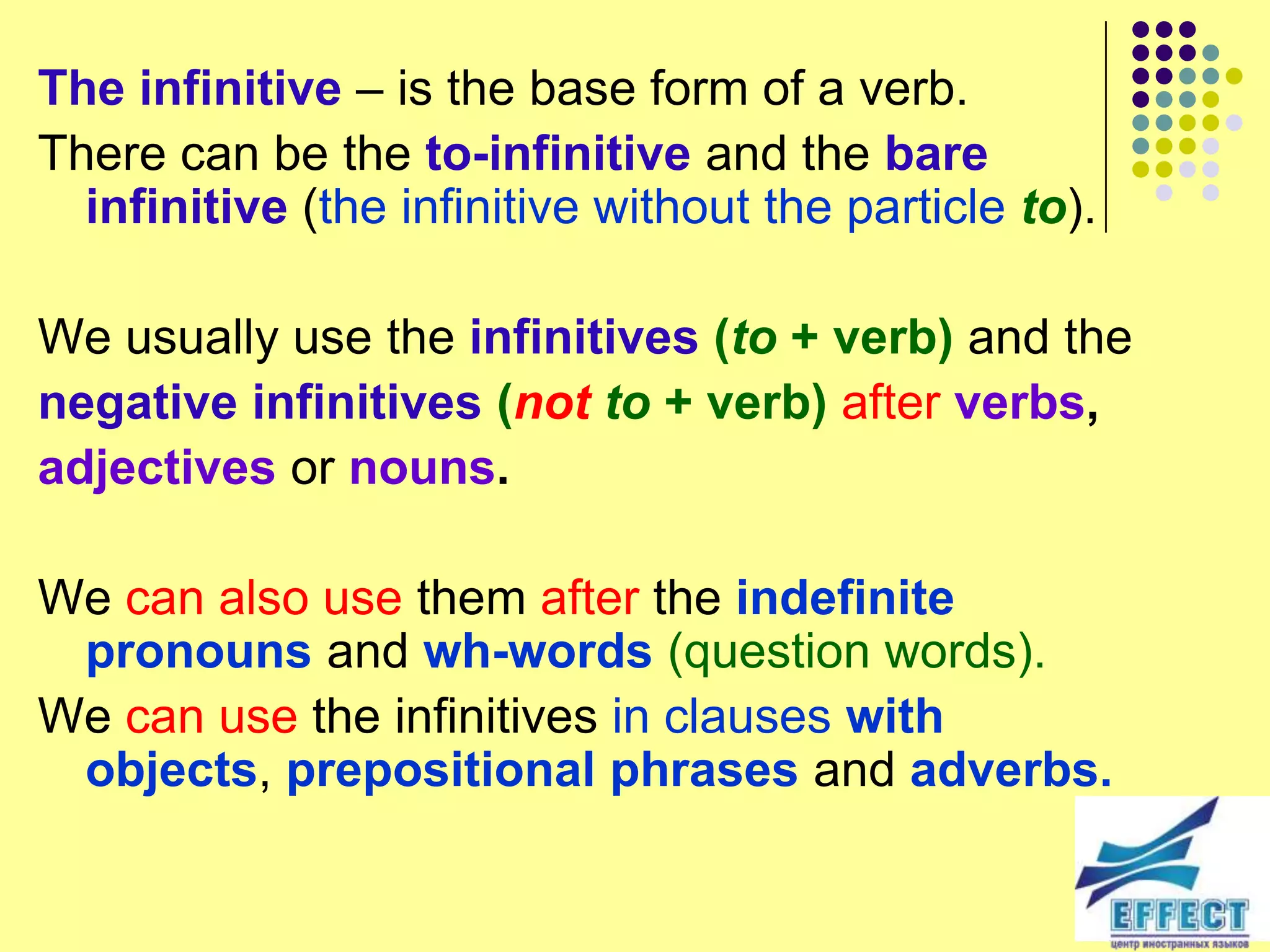
The infinitive is the base dictionary form of a verb. It serves as an un-conjugated building block in sentence construction, functioning not as the main finite verb that marks tense or person, but as a noun, adjective, or adverb within the broader predicate.
In English linguistics, infinitives manifest in two primary forms:
- The To-Infinitive: The preposition particle "to" combined with the base verb (e.g., to run, to understand, to speak).
- The Bare Infinitive: The base verb standing alone without "to" (e.g., run, understand, speak).
Mastering when to select an infinitive—and choosing correctly between the to-infinitive, the bare infinitive, and the gerund (-ing form)—is one of the most critical steps toward fluency in written and spoken English.
1. Using the To-Infinitive After Specific Verbs
One of the most frequent uses of the to-infinitive occurs when one verb directly follows another main verb. In English syntax, verbs do not combine arbitrarily; specific main verbs mandate that any following verb take the infinitive form rather than a gerund.
Main Verbs Demanding a To-Infinitive
When expressing plans, desires, intentions, promises, or choices, the following high-frequency verbs take a to-infinitive:
- Intentions and Desires: want, wish, hope, plan, intend, aim, long
- Decisions and Agreements: decide, agree, choose, offer, refuse, consent, prepare
- Promises and Expectations: promise, swear, expect, guarantee, undertake
- Learning and Management: learn, manage, fail, afford, pretend, attempt, hesitate
Examples in Context
- She decided to submit her application before the official deadline.
- The development team managed to resolve the database issue ahead of schedule.
- We cannot afford to compromise on security standards during the migration.
- He promised to update the executive board by Friday afternoon.
In these structures, the first verb carries the tense (past, present, or future), while the second verb remains fixed as a to-infinitive.
2. Using the To-Infinitive to Express Purpose or Reason
The to-infinitive frequently functions as an adverbial phrase of purpose, explaining why an action occurs. It serves as a concise alternative to the longer phrases "in order to" or "so as to."
Shortened Form vs. Formal Form
In standard writing and conversation, you can drop "in order" while retaining the exact same meaning:
- Full Purpose Phrase: They restructured the department in order to improve cross-functional communication.
- Standard To-Infinitive: They restructured the department to improve cross-functional communication.
Both formulations are grammatically correct, though using the plain to-infinitive is generally preferred in modern professional and academic style for conciseness.
Negative Purpose Construction
When expressing a goal to avoid something, you must use in order not to or so as not to. Simply adding "not to" directly to the verb without "in order" or "so as" can sound awkward or ambiguous.
- Correct: She set three separate alarms in order not to miss the early flight.
- Incorrect/Awkward: She set three separate alarms not to miss the early flight.
3. Verb + Object + To-Infinitive Patterns
Many transitive verbs require a direct object before the infinitive clause. In this sentence construction, the main verb acts upon a person or entity, directing or enabling that object to perform a secondary action.
Common Verbs in This Pattern
- Commanding and Advising: advise, instruct, order, command, urge, encourage, recommend
- Permitting and Enabling: allow, permit, enable, cause, require, force
- Persuading and Expecting: persuade, convince, remind, expect, invite, ask
Sentence Structural Breakdown
| Main Subject | Main Verb | Object (Noun/Pronoun) | To-Infinitive Clause |
|---|---|---|---|
| The policy | allows | employees | to work remotely. |
| The manager | advised | him | to review the contract terms. |
| Technical failures | caused | the system | to reboot automatically. |
| We | invite | all stakeholders | to attend the webinar. |
Notice that the object pronoun must be in the objective case (him, her, them, us) rather than the subjective case (he, she, they, we).
4. Infinitives After Adjectives and Adverbs
When an adjective evaluates an experience, describes an emotional response, or indicates readiness, it is typically followed by a to-infinitive.
Key Adjective Categories
Emotional States and Attitudes: happy, glad, delighted, surprised, eager, reluctant, willing, anxious
- We are delighted to announce our new institutional partnership.
- The committee members were reluctant to approve the budget increase.
Evaluative Descriptions (often with dummy subject "It"): important, necessary, difficult, easy, essential, impossible, wise
- It is essential to verify credentials before granting administrative access.
- It was difficult to identify the root cause without detailed diagnostic logs.
Degree Modifiers (Too / Enough):
- Too + Adjective + To-Infinitive: The system memory is too low to process the dataset.
- Adjective + Enough + To-Infinitive: The infrastructure is stable enough to handle peak traffic.
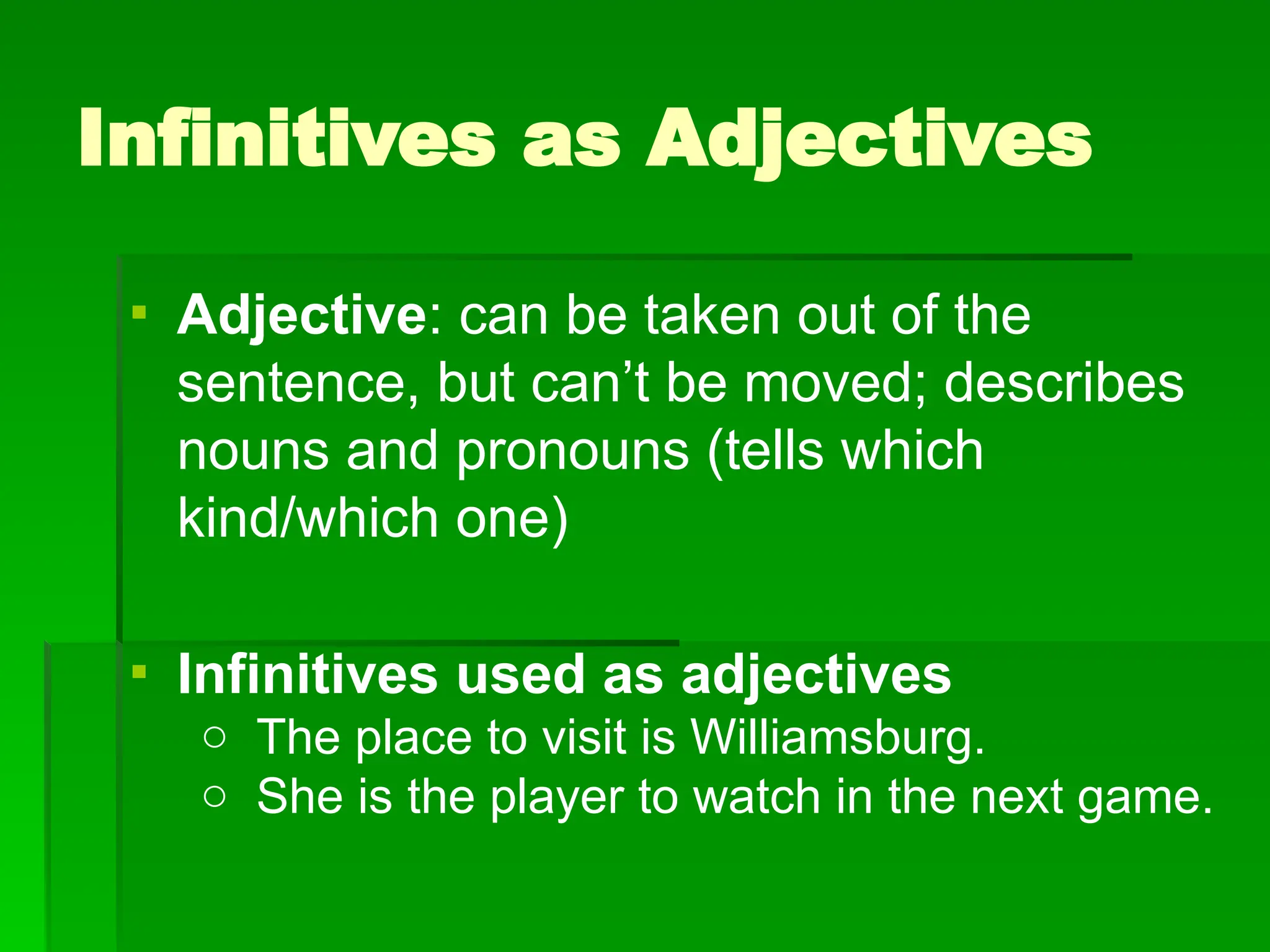
5. Infinitives Modifying Nouns and Pronouns
The to-infinitive can function as a post-modifier for abstract nouns and indefinite pronouns, replacing a relative clause (such as that we should do or which needs to be addressed).
Abstract Nouns Followed by Infinitives
Specific nouns often require an infinitive to complete their meaning:
- ability, chance, decision, effort, failure, need, opportunity, plan, right, time, way
Examples:
- She demonstrated a remarkable ability to solve complex organizational challenges.
- Now is the time to invest in modern software solutions.
- The board made a clear decision to expand into international markets.
Indefinite Pronouns
Indefinite pronouns such as something, anything, nothing, someone, and somewhere are frequently modified by infinitives:
- Do you have anything to add to the proposed meeting agenda?
- The stranded travelers needed somewhere to stay for the night.
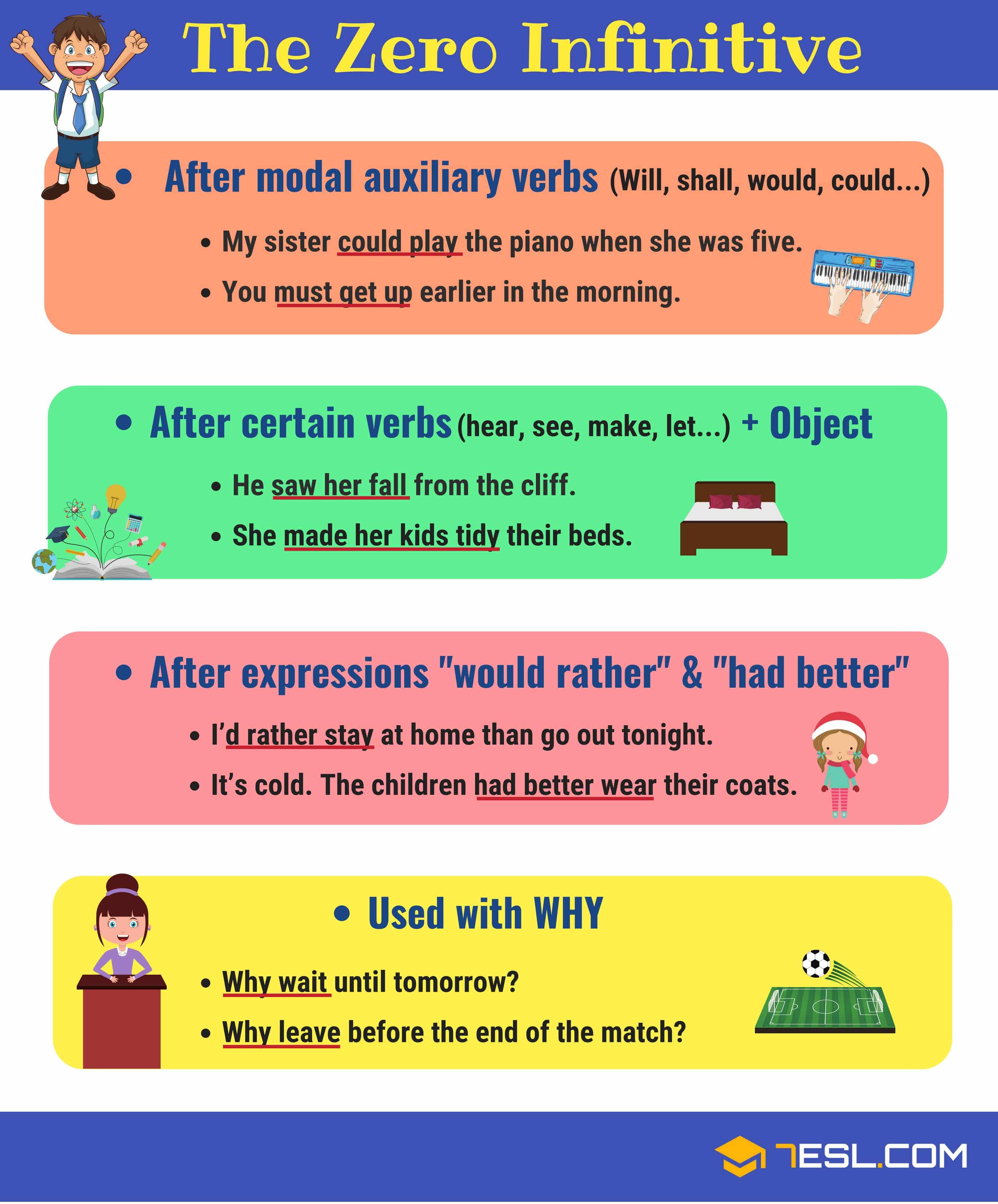
6. When to Use the Bare Infinitive (Without "To")
While the to-infinitive dominates many grammatical patterns, omitting the particle "to" is required under specific syntactical conditions.
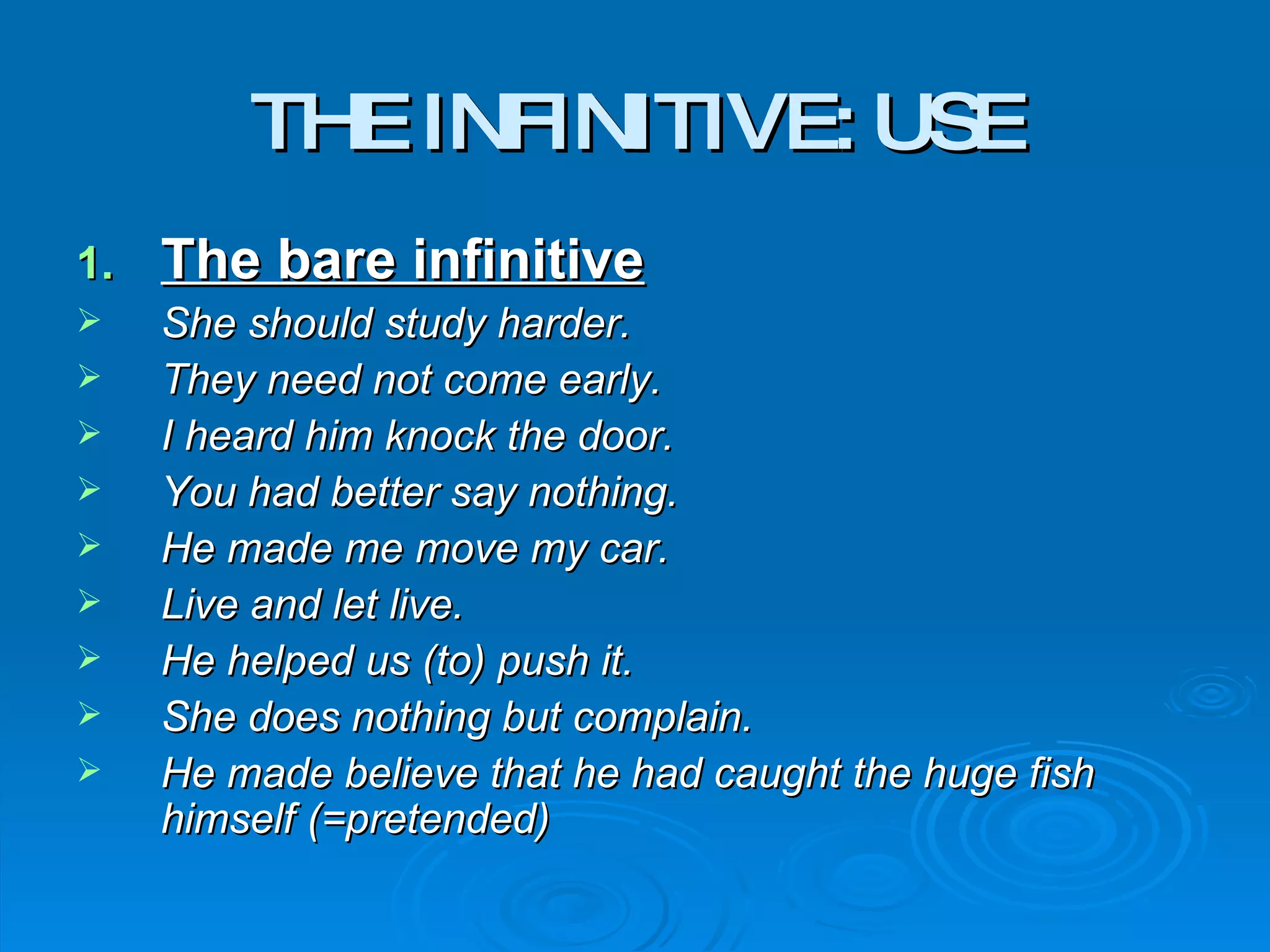
A. After Auxiliary Modal Verbs
All core modal auxiliary verbs take a bare infinitive. These include:
can, could, may, might, must, shall, should, will, would
Correct: You must submit the compliance documentation by end of day.
Incorrect: You must to submit the compliance documentation...
Note: Semi-modals like ought to and have to retain the particle "to" because "to" is built into the modal structure itself.
B. After Causative Verbs (Make, Let, Have)
Causative verbs indicate that an agent causes someone else to perform an action. When using make, let, or have in an active voice structure, use the bare infinitive:
- Let (permission): The compliance office let us proceed with the deployment.
- Make (compulsion): The updated security protocol makes users update passwords quarterly.
- Have (delegation): The director will have her assistant schedule the meeting.
Crucial Passive Voice Exception: When make is converted into the passive voice, the infinitival "to" returns:
- Active: They made him testify under oath.
- Passive: He was made to testify under oath.
C. After Verbs of Perception
Verbs of sensory perception—such as see, hear, watch, feel, notice, observe—take an object followed by either a bare infinitive or a present participle (-ing).
- Bare Infinitive (emphasizes a completed, whole action):
- I saw him lock the office door and walk away. (I witnessed the entire act from start to finish.)
- Present Participle (emphasizes an action in progress):
- I saw him locking the office door. (I caught a glimpse of him mid-action.)
Gerund vs. Infinitive: Verbs That Change Meaning
Certain English verbs can be followed by either a gerund (-ing) or a to-infinitive, but the choice completely alters the sentence's meaning. Understanding these distinctions prevents major communication errors.
[ VERB CHOICE ] / \ / \ [ + TO-INFINITIVE ] [ + GERUND (-ING) ] | | Future action / Past memory / Interruption to act Ongoing habit
1. Stop
- Stop + To-Infinitive: To interrupt an ongoing activity for the purpose of doing something else.
- During the long drive, we stopped to eat lunch. (We paused driving in order to eat.)
- Stop + Gerund: To terminate or cease an action entirely.
- He stopped smoking three years ago. (He quit the habit completely.)
2. Remember / Forget
- Remember/Forget + To-Infinitive: An action that occurs after remembering (focusing on a task, duty, or future action).
- Please remember to send the client invoice. (Remember first, then send it.)
- Remember/Forget + Gerund: Recalling a past action or event that already happened.
- I remember sending the invoice yesterday morning. (I recall the past memory of having sent it.)
3. Try
- Try + To-Infinitive: To make a physical or mental effort to achieve a difficult task (which may fail).
- We tried to repair the server, but the hardware damage was irreversible.
- Try + Gerund: To experiment with a method or alternative to see if it solves a problem.
- If the application crashes, try clearing your browser cache. (Test this action as an experiment.)
4. Regret
- Regret + To-Infinitive: To express sorrow or formal apology about bad news you are about to deliver.
- We regret to inform you that your application was unsuccessful.
- Regret + Gerund: To feel remorse about an action that occurred in the past.
- He regrets leaving his previous job without another offer lined up.
Comparison Matrix: Infinitive Structures at a Glance
Use this summary table to select the correct verb form across different syntactic structures.
| Grammatical Context | Verb Form Required | Example Structure | Correct Sentence |
|---|---|---|---|
| Intentions / Decisions | To-Infinitive | Main Verb + To + Verb | She decided to apply for the role. |
| Expressing Purpose | To-Infinitive | Verb + (In order) To + Verb | He called to confirm the booking. |
| Adjective Evaluation | To-Infinitive | It + Be + Adjective + To + Verb | It is vital to follow regulations. |
| Modal Auxiliaries | Bare Infinitive | Modal + Base Verb | We must act quickly. |
| Causative (Make/Let) | Bare Infinitive | Verb + Object + Base Verb | She let him speak uninterrupted. |
| Perception (Completed) | Bare Infinitive | Sensory Verb + Object + Base Verb | They heard her call for assistance. |
| Prepositions (Except To) | Gerund (-ing) | Preposition + Verb-ing | They succeeded by working together. |
Common Infinitive Errors and How to Fix Them
Grammatical missteps involving infinitives frequently stem from native language transfer or confusion between prepositional phrases and infinitival clauses.
1. Split Infinitives
A split infinitive occurs when an adverb is inserted between "to" and the base verb (e.g., to quickly run).
- Split: He decided to quickly finish the report.
- Unsplit: He decided to finish the report quickly.
Modern Standard Usage: While style guides historically strictly forbade split infinitives, modern editorial standards—including those published by the Oxford University Press and standard academic manuals—accept split infinitives if unsplitting them creates awkward or ambiguous phrasing. However, keeping the infinitive unified remains preferred in formal academic and legal contexts.
2. Confusing the Preposition "To" with the Infinitival "To"
When "to" acts as a true preposition (indicating direction or relationship), it must be followed by a noun or a gerund (-ing), not a base infinitive verb.
- Look forward to: I look forward to meeting you. (NOT to meet)
- Be used to / Accustomed to: She is used to working late hours. (NOT to work)
- Object to: They object to paying additional processing fees. (NOT to pay)
3. Double Infinitives and Omitted "To"
When linking two infinitives with a conjunction (and, or, but), you do not need to repeat the particle "to" for the second verb unless emphasis or structural balance is specifically desired.
- Redundant: She wants to sit down and to relax.
- Streamlined: She wants to sit down and relax.
Frequently Asked Questions
What is the difference between a gerund and an infinitive?
A gerund is a verb ending in -ing that functions as a noun (e.g., "Swimming is great exercise"). An infinitive is the base verb form, usually preceded by "to" (e.g., "To learn is essential"). While both can act as nouns in a sentence, infinitives more commonly express potentiality, abstract ideals, or specific future goals, whereas gerunds tend to describe real, completed, or continuous activities.
Can an infinitive be the subject of a sentence?
Yes, an infinitive can serve as the primary subject of a sentence (e.g., "To err is human; to forgive is divine"). However, in modern written and spoken English, using an infinitive subject can sound formal or archaic. English speakers generally prefer using the dummy subject "it" with a delayed infinitive (e.g., "It is human to err") or replacing the infinitive with a gerund (e.g., "Erring is part of the process").
When should I use "to go" versus "going"?
Use "to go" after main verbs that project future intent, choices, or obligations (e.g., I plan to go, I want to go, I decided to go). Use "going" after prepositions (e.g., interested in going, before going), as the subject of a sentence (e.g., Going abroad broadens your perspective), or after specific verbs that require gerunds (e.g., I enjoy going, She considers going).
Is it wrong to use a bare infinitive after "help"?
No, both forms are grammatically valid after the verb help. You can say "She helped me to edit the report" or "She helped me edit the report." The bare infinitive construction ("help me edit") is significantly more common in American English, while both forms are widely utilized in British English.
Why do modal verbs take the bare infinitive instead of the to-infinitive?
Modal verbs (can, could, should, must, might, will, would) act as auxiliary markers of mood and modality. Historically, in the evolution of Germanic verb syntax, modal verbs directly modified bare verbal roots. As a result, modal verbs directly govern the base form of the following principal verb without requiring the prepositional particle "to."
Practical Action Plan for Language Mastery
To eliminate errors when using infinitives in your writing:
- Categorize Your Main Verbs: Learn new English verbs in context alongside their required complement structures (e.g., memorize refuse to do, suggest doing, advise someone to do as complete patterns rather than isolated words).
- Audit Prepositional Phrases: Identify whether "to" in a complex verb construction is an infinitive marker or a preposition. If you can replace "to" with "towards" or a noun phrase, it is a preposition that requires an -ing gerund (e.g., committed to excellence $\rightarrow$ committed to achieving excellence).
- Check Purpose Statements: Use plain to-infinitives for affirmative intent, but switch to "in order not to" or "so as not to" whenever writing negative purpose clauses.
Image Gallery