Why the French Horror Film Eyes Without a Face Matters
Released in 1960, Georges Franju’s French horror masterpiece Eyes Without a Face (Les Yeux sans visage) redefined cinematic horror by fusing clinical body horror with poetic realism. By pairing graphic surgical realism with a haunting,...
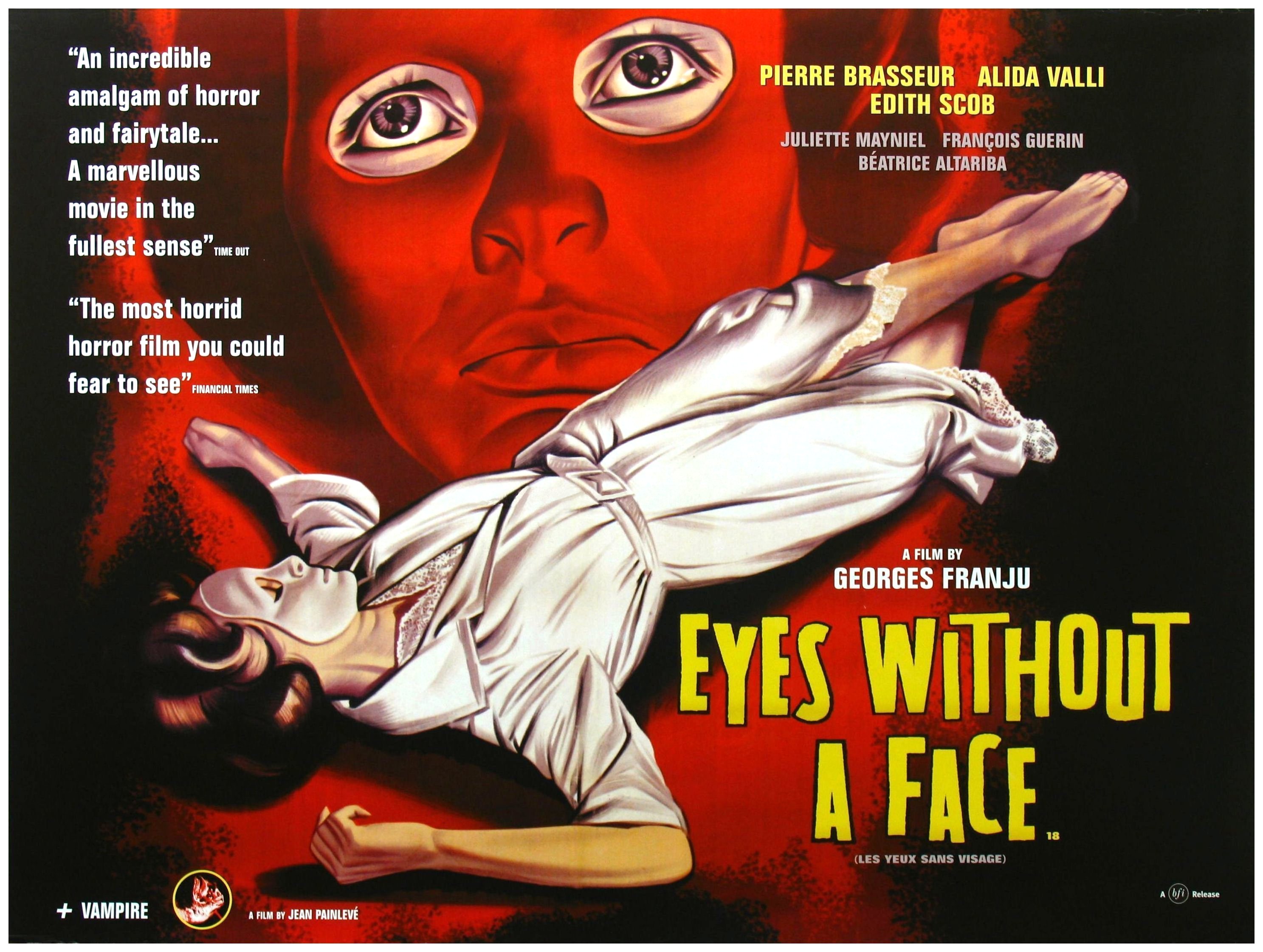
Released in 1960, Georges Franju’s French horror masterpiece Eyes Without a Face (Les Yeux sans visage) redefined cinematic horror by fusing clinical body horror with poetic realism. By pairing graphic surgical realism with a haunting, fairytale-like melancholy, the film challenged strict international censorship, established structural tropes for modern psychological thrillers, and created visual iconography—most notably Édith Scob’s frozen white mask—that continues to shape international cinema today.
Contents
Historical Context: Navigating European Censorship
To understand the historical importance of Eyes Without a Face, one must examine the state of European horror cinema in the late 1950s. At the time, French cinema was dominated by traditional literary adaptations and the emerging French New Wave (La Nouvelle Vague). Horror was largely viewed by European distributors as a low-brow American export or a British staple driven by Hammer Film Productions, known for colorful, gothic bloodletting in films like Horror of Dracula (1958).
Producer Jules Borkon acquired the rights to Jean Redon’s novel Les Yeux sans visage with the explicit goal of launching a French horror wave. However, European censorship boards operated under strict guidelines:
- French Censors: Expressed severe concern over graphic medical procedures and cruelty toward animals, threatening heavy cuts or outright bans.
- Italian Censors: Warned against explicit visual gore, demanding that the narrative focus on moral accountability rather than visceral shock.
- British Board of Film Censors (BBFC): Maintained rigorous standards regarding sadistic violence, leading to substantial cuts upon the film's UK theatrical release.
Director Georges Franju navigated these restrictions not by diluting the film's impact, but by altering its tone. Instead of relying on traditional horror tropes—such as mad scientists cackling in gothic dungeons or monster transformations—Franju set the story in a sunlit, contemporary Parisian suburb. The antagonist, Dr. Génessier (played by Pierre Brasseur), is not an overt maniac, but an esteemed, cold surgeon operating out of paternal guilt and professional hubris.
When Eyes Without a Face premiered, its unique synthesis of restraint and shock deeply unsettled contemporary audiences. Reports from the 1960 Edinburgh Film Festival documented several audience members fainting during the film's infamous face-transplant sequence. Critics initially split over its terrifying subject matter, but over the following decades, film scholars recognized Franju’s achievement: he had bypassed standard genre sensationalism to create a sophisticated, high-art terror.
The Intersection of Poetic Realism and Surgical Horror
The primary reason Eyes Without a Face remains a landmark in film history is its jarring synthesis of two contrasting styles: lyrical, poetic realism and visceral, clinical horror. Franju achieved this balance through careful visual composition, sound design, and narrative pacing.
| POETIC ELEGANCE | CLINICAL HORROR |
|---|---|
| • Ethereal black-and-white lit | • Cold, methodical surgery |
| • Flowing gowns & isolation | • Scalpel precision & blood |
| • Melancholic carousel score | • Barking caged test animals |
Cinematography by Eugen Schüfftan
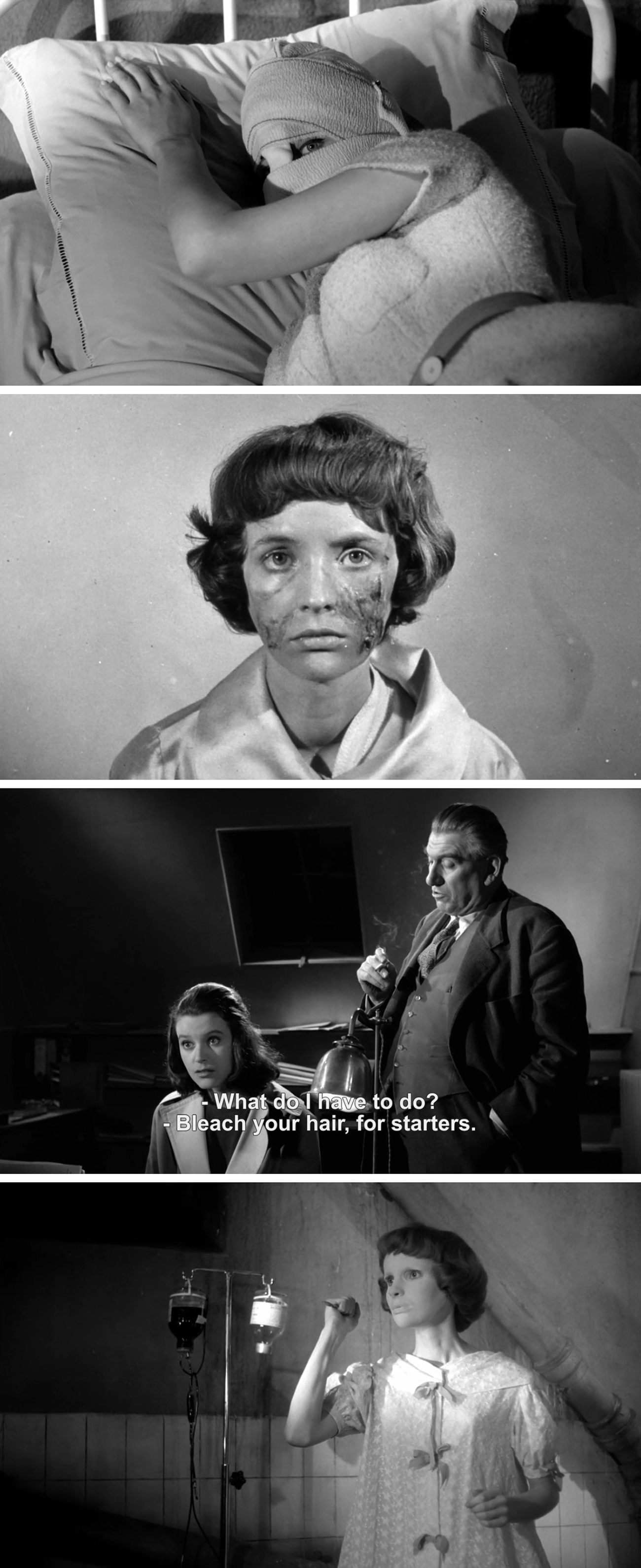
Franju hired veteran cinematographer Eugen Schüfftan, famous for his pioneering visual effects work on Fritz Lang’s Metropolis (1927) and his contributions to 1930s French poetic realism. Schüfftan lit the film in crisp, high-contrast black-and-white. Rather than hiding horrors in pitch-black shadows, Schüfftan illuminated the surgical theater with harsh, sterile lights, making the physical violence undeniably real. Conversely, when framing Christiane (Édith Scob) gliding through the secluded estate, Schüfftan used soft focus, long takes, and delicate shadows, framing her as a tragic ghost wandering a physical world.
The Heterograft Sequence
The centerpiece of the film—a nearly three-minute, uninterrupted surgical sequence depicting Dr. Génessier removing the face of a kidnapped young woman—changed how cinema portrayed medical violence. Franju insisted on clinical accuracy. The scalpel traces the hairline, skin is peeled back, and blood pools around the incision with quiet, methodical precision. By presenting the act without sensationalized editing or frantic music, Franju forced audiences to confront the physical reality of the procedure. This scene laid the foundation for modern body horror, paving the way for directors like David Cronenberg and Clive Barker.
Maurice Jarre’s Score
The musical score, composed by Maurice Jarre (who would later win Academy Awards for Lawrence of Arabia and Doctor Zhivago), provides a stark contrast to the visuals. Instead of conventional dramatic strings or suspenseful brass, Jarre composed a light, jaunty, carnival-like waltz. This playful rhythm recurs throughout the film, underlining the absurdity and psychological fragmentation of Dr. Génessier’s household.
Critical Themes: Guilt, Control, and the Male Gaze
Beyond its technical mastery, Eyes Without a Face matters because of its profound thematic depth. The narrative operates as a dark fairytale that critiques patriarchal control, vanity, and medical ethics.
- [ DR. GÉNESSIER ] (Paternal Guilt & Control)
- [ CHRISTIANE GÉNESSIER ] (Objectification & Identity)
- [ Visual Isolation ] (White Fiberglass Mask)
- [ Subversive Agency ] (Climatic Liberation)
- [ CHRISTIANE GÉNESSIER ] (Objectification & Identity)
Paternal Obsession and Objectification
Dr. Génessier’s quest to repair his daughter Christiane’s face is driven by a car crash that he caused. His obsession with grafting a victim's face onto hers is less about her well-being and more about erasing his own guilt and preserving his image as an infallible surgeon. Christiane’s face becomes a blank canvas for her father's ego. She is stripped of her identity, pronounced dead to the public, and confined to the family mansion.
Identity and the Mask
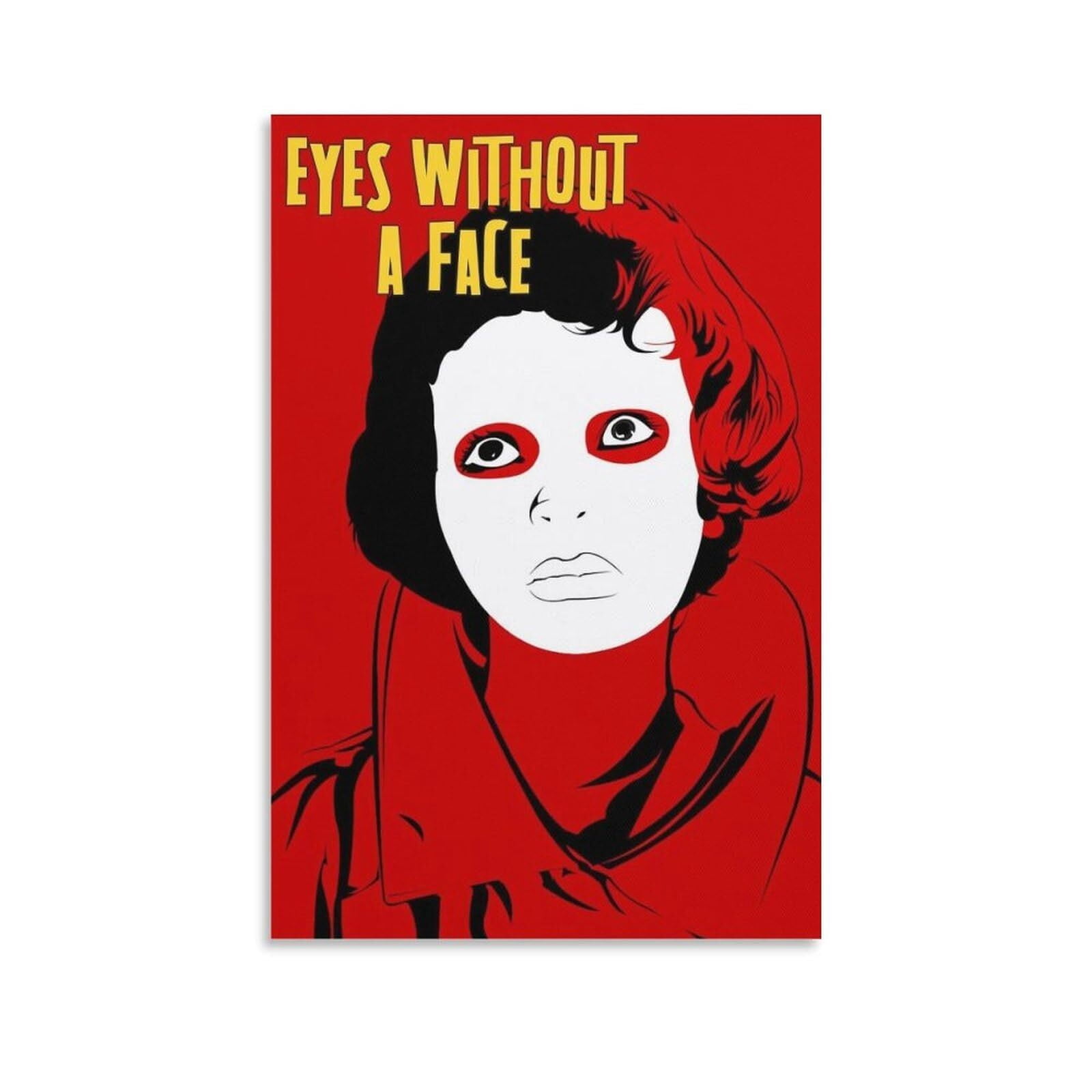
Christiane’s rigid, white fiberglass mask is one of the most powerful symbols in horror cinema. The mask permits no facial expressions, forcing actress Édith Scob to convey complex emotions entirely through her eyes, posture, and physical movement. The mask renders Christiane both victim and monster: to her father, she is a clinical project; to herself, a prisoner in a lifeless shell. The mask symbolizes the societal pressure to maintain an idealized standard of physical perfection, showing how identity is destroyed when a person is reduced strictly to their exterior appearance.
Rejection of Female Victimhood
Unlike many early horror narratives where female characters exist primarily to be rescued or victimized, Eyes Without a Face concludes with a subversion of patriarchal authority. Realizing the horror her existence inflicts on other young women, Christiane turns against her father. In the film's climax, she releases the caged dogs and birds used for medical experiments. The animals turn on Dr. Génessier, disfiguring and killing him, while Christiane steps into the dark woods carrying a white dove—liberated, yet permanently detached from human society.
Architectural Breakdown of Film Elements and Legacy Impact
The structural and thematic elements of Eyes Without a Face established a template that echoes across modern cinema. The table below details how the film's core components influenced subsequent genre developments.
| Narrative / Visual Dimension | Execution in Eyes Without a Face | Influence on Subsequent Cinema |
|---|---|---|
| Mask Iconography | Emotionless, custom-fit white fiberglass mask hiding facial disfigurement. | Inspired Michael Myers' mask in John Carpenter's Halloween (1978); shaped facial mask motifs in V for Vendetta and The Mask of Zorro. |
| Clinical Body Horror | Explicit, quiet, photorealistic surgery showing skin removal and tissue grafts. | Laid structural groundwork for David Cronenberg (Dead Ringers), Jesus Franco (Faceless), and Julia Ducournau (Raw). |
| Paternal & Medical Hubris | A respected authority figure committing atrocities under the guise of love and science. | Direct precursor to Pedro Almodóvar’s The Skin I Live In (2011) and modern medical thrillers. |
| Atmospheric Contrast | Juxtaposition of light, lyrical imagery with visceral, grotesque violence. | Established the "poetic horror" visual style used by filmmakers like Guillermo del Toro and Nicolas Winding Refn. |
| Auditory Irony | Upbeat waltz music accompanying horrific human experimentation and tragedy. | Popularized the counter-scoring technique used extensively in modern psychological thrillers and horror films. |
Lasting Influence on Global Cinema and Culture
The cultural impact of Eyes Without a Face extends across international film history, influencing major directors, literary figures, and pop culture icons.
John Carpenter’s Halloween (1978)
Director John Carpenter cited Édith Scob’s motionless white mask as a direct visual inspiration for the character of Michael Myers. Carpenter sought to replicate the terrifying neutrality of Scob’s mask—where the absence of expression allows the viewer to project their worst fears onto the blank surface.
Pedro Almodóvar’s The Skin I Live In (2011)
Spanish auteur Pedro Almodóvar crafted The Skin I Live In as an explicit modern homage to Franju’s film. Starring Antonio Banderas as a plastic surgeon obsessed with creating synthetic skin, Almodóvar adapted similar themes of surgical control, captive identity, and artificial facial coverings, updated with contemporary bioethical concerns.
Popular Music and Subcultures
The film’s influence extends beyond cinema into popular culture:
- Billy Idol: Recorded the hit 1983 song "Eyes Without a Face," directly referencing the film's French title (Les Yeux sans visage) in the backing vocals and adopting its themes of emotional numbness and identity loss.
- Gothic and Synth Wave Movements: Scob’s ethereal, tragic aesthetic became an enduring visual touchstone for gothic fashion, music videos, and performance art.
How to Analyze and Study the Film Today
For film students, critics, and horror enthusiasts, analyzing Eyes Without a Face requires looking beyond its surface plot. When viewing the film, consider focusing on these specific technical and narrative techniques:
- Observe the Framing of Spatial Isolation: Notice how Franju uses wide shots of the mansion's gates, winding staircases, and isolated corridors to emphasize Christiane's psychological imprisonment.
- Analyze the Sound Design: Pay attention to the complete silence during tension-building scenes, interrupted only by distant dog barks or car engines. Franju deliberately avoided non-diegetic sound effects during moments of real-world violence.
- Trace the Screenplay Structure: Co-written by Pierre Boileau and Thomas Narcejac—the legendary writing duo behind Vertigo (1958) and Les Diaboliques (1955)—the script carefully balances suspense, mystery, and tragic melodrama. Watch how narrative information is revealed to the audience before it is known to the police, heightening suspense.
- Evaluate Restored Editions: Modern 4K digital restorations (such as those released by The Criterion Collection) preserve Eugen Schüfftan’s original grain and deep grey scales, revealing intricate lighting details lost in early VHS and low-definition transfers.
Frequently Asked Questions
Is Eyes Without a Face based on a true story?
No, Eyes Without a Face is a fictional story adapted from the 1959 French novel Les Yeux sans visage by Jean Redon. However, its depiction of skin grafting and facial reconstruction drew upon real-world medical advances made during and after World War II in the field of reconstructive surgery.
What is the significance of Édith Scob's mask in film history?
Édith Scob’s mask established a new visual language for horror. By removing facial movement, the mask forced the audience to focus on her eyes and body language, creating an uncanny sense of emotional isolation. It showed filmmakers that stillness and blankness can be far more unsettling than expressive monster makeup.
Why was the film controversial upon its release in 1960?
The film scandalized critics and audience members due to its realistic surgical scenes—specifically the heterograft surgery—and its dark moral ambiguity. At the 1960 Edinburgh Film Festival, several viewers reportedly fainted, leading mainstream critics to dismiss it initially as overly graphic before re-evaluating it as a masterpiece.
How did Eyes Without a Face influence modern body horror?
Before Eyes Without a Face, horror violence was typically depicted through exaggerated monster make-up or off-screen action. Franju’s insistence on showing precise surgical cuts with clinical detachment laid the groundwork for directors like David Cronenberg, who modernized body horror by focusing on biological transformations and medical trauma.
What is the difference between Eyes Without a Face and The Horror Chamber of Dr. Faustus?
The Horror Chamber of Dr. Faustus was the retitled, edited version released in the United States in 1962 as a double feature. This US release cut parts of the surgical scene to pass censorship boards and marketed the movie as a low-budget drive-in creature feature, obscuring the artistic intentions of Franju's original cut.
Final Recommendation: Essential Viewing for Cinema History
Eyes Without a Face remains essential viewing for anyone seeking to understand the evolution of modern cinema. It demonstrates that horror does not need to choose between graphic intensity and artistic sophistication—it can achieve both simultaneously.
To fully appreciate its legacy, viewers should watch the unedited French version in a restored high-definition format, paying particular attention to Eugen Schüfftan’s lighting, Maurice Jarre’s score, and Édith Scob’s groundbreaking physical performance. By viewing the film within its historical context, one gains a deeper understanding of how European cinema broke free from traditional studio constraints to create a darker, more psychologically complex era of film art.
Image Gallery