The Legacy of Salvador Dalí in Spain: Museums, Cultural Impact, and Artistic Heritage
Salvador Dalí’s legacy in Spain is anchored by the "Dalí Triangle" in Catalonia—comprising the Dalí Theatre-Museum in Figueres, his home in Portlligat, and Gala’s Castle in Púbol—alongside major national holdings at Madrid’s Museo Rein...
Salvador Dalí’s legacy in Spain is anchored by the "Dalí Triangle" in Catalonia—comprising the Dalí Theatre-Museum in Figueres, his home in Portlligat, and Gala’s Castle in Púbol—alongside major national holdings at Madrid’s Museo Reina Sofía. Managed by the Fundació Gala-Salvador Dalí and the Spanish State, his physical, intellectual, and architectural heritage remains a pillar of global Surrealism and Spanish tourism.
Contents
The Geography of Dalí's Legacy: The Catalan Dalí Triangle
The physical foundation of Salvador Dalí’s legacy in Spain resides in the Alt Empordà region of Catalonia, an area whose rugged coastal landscapes and stark light directly inspired his Surrealist iconography. Known collectively as the Dalí Triangle, three distinct locations preserved by the Fundació Gala-Salvador Dalí showcase the artist’s work, intimate life, and architectural vision.
[ Portlligat / Cadaqués ] (House-Museum & Studio) / \ / \ / \ [ Figueres ] ----------- [ Púbol ] (Theatre-Museum) (Gala Dalí Castle)
The Dalí Theatre-Museum in Figueres
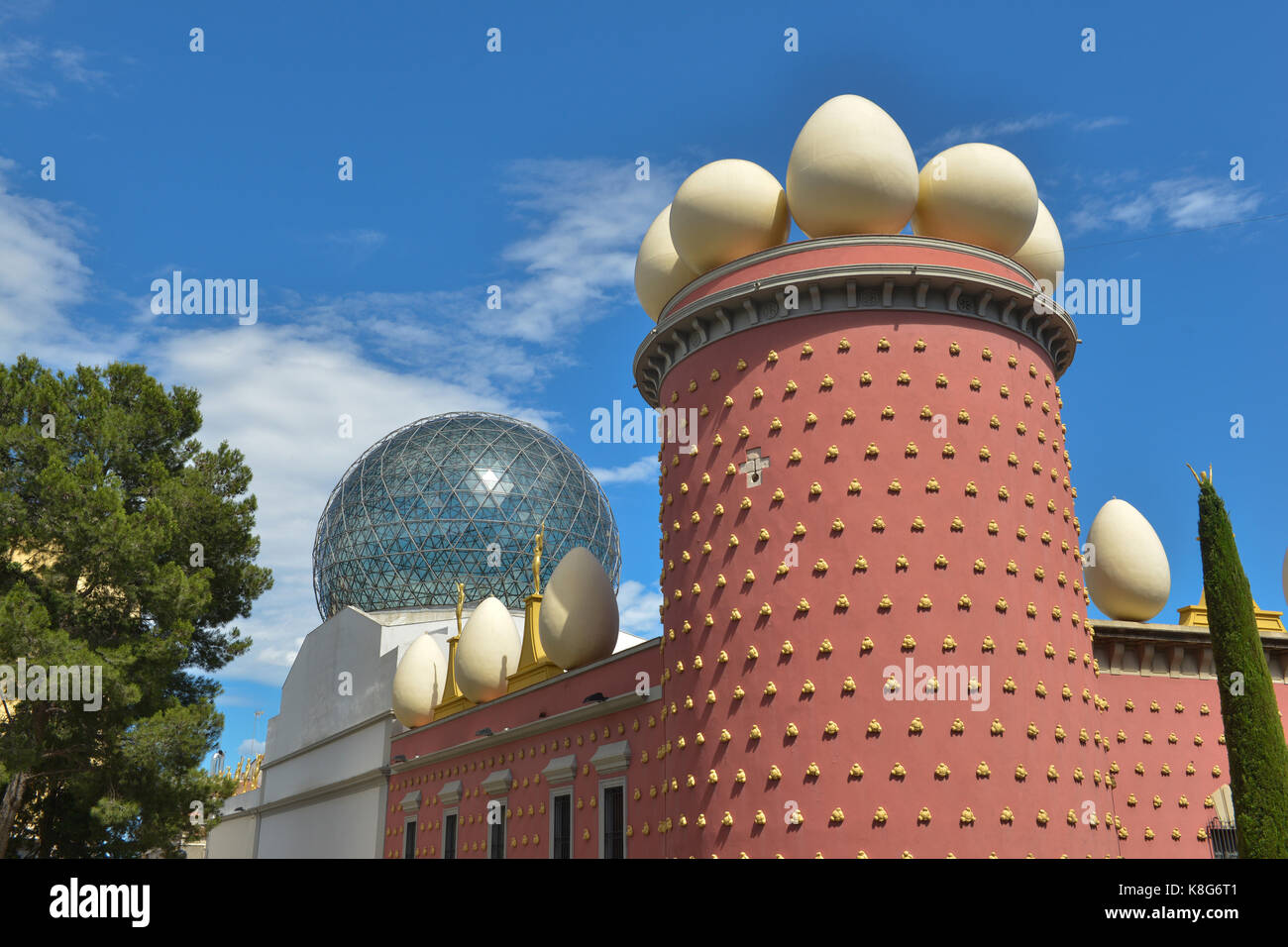
Located in Dalí’s birthplace, the Dalí Theatre-Museum (Teatre-Museu Dalí) in Figueres stands as the supreme architectural testament to his genius. Built upon the ruins of the municipal theatre destroyed during the Spanish Civil War, Dalí personally designed the facility to be a unified, immersive Surrealist object.
Opened to the public in 1974, the museum contains thousands of works spanning every medium Dalí explored, including oil paintings, installations, holograms, stereoscopic works, and custom jewellery. Key structural features include:
- The Geodesic Dome: Designed by architect Emilio Pérez Piñero, this glass dome serves as an iconic symbol of Figueres and crowns the main stage of the former theatre.
- The Crypt: Located beneath the main stage, the crypt contains Dalí’s final resting place, placing his body permanently at the heart of his master creation.
- Mae West Room and Rainy Taxi: Large-scale 3D installations that illustrate Dalí’s mastery of spatial manipulation, optical illusion, and theatrical assemblage.
The House-Museum Salvador Dalí in Portlligat (Cadaqués)
Situated in the secluded bay of Portlligat, near Cadaqués, this museum was Dalí’s primary residence and studio from 1930 until the death of his wife and muse, Gala, in 1982. Originating as a modest fisherman's hut, Dalí systematically purchased adjoining structures over several decades, modifying them into a labyrinthine compound.
The Portlligat house provides an unprecedented look at Dalí’s creative process and domestic life. Visitors can view his studio—complete with easel systems designed to raise and lower canvases through floor slots—alongside his glass-roofed bedroom, personal library, and surreal garden installations featuring yellow crowns, lip-shaped sofas, and taxidermy.
The Gala Dalí Castle in Púbol
Purchased by Dalí in 1969 as a retreat for Gala, the medieval Castle of Púbol represents a unique expression of courtly love and Surrealist interior decoration. Dalí transformed the neglected 11th-century structure into a secluded sanctuary where Gala held absolute domain; Dalí himself could only visit upon her written invitation.
Following Gala’s death in 1982, Dalí moved into the castle and established his final active studio there until a fire in 1984 prompted his relocation to Figueres. Today, the castle functions as a museum holding Gala’s haute couture dresses, Dalí’s painted ceilings, surreal elephant statues in the romantic garden, and the subterranean crypt where Gala is buried.
National Preservation: The Madrid Masterworks and State Ownership
While Catalonia holds the physical environments Dalí inhabited, Spain’s national institutions in Madrid preserve some of his most famous oil paintings. The division of Dalí’s work across Spanish institutions is the direct result of his final legal decisions and complex relationship with the nation state.
The 1982 Will and the Spanish State as Sole Heir
In his final will executed in 1982, Salvador Dalí designated the Spanish State as the sole heir to his property, artistic production, and intellectual rights. This decision bypassed regional political expectations at the time and ensured that the national government, working in coordination with local authorities, would oversee his estate.
To manage this complex mandate, the Fundació Gala-Salvador Dalí—created by Dalí himself in 1983—was tasked with conserving, protecting, and disseminating his artistic work across Spain and internationally. The foundation operates under the honorary presidency of the Spanish monarch, reinforcing the state's long-term guardianship of his heritage.
Dalí at the Museo Nacional Centro de Arte Reina Sofía
Following Dalí’s death in 1989, his private collection and non-exhibited works were divided between the Theatre-Museum in Figueres and the state museums in Madrid. The Museo Nacional Centro de Arte Reina Sofía in Madrid received a comprehensive cross-section of his visual output, establishing the capital as a fundamental center for Dalí scholarship.
The Reina Sofía holds several pivotal works that trace Dalí’s transition from early Impressionist and Cubist experiments to his mature paranoiac-critical period:
- The Great Masturbator (El gran masturbador, 1929): A cornerstone of Surrealist painting, capturing Dalí’s psychological obsessions, anxieties, and iconic dream imagery.
- The Enigma of Desire (El enigma del deseo, 1929): A poignant tribute to his complex relationship with his mother and his emerging Surrealist vocabulary.
- Portrait of Luis Buñuel (Retrato de Luis Buñuel, 1924): A major masterpiece from his student days at the Residencia de Estudiantes in Madrid, reflecting his early network of avant-garde collaborators.
Intellectual Property, Branding, and Economic Impact
Dalí’s legacy in Spain extends far beyond static museum displays; it constitutes an active legal framework and a major driver of regional economics.
[ Spanish State ] | (Delegates Rights & Heritage) v [ Fundació Gala-Salvador Dalí ] / | \ / v \ [ Museum Management ] [ IP & Authentication ] [ Economic Tourism ] (Figueres, Portlligat, (Trademarks, Licensing, (Alt Empordà & Púbol Castles) Catalogues Raisonnés) Girona Economy)
Protection of Intellectual Property and Authenticity
The Fundació Gala-Salvador Dalí manages the moral rights, copyright, and trademarks associated with Dalí’s name, image, and artwork on behalf of the Kingdom of Spain. The foundation actively battles forgery, unapproved commercial exploitation, and unauthorized reproductions worldwide.
Additionally, the foundation maintains the definitive Catalogue Raisonné of Salvador Dalí Paintings, a comprehensive scholarly database that authenticates his work. This rigorous institutional work protects the economic value and historical integrity of Dalí’s corpus.
Commercial Design and Public Art
Dalí’s integration into everyday Spanish commercial culture remains visible today. In 1969, Dalí designed the iconic bright-yellow daisy logo for the Spanish lollipop brand Chupa Chups. Insisting that the logo be placed on top of the wrapper rather than the side so it would always remain fully visible, Dalí created an enduring piece of corporate graphic design that remains in global use.
Furthermore, public sculptures by Dalí grace several Spanish cities, including Madrid (at the Plaza de Salvador Dalí) and Marbella, bridging the gap between museum spaces and public urban landscapes.
Summary of Major Dalí Institutions in Spain
The following table provides a quick reference for the primary sites, institutions, and legal bodies that preserve Salvador Dalí's legacy within Spain:
| Institution / Site | Location | Original Function | Key Highlights / Works Held | Primary Authority |
|---|---|---|---|---|
| Teatre-Museu Dalí | Figueres, Girona | Municipal Theatre (19th c.) / Custom Museum | Crypt of Dalí, Geodesic Dome, Mae West Room, Dalí Joies (Jewellery) | Fundació Gala-Salvador Dalí |
| Casa-Museu Salvador Dalí | Portlligat (Cadaqués), Girona | Fisherman’s hut / Personal residence & studio | Original easel system, glass bedroom, customized Surrealist gardens | Fundació Gala-Salvador Dalí |
| Castell de Púbol | Púbol (La Pera), Girona | Gothic-Renaissance Castle / Sanctuary for Gala | Crypt of Gala, Gala's wardrobe collection, painted ceilings, elephant sculptures | Fundació Gala-Salvador Dalí |
| Museo Nacional Centro de Arte Reina Sofía | Madrid | Hospital (18th c.) / National Art Museum | The Great Masturbator, The Enigma of Desire, Portrait of Luis Buñuel | Ministry of Culture (Spain) |
| Fundació Gala-Salvador Dalí | Figueres, Girona | Administrative Head Office | Intellectual property management, cataloguing, research archives | Board of Trustees / Spanish State |
Influence on Spanish Art History and Cultural Tourism
Salvador Dalí’s career redefined Spain’s role in the 20th-century global avant-garde. Alongside Pablo Picasso and Joan Miró, Dalí positioned Spain as an epicenter of modern artistic revolution despite the country’s mid-century political isolation under Francoist rule.
The Modern Avant-Garde and Residencia de Estudiantes
Dalí’s formative years at the Residencia de Estudiantes in Madrid during the 1920s brought him into close contact with poet Federico García Lorca and filmmaker Luis Buñuel. This intellectual triumvirate helped spawn Spanish Surrealism.
Dalí’s collaboration with Buñuel on the groundbreaking Surrealist film Un Chien Andalou (1929) established a visual language that influenced generations of Spanish filmmakers, visual artists, and writers.
Economic Impact on the Alt Empordà Region
The establishment of the Dalí Triangle has transformed the Alt Empordà region into an international destination for cultural tourism. Millions of visitors travel to Figueres, Cadaqués, and Púbol annually, driving hospitality, transportation, and service sectors across northern Catalonia.
By preserving his immediate physical environment, Spain has successfully linked Dalí’s artistic legacy to regional environmental conservation, particularly around the Cap de Creus Natural Park, whose distinctive rock formations feature prominently in Dalí’s most iconic paintings.
Planning a Visit to Dalí Sites in Spain
For those seeking to explore Dalí’s physical and artistic legacy in Spain, practical planning is essential due to high visitor demand and ticket entry restrictions.
Entry Requirements and Reservations
- Advance Booking: Tickets for the House-Museum in Portlligat must be reserved weeks in advance, as entry is strictly limited to small groups every ten minutes to preserve the fragile living space.
- Ticketing Options: The Fundació Gala-Salvador Dalí offers individual and combined passes for the Theatre-Museum in Figueres, the Dalí Jewels collection, and Púbol Castle.
- Madrid Travel: The Museo Reina Sofía operates independently of the Catalan sites. Visiting the national collections in Madrid requires a separate museum entry ticket, with advance time-slot booking recommended.
Geographic Routing
- Day 1–2 (Catalonia): Base yourself in Girona or Figueres. Explore the Teatre-Museu Dalí in Figueres in the morning, followed by an afternoon visit to Gala's Castle in Púbol.
- Day 3 (Catalonia): Travel coastal routes to Cadaqués and Portlligat to tour the artist's waterfront studio home and the surrounding Cap de Creus coastline.
- Day 4 (Madrid): Take the high-speed AVE train from Figueres/Girona to Madrid to view his early and peak Surrealist oil masterworks at the Museo Reina Sofía.
Frequently Asked Questions
Why did Salvador Dalí leave his estate to the Spanish State?
Dalí named the Spanish State his sole heir in his final 1982 will to ensure his artistic output, personal collection, and property would be protected under national law. This institutional backing provided stable management and funded long-term conservation through the Fundació Gala-Salvador Dalí.
What is the Dalí Triangle?
The Dalí Triangle is a geographic concept and cultural route in the Alt Empordà region of Catalonia, Spain. It comprises three key locations: the Dalí Theatre-Museum in Figueres, the Salvador Dalí House-Museum in Portlligat (Cadaqués), and the Gala Dalí Castle in Púbol.
Where is Salvador Dalí buried?
Salvador Dalí is buried in a subterranean crypt beneath the main stage of the Dalí Theatre-Museum in his hometown of Figueres, Catalonia, Spain. He designed the museum so that his grave would be physically integrated into his largest masterwork.
Can you see The Persistence of Memory in Spain?
No. The Persistence of Memory (1931), which features Dalí’s famous melting clocks, is owned by and on permanent display at the Museum of Modern Art (MoMA) in New York City. However, major Surrealist masterpieces like The Great Masturbator are housed at the Museo Reina Sofía in Madrid.
How does the Fundació Gala-Salvador Dalí protect his legacy?
The foundation manages the three official Dalí museums in Catalonia, authenticates works via the official Catalogue Raisonné, controls global licensing and copyright rights delegated by the Spanish government, and curates international loan exhibitions.
Next Steps for Art Enthusiasts and Researchers
To further explore or research Salvador Dalí’s enduring presence in Spain:
- Consult the Fundació Gala-Salvador Dalí online portals to access the complete digital Catalogue Raisonné of Salvador Dalí Paintings and review archival documents.
- Reserve entry tickets through the official foundation site prior to visiting Figueres, Portlligat, or Púbol.
- Review the Museo Nacional Centro de Arte Reina Sofía online catalogue to cross-reference his Madrid holdings alongside contemporaries such as Joan Miró and Pablo Picasso.
EDITORIAL CATEGORY METADATA:
Image Gallery