Michigan Workers' Compensation Cost Estimator: How to Calculate Your Business Insurance Premiums
To estimate your Michigan workers' compensation premium, divide your annual gross payroll by 100, multiply that figure by your industry’s specific classification code rate, and apply your Experience Modification Rating (EMR). Final pre...
To estimate your Michigan workers' compensation premium, divide your annual gross payroll by 100, multiply that figure by your industry’s specific classification code rate, and apply your Experience Modification Rating (EMR). Final premiums reflect mandatory state assessments, administrative fees, and any applicable schedule credits or debits negotiated through your carrier.
Contents
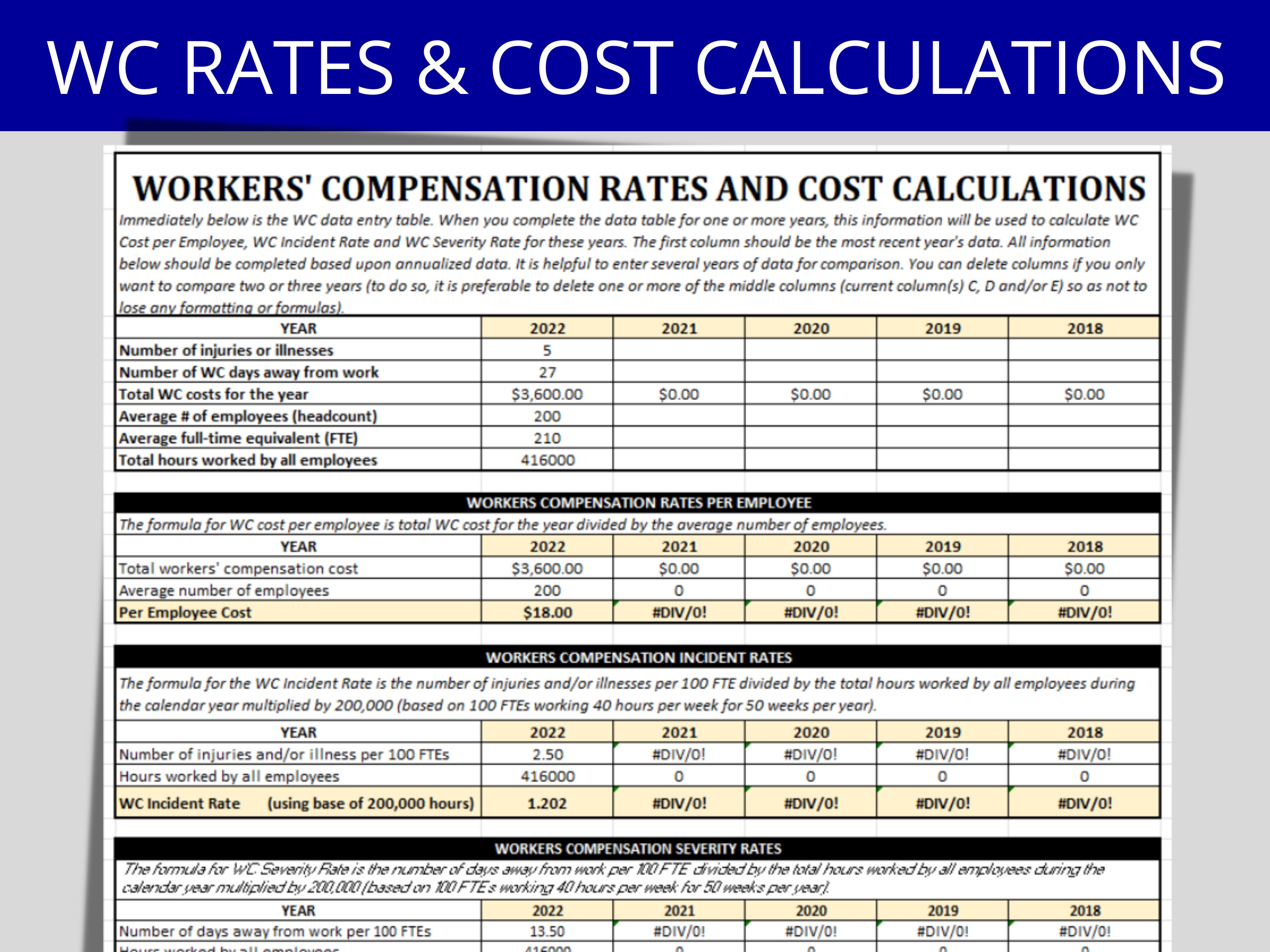
Estimated Premium = (Gross Annual Payroll ÷ 100) × Class Code Base Rate × Experience Modification Factor + State Fees
Navigating workers' compensation insurance costs in Michigan requires understanding how the state calculates risk, sets classification codes, and regulates workplace disability benefits. Whether you are a small business owner hiring your first employees or a CFO reviewing commercial policy renewals, using a reliable framework to project your annual premium prevents expensive surprises during your year-end payroll audit.
Michigan Workers' Compensation Legal Requirements and Thresholds
The state of Michigan mandates workers' compensation insurance under the Michigan Workers' Disability Compensation Act (WDCA). Compliance is overseen by the Workers' Disability Compensation Agency (WDCA), housed within the Michigan Department of Labor and Economic Opportunity (LEO).
Michigan applies clear statutory criteria to determine when an employer must secure workers' compensation coverage:
- The Three-Employee Rule: All private employers that regularly employ three or more people at one time, including part-time and seasonal staff, must carry coverage.
- The 35-Hour / 13-Week Rule: Any private employer employing one or more workers for 35 hours or more per week for 13 or more weeks during the preceding 52 weeks must maintain an active workers' compensation policy.
- Public Employers: All public sector entities, municipal organizations, and state departments are required to provide coverage regardless of worker count or hours.
- Subcontractor Liability: General contractors are legally liable for injuries sustained by uninsured subcontractors and their employees. If an independent contractor lacks statutory coverage and meets the legal definition of an employee under Michigan law, the primary contractor’s policy must absorb the exposure.
Failure to maintain mandatory workers' compensation insurance in Michigan constitutes a serious statutory violation. Uninsured employers face court-ordered injunctions against business operations, personal financial liability for all medical and wage loss benefits resulting from workplace injuries, civil fines of up to $1,000 per day, and potential misdemeanor criminal charges carrying up to six months of imprisonment.
Core Components of the Michigan Workers' Comp Cost Formula
To build an accurate cost estimate, employers must understand the four primary variables that insurance underwriters use to establish annual premiums.
1. Gross Annual Payroll (Per $100 Unit)
Workers' compensation rates are calculated per $100 of gross payroll. For insurance purposes, payroll includes:
- Hourly wages and standard salaries
- Overtime pay (calculated at straight-time rates in underwriting audits)
- Bonuses and performance incentives
- Paid time off (vacation, sick pay, and holiday compensation)
- Profit-sharing distributions treated as taxable wages
Exclusions typically include tips, discretionary end-of-year gifts of nominal value, and certain employer-paid fringe benefits such as medical insurance premiums or group retirement contributions.
2. Industry Classification Codes and Pure Premium Rates
Michigan operates as an independent bureau state. Rates and industry class codes are cataloged by the Compensation Advisory Organization of Michigan (CAOM), which submits loss-cost data to the Michigan Department of Insurance and Financial Services (DIFS).
Every business activity is assigned a specific four-digit classification code reflecting its inherent occupational hazard:
- Low-Risk Environments: Office clerical staff, accountants, and software developers have minimal occupational hazard exposure, leading to rates well below $0.50 per $100 of payroll.
- Medium-Risk Environments: Retail workers, restaurant service staff, and light assembly workers face moderate injury exposure, resulting in rates usually ranging between $1.00 and $3.50 per $100 of payroll.
- High-Risk Environments: Roofing, structural steel construction, logging, and heavy transportation carry severe injury profiles, often producing baseline rates from $8.00 to upwards of $20.00 per $100 of payroll.
Individual carriers file their own loss-cost multipliers (LCM) with DIFS, adjusting the baseline CAOM loss-costs upward to cover carrier operational expenses, underwriting margins, and profit.
3. Experience Modification Rating (EMR)
The Experience Modification Rating—often called the "mod factor"—is an actuarial metric comparing your company's actual claims history to the expected losses of other businesses within your exact industry and payroll size.
- Baseline (1.00): A 1.00 rating means your loss history mirrors the statistical average for your classification.
- Credit Mod (Below 1.00): If your business exhibits lower claim frequency and severity than the statistical baseline, you receive a credit mod (e.g., 0.82), which reduces your final premium by 18%.
- Debit Mod (Above 1.00): A pattern of severe or repeated claims drives your mod factor above 1.00 (e.g., 1.35), imposing a 35% surcharge on your policy.
In Michigan, small employers with low total premiums do not qualify for an EMR. Once a business generates sufficient manual premium—typically averaging several thousand dollars over a three-year rolling window—the CAOM automatically calculates and publishes an official mod factor for that business.
4. Surcharges, Assessments, and Policy Fees
Beyond the core payroll rate calculation, every Michigan policy includes administrative fees:
- Michigan Silicosis, Dust Disease, and Logging Industry Compensation Fund: A mandatory statutory assessment supporting dedicated state-run compensation funds.
- Expense Constant: A flat administrative handling fee charged by carriers to process and service the policy, usually ranging from $150 to $300.
- Terrorism Risk Insurance Act (TRIA): A federal surcharge applied across commercial policies, usually calculated as a few cents per $100 of payroll.
Estimated Benchmark Rates Across Common Michigan Industries
Actual carrier rates vary according to individual loss-cost multipliers and specific insurer appetite. The following benchmark table reflects typical manual base rate ranges per $100 of payroll across standard Michigan industries.
| CAOM Class Code | Industry / Classification Description | Risk Level | Typical Base Rate Range (Per $100 Payroll) | Estimated Cost on $100,000 Payroll |
|---|---|---|---|---|
| 8810 | Clerical Office Employees / Administrative | Very Low | $0.18 – $0.40 | $180 – $400 |
| 8742 | Outside Sales / Field Representatives | Low | $0.35 – $0.75 | $350 – $750 |
| 8017 | Retail Stores (General Merchandise / Hardware) | Moderate | $1.20 – $2.10 | $1,200 – $2,100 |
| 9079 | Restaurants (Full-Service Food Preparation) | Moderate | $1.40 – $2.40 | $1,400 – $2,400 |
| 8380 | Automobile Service / Repair Facilities | Moderate-High | $2.30 – $4.10 | $2,300 – $4,100 |
| 3632 | Machine Shops / Metal Fabrication | Moderate-High | $2.80 – $4.90 | $2,800 – $4,900 |
| 5403 | Carpentry (Commercial / Framing) | High | $7.50 – $12.00 | $7,500 – $12,000 |
| 5551 | Roofing (All Operations / Commercial & Residential) | Severe | $14.00 – $24.00 | $14,000 – $24,000 |
Note: Base rates exclude experience modification adjustments, premium discounts, expense constants, and carrier-specific discretionary schedule credits or debits.
Step-by-Step Manual Calculation Walkthrough
To see how the numbers combine in a real-world scenario, consider a mid-sized Michigan precision manufacturing facility.
Company Profile
- Annual Clerical Payroll (Code 8810): $250,000
- Annual Machine Shop Payroll (Code 3632): $600,000
- Assigned Class Rates: $0.25 (Code 8810) and $3.50 (Code 3632)
- Company Experience Modification Factor (EMR): 0.90 (reflecting a 10% credit for strong safety management)
- Carrier Expense Constant: $250
Step 1: Calculate Manual Premium for Each Code
Divide total payroll in each class code by 100, then multiply by the specific class rate:
$$\text{Office Premium} = \left(\frac{$250,000}{100}\right) \times 0.25 = 2,500 \times 0.25 = $625$$
$$\text{Shop Premium} = \left(\frac{$600,000}{100}\right) \times 3.50 = 6,000 \times 3.50 = $21,000$$
$$\text{Total Manual Premium} = $625 + $21,000 = $21,625$$
Step 2: Apply the Experience Modification Factor
Multiply the combined manual premium by the employer's EMR:
$$\text{Modified Premium} = $21,625 \times 0.90 = $19,462.50$$
Step 3: Add State Assessments and Administrative Fees
Incorporate the flat carrier expense constant and statutory surcharges:
$$\text{Final Estimated Annual Premium} = $19,462.50 + $250 = $19,712.50$$
Through proactive safety protocols, this company’s 0.90 mod factor saves $2,162.50 annually compared to a peer competitor operating with an average 1.00 EMR.
Independent Contractors and Executive Officer Rules in Michigan
Accurately calculating your workers' comp costs requires classifying your workforce correctly under Michigan law. Misclassifications create massive back-payment liabilities during year-end policy audits.
Independent Contractors: The 20-Factor Test
Michigan evaluates worker status through strict legal standards based on economic reality and direction/control. Do not assume that issuing an IRS Form 1099 shields your business from insurance obligations.
If an independent contractor lacks their own certificate of workers' compensation insurance, your insurance carrier will audit their 1099 invoices, classify them as regular employees, and bill you retroactively for the full payroll exposure. To prevent this:
- Always obtain a current Certificate of Insurance (COI) before any subcontractor begins work.
- Verify that the subcontractor’s policy contains valid statutory workers' compensation coverage, not just commercial general liability.
- Retain filed certificates in your compliance archives for at least three calendar years.
Executive Officer and Owner Exclusions
Under Michigan law, business owners and corporate officers have options regarding personal inclusion in policy coverage:
- Sole Proprietors and Partners: Automatically excluded from workers' comp coverage, but can elect to be included by specific policy endorsement.
- Corporate Officers: Officers who are shareholders in a closed corporation owning at least 10% of stock (or all corporate officers in entities with 10 or fewer stockholders) may file a Notice of Exclusion (Form WC-337) with the WDCA to exempt themselves from coverage, reducing their reported gross payroll.
- LLC Members: Managing members of limited liability companies can formally exclude themselves by executing the proper statutory forms through their insurance underwriter.
Proven Strategies to Lower Your Michigan Workers' Comp Costs
Managing your workers' compensation costs requires active operational control. Business owners can deploy several verified strategies to lower premiums:
1. Maintain Accurate Class Code Segregation
Carriers apply the highest-rated classification to an employee's total wages if job tasks overlap and payroll records are imprecise. Ensure your payroll software cleanly separates operational labor from administrative and sales activities. Never allow a clerical worker's wages to be bundled into general manufacturing or field codes.
2. Implement an Active Return-to-Work Program
The indemnity (wage-replacement) component of a workers' compensation claim impacts your Experience Modification Rating far more heavily than the medical component. Under Michigan law, injured workers capable of transitional or light-duty tasks must be offered suitable alternative employment. Establishing a clear light-duty program returns employees to productive work sooner, limits disability payouts, and preserves your credit mod factor.
3. Audit Your Annual Payroll Pre-Closing
At the close of each annual policy term, insurance carriers conduct a mandatory payroll audit to square estimated payroll against actual tax returns (Forms 941, W-2s, and 1099s). Proactively reconciling your payroll entries before submitting documents prevents unexpected, single-invoice audit adjustments.
Ensure that overtime wages are tracked separately so your insurer discounts the overtime premium portion (paying straight time only for rating purposes), which can yield substantial premium reductions.
4. Negotiate Schedule Credits
Carriers have the discretionary authority to apply schedule credits (discounts up to 15–25%) based on non-actuarial risk improvements. Features such as modern equipment guards, formal safety committee meetings, certified drug-free workplace initiatives, and telematics systems in commercial vehicle fleets provide justification for underwriters to discount your baseline premium.
Frequently Asked Questions
What happens if an employee gets injured and I do not have workers' compensation in Michigan?
If an employer fails to carry mandatory coverage, the injured employee can file a claim with the Michigan Workers' Disability Compensation Agency and simultaneously file a civil lawsuit for negligence in circuit court. In this scenario, the employer loses common-law defenses (such as contributory negligence or assumption of risk). Additionally, the state can order the business to immediately cease all operations until coverage is secured and substantial fines are paid.
How does Michigan calculate weekly wage loss benefits for injured workers?
Michigan workers' compensation provides weekly wage replacement benefits calculated at approximately 80% of the employee’s after-tax average weekly wage, subject to a state maximum benefit ceiling adjusted annually by the WDCA. Wage loss benefits begin on the eighth consecutive day of disability; if the disability persists for two consecutive weeks or longer, compensation is paid retroactively to the date of injury.
Can I use online payroll software to pay workers' comp automatically?
Yes. Many modern commercial insurers offer "Pay-As-You-Go" integration with standard payroll processors. Instead of paying a large estimated deposit at policy inception and risking an unexpected audit adjustment at year-end, the Pay-As-You-Go model calculates your exact premium every pay cycle based on real-time payroll figures, minimizing audit discrepancies.
Are family members exempt from workers' compensation in Michigan?
Certain immediate family members (spouse, child, or parent) of a sole proprietor can be excluded from coverage under Michigan law. However, this statutory exclusion does not apply automatically to incorporated entities, LLCs, or partnerships without formal notification and specific entity-level filings submitted to the state.
How long does an injury claim impact my Experience Modification Rating?
Workers' compensation claims impact your EMR for a three-year period. However, the rating ignores the immediate preceding policy year. For example, your 2026 EMR is calculated using claims data from the 2022, 2023, and 2024 policy years. After three years, older claims roll off the calculation window, allowing your mod factor to recover if ongoing workplace safety remains consistent.
Practical Next Steps for Michigan Business Owners
To establish an accurate workers' comp projection and optimize your annual commercial insurance spend:
- Pull Your Historical Payroll Reports: Separate your trailing 12-month gross wages into functional categories: administrative/office, outside sales, and direct field operations.
- Review Your Most Recent Loss Runs: Request your 3-to-5 year loss runs from your commercial insurance agent to verify that closed claims do not contain inaccurate open reserve balances.
- Verify Subcontractor Documentation: Collect updated Certificates of Insurance for all current independent contractors and 1099 vendors before the carrier's annual audit period.
- Request Multi-Carrier Loss-Cost Quotes: Because different carriers apply different loss-cost multipliers and schedule rating credits within Michigan, obtain comparative quotes from an independent agent licensed through DIFS to identify the most competitive market terms.
Disclaimer: This article provides general insurance and regulatory analysis for operational planning purposes and does not constitute formal legal, financial, or licensing advice. Consult a licensed Michigan commercial insurance professional or employment attorney to address business-specific risk exposures and statutory compliance obligations.
Image Gallery