Game of the Year 2019 Winner: The Definitive Guide to Sekiro and Industry Accolades
The definitive Game of the Year 2019 winner at The Game Awards was Sekiro: Shadows Die Twice, developed by FromSoftware and published by Activision. Directed by Hidetaka Miyazaki, this demanding action-adventure title earned the indust...
The definitive Game of the Year 2019 winner at The Game Awards was Sekiro: Shadows Die Twice, developed by FromSoftware and published by Activision. Directed by Hidetaka Miyazaki, this demanding action-adventure title earned the industry's highest honor by transforming third-person melee combat through precision swordplay, posture mechanics, and vertical movement.
Contents
While Sekiro secured the flagship trophy at the gaming calendar’s most-watched ceremony, 2019 stood out as one of the most mechanically diverse years in interactive entertainment. Major award bodies split their top honors among innovative indie breakthroughs, technical remakes, and auteur-driven blockbusters. Understanding the 2019 award cycle requires examining not just Sekiro's triumph, but how critical institutions evaluated that standout release calendar.
The Primary Winner: Sekiro: Shadows Die Twice
Announced at E3 2018 and released globally in March 2019, Sekiro: Shadows Die Twice represented a marked departure from FromSoftware's established Dark Souls and Bloodborne formula. Rather than offering character customization, statistical builds, stamina bars, and varied weaponry, Sekiro restricted players to a single fixed protagonist—the shinobi Wolf—and a singular primary katana, the Kusabimaru.
- 2019 Industry Consensus
- The Game Awards 2019: Sekiro: Shadows Die Twice
- Golden Joystick 2019: Resident Evil 2 (Remake)
- BAFTA / D.I.C.E.: Outer Wilds / Untitled Goose Game
Innovative Posture and Deflection Systems
The core innovation that propelled Sekiro to critical dominance was the Posture Gauge. In standard action role-playing games (RPGs), combat relies on managing player stamina while chipping away at an opponent’s hit points. Sekiro inverted this dynamic:
- Direct Deflections: Players neutralized incoming attacks by deflecting blows at the exact millisecond of impact, reducing enemy posture while preserving their own.
- Perilous Attacks: Unblockable thrusts, sweeps, and grabs forced split-second tactical reads requiring specialized responses, such as the Mikiri Counter or mid-air head stomps.
- Shinobi Prosthetic Utility: The protagonist's mechanical left arm integrated shurikens, firecrackers, flame vents, and an umbrella shield, transforming defensive encounters into rhythmic offensive openings.
- Vertical Agility: A grappling hook mechanic eliminated the ground-bound pacing of previous FromSoftware releases, allowing dynamic escapes, spatial stealth, and vertical ambush tactics.
By trading the safety of distance for high-stakes, close-quarters rhythm, director Hidetaka Miyazaki delivered an experience where player skill was the only progression gate. This uncompromising design philosophy was central to its selection as Game of the Year.
The 2019 Game Awards Nominees and Landscape
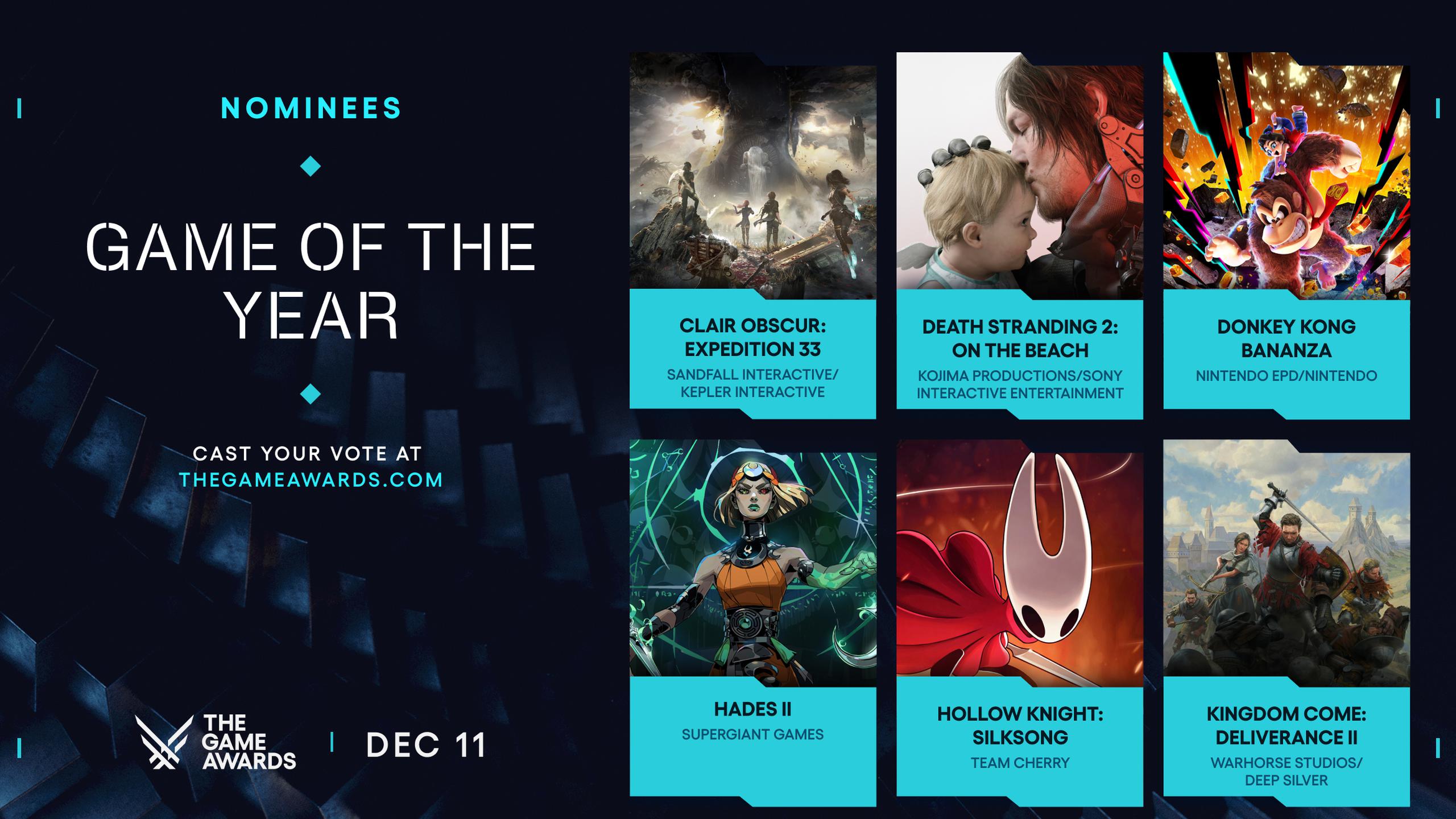
The Game Awards 2019 ceremony, hosted by Geoff Keighley at the Microsoft Theater in Los Angeles, featured one of the most closely contested fields in the event's history. Six titles competed for the ultimate award across wildly divergent genres.
| Game Title | Developer | Publisher | Primary Genre | Metacritic Score (Launch) |
|---|---|---|---|---|
| Sekiro: Shadows Die Twice (Winner) | FromSoftware | Activision | Action-Adventure | 90 |
| Control | Remedy Entertainment | 505 Games | Third-Person Shooter / Metroidvania | 85 |
| Death Stranding | Kojima Productions | Sony Interactive Entertainment | Action / Strand | 82 |
| Resident Evil 2 | Capcom | Capcom | Survival Horror Remake | 91 |
| Super Smash Bros. Ultimate | Bandai Namco / Sora Ltd. | Nintendo | Platform Fighter | 93 |
| The Outer Worlds | Obsidian Entertainment | Private Division | First-Person Action RPG | 85 |
The Contenders Analyzed
Each nominated game brought distinct technical and narrative strengths to the 2019 competition:
- Control: Remedy Entertainment showcased environmental destruction, ray-traced lighting physics, and an enigmatic brutalist setting in the Oldest House, securing awards for Best Art Direction.
- Death Stranding: Hideo Kojima’s debut independent title divided critics but won Best Game Direction and Best Score/Music for its asymmetric multiplayer network, cinematic scope, and isolated delivery traversal.
- Resident Evil 2: Capcom’s ground-up reimagining of the 1998 classic established a benchmark for modern video game remakes, pairing claustrophobic survival-horror tension with over-the-shoulder gunplay and the relentless AI stalker, Mr. X.
- Super Smash Bros. Ultimate: Recognized with the award for Best Fighting Game, Masahiro Sakurai’s crossover feat balanced a massive roster of 74 launch combatants with universal accessibility and deep competitive balance.
- The Outer Worlds: Obsidian delivered an anti-corporate, choice-driven narrative RPG that resonated with fans of classic branching dialogue and player agency.
How Other Major Ceremonies Decided 2019
Unlike years featuring a single undisputed sweep, 2019 saw major awarding organizations split their highest accolades. Different voting bodies—spanning consumer-voted polls, developer peer groups, and academic panels—selected alternative winners based on differing evaluation criteria.
Golden Joystick Awards (November 2019)
The Golden Joystick Awards rely heavily on public fan voting. The Ultimate Game of the Year award was captured by Capcom’s Resident Evil 2, which resonated broadly across the gaming public for its technical execution, accessible pacing, and fidelity to survival-horror heritage.
D.I.C.E. Awards (February 2020)
Organized by the Academy of Interactive Arts & Sciences (AIAS), the D.I.C.E. Awards represent the peer-reviewed votes of game developers and industry specialists. In a major upset over big-budget productions, the peer panel awarded Game of the Year to Untitled Goose Game, developed by House House. The panel praised its pure comedic design, dynamic reactive audio, and universal accessibility.
BAFTA Games Awards (April 2020)
Presented by the British Academy of Film and Television Arts, the 2020 BAFTA ceremony awarded its Best Game honor to Outer Wilds, developed by Mobius Digital and published by Annapurna Interactive. The Academy recognized the title’s 22-minute solar-system time loop, non-linear planetary physics, and curiosity-driven archaeological storytelling as a high-water mark for the medium.
Game Developers Choice Awards (GDC 2020)
Voted on entirely by working video game creators, the GDC Awards mirrored D.I.C.E. by granting its Game of the Year trophy to Untitled Goose Game, affirming that independent studios operating on modest budgets could out-innovate triple-A development houses in mechanical clarity and cultural resonance.
Technical Specifications and Availability
For players seeking to experience the 2019 Game of the Year winner on modern hardware, Sekiro: Shadows Die Twice is accessible across contemporary ecosystems with performance enhancements unlocked by modern hardware.
System Requirements for PC
To run Sekiro reliably at standard performance metrics, hardware configurations require the following baseline parameters:
- Minimum Requirements:
- OS: Windows 7 / 8 / 10 / 11 (64-bit)
- Processor: Intel Core i3-2100 or AMD FX-6300
- Memory: 4 GB RAM
- Graphics: NVIDIA GeForce GTX 760 or AMD Radeon HD 7950
- DirectX: Version 11
- Storage: 25 GB available space
- Recommended Specifications (1080p, 60 FPS):
- OS: Windows 10 / 11 (64-bit)
- Processor: Intel Core i5-2500K or AMD Ryzen 5 1400
- Memory: 8 GB RAM
- Graphics: NVIDIA GeForce GTX 970 or AMD Radeon RX 570
- DirectX: Version 11
Console Performance Profiles
- PlayStation Ecosystem: While designed natively for the base PlayStation 4 (which targeted 1080p at an unlocked ~30–40 FPS), the game runs on PlayStation 5 via backward compatibility, locking to a smooth 60 frames per second at an upscaled 1800p resolution.
- Xbox Ecosystem: On Xbox Series X, the title benefits from backward-compatibility optimizations, running at a stable 60 FPS at native 1800p, eliminating the frame drops that affected the Xbox One and Xbox One X hardware cycles.
Long-Term Impact: How 2019 Reshaped Combat Design
The critical elevation of Sekiro: Shadows Die Twice permanently altered the expectations for melee combat systems across the industry. Before 2019, third-person action games frequently relied on dodge-roll invincibility frames (i-frames), popularized by the wider Soulslike subgenre.
Following Sekiro’s Game of the Year validation, studios increasingly shifted toward defensive parry systems, rhythm counters, and posture-based combat design. Elements of FromSoftware’s posture meter and deflection timings can be traced directly into prominent subsequent titles, including Respawn Entertainment's Star Wars Jedi series, Team Ninja's Wo Long: Fallen Dynasty, and Sloclap's martial-arts brawler Sifu.
Furthermore, the win marked FromSoftware’s first Game of the Year victory at The Game Awards, validating Hidetaka Miyazaki’s willingness to strip away player-friendly RPG crutches in favor of singular mechanical execution. This established the momentum that culminated in the studio's broader mainstream reach with Elden Ring in 2022.
Practical Guide: Tips for First-Time Players
Because Sekiro does not allow players to grind character levels or summon cooperative allies to overcome difficult encounters, newcomers frequently struggle during the opening chapters. Implement these core tactical rules to master its mechanics:
- Stop Dodging, Start Deflecting: Dodging carries minimal invincibility frames compared to other action games. Stand your ground and tap the guard button at the exact moment of incoming strikes.
- Watch the Posture Bar, Not the Health Bar: An enemy at 80% health can be executed instantly if their posture bar is fully filled. Keep constant pressure on opponents so their posture cannot recover.
- Listen for the Audio Cue: A standard block generates a dull clatter, while a perfect deflection produces a bright, high-pitched metallic ring accompanied by a large spark. Use this audio feedback to confirm your timing.
- Acquire the Mikiri Counter Immediately: When spending your initial skill points at an Idol, unlock the Mikiri Counter first. This foundational ability neutralizes thrust attacks by allowing you to step directly onto the enemy’s blade.
- Use Stealth to Remove Boss Nodes: Mini-bosses frequently possess two deathblow nodes. Scout the arena, break line of sight, and drop down behind them to eliminate their first health bar before the formal duel begins.
Frequently Asked Questions
Which game won the Game of the Year at The Game Awards in 2019?
Sekiro: Shadows Die Twice won the Game of the Year title at The Game Awards 2019. The game was directed by Hidetaka Miyazaki, created by FromSoftware, and published worldwide by Activision.
Did Death Stranding or Resident Evil 2 win Game of the Year?
Neither won the top prize at The Game Awards 2019, though both earned major honors elsewhere. Resident Evil 2 captured the fan-voted Ultimate Game of the Year trophy at the Golden Joystick Awards, while Death Stranding received The Game Awards trophies for Best Game Direction, Best Performance (Mads Mikkelsen), and Best Score/Music.
Why did Untitled Goose Game win Game of the Year at D.I.C.E. and GDC?
Industry professionals and peer developers selected Untitled Goose Game for its accessible sandbox puzzle design, clean environmental storytelling, dynamic music programming, and immediate cultural reach. Both ceremonies frequently reward mechanical innovation and execution over pure production budget.
Can you adjust the difficulty settings in Sekiro: Shadows Die Twice?
No, Sekiro does not contain a traditional menu difficulty slider. Instead, the game features optional in-game mechanics that make the experience harder, such as ringing the Demon Bell in Senpou Temple or relinquishing Kuro’s Charm at the start of a New Game Plus cycle, which causes enemies to deal chip damage through regular blocks.
Is Sekiro connected to the Dark Souls or Bloodborne universe?
No, Sekiro is an entirely standalone intellectual property set in a fictionalized, mythological reimagining of Japan's late 1500s Sengoku period. It shares no narrative, geographic, or lore connections with the Dark Souls series, Bloodborne, or Elden Ring.
Next Steps for Players
To experience the complete 2019 critical canon, consider approaching these titles according to your preferred gameplay style:
- For High-Skill Melee Combat: Begin with Sekiro: Shadows Die Twice, available digitally on Steam, PlayStation Store, and Xbox Live, targeting 60 FPS performance on current-generation consoles.
- For Atmosphere and Survival Horror: Play Capcom's Resident Evil 2, which provides a benchmark demonstration in real-time pacing and modern visual design.
- For Systemic and Narrative Discovery: Play Mobius Digital's Outer Wilds without reading external guides or walkthroughs to experience its award-winning time-loop mystery uncompromised.
Image Gallery