Why the Online Bachelor's Degree in Electrical Engineering Matters for You
An online bachelor’s degree in electrical engineering provides an accessible, rigorous path to entering a high-demand profession without sacrificing employment or relocating. Provided the program holds ABET accreditation, it delivers t...
An online bachelor’s degree in electrical engineering provides an accessible, rigorous path to entering a high-demand profession without sacrificing employment or relocating. Provided the program holds ABET accreditation, it delivers the exact same mathematical grounding, technical laboratory credentials, and professional licensure eligibility as traditional campus equivalents, drastically reducing opportunity costs for working adults and non-traditional students.
Contents
The Strategic Shift in Undergraduate Engineering
For decades, earning a Bachelor of Science in Electrical Engineering (BSEE) required full-time, physical presence in academic lecture halls and circuit fabrication laboratories. Today, structural shifts in industry demand and instructional technology have transformed that paradigm. The electrification of automotive platforms, ongoing expansion of domestic semiconductor manufacturing, modernization of the electrical grid, and acceleration of autonomous systems have created an urgent shortage of hardware engineers.
Traditional on-campus degree programs cannot graduate enough qualified engineers to meet this demand. Consequently, premier research universities have developed fully accredited online BSEE programs designed to widen the talent pipeline.
For working technicians, military veterans, associate degree holders, and career changers, an online BSEE represents a practical bridge between technical curiosity and certified engineering practice. It eliminates the economic hazard of leaving the workforce for four years while ensuring students master the electromagnetic theory, signal analysis, and computational mathematics required for modern engineering roles.
ABET Accreditation: The Non-Negotiable Criterion
When evaluating an online electrical engineering degree, one credential takes precedence over all others: programmatic accreditation by the Accreditation Board for Engineering and Technology (ABET), specifically through its Engineering Accreditation Commission (EAC).
- ABET Accreditation Pathways
- EAC Accredited (BSEE)
- Calculus-based theory
- Universal PE exam eligibility
- R&D and core systems design
- ETAC Accredited (BSEET)
- Application & practical focus
- State-restricted licensure
- Implementation & maintenance
- EAC Accredited (BSEE)
Accreditation verifies that an institution’s curriculum, faculty, laboratory apparatus, and student assessment metrics satisfy international professional standards. In industry, employers rarely differentiate between online and residential degrees on a diploma; university transcripts and degree certificates are typically identical. However, recruiters and enterprise engineering divisions will verify whether your degree originates from an ABET-EAC-accredited program.
ABET accreditation directly affects state licensure:
- Fundamentals of Engineering (FE) Examination: Graduating from an ABET-accredited program grants immediate qualification to sit for the FE exam in all 50 states, yielding the Engineer in Training (EIT) designation.
- Professional Engineer (PE) Licensure: Achieving full PE licensure requires four years of qualifying engineering experience under an existing PE, followed by passing the Principles and Practice of Engineering exam. Non-ABET graduates face strict state-level hurdles, often needing eight to ten years of additional experience, and several state licensing boards reject non-accredited degrees outright.
- Federal and Defense Clearance: Major defense contractors, aerospace companies, and federal agencies like the Department of Energy enforce strict candidate filters that mandate EAC accreditation for title eligibility as a standard electrical engineer.
Ensure you do not mistake ETAC (Engineering Technology Accreditation Commission) for EAC. An Electrical Engineering Technology (BSEET) degree emphasizes applied implementation and testing over advanced theoretical design, which limits career mobility in research, high-frequency design, and circuit architecture.
How Technical Labs Function in a Virtual Environment
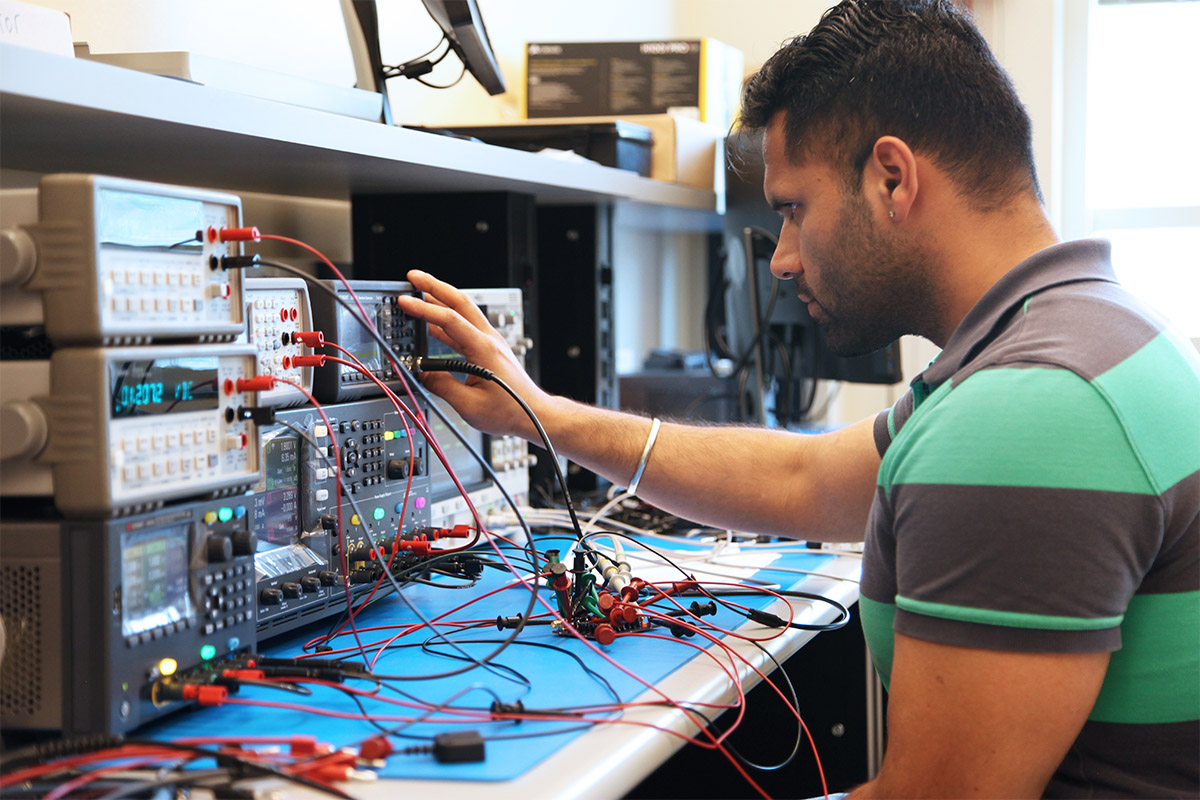
The primary skepticism surrounding online engineering degrees involves laboratory coursework. Electrical engineering requires hands-on familiarity with physical hardware: breadboards, power supplies, digital multimeters, function generators, and oscilloscopes.
Modern online BSEE programs resolve this challenge through three integrated mechanisms:
1. Portable Hardware Instrumentation Kits
Rather than working exclusively through digital animations, students purchase or receive university-issued portable instrumentation modules, such as the Digilent Analog Discovery or the Analog Devices ADALM2000. These USB-driven units connect directly to a personal computer, turning it into a complete benchtop testing station equipped with a dual-channel oscilloscope, arbitrary waveform generator, logic analyzer, and variable power supplies. Students wire physical capacitors, operational amplifiers, diodes, and microcontrollers on real breadboards at home, measuring real-time signal behaviors.
2. Industry-Standard Simulation Software
Engineers in industrial environments rarely build physical prototypes without comprehensive digital modeling. Online curricula integrate professional simulation tools from the first semester. Students analyze circuit behavior using SPICE packages (like LTspice and PSpice), model dynamic systems and signals using MATLAB and Simulink, and draft printed circuit board (PCB) layouts using Altium Designer or KiCad. This practice mirrors modern workplace engineering, where simulation precedes physical deployment.
3. Remote Benchtop Access and Local Collaborations
For specialized upper-division courses requiring multimillion-dollar instruments—such as high-voltage power distribution testing or RF network analysis—leading institutions utilize cloud-accessible laboratory servers. Students write scripts or control robotic interfaces to conduct physical runs on campus hardware from afar. Certain universities also offer intensive, one-week summer residency modules or maintain articulation agreements with regional community colleges to satisfy high-voltage safety requirements.
Core Curriculum and Mathematical Progression
An online electrical engineering degree demands significant discipline. The coursework is mathematically intensive and builds cumulatively; success in advanced electronics hinges on total mastery of earlier differential equations and electromagnetic principles.
- Engineering Foundations (Calculus, Physics)
- Core Systems (Circuits, Digital Logic, Differential Equations)
- Advanced Electives (Power, Embedded Systems, Signal Processing)
- Capstone Design (Year-Long Physical Prototyping)
Prospective students should anticipate coursework structured around several foundational pillars:
- Foundational Mathematics: Calculus I through III, Differential Equations, Linear Algebra, and Discrete Mathematics form the language of the discipline.
- Basic Engineering Sciences: Calculus-based Physics (Mechanics, Electricity and Magnetism), alongside introductory Chemistry and programming (typically C, C++, or Python).
- Core Electrical Concepts: Linear Circuit Analysis, Microelectronic Circuits (MOSFETs, BJTs), Signals and Systems (Fourier and Laplace transforms), and Electromagnetic Field Theory.
- Specialized Upper-Level Tracks: Power Systems and Grid Infrastructure, Embedded Systems, Control Systems, Digital Signal Processing (DSP), and Communication Systems.
- Senior Capstone Design: A year-long, team-based engineering project. Online students coordinate remotely using version-control software, CAD tools, and distributed hardware prototyping to design, build, and defend a complete engineering solution before a faculty board.
Online vs. On-Campus BSEE: Comparative Breakdown
Evaluating whether the online format aligns with your current life situation requires a balanced comparison against traditional residential tracks.
| Dimension | Online Bachelor's (ABET-EAC) | Traditional On-Campus BSEE |
|---|---|---|
| Delivery Mechanism | Asynchronous lectures with scheduled project deadlines | Synchronous, in-person lectures and set laboratory blocks |
| Geographic Flexibility | 100% remote; study from anywhere without relocation | Requires physical residency or daily campus commute |
| Lab Execution | Portable hardware suites, cloud benches, SPICE software | Fixed institutional benches, shared oscilloscopes, on-site TAs |
| Tuition & Incidental Costs | Typically eliminates room, board, and campus parking fees | Incurs housing, meal plan, travel, and campus facility fees |
| Employment Continuity | High; allows concurrent full-time technical employment | Low; rigorous daytime schedules often preclude full-time work |
| Time to Completion | 3.5 to 6 years, depending on transfer credits and pacing | 4 to 5 years under standard full-time institutional pathways |
| Diploma & Transcript | Reads "Bachelor of Science in Electrical Engineering" | Reads "Bachelor of Science in Electrical Engineering" |
| Licensure Alignment | Identical path to FE/PE exams if ABET-EAC certified | Identical path to FE/PE exams |
Career Trajectories and Industry Demand
Graduating with an online BSEE qualifies you for identical entry-level and mid-level roles as traditional graduates. According to the U.S. Bureau of Labor Statistics (BLS), employment for electrical and electronics engineers continues to expand steadily, with median annual wages exceeding national averages for all technical professions.
- Core Industry Segments
- Power & Grid
- Renewable energy
- Smart grids
- High-voltage DC
- Semiconductors
- Microchip design
- Fabrication (Fab)
- Lithography test
- Embedded Systems
- Robotics
- IoT sensors
- Automotive ECUs
- Power & Grid
Critical areas where online graduates deliver immediate value include:
- Power Systems and Renewable Integration: Modernizing aging electrical grids to integrate distributed solar, wind, and industrial battery storage requires electrical engineers who understand power flow analysis, switchgear, and protection schemes.
- Semiconductor and Hardware Manufacturing: Federal and private investments in domestic chip fabrication facilities have created demand for design, test, and quality-assurance engineers who understand physical electronics and solid-state physics.
- Embedded Systems and IoT: Consumer electronics, medical diagnostic machines, and industrial robotics rely on engineers capable of writing low-level firmware that interfaces cleanly with microcontrollers and analog sensors.
- Defense and Avionics: Government contractors require engineers for radar processing, guidance systems, and secure communications arrays.
Holding an online degree while working as an engineering technician or drafter often yields faster career acceleration than entering the workforce fresh from a residential program. Employers appreciate candidates who combine practical hands-on field experience with theoretical design capabilities.
Prerequisites, Academic Rigor, and Common Pitfalls
While the flexibility of an online BSEE is attractive, attrition rates in remote technical disciplines can be high. Succeeding in an online program requires careful preparation and an understanding of its distinct challenges.
1. Mathematics Readiness
The most common point of failure for returning adult students is advanced mathematics. Entering an engineering program without mastery of intermediate algebra and trigonometry creates an immediate bottleneck. Prospective students should audit their skills using community college bridge courses or standardized placement exams before attempting college-level Calculus I and analytical physics.
2. Time Commitment and Self-Regulation
Asynchronous learning does not mean reduced workload. A typical 3-credit engineering course requires approximately 9 to 12 hours of dedicated effort each week. A student attempting two courses per semester while working full-time must carve out 20 to 25 hours weekly for problem sets, laboratory builds, and video lectures. Without strict calendar management, falling behind by two weeks often makes recovery mathematically impossible.
3. Verification of Hidden Residency Requirements
Some programs advertise themselves as "online," yet require mandatory weekend campus visits for testing, hands-on machining, or lab assessments. Before enrolling, review each institution's syllabus expectations to confirm whether in-person proctored testing or campus lab sessions are required.
4. Transfer Credit Optimization
If you already possess military training, an associate degree in science, or credits from an accredited community college, map those units against the university’s transfer guide. Completing general education requirements, basic calculus, and English composition at an affordable regional institution can cut total tuition costs by nearly 50 percent.
Frequently Asked Questions
Will my diploma state that the electrical engineering degree was earned online?
No. Accredited universities issue the exact same credential to online students as they do to on-campus students. Your diploma and transcript will read "Bachelor of Science in Electrical Engineering." The method of delivery is not indicated on the official transcript.
Can I become a licensed Professional Engineer (PE) with an online BSEE?
Yes, as long as the online program holds programmatic accreditation from the EAC of ABET. State licensing boards evaluate the accreditation status of the program rather than its instructional format. EAC accreditation guarantees your eligibility to sit for the Fundamentals of Engineering (FE) exam and pursue full licensure.
How do I complete physical circuit experiments at home?
Programs require you to purchase portable benchtop hardware kits (such as the Digilent Analog Discovery) paired with standard electronics components. These devices use your computer to generate signals and measure voltages on real breadboards. You build the circuits physically and capture the output data directly into your laboratory reports.
Is an online electrical engineering degree respected by corporate recruiters?
Yes. Modern employers focus primarily on ABET accreditation, project portfolios, and technical competence. Candidates who complete an online degree while working full-time often stand out because they demonstrate exceptional time management, self-motivation, and operational discipline.
How much does an online bachelor’s degree in electrical engineering typically cost?
Tuition rates generally range from $350 to $700 per credit hour for in-state and public out-of-state learners, leading to a total program cost between $42,000 and $85,000 for a 120- to 128-credit degree. Completing general education and early math requirements at a community college before transferring substantially reduces this expense.
Next Steps to Launch Your Engineering Path
To take action toward an electrical engineering degree, avoid rushing into admissions applications without a structured evaluation plan:
- Verify ABET-EAC Status: Access the official ABET Accredited Program Search and confirm that your target university's online electrical engineering program is accredited under the Engineering Accreditation Commission (EAC).
- Audit Your Mathematical Readiness: Complete a formal assessment of your algebra, trigonometry, and pre-calculus proficiency. If necessary, enroll in a local or online community college calculus course to establish an active academic track record.
- Request Transcript Evaluations: Contact the admissions departments of three target universities to receive an official transfer credit audit, determining exactly how many prior college credits or military experiences transfer into the BSEE major.
- Inspect Laboratory Tooling Requirements: Review course syllabi for early lab sequences to understand what hardware packages, software licenses, and personal computing hardware will be required.
Image Gallery