How a DAT Truck Load Board Shapes Freight Decisions in 2026
A DAT truck load board shapes freight decisions by providing real-time visibility into market capacity, demand, and pricing benchmarks. By leveraging historical rate data and the Market Conditions Index (MCI), carriers and brokers can...
A DAT truck load board shapes freight decisions by providing real-time visibility into market capacity, demand, and pricing benchmarks. By leveraging historical rate data and the Market Conditions Index (MCI), carriers and brokers can optimize route selection, negotiate competitive linehaul rates, and mitigate credit risks, ensuring higher profitability and operational resilience.
Contents
In the complex logistics landscape of 2026, the movement of goods is no longer dictated by simple proximity or gut feeling. Instead, the industry relies on massive data aggregates to determine which loads to take, which lanes to avoid, and how to price services. At the center of this data-driven revolution is the DAT (Digital Analysis and Transactions) network, the largest marketplace for truckload freight in North America. For owner-operators, fleet managers, and freight brokers, the DAT load board is not merely a list of available freight; it is a sophisticated decision-support system that influences every facet of the supply chain.
The Architecture of Informed Decision-Making
To understand how a DAT truck load board shapes decisions, one must first recognize the sheer volume of data it processes. In 2026, DAT One—the unified platform for the company’s services—integrates spot market postings with deep-tier analytics. Every time a load is posted, searched, or booked, it generates a data point. When thousands of these points are aggregated, they reveal the pulse of the freight economy.
Decisions in freight are typically categorized into three horizons: tactical (daily load picking), operational (weekly lane planning), and strategic (long-term contract negotiation). DAT influences all three by providing transparency in an industry that was historically opaque.
Tactical Decisions: Daily Load Selection and Pricing
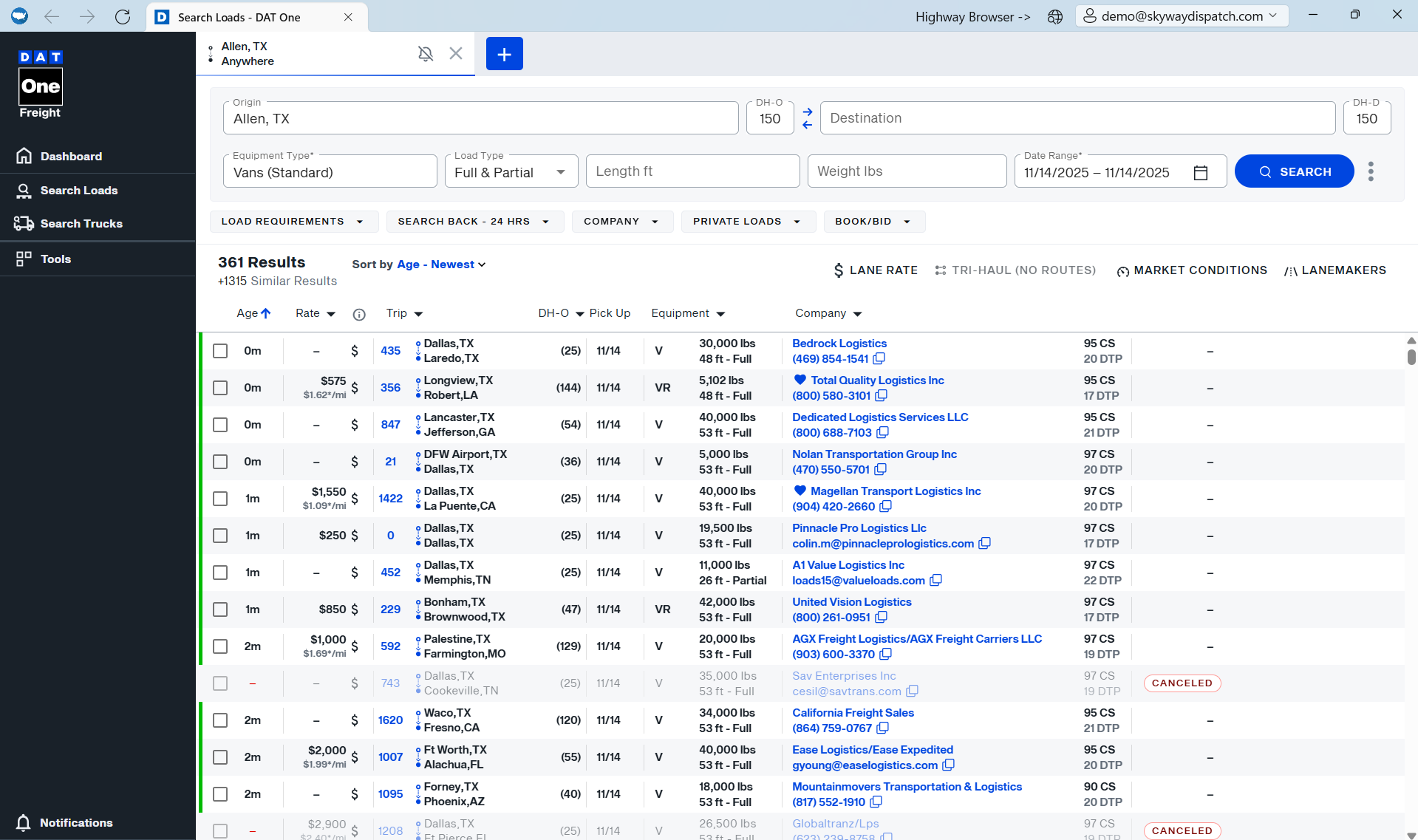
On a daily basis, a carrier uses the load board to find work that minimizes "deadhead" (driving an empty trailer). However, the decision to click "Book Now" is shaped by several DAT-specific metrics:
- RateView Benchmarking: DAT RateView provides carriers and brokers with actual transacted rates on more than 68,000 lanes. When a carrier sees a load from Chicago to Atlanta, they don't just see the offered price; they see the 15-day and 30-day average for that specific lane. This data shapes the decision of whether to accept the offer or counter with a higher bid.
- Market Conditions Index (MCI): The MCI is a visual representation of supply and demand. If a market is "hot" (indicated by a high MCI score), carriers know they have the leverage to demand higher rates. Conversely, if a market is "cold," a broker knows they can likely find capacity at a lower price point.
- Offer Transparency: In 2026, the inclusion of "all-in" rates versus linehaul plus fuel surcharge allows for more precise margin calculations.
Strategic Lane Analysis and the "Trihaul" Strategy
One of the most profound ways a DAT load board shapes decisions is through geographic optimization. Traditional "out-and-back" routes are often inefficient because the return leg (the backhaul) may pay significantly less than the headhaul.
DAT’s "Trihaul" tool suggests alternative routes to turn a low-paying return trip into a more profitable three-legged journey. For example, if a carrier moves a load from Point A to Point B, and the return from B to A is paying poorly, the load board may suggest a route from B to Point C, then C to A. By analyzing these triangular routes, carriers decide to bypass certain markets entirely, shifting the national distribution of truck capacity.
This shifting capacity, in turn, influences broker decisions. If brokers see that carriers are moving away from a specific region due to poor backhaul opportunities, they must decide whether to increase their offer prices to lure trucks back or to advise their shipper clients to adjust their shipping schedules.
Risk Management and Partner Vetting
In the freight industry, a decision isn't just about the money on the screen; it is about the certainty of payment and the safety of the cargo. The load board shapes these "who to work with" decisions through integrated credit and performance data.
| Data Point | Impact on Decision-Making |
|---|---|
| Credit Score | Helps carriers decide if a broker is financially stable enough to pay on time. |
| Days to Pay | Influences whether a carrier will require factoring or upfront payment. |
| Bond Information | Provides legal assurance for carriers in case of non-payment. |
| Carrier Reviews | Allows brokers to decide if a carrier is reliable or has a history of "falling off" loads. |
| Verification Status | Vital for 2026 fraud prevention, helping users decide if an entity is legitimate. |
By surfacing this information, DAT reduces the friction of trust. A carrier may decide to take a slightly lower-paying load from a broker with a 98-point credit score over a high-paying load from a broker with a 60-point score, prioritizing cash flow stability over raw revenue.
Mitigating Fraud in the 2026 Freight Landscape
As of 2026, freight fraud, including identity theft and double-brokering, remains a significant challenge for the industry. DAT’s platform shapes decisions by acting as a first line of defense. The board’s "Verified" badges and multi-factor authentication requirements for posting loads force users to make safer choices.
Brokers use the platform to verify a carrier's FMCSA (Federal Motor Carrier Safety Administration) authority and insurance status in real-time. If a carrier’s insurance has lapsed, the load board restricts their ability to see certain high-value loads. This automated gatekeeping shapes the broker’s decision to engage only with compliant, low-risk partners, effectively weeding out "bad actors" from the digital ecosystem.
How DAT iQ Shapes Enterprise-Level Decisions
For larger fleets and high-volume brokerages, the standard load board is supplemented by DAT iQ. This is where freight decisions move from the tactical to the predictive. DAT iQ uses machine learning to forecast future rate movements based on historical cycles, seasonal trends, and current economic indicators.
Shippers use this data to decide their annual transportation budgets. If DAT iQ predicts a 10% increase in spot rates for the third quarter, a shipper might decide to lock in more contract freight early in the year to hedge against rising costs. Simultaneously, carriers might decide to hold back a portion of their fleet for the spot market to capitalize on the predicted volatility. This interplay of decisions, all fueled by the same data source, creates a more synchronized—if competitive—market.
Integration with Transportation Management Systems (TMS)
The modern freight decision is rarely made in a vacuum; it is made within a Transportation Management System (TMS). In 2026, the DAT load board is often not viewed as a separate website but as an integrated data feed within a company's internal software.
This integration allows for "Automated Decisioning." For instance, a broker’s TMS can be programmed to automatically post a load to DAT if it isn't covered by a contract carrier within two hours. Conversely, a carrier’s system can "auto-bid" on loads that meet specific criteria (e.g., specific lane, minimum rate per mile, and broker credit score). This automation doesn't just speed up the process; it enforces a disciplined decision-making framework that removes emotional bias from the negotiation.
FAQs
How does the DAT Market Conditions Index (MCI) actually work?
The MCI measures the ratio of loads to trucks in a specific geographic area. It is calculated on a scale of 0 to 100. A score of 50 indicates a neutral market. Scores toward 100 indicate a "seller's market" (more loads than trucks), where carriers can demand higher rates. Scores toward 0 indicate a "buyer's market" (more trucks than loads), where brokers have the upper hand in negotiations.
Is the pricing data on DAT based on asking prices or actual paid rates?
DAT provides both, but the most valuable data point is the actual transacted rate. Through its RateView tool, DAT collects anonymized data from real freight bills and contracts. This ensures that the decisions shaped by the platform are based on what is actually happening in the market, rather than just the "sticker price" posted on the board.
Can a DAT load board help reduce fuel costs?
Yes, primarily through the reduction of empty miles (deadhead). By providing a high density of load options and suggesting "Trihaul" routes, the platform allows carriers to plan more efficient paths that maximize revenue per gallon of fuel consumed. Furthermore, integrated routing tools often highlight the most fuel-efficient paths between pickup and delivery.
How has DAT addressed double-brokering in 2026?
DAT has implemented advanced identity verification and behavioral monitoring. The platform tracks the history of load postings and carrier interactions. If a user's behavior matches the patterns of double-brokering (e.g., reposting a load they just "won" at a lower price), the system flags the account. This helps users decide to avoid suspicious postings, drastically reducing the success rate of fraudulent schemes.
What is the difference between DAT One and DAT iQ?
DAT One is the operational platform used for searching, posting, and tracking loads. It is designed for daily execution. DAT iQ is an analytics suite designed for deep market research, forecasting, and benchmarking. While DAT One helps you find a load today, DAT iQ helps you decide where your business should be positioned six months from now.
Practical Recommendation for 2026 Freight Professionals
To maximize the value of a DAT load board in 2026, users should move beyond "search and call." Carriers should prioritize the MCI Map to position their equipment in high-demand "hot zones" before they even finish their current delivery. Brokers should utilize RateView to provide shippers with data-backed quotes, moving away from "flat rates" toward dynamic pricing that reflects current market volatility. Finally, both parties must utilize the integrated identity verification tools as a mandatory step in every transaction to safeguard their business against the evolving risks of digital freight fraud.
Image Gallery