Zero Percent Financing Explained: How It Works and What to Watch For
Zero percent financing is a promotional credit offer where a lender allows a borrower to pay for a purchase over a set period without incurring interest charges. While it appears to be "free money," these deals are strategic marketing...
Zero percent financing is a promotional credit offer where a lender allows a borrower to pay for a purchase over a set period without incurring interest charges. While it appears to be "free money," these deals are strategic marketing tools designed for consumers with excellent credit, often requiring strict adherence to repayment terms to avoid significant backdated interest penalties.
Contents
Understanding the nuances of zero percent (0% APR) financing is essential for any consumer looking to make a major purchase in 2026, whether it is a vehicle, home appliance, or high-end electronics. While the concept seems straightforward, the legal fine print, eligibility requirements, and potential "opportunity costs" can make these deals more expensive than traditional low-interest loans if not managed correctly.
Understanding the Mechanics of 0% APR Financing
At its core, 0% financing is a loan where the Annual Percentage Rate (APR) is set to zero for a specific introductory period. This means that every dollar you pay goes directly toward the principal balance of the loan rather than being split between the principal and the lender's profit (interest). These offers are typically presented by "captive lenders"—financial institutions owned by manufacturers, such as Ford Credit or Toyota Financial Services—or through retail credit card partnerships.
Lenders offer these terms not out of altruism but as a powerful incentive to move inventory. For a car manufacturer, offering 0% financing might be more effective at clearing a lot full of last year’s models than a simple price reduction. For retail stores, it encourages "upselling," as consumers are often willing to buy a more expensive model if they know they can spread the payments over 24 months without interest.
However, the "cost" of the interest is often baked into the transaction elsewhere. You may find that a 0% offer is "either-or"—meaning you can take the 0% interest rate OR a $3,000 cash rebate, but not both. In such cases, the "interest-free" loan actually costs you the $3,000 you would have otherwise saved on the purchase price.
The Critical Distinction: Waived Interest vs. Deferred Interest
One of the most dangerous areas of consumer finance is the confusion between "true" 0% APR and "deferred interest" plans. While they may both be marketed as "no interest for 12 months," the underlying mechanics are vastly different, particularly if you fail to pay off the balance in full by the deadline.
True 0% APR (Waived Interest)
In a true 0% APR agreement, common with many credit card introductory offers and major auto loans, the interest is simply not charged during the promotional window. If you have a balance remaining after the 12-month period ends, the interest starts accruing only on the remaining balance from that date forward. You are not penalized for the interest that would have accrued during the previous year.
Deferred Interest Plans
Deferred interest is common in retail "store cards" for furniture, jewelry, and electronics. Under these terms, the interest is calculated from the date of purchase but is "deferred" or put on hold. If you pay the balance in full before the promotion ends, you pay no interest. However, if even $1 remains on the balance the day after the promotion expires, the lender will charge you all the interest that has been accumulating since day one. This can result in a massive, unexpected bill that significantly increases the total cost of the item.
Qualification Requirements: The "Excellent Credit" Gate
Zero percent financing is a privilege reserved for the most creditworthy borrowers. Because the lender is making little to no profit on the interest, they mitigate their risk by only lending to individuals who are highly likely to repay the debt in full and on time.
To qualify for 0% financing in 2026, lenders generally look for a FICO score in the "Exceptional" or "Very Good" range, typically 740 or higher. If your credit score is in the 600s, you are unlikely to be approved for these specific promotions, though the salesperson may still try to pivot you toward a "low interest" alternative that carries a much higher cost over time.
Beyond the credit score, lenders examine your Debt-to-Income (DTI) ratio. Even with a high credit score, if a significant portion of your monthly income is already committed to mortgages, student loans, or other credit card debt, a lender may deny a 0% offer because the lack of interest profit doesn't justify the risk of your potential default.
Common Industries Offering 0% Deals
The Automotive Sector
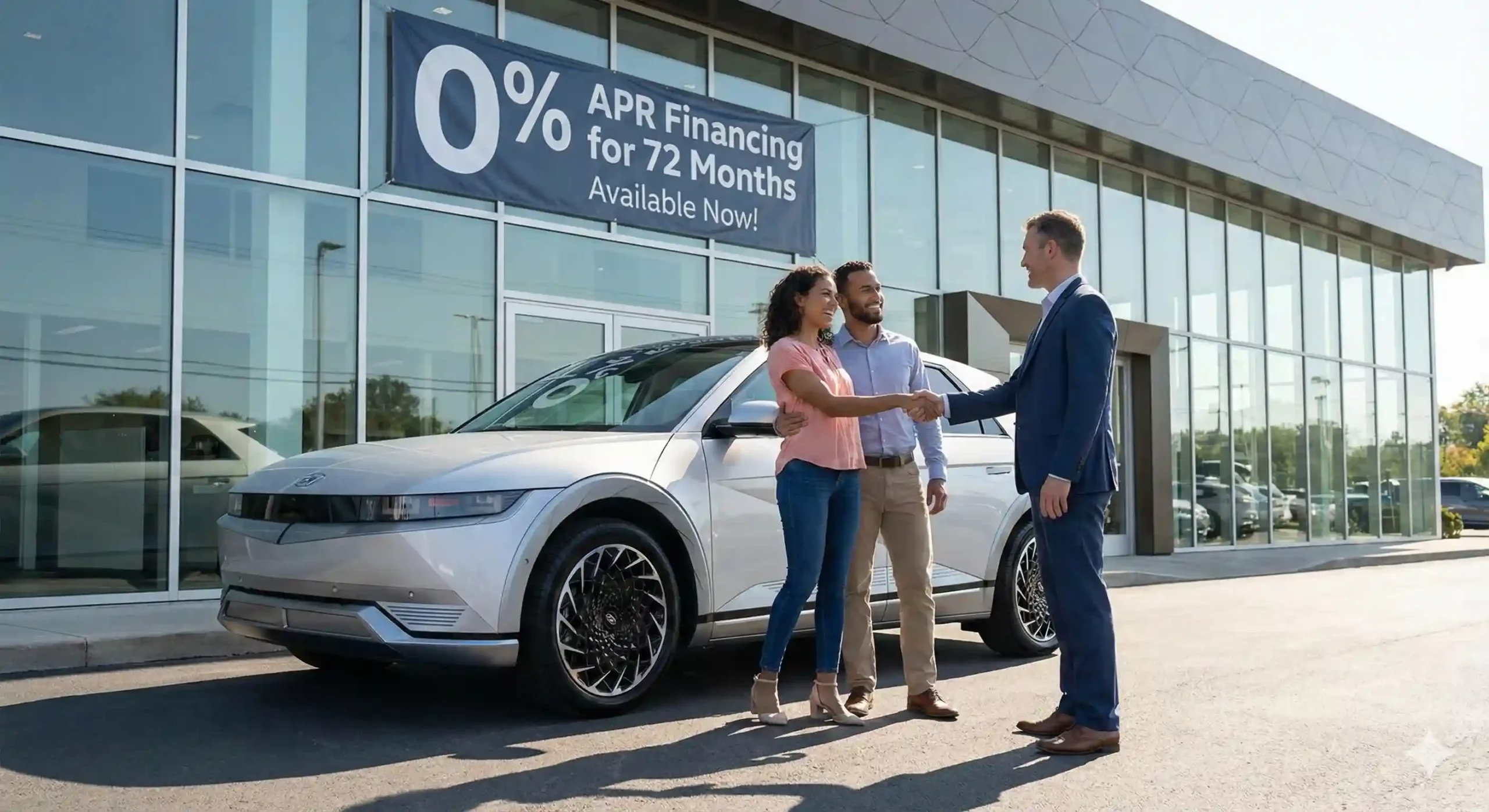
Auto manufacturers are perhaps the most prolific users of 0% financing. These deals are usually restricted to specific models (often those with slower sales) and shorter loan terms, such as 36 or 48 months. While a 72-month 0% loan exists, it is rare and requires nearly perfect credit. Buyers should be aware that these offers often exclude the best dealer incentives or manufacturer rebates.
Retail and Consumer Electronics
Store-branded credit cards frequently offer "No Interest if Paid in Full" within 6, 12, or 24 months. These are almost always deferred interest plans. They are designed to encourage consumers to buy appliances or technology that they cannot afford to pay for upfront. The risk here is that the high standard APR (often 25% to 30%) kicks in the moment the promotional period ends.
Credit Card Introductory Offers
Many "general use" credit cards offer a 0% intro APR on new purchases or balance transfers for 12 to 21 months. These are excellent tools for consolidating high-interest debt or financing a large upcoming expense. However, balance transfers usually involve a one-time fee of 3% to 5% of the total amount transferred, which must be factored into the total savings.
The Mathematical Reality: Comparison Table
To understand if 0% financing is actually the best deal, you must compare it against a standard loan that includes a cash rebate. Often, taking the cash discount and a low-interest loan from a credit union results in a lower total cost of ownership.
| Feature | 0% Financing Offer | Standard Loan with $3,000 Rebate |
|---|---|---|
| Purchase Price | $40,000 | $40,000 |
| Cash Rebate | $0 | $3,000 |
| Loan Amount | $40,000 | $37,000 |
| Interest Rate (APR) | 0% | 5.5% |
| Term Length | 60 Months | 60 Months |
| Monthly Payment | $666.67 | $707.12 |
| Total Interest Paid | $0 | $5,427.20 |
| Total Cost of Purchase | $40,000 | $42,427.20 |
Note: In this specific example, the 0% financing saves the consumer $2,427.20 compared to taking the rebate with a 5.5% loan. However, if the rebate were $6,000, the standard loan would actually be the cheaper option.
Hidden Costs and Potential Risks
While the interest rate is 0%, there are other financial impacts to consider before signing a contract.
- Strict Payment Deadlines: In many 0% contracts, a single late payment can void the entire promotional offer. If you are one day late, the lender may have the right to revoke the 0% rate and jump your interest rate to the "default" APR, which can be as high as 29.99%.
- Impact on Credit Utilization: Opening a new line of credit for a 0% retail offer can lower your average account age. Furthermore, if you max out the card to buy a $3,000 refrigerator, your credit utilization on that specific card is 100%, which can temporarily ding your credit score.
- The "Losing the Rebate" Trade-off: As demonstrated in the table above, the most common hidden cost is the opportunity cost of the manufacturer's rebate. You must always run the math to see if the interest you save is greater than the cash you are leaving on the table.
- Upselling Pressure: Salespeople know that if you aren't paying interest, you feel like you have more "room" in your budget. This often leads consumers to add warranties, gap insurance, or higher trim levels that they wouldn't have purchased if they were paying a standard 7% interest rate.
Strategic Guidance: How to Navigate 0% Offers
Before accepting a 0% financing offer, follow these steps to ensure you are actually getting a deal:
- Verify the Type of Interest: Ask the lender explicitly: "Is this a true 0% APR or a deferred interest plan?" If it is deferred interest, you must have a rigorous plan to pay it off one month before the deadline to account for any processing delays.
- Check the Total Price: Ensure the salesperson hasn't inflated the price of the item to compensate for the 0% financing. The price of the vehicle or appliance should be the same whether you pay cash or use the 0% offer.
- Calculate the "Rebate vs. Interest" Math: Use an online loan calculator to compare the 0% offer against a standard loan with a cash-back rebate.
- Automate Payments: Set up autopay for an amount slightly higher than the minimum requirement to ensure the balance hits zero well before the promotional period expires.
Disclaimer: This article provides general financial information and does not constitute professional financial, legal, or investment advice. Interest rates and lending terms are subject to change based on market conditions and individual creditworthiness.
Frequently Asked Questions
Does 0% financing affect my credit score?
Yes, in two ways. Initially, the lender will perform a "hard inquiry" to check your credit, which can cause a small, temporary dip in your score. Secondly, carrying a large balance on a retail card can increase your credit utilization ratio. However, if you make all payments on time, it can eventually help build a positive payment history.
Can I pay off a 0% loan early?
Usually, yes. Most 0% auto loans and credit cards do not have prepayment penalties. However, you should always check the "Prepayment Penalty" clause in your specific contract. Paying off a 0% loan early doesn't save you money on interest, but it does clear the debt from your balance sheet and improve your DTI ratio.
What happens if I miss a payment on a 0% financing plan?
Missing a payment is the most common way consumers lose their 0% status. Depending on the contract, the lender may immediately apply a high "penalty APR" to your remaining balance. In deferred interest plans, a missed payment could trigger the application of all back-dated interest from the original purchase date.
Is 0% financing available for used cars?
It is very rare. 0% financing is almost exclusively a tool used by manufacturers to sell new inventory. Used car loans are typically handled by banks or credit unions at standard market rates. Occasionally, "Certified Pre-Owned" (CPO) vehicles may have low-interest promotions, but they rarely hit 0%.
Should I take 0% financing if I have the cash to pay upfront?
Strategically, yes. If you have the cash, you can keep that money in a high-yield savings account or a money market fund earning interest (e.g., 4% to 5% in the current 2026 market) while using the lender's money for free. This is known as "arbitrage." However, this only works if you are disciplined enough not to spend the cash elsewhere.
Image Gallery