Understanding the Giver Annex: Context, Interpretation, and Literary Significance
The "Giver Annex" refers to the isolated, book-filled dwelling where the Receiver of Memory lives and trains the new Receiver in Lois Lowry’s seminal 1993 dystopian novel, The Giver. Functioning as both a physical refuge and a reposito...
The "Giver Annex" refers to the isolated, book-filled dwelling where the Receiver of Memory lives and trains the new Receiver in Lois Lowry’s seminal 1993 dystopian novel, The Giver. Functioning as both a physical refuge and a repository of human history, the Annex serves as the narrative catalyst for the protagonist Jonas's awakening, contrasting sharply with the sterile, controlled environment of the community.
Contents
Literary Context and the Setup of the Annex
To understand the role of the Giver Annex, one must examine the societal architecture of the community in The Giver. The society operates under "Sameness," a utilitarian social engineering experiment that has eradicated climate variations, topographical diversity, color, sensory pain, and profound emotional depth. In this uniform environment, citizens live in prescribed family units, adhere to strict behavioral codes, and suppress memories of the past to maintain absolute social stability.
Within this framework, the community maintains a single individual known as the Receiver of Memory. This person holds the burden of all historical memory—both the joyful experiences of humanity, such as music, love, and nature, and the harrowing horrors of war, hunger, and grief. Because this role requires total seclusion from the general population to protect citizens from the psychological weight of the past, a specialized domicile is designated for the Receiver: the Annex.
Attached to the House of the Old—where elderly citizens reside before their scheduled release—the Annex represents a physical and architectural anomaly. While standard dwellings in the community are uniform, stark, and devoid of personal clutter, the Annex is characterized by heavy locked doors, private rooms, and, most remarkably, thousands of books.
Architectural and Environmental Characteristics
The physical structure of the Giver Annex is engineered to isolate its occupant while simultaneously housing the immense weight of human history. Several key features define the Annex within the narrative:
- Security and Privacy: Unlike standard community homes where doors remain unlocked and privacy is actively discouraged through public sharing rituals, the Annex features a locked front door. This barrier emphasizes the separation between the controlled community and the raw, unfiltered reality preserved within.
- The Book Collection: Standard community dwellings contain only a few reference volumes, such as the dictionary, the community rules, and the Book of Addresses. In contrast, the Annex houses row upon row of books with varied bindings and old paper, representing literature, history, and philosophy from eras long forgotten by the rest of society.
- Sensory Contrast: The interior of the Annex is softly lit, featuring lamps rather than harsh overhead fluorescent panels. The furniture is heavy and comfortable, and the room contains a bed where Jonas receives memories transmitted through physical touch.
This environment acts as a sensory sanctuary. When Jonas first enters the Annex, he is struck by the quiet dignity of the space and the palpable absence of the community's omnipresent PA speakers. The Annex is not merely a living space; it is a museum of human consciousness preserved against the systemic amnesia enforced by the Committee of Elders.
| Feature | Standard Community Dwellings | The Giver Annex |
|---|---|---|
| Access Control | Unlocked, open to community monitoring | Locked doors, restricted entry |
| Literary Resources | Three standardized reference books | Thousands of historical books and records |
| Lighting & Ambiance | Bright, uniform, sterile illumination | Soft, warm lighting via lamps |
| Emotional Tone | Calm, superficial, and emotion-regulated | Heavy, complex, and deeply emotional |
The Function of the Annex in Jonas’s Training
The primary operational purpose of the Giver Annex is to facilitate the transmission of memories from the current Receiver (who becomes known as "The Giver") to the apprentice ("The Receiver in Training"). This process requires a controlled, undisturbed environment because memory transmission is physically and psychologically taxing.
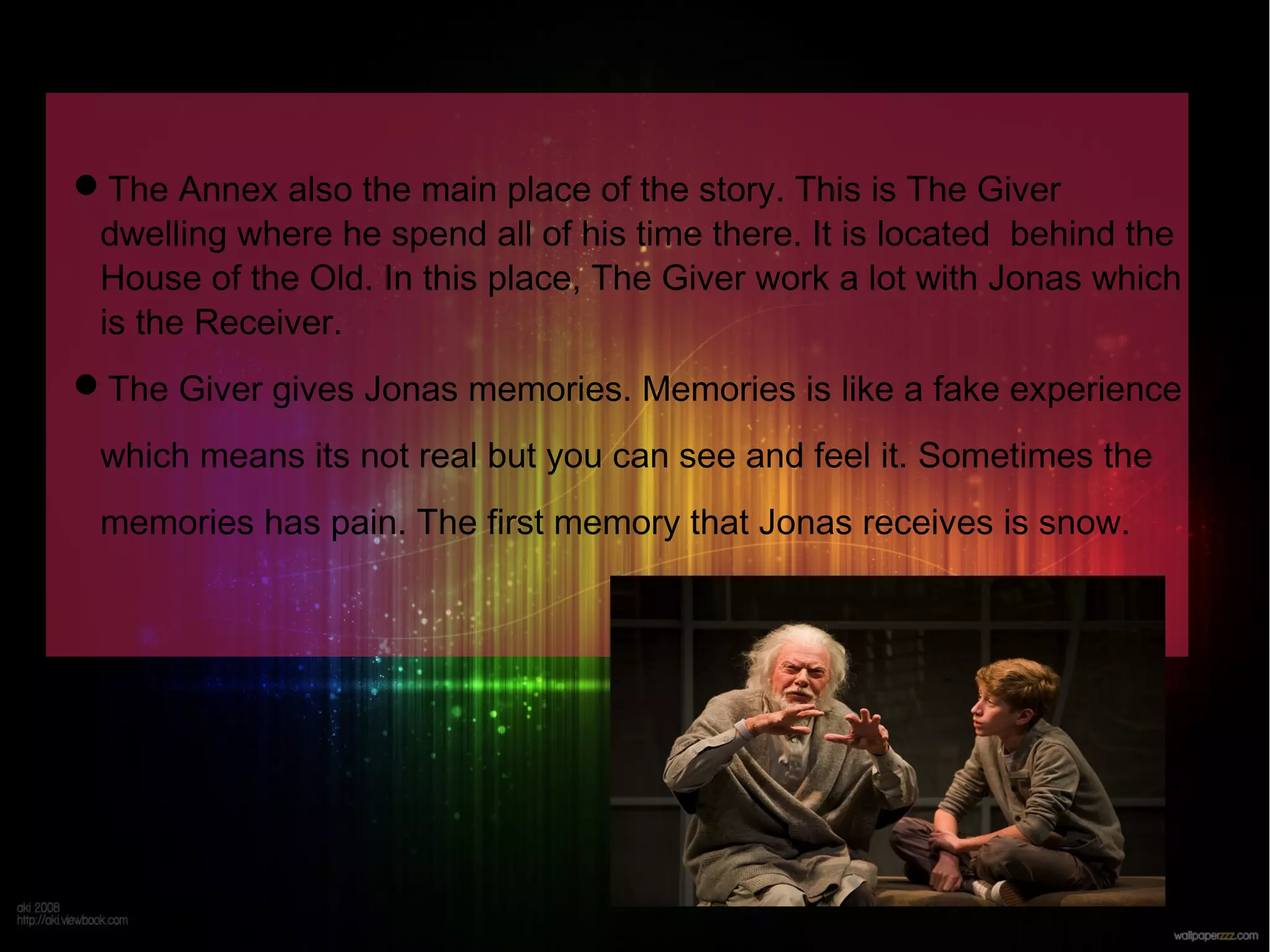
During training sessions, Jonas lies on a bed while the Giver places his hands on Jonas's bare back. Through this tactile connection, historical events, sensations, and concepts flow into Jonas's consciousness. The Annex acts as a psychological decompression chamber. When Jonas experiences the agony of a sled crash, the blinding glare of snow, or the crushing weight of starvation, he does so within the secure boundaries of the Annex. Afterward, he must process these revelations before returning to the sanitized predictability of his family unit.
Furthermore, the Annex serves as a sanctuary for intellectual discourse. It is the only place in the community where citizens—or at least the two designated memory-holders—are permitted to speak freely without monitoring or fear of repercussion. Here, Jonas learns about color, love, family heritage, and the concept of choice. The books in the Annex provide the intellectual scaffolding that supports the emotional weight of the memories, allowing Jonas to contextualize what he feels through literature and historical record.
Symbolism and Themes Connected to the Annex
Within the broader thematic structure of The Giver, the Annex carries profound symbolic weight, representing several core ideas:
1. The Preservation of Humanity
The Annex symbolizes the fragile thread of true human experience. Without the books and memories stored within its walls, humanity in the novel would be reduced to mere biological automation. The Annex proves that civilization's true wealth is not its technological efficiency or social harmony, but its capacity for art, memory, and emotional depth.
2. The Cost of Knowledge
Access to the Annex comes at an immense psychological price. While the rest of the community lives in blissful, painless ignorance, the Annex is a house of suffering. The Giver carries the physical and mental scars of every war, disease, and heartbreak humanity has ever endured. Thus, the Annex symbolizes the heavy burden that accompanies truth and enlightenment.
3. Rebellion and Escape
As the narrative progresses, the Annex evolves from a place of passive learning into a base of operations for resistance. It is within the Annex that Jonas and the Giver formulate their plan to alter the community forever. By deciding that the memories must be returned to the citizens so they can feel again, Jonas uses the Annex as the launchpad for his flight across the river toward Elsewhere.
Common Misconceptions Regarding the Giver Annex
Readers and literary analysts occasionally misinterpret certain aspects of the Annex and its relation to the community:
- Is the Annex outside the community? No, the Annex is located within the physical boundaries of the community, specifically adjacent to the House of the Old. It is isolated by policy and social taboo, not by physical distance.
- Can anyone enter the Annex? Only the Receiver and the Giver have authorized access. Even the Chief Elder rarely visits, and doors are strictly kept locked to prevent accidental exposure to un-sanitized historical records.
- Are the books in the Annex fictional stories? While some may be literature, the collection primarily represents real historical records, poetry, and philosophy from eras prior to the implementation of Sameness.
Frequently Asked Questions About the Giver Annex
Why is the Giver Annex locked when other doors in the community are unlocked?
The Annex is locked to maintain strict security over the prohibited knowledge and memories it contains. In Lois Lowry's society, ordinary citizens are shielded from the past to prevent emotional turmoil and dissent. The locks ensure that only authorized memory-holders can access the books and the Giver's living quarters.
How does the architecture of the Annex differ from standard homes?
Standard dwellings are uniform, sparsely furnished, and designed for maximum surveillance and efficiency. The Annex features older architectural elements, heavy interior doors, multiple rooms, soft lighting, and extensive shelving specifically built to hold thousands of physical books rather than standardized digital displays or bare walls.
What role do books play inside the Annex during Jonas's training?
The books serve as a tangible complement to the transferred memories. While memories are transmitted psychically through touch, the library provides Jonas with historical context, vocabulary, and intellectual frameworks to understand concepts like warfare, cultural diversity, and romantic love that do not exist in the wider community.
Is the Giver Annex featured in cinematic adaptations of the novel?
Yes, in the 2014 film adaptation directed by Phillip Noyce, the Annex is visually re-imagined as a sprawling, futuristic yet archaic structure standing apart from the hyper-stylized community, often depicted at the edge of the community boundary to visually emphasize its isolation and connection to the natural world.
What happens to the Annex after Jonas leaves the community?
Following Jonas's escape, the Annex is left vacant, but the departure of Jonas triggers the release of all accumulated memories back into the general population of the community, fulfilling the ultimate goal planned by Jonas and the Giver.
Conclusion and Next Actions
The Giver Annex remains one of literature's most potent symbols of intellectual freedom, historical preservation, and the human cost of censorship. For readers and students examining The Giver, analyzing the Annex provides deep insight into Lois Lowry's exploration of memory as both a blessing and a burden. To further explore this topic, examine the historical parallels between the society's enforcement of Sameness and real-world historical instances of book burning, ideological censorship, and the systemic erasure of cultural memory.
Image Gallery