Finding Cheap Life Insurance for Couples: A Practical Guide to Shared Protection
Finding cheap life insurance for couples involves comparing individual versus joint policy structures, assessing your combined financial obligations, and optimizing your coverage based on your unique health and lifestyle profiles. By u...
Finding cheap life insurance for couples involves comparing individual versus joint policy structures, assessing your combined financial obligations, and optimizing your coverage based on your unique health and lifestyle profiles. By understanding the trade-offs between "first-to-die" policies and separate term-life plans, you can secure essential financial security for your household while minimizing monthly premiums.
Contents
Understanding the Financial Mechanics of Couples' Insurance
Life insurance for couples is not a single product, but rather a strategic choice between how two individuals are covered under one or two contracts. When shopping for coverage, the primary goal is to ensure that if one partner passes away, the surviving partner has the liquidity necessary to cover debts, mortgage payments, childcare, and daily living expenses.
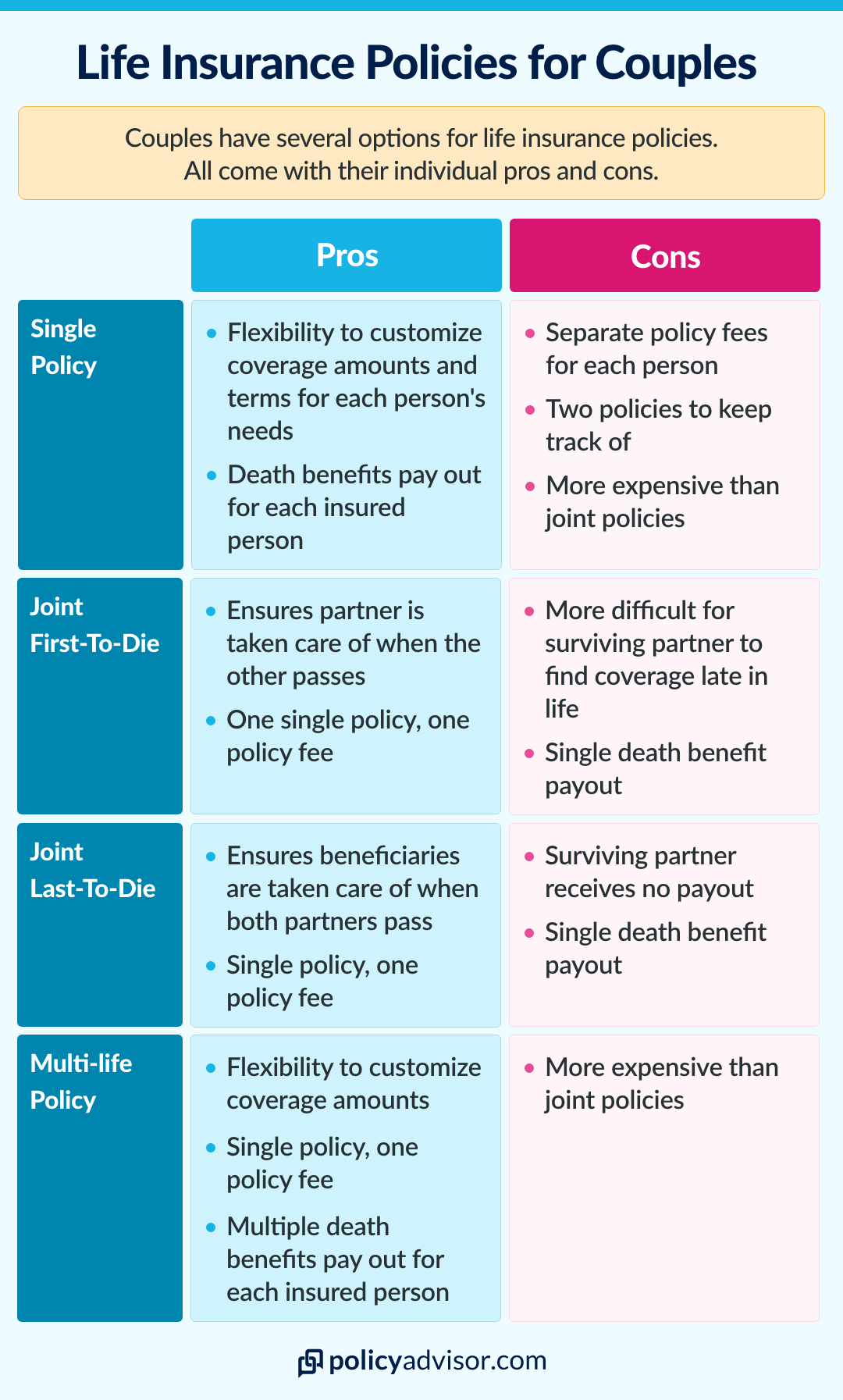
In 2026, the marketplace offers two main pathways: purchasing two separate term-life policies or opting for a joint "first-to-die" policy. Separate policies are generally more flexible; they allow each individual to maintain their own coverage even if the relationship status changes. Conversely, a joint policy—often structured as a single contract—pays out upon the first death. While these may appear more convenient, they can be restrictive and, surprisingly, are not always cheaper than two high-quality term life policies.
Separate Term Policies vs. Joint Policies
The most cost-effective route for most couples is the purchase of two independent level-term life insurance policies. This approach is widely considered the "gold standard" for middle-market financial planning because it treats each life as a unique economic entity.
Separate Term Policies
- Flexibility: If you divorce or decide to cancel one policy, the other remains fully active and unaffected.
- Customization: One partner might need a 20-year term to cover a mortgage, while the other might only need a 10-year term to cover a shorter debt period.
- Predictability: Premiums are fixed for the duration of the term, providing stable, long-term budgeting.
Joint "First-to-Die" Policies
- Simplicity: A single premium payment and one contract to manage.
- Cost Nuance: These are often marketed as "easier," but they can become complicated if the couple separates.
- Benefit Limitations: Once the first person dies and the benefit is paid, the policy terminates. The surviving partner is left without coverage and may be older, making it significantly more expensive to purchase new insurance at that later stage in life.
Table: Comparing Policy Structures for Couples
| Feature | Two Separate Term Policies | Joint First-to-Die Policy |
|---|---|---|
| Premium Structure | Two separate premiums | One combined premium |
| Flexibility | High (independent control) | Low (linked contract) |
| Survivor Status | Second policy continues | Policy ends at first death |
| Divorce Scenario | Simple to divide or cancel | Complex legal/financial tie |
| Best For | Families seeking long-term value | Specific business/estate needs |
Factors That Influence Your Premiums
Insurance companies calculate premiums based on mortality risk. To get the cheapest rates, you must understand how your personal details are weighted by underwriters.
- Age: This is the most significant factor. The younger you are, the lower the risk of death, leading to lower premiums. Locking in a policy while you are in your 20s or 30s is exponentially cheaper than waiting until your 40s or 50s.
- Health Status: Chronic conditions such as diabetes, high blood pressure, or a history of heart disease can increase premiums. Couples should compare policies from insurers that specialize in their specific health profiles, as different companies use different underwriting guidelines for pre-existing conditions.
- Lifestyle Factors: Smoking or vaping is the single most impactful lifestyle factor that inflates costs. Many insurers consider tobacco users "high-risk," and premiums can be two to three times higher than those for non-smokers.
- Term Length: A 30-year policy will always be more expensive than a 10-year policy. By laddering your insurance—choosing terms that align specifically with your debt (like a mortgage expiration date)—you can avoid paying for unnecessary coverage.
Steps to Secure the Most Affordable Rates
To secure the best rates in 2026, you should follow a systematic process that prioritizes transparency and comparison.
1. Calculate Your Combined "Gap"
Do not simply guess a round number like $1 million. Calculate your total financial obligations, including the mortgage balance, total private and student loans, projected childcare costs, and the annual salary replacement needed for your spouse to maintain their current lifestyle.
2. Obtain Quotes from Multiple Carriers
Never rely on a single quote. Use independent brokerage sites or contact an independent broker who can run comparisons across at least 5 to 10 major insurers. Because different insurers weigh health factors differently, one company might penalize you for a minor health issue while another may view it as negligible.
3. Opt for Fully Underwritten Policies
While "no-exam" life insurance is popular for its speed, it is often more expensive than a traditional, fully underwritten policy. If you and your partner are in generally good health, taking the medical exam allows the insurer to see your true health markers, which often results in lower, more accurate premium quotes.
4. Pay Annually if Possible
Many insurance carriers offer a discount—typically 3% to 5%—if you pay your premiums on an annual basis rather than monthly. While this requires a larger upfront cash outlay, the long-term savings over a 20-year term are substantial.
Common Mistakes to Avoid
Couples often fall into traps that lead to overpayment or inadequate protection. One common error is "under-insuring" the non-earning or lower-earning partner. Even if one spouse earns significantly more, the financial impact of losing the partner who manages household management, childcare, or elder care is massive. Replacing those services costs money; ensure the stay-at-home or part-time earning partner has sufficient coverage to hire help if necessary.
Another mistake is relying solely on employer-provided group life insurance. While this is a valuable perk, it is rarely enough to cover a family's full needs, and the coverage is almost always tied to your employment. If you lose your job, you lose your coverage. Supplemental private insurance provides a "portable" safety net that follows you regardless of your employment status.
Professional Advice Limitation
The financial and tax implications of life insurance, particularly regarding beneficiaries and estate planning, can be complex. This guide is for informational purposes and does not constitute financial, legal, or tax advice. You should consult with a certified financial planner (CFP) or a licensed insurance advisor to ensure that the policy structures you choose align with your specific household financial plan and tax residency requirements.
Frequently Asked Questions
Does marriage automatically make life insurance cheaper? Marriage itself does not change the premium calculation. Insurance companies look at individual mortality risk. However, being married may encourage you to get insured earlier, which is when rates are naturally lower.
Should we get a joint policy if we are buying a house together? Not necessarily. While a joint policy covers the mortgage debt, two individual term policies are usually more cost-effective and provide individual death benefits that the survivor can use for more than just mortgage payments, such as funeral costs or future income replacement.
Can we get a discount for buying policies together? Some insurance companies offer "multi-policy" or household discounts if two people apply for individual policies simultaneously. Always ask your broker if the carrier offers a discount for bundling household applications.
What happens if one of us develops a health issue after the policy starts? With a level-term policy, your premium is locked in for the duration of the term. Even if your health deteriorates, your rate will not increase as long as the policy remains in force and premiums are paid on time.
Is no-exam insurance worth it for couples? It is only worth it if speed is your absolute priority, such as needing coverage immediately for a loan requirement. For most couples, the traditional medical exam is the best way to secure the lowest possible "preferred" or "super-preferred" rate classes.
Can we change our beneficiary later? Yes. You retain ownership of your individual policies. You can change your beneficiary at any time, which is why individual policies are often preferred over joint or employer-based plans that may have restrictive beneficiary rules.
Next Steps for Your Household
Start by creating a simple spreadsheet documenting your total shared debt and monthly expenses. Contact an independent insurance broker to request quotes for two separate 20-year term policies for both partners. Before signing, review the "contestability period" in the policy documents, which is typically two years, during which the insurer can investigate claims. Ensure your applications are 100% accurate regarding your health and history to avoid any issues with future payouts.
Image Gallery