Understanding the T T Medical Abbreviation: Context and Clinical Usage
In clinical settings, the abbreviation "T T" most commonly refers to "table tilt," a critical maneuver in diagnostic testing or patient positioning, though it can occasionally represent "tetanus toxoid" depending on the documentation c...
In clinical settings, the abbreviation "T T" most commonly refers to "table tilt," a critical maneuver in diagnostic testing or patient positioning, though it can occasionally represent "tetanus toxoid" depending on the documentation context. Because medical shorthand varies by institution, confirming the intent through the medical record’s specific section—such as nursing notes or medication administration records—is essential for patient safety.
Contents
The Importance of Standardized Medical Abbreviations
Medical abbreviations are designed to increase the efficiency of documentation and communication between healthcare professionals. However, the use of shorthand is a known contributor to medical errors. The Joint Commission, an independent non-profit organization that accredits healthcare institutions in the United States, maintains a "Do Not Use" list of abbreviations prone to misinterpretation. While "T T" is not universally banned, its ambiguity necessitates careful interpretation based on the environment in which it appears.
Healthcare providers are trained to utilize context clues to disambiguate shorthand. If a note appears in a cardiovascular diagnostic report, "T T" almost certainly refers to a "Tilt Table" test. If the abbreviation appears in a vaccination log or an emergency department triage note regarding wound care, it is a shorthand notation for the "Tetanus Toxoid" vaccine.
Clinical Context 1: Tilt Table Testing (T T)
The most frequent use of "T T" in diagnostic medicine refers to a Tilt Table Test. This procedure is primarily used to evaluate patients suffering from unexplained syncope (fainting) or near-fainting episodes.
Purpose of the Tilt Table Test
The test aims to reproduce the conditions that cause a patient to faint. By placing the patient on a specialized table that can be moved from a flat (supine) position to an upright (vertical) position, clinicians monitor the body’s compensatory mechanisms. The test is specifically designed to diagnose neurally mediated hypotension or orthostatic intolerance.
The Procedure
- Preparation: The patient is placed on a flat, motorized table, often with an IV line established for medication administration if needed.
- Baseline Monitoring: Vital signs, including heart rate and blood pressure, are recorded in the supine position.
- The Tilt: The table is tilted to a 60- to 80-degree angle. This forces the body to adjust to gravity.
- Monitoring: The patient remains in this position for 20 to 45 minutes while the medical team watches for a drop in blood pressure or a sudden change in heart rate.
- Provocation: If the passive tilt does not produce symptoms, medication (such as isoproterenol or nitroglycerin) may be administered to "provoke" a syncopal episode.
Clinical Context 2: Tetanus Toxoid (T T)
In immunization and trauma care, "T T" serves as a standard abbreviation for Tetanus Toxoid. Tetanus is a serious bacterial infection caused by Clostridium tetani, which can enter the body through cuts, scratches, or puncture wounds.
Usage in Patient Care
When a patient presents to an urgent care facility or emergency department with a wound, clinicians must determine the patient’s vaccination status. If the patient has not received a tetanus booster in the last 5 to 10 years, or if the wound is "dirty" (contaminated with soil or rust), the administration of Tetanus Toxoid is a standard prophylactic measure to prevent infection.
Documentation often uses the "T T" abbreviation to indicate:
- T T (Tetanus Toxoid): Used for primary immunization or booster shots.
- T T-IG: Often seen in conjunction with Tetanus Immune Globulin, which provides immediate, short-term passive immunity for high-risk wounds.
Comparative Analysis of Medical Shorthand
To avoid errors, healthcare professionals must differentiate between various "T" related abbreviations. The following table highlights common look-alike or sound-alike abbreviations.
| Abbreviation | Common Meaning | Clinical Environment |
|---|---|---|
| T T | Tilt Table | Cardiology/Neurology |
| T T | Tetanus Toxoid | Emergency/Primary Care |
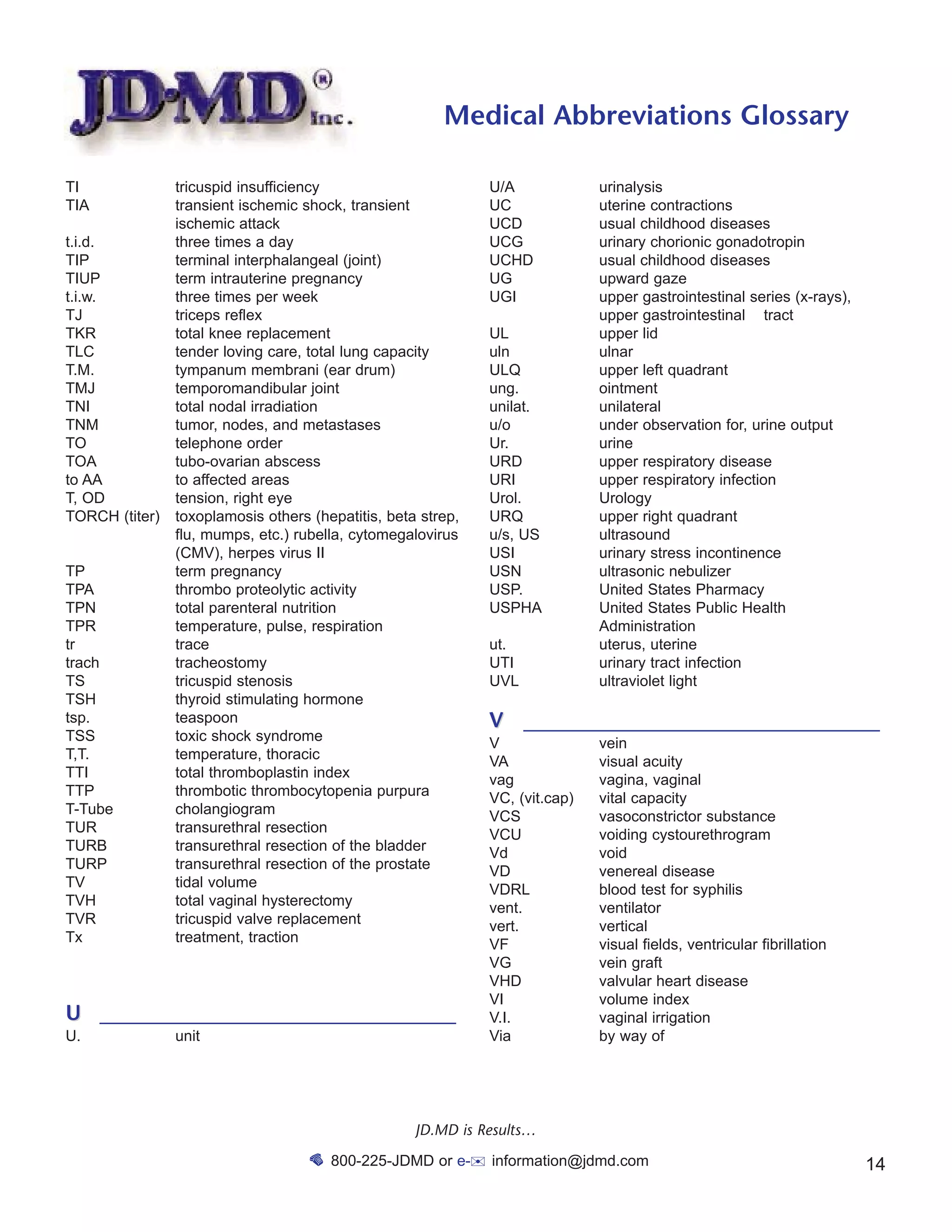
| T.T. | To Time | Pharmacy/Medication orders |
| T-test | Temperature Test | Laboratory/Nursing |
| TTN | Transient Tachypnea of the Newborn | Neonatal ICU |
| T-tube | T-shaped drainage tube | Post-operative/General Surgery |
Risks of Ambiguous Abbreviations
The primary risk associated with the "T T" abbreviation is miscommunication during handoffs or medication administration. A clinician reading "T T" in a chart might assume a patient has received a vaccine when the note actually referred to a diagnostic test, or vice versa.
To mitigate these risks, modern Electronic Health Record (EHR) systems are increasingly moving away from manual abbreviations in favor of standardized, dropdown-menu-driven documentation. If you are a patient or a caregiver, you should never hesitate to ask a provider to clarify the meaning of any shorthand found in your medical records.
Patient Rights and Clarification
As a patient, you have a legal right to understand your medical record. Under the Health Insurance Portability and Accountability Act (HIPAA) in the United States, you can request an amendment or clarification to your medical files if you believe information is confusing or inaccurate. If you encounter an abbreviation like "T T" and the context is unclear, follow these steps:
- Review the Section: Look at the header of the document. Is it a lab report, a nurse’s progress note, or an immunization summary?
- Ask the Provider: Directly ask, "Could you clarify what this note means for my care plan?"
- Verify with Records: If the abbreviation is related to a medication or treatment, check the order entry system or the pharmacy records for the full name of the drug or procedure.
Troubleshooting Interpretation
If you are reviewing clinical documentation and find the abbreviation "T T" in a context that does not fit either the Tilt Table or Tetanus Toxoid definitions, consider the following possibilities:
- Typhoid Typhus: Sometimes used in travel medicine clinics regarding vaccine history.
- Tympanic Temperature: Occasionally used in older nursing charts to record how a fever was measured.
- Target Time: Used in time-sensitive stroke or myocardial infarction protocols to denote the goal for intervention.
If an abbreviation remains ambiguous, always defer to the most senior clinician involved in the care team for verification. Relying on professional context rather than online glossaries is the gold standard for clinical safety.
Frequently Asked Questions
Does T T always mean the same thing in every hospital?
No. Medical abbreviations are notoriously non-standardized across different healthcare systems. While T T has strong associations with Tilt Table and Tetanus Toxoid, it is vital to interpret it based on the specific clinical department where it was written.
If I see T T in my child’s vaccine records, is it Tetanus?
Yes, in the context of vaccination or immunization history, T T refers to Tetanus Toxoid. You can confirm this by looking for the date of administration and the associated lot number in the record.
Why is a Tilt Table test necessary?
A Tilt Table test is necessary when standard cardiac workups (like ECGs or echocardiograms) fail to reveal the cause of fainting. It specifically identifies if the fainting is caused by an abnormal autonomic nervous system response to gravity.
Is T T a dangerous abbreviation to use?
It is considered a "weak" abbreviation because it is not specific. While not inherently dangerous, it lacks the clarity required for high-stakes medical communication, which is why many hospitals are shifting toward writing out full medical terms.
What should I do if my doctor uses abbreviations I don't understand?
You should always ask for clarification. Doctors are ethically obligated to provide you with understandable information about your treatment, diagnostic tests, and vaccination status.
Recommendation for Patients
If you are reviewing your own health records and encounter the "T T" abbreviation, do not make assumptions regarding your health status. If the context is missing, note the date and the department where the record was created, and contact the clinic's medical records department or your primary care physician to request a formal clarification. Maintaining an accurate, clear personal health file is a proactive step in managing your long-term wellness.
Image Gallery