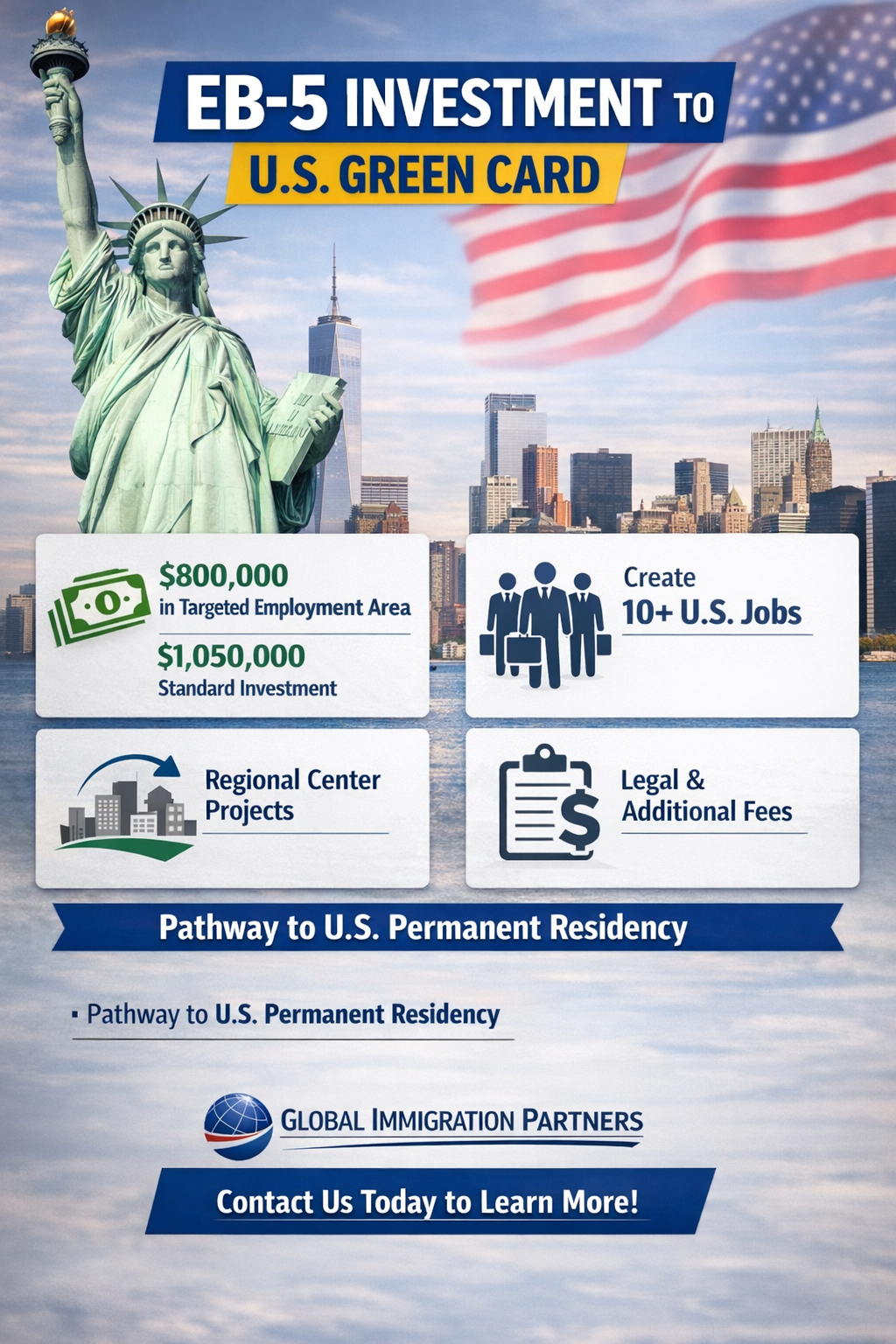
EB-5 Investment Requirements Explained
The EB-5 Immigrant Investor Program allows foreign nationals to obtain a U.S. permanent resident card (Green Card) by investing a mandatory minimum capital amount into a new commercial enterprise that creates or preserves at least 10 f...
The EB-5 Immigrant Investor Program allows foreign nationals to obtain a U.S. permanent resident card (Green Card) by investing a mandatory minimum capital amount into a new commercial enterprise that creates or preserves at least 10 full-time jobs for qualifying U.S. workers.
Contents
Navigating the United States immigration system through investment can appear complex, particularly given the rigorous statutory and regulatory frameworks established by the United States Citizenship and Immigration Services (USCIS). For investors, entrepreneurs, and families aiming to establish permanent roots in the U.S., understanding the foundational economic mandates of the EB-5 visa category is critical. This guide breaks down the legal benchmarks, capital thresholds, job creation rules, and strategic considerations governing the EB-5 program.
Overview of the EB-5 Immigrant Investor Program
Established by the United States Congress in 1990 under the Immigration and Nationality Act (INA), the EB-5 program was designed to stimulate the U.S. economy through capital investment and job creation by foreign investors. Over the decades, the program has undergone various administrative and legislative modifications, most notably through the EB-5 Reform and Integrity Act of 2022 (RIA).
At its core, the program operates on a straightforward exchange: a foreign national contributes a designated amount of risk capital to a qualifying commercial enterprise in the United States and demonstrates that the investment directly or indirectly generates sustainable employment. In return, the investor, their spouse, and their unmarried children under the age of 21 become eligible to apply for conditional permanent residency, which can later be converted to unconditional permanent resident status.
Core Financial Thresholds and Capital Requirements
The financial commitment required for an EB-5 application is dictated by the geographic location and economic status of the enterprise receiving the funds. The law establishes two primary investment tiers: the standard minimum investment and the reduced minimum investment associated with targeted economic zones.
Standard Investment vs. Targeted Employment Areas (TEAs)
Under current regulations, the baseline standard minimum investment amount is $1,050,000. This applies to any commercial enterprise that does not qualify as a Targeted Employment Area (TEA) or infrastructure project.
However, to encourage foreign capital influx into economically distressed or rural regions, Congress authorized a reduced investment threshold. The reduced minimum investment amount is $800,000 if the capital is invested in:
- A Rural Area: Any area outside a metropolitan statistical area (MSA), as designated by the Office of Management and Budget, or outside the outer boundary of any city or town with a population of 20,000 or more.
- A High Unemployment Area: An urban area that has experienced an average unemployment rate of at least 150 percent of the national average rate.
These figures are subject to statutory adjustments every five years, with the next adjustment scheduled to occur automatically based on the Consumer Price Index (CPI).
Source and Path of Funds Verification
A critical hurdle in the EB-5 process is not merely possessing the required capital, but proving its lawful origin. USCIS enforces rigorous anti-money laundering and compliance standards, requiring investors to document the complete paper trail of their investment funds.
Acceptable sources of capital include:
- Earnings from employment or business ownership.
- Sale of real estate, stocks, or other personal assets.
- Lawful gifts or inheritances.
- Proceeds from judicial settlements or commercial loans, provided the loans are secured by assets owned by the investor.
Investors must submit extensive documentation—such as tax returns, corporate financial statements, bank records, and deeds—to demonstrate that every dollar invested was obtained through legal means.
Job Creation Mandates
Capital investment alone does not satisfy the statutory criteria of the EB-5 program; the funds must translate directly into tangible economic activity measured by employment metrics.
Direct vs. Indirect Job Creation
The required 10 full-time jobs must meet strict federal definitions depending on whether the investor chooses a direct investment model or an indirect regional center model:
- Direct Investment: The new commercial enterprise must directly employ at least 10 qualifying U.S. workers on its payroll. These workers must be U.S. citizens, lawful permanent residents, or other immigrants lawfully authorized to work in the United States (excluding the investor and their immediate family members).
- Regional Center Investment: If the investment is made through a USCIS-approved Regional Center, the required 10 jobs can be created directly or indirectly. Indirect jobs are calculated using econometric models approved by USCIS, capturing employment generated collaterally through supply chains, construction, and local economic stimulation.
| Parameter | Standard Investment | Targeted Employment Area (TEA) |
|---|---|---|
| Minimum Capital Amount | $1,050,000 | $800,000 |
| Job Creation Requirement | 10 full-time positions | 10 full-time positions |
| Qualifying Entities | Standard commercial enterprises | Rural areas or high unemployment urban tracts |
| Calculation Method | Direct payroll only | Direct, indirect, or induced via Regional Center models |
Investment Risk and Commercial Reality
A frequently misunderstood aspect of the EB-5 program is the legal requirement that investment capital must be "at risk." USCIS regulations explicitly prohibit guaranteed returns, buyback agreements, or safety nets that shield the investor from financial loss.
To satisfy the at-risk requirement:
- The capital must be placed into commercial operations with the objective of generating a profit.
- The funds must be fully committed to the enterprise and subject to the normal gains and losses associated with business ventures.
- Promissory notes or unsecured debt arrangements are generally insufficient unless fully collateralized by the investor’s personal assets.
The EB-5 Application Lifecycle
The path from initial capital commitment to permanent residency follows a structured, multi-stage legal process.
- Capital Placement & Form I-526E Filing: The investor places the required funds into an escrow account or directly into the enterprise and files Form I-526E (or Form I-526 for direct investors). This petition establishes the legitimacy of the investment and the investor’s compliance with economic guidelines.
- Conditional Permanent Residency: Upon approval of the initial petition, the investor and their eligible dependents receive conditional green cards valid for two years.
- Form I-829 Removal of Conditions: Within the 90-day window preceding the two-year anniversary, the investor files Form I-829 to remove conditions. At this stage, the petitioner must prove that the capital remained invested throughout the conditional period and that the requisite 10 jobs were created or are sustained by reasonable projections.
Frequently Asked Questions
Can borrowed funds be used for an EB-5 investment?
Yes, borrowed funds can be used, provided the loan is secured by the investor’s own personal assets (such as real estate or securities). Loans secured by the assets of the new commercial enterprise itself are strictly prohibited. Additionally, the investor must prove that they are personally liable for the repayment of the loan and that the loan proceeds originated from a lawful source.
What is the difference between a direct EB-5 investment and a Regional Center investment?
A direct investment involves putting capital into a standalone business where the investor manages day-to-day operations and directly employs 10 workers. A Regional Center investment involves pooling funds with other investors into large-scale projects (such as real estate developments or infrastructure) managed by a third party, allowing the investor to count indirect and induced jobs toward the 10-job requirement.
Are family members included in the initial investment amount?
Yes. The single minimum investment amount covers the primary investor, their legal spouse, and all unmarried children under the age of 21 at the time of filing. Dependents receive the same conditional permanent resident status and eventual path to citizenship as the primary applicant.
What happens if the business fails after making the investment?
If the business fails or jobs are lost before the conditions on residency are removed, it can jeopardize the approval of the Form I-829 petition. However, USCIS evaluates whether the investor met the capital-at-risk requirement and whether the job creation threshold was achieved or sustained during the conditional residence period. Consulting specialized immigration counsel is essential if operational setbacks occur.
Next Actions and Strategic Guidance
For prospective investors evaluating the EB-5 program, the immediate priority is conducting comprehensive due diligence on project viability, regional center track records, and source-of-funds documentation. Because U.S. immigration laws intersect heavily with international corporate finance and tax regulations, engaging qualified immigration attorneys and financial advisors experienced in cross-border transactions is vital to safeguarding both capital and residency objectives.
Image Gallery