How Does Tax Lien Investing Work?
Tax lien investing works by allowing individuals to pay delinquent property taxes on behalf of a homeowner in exchange for a legal claim against the property. Investors receive a tax lien certificate, which entitles them to the origina...
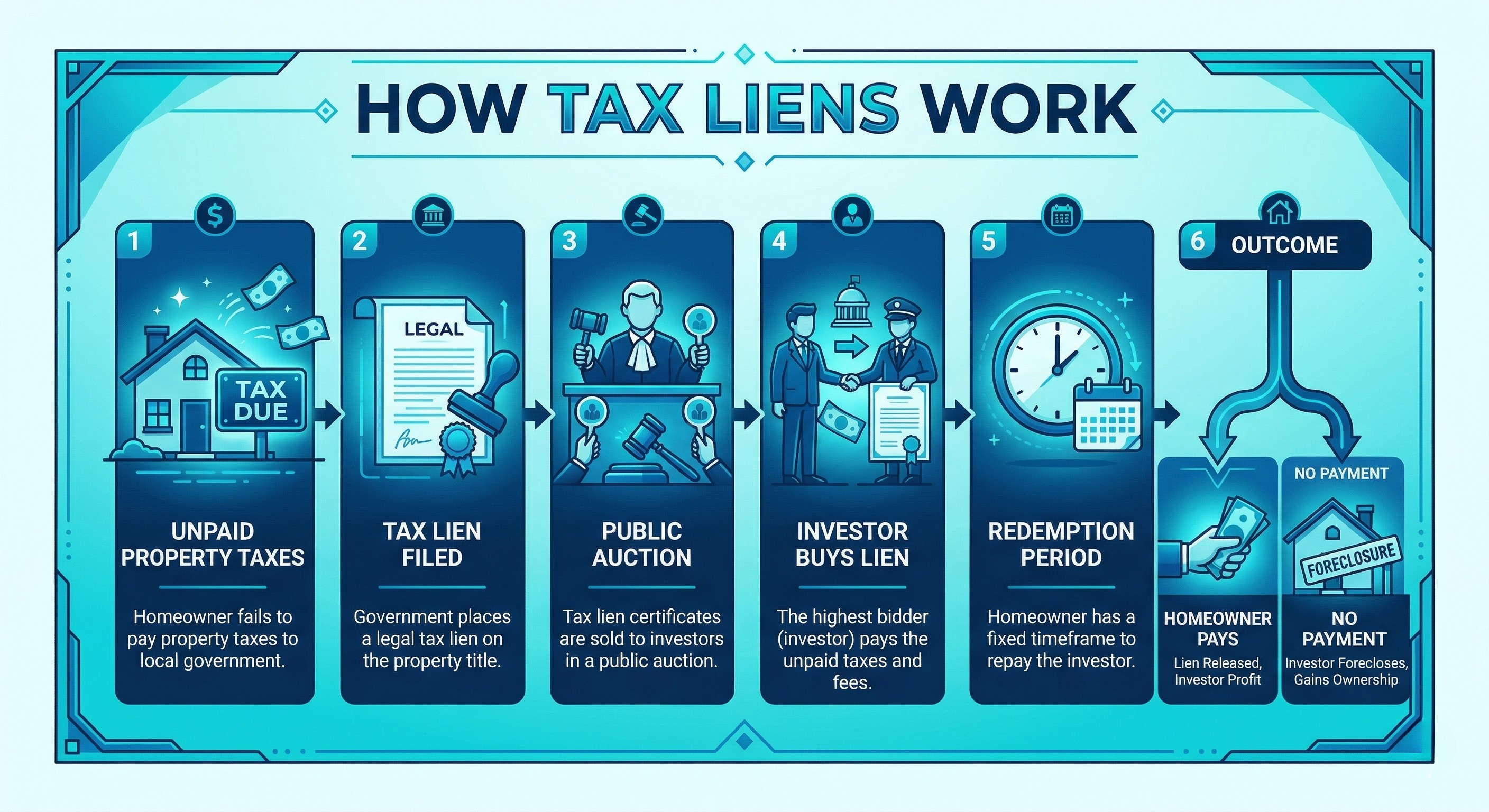
Tax lien investing works by allowing individuals to pay delinquent property taxes on behalf of a homeowner in exchange for a legal claim against the property. Investors receive a tax lien certificate, which entitles them to the original tax amount plus a high interest rate mandated by state law. If the owner fails to pay the debt within a specific timeframe, the investor may gain the right to foreclose and take ownership of the property.
Contents
Property taxes are the lifeblood of local municipal operations, funding schools, police departments, and infrastructure. When a property owner fails to pay these taxes, the local government cannot simply wait indefinitely for the revenue. To bridge this financial gap, many jurisdictions issue tax liens. For the investor, this represents a unique asset class that sits at the intersection of fixed-income investing and real estate. However, navigating this market requires a deep understanding of state-specific statutes, auction mechanics, and the legal nuances of property titles.
The Fundamentals of Tax Lien Certificates
A tax lien is a legal claim placed on a property by a local government entity when the owner falls behind on property taxes. To recoup the lost revenue immediately, the county or municipality sells this claim to a third-party investor in the form of a Tax Lien Certificate.
When you purchase a tax lien certificate, you are not buying the property itself. Instead, you are paying the government the taxes owed. In exchange, you step into the shoes of the government as a creditor. The property owner now owes you the principal amount of the taxes, plus any penalties and a predetermined interest rate.
The most attractive feature for many investors is the interest rate. Depending on the state, these rates can range from 8% to as high as 36% annually. Because the lien is secured by the real estate, it is often viewed as a "secured" investment, though it is not without significant risks.
The Tax Lien Auction Process
Most tax lien certificates are sold through public auctions, which are increasingly held online. As of 2026, the digital transition of these auctions has made it possible for investors to participate in sales across the United States from a single location.
Types of Bidding Strategies
The method of bidding varies significantly by jurisdiction. Understanding the specific "rules of the room" is essential before committing capital.
- Bid-Down Interest: In this model, the auction starts at the maximum interest rate allowed by state law (e.g., 18%). Investors bid by offering to accept a lower interest rate. The certificate is awarded to the person willing to accept the lowest return. In highly competitive markets, bids can sometimes drop to 0% or 0.25%, where the investor is betting solely on the chance of foreclosing on the property.
- Premium Bidding: Investors bid a dollar amount above the actual tax debt. The highest bidder wins the certificate. In some states, the "premium" paid does not earn interest, which can dilute the overall return on investment (ROI).
- Random Selection or Rotational Bidding: Some smaller jurisdictions use a "round-robin" style where certificates are offered to registered investors in a specific order at a fixed interest rate.
Registration and Participation
To participate, investors must typically register weeks in advance and often provide a deposit (frequently 10% of their intended bidding budget). In 2026, most counties utilize platforms like RealAuction or GovEase to manage these sales, providing digital access to property records and tax maps.
The Redemption Period: How You Get Paid
Once you hold the certificate, the "waiting game" begins. This timeframe is known as the Redemption Period. During this time, the property owner has the opportunity to pay the back taxes, penalties, and interest to the county tax collector.
The length of the redemption period varies by state, typically ranging from one to three years. If the owner pays the debt, the county collects the funds and distributes them to the investor. This is the outcome in approximately 95% to 98% of tax lien cases. The investor receives their initial investment back plus the accrued interest, and the lien is released.
It is important to note that the investor usually has no right to contact the homeowner or enter the property during this period. Doing so can, in some jurisdictions, result in the forfeiture of the lien.
Foreclosure: The Path to Property Ownership
If the property owner fails to "redeem" the lien before the redemption period expires, the investor has the legal right to initiate foreclosure proceedings. This is the process by which the investor attempts to take title to the property to satisfy the debt.
Foreclosure is not automatic. It requires a legal filing, and the investor is often responsible for all associated legal fees and title search costs. In many states, the investor must also pay any subsequent years' taxes that have fallen delinquent to maintain their priority position.
While acquiring a property for the price of a few years of taxes sounds like a windfall, the reality is complex. Properties that go all the way to foreclosure are often distressed, abandoned, or encumbered by other issues. Furthermore, a tax deed obtained through foreclosure may not provide a "clear title." Investors often need to undergo a Quiet Title Action—a legal process to remove any other claims to the property—before they can sell the asset or obtain title insurance.
Tax Liens vs. Tax Deeds: Understanding the Difference
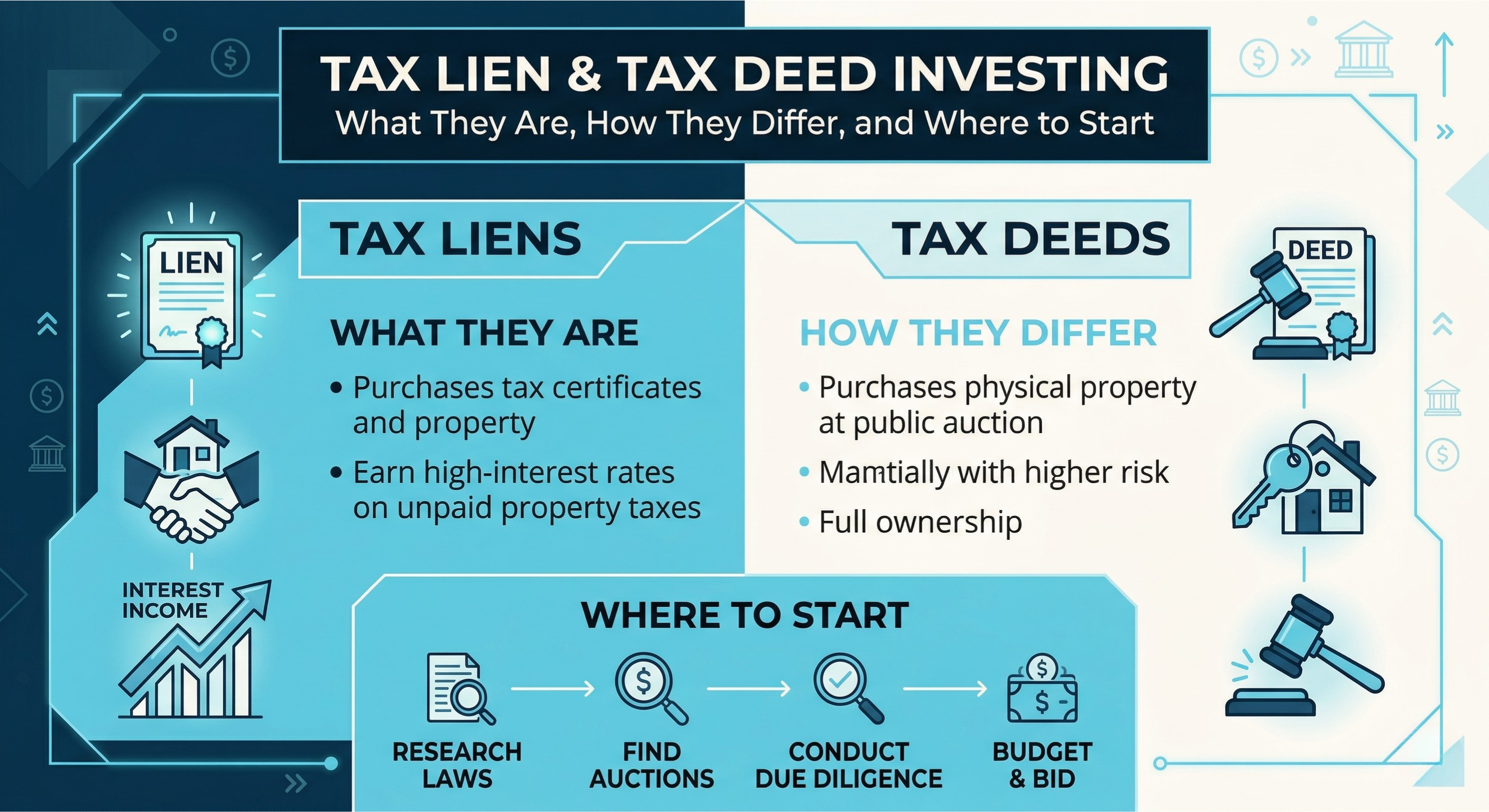
It is vital to distinguish between tax lien states and tax deed states. While the terms are often used interchangeably by novices, they represent different investment vehicles.
| Feature | Tax Lien Certificate | Tax Deed |
|---|---|---|
| Primary Goal | Earning interest on the tax debt. | Acquiring the actual real estate. |
| What is Purchased | A legal claim/lien against the property. | The property itself. |
| Redemption Period | Yes (usually 1–3 years). | No (typically sold after redemption expires). |
| Investor Role | Passive creditor. | Active property owner. |
| Typical Returns | Fixed interest (8%–36%). | Capital gains from property resale. |
| State Examples | Florida, Arizona, New Jersey. | Texas, California, New York. |
Some "hybrid" states, such as Georgia and Texas, offer "Redeemable Deeds." In these cases, you purchase a deed at the auction, but the owner still has a short window to buy it back at a very high penalty rate (often 20%–25% flat).
Essential Due Diligence for Investors
The most common mistake in tax lien investing is failing to research the underlying collateral. You are not just buying a piece of paper; you are buying a claim against a specific piece of land.
1. Physical Property Inspection
Never buy a lien on a property you haven't seen, at least via modern satellite imagery or a drive-by. You could inadvertently purchase a lien on a "junk" property, such as a sliver of land under a highway, a retention pond, or a chemically contaminated industrial site. If the property has no value, the owner won't redeem the lien, and you won't want to foreclose.
2. Title and Lien Priority
While property tax liens generally have "super priority" over mortgages, they may not wipe out all other encumbrances. Federal tax liens (IRS) or certain municipal health and safety liens might remain. You must understand the IRS right of redemption, which allows the federal government to redeem a property for a limited time after a foreclosure.
3. Bankruptcy Risks
If a property owner files for bankruptcy, an "automatic stay" is placed on all collection efforts, including tax lien foreclosures. This can freeze your investment for years, and while interest may still accrue, your capital becomes highly illiquid.
Common Pitfalls and Technical Challenges
Tax lien investing is often marketed as a "get rich quick" scheme, but it is a technically demanding field that requires patience.
- Subsequent Taxes: In many jurisdictions, if you buy a lien in 2026, you must also pay the 2027 and 2028 taxes as they become delinquent to protect your interest. If another investor buys a later year's lien, they could potentially foreclose and wipe out your earlier lien.
- The "Washout" Risk: If the property is seized by the state for other reasons or becomes part of a federal seizure, your lien might be extinguished.
- Administrative Errors: Counties occasionally make mistakes. If a lien is sold in error (for example, if the owner actually had paid their taxes), the county will "cancel" the certificate. You will get your principal back, but usually only at a very low "administrative" interest rate, not the high auction rate you expected.
FAQs
Can I lose money in tax lien investing?
Yes. While the investment is secured by real estate, you can lose money if the property value is lower than the lien amount (common with environmental hazards or unusable land) or if the property is wiped out by a superior government claim. Additionally, legal fees for foreclosure can sometimes exceed the value of the property.
How much money do I need to get started?
Tax liens can be purchased for as little as a few hundred dollars for small residential lots or thousands for larger commercial properties. There is no set minimum, but most professional investors recommend starting with at least $5,000 to $10,000 to diversify across multiple certificates and cover potential legal costs.
Do I need a real estate license to invest in tax liens?
No. Anyone who meets the age and residency requirements (which vary by county) can register for an auction. You are acting as a private investor, not a real estate agent or broker.
Does the mortgage get wiped out if I foreclose?
In most jurisdictions, a tax lien foreclosure "wipes out" the mortgage because property taxes have priority. However, banks are aware of this. To protect their collateral, banks will often pay the delinquent taxes themselves and add the cost to the homeowner's mortgage balance. This is why many high-value properties never actually make it to the tax lien auction.
How long does it take to get my money back?
It depends entirely on the property owner. Some owners redeem within weeks of the auction; others wait until the very last day of the redemption period. Investors must be prepared for their capital to be tied up for the full duration of the state's redemption window.
Strategic Recommendation
For those looking to enter the market in 2026, the most effective approach is to focus on institutional-grade research. Use the National Tax Lien Association (NTLA) as a resource for educational materials and state-by-state legislative updates. Start by choosing one state and mastering its specific statutes before expanding geographically. Diversify your portfolio by purchasing multiple smaller liens across different property types to mitigate the risk of a single bankruptcy or environmental issue.
Image Gallery