How to Display the Washington State Labor Law Poster: A Complete Compliance Guide for 2026
To display the Washington state labor law poster correctly, employers must hang all required notices in a conspicuous, high-traffic area accessible to all employees, such as a breakroom, cafeteria, or near a time clock. In 2026, employ...
To display the Washington state labor law poster correctly, employers must hang all required notices in a conspicuous, high-traffic area accessible to all employees, such as a breakroom, cafeteria, or near a time clock. In 2026, employers must also provide electronic access to these posters for remote and mobile workers via email or an internal company portal.
Contents
Understanding Mandatory Washington State Poster Requirements
In Washington, the Department of Labor & Industries (L&I) mandates that every employer, regardless of size, display specific posters that inform employees of their rights and the employer's responsibilities. These posters are not merely suggestions; they are legal requirements under various state statutes. Failure to display them can result in citations and fines during a workplace inspection.
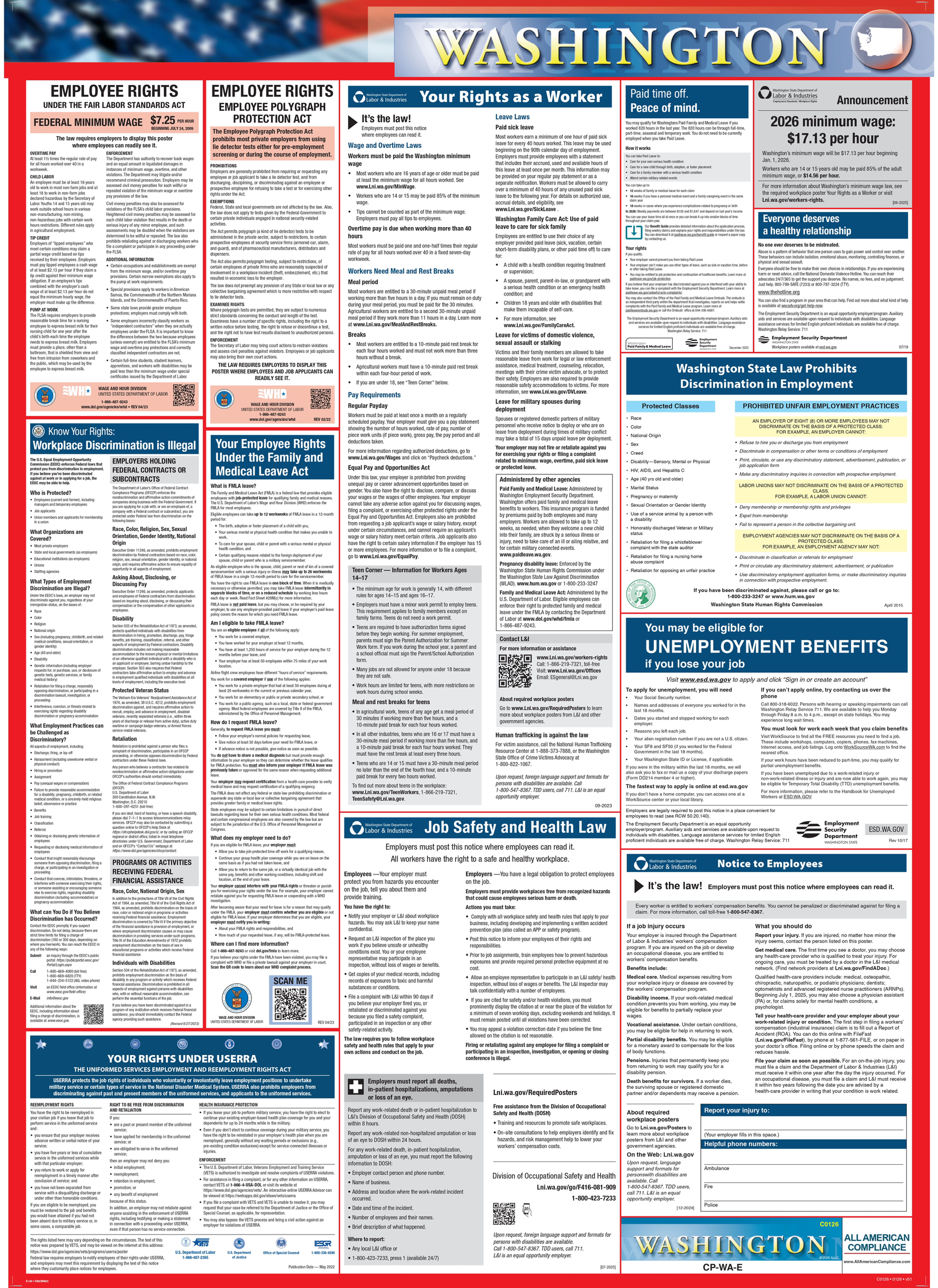
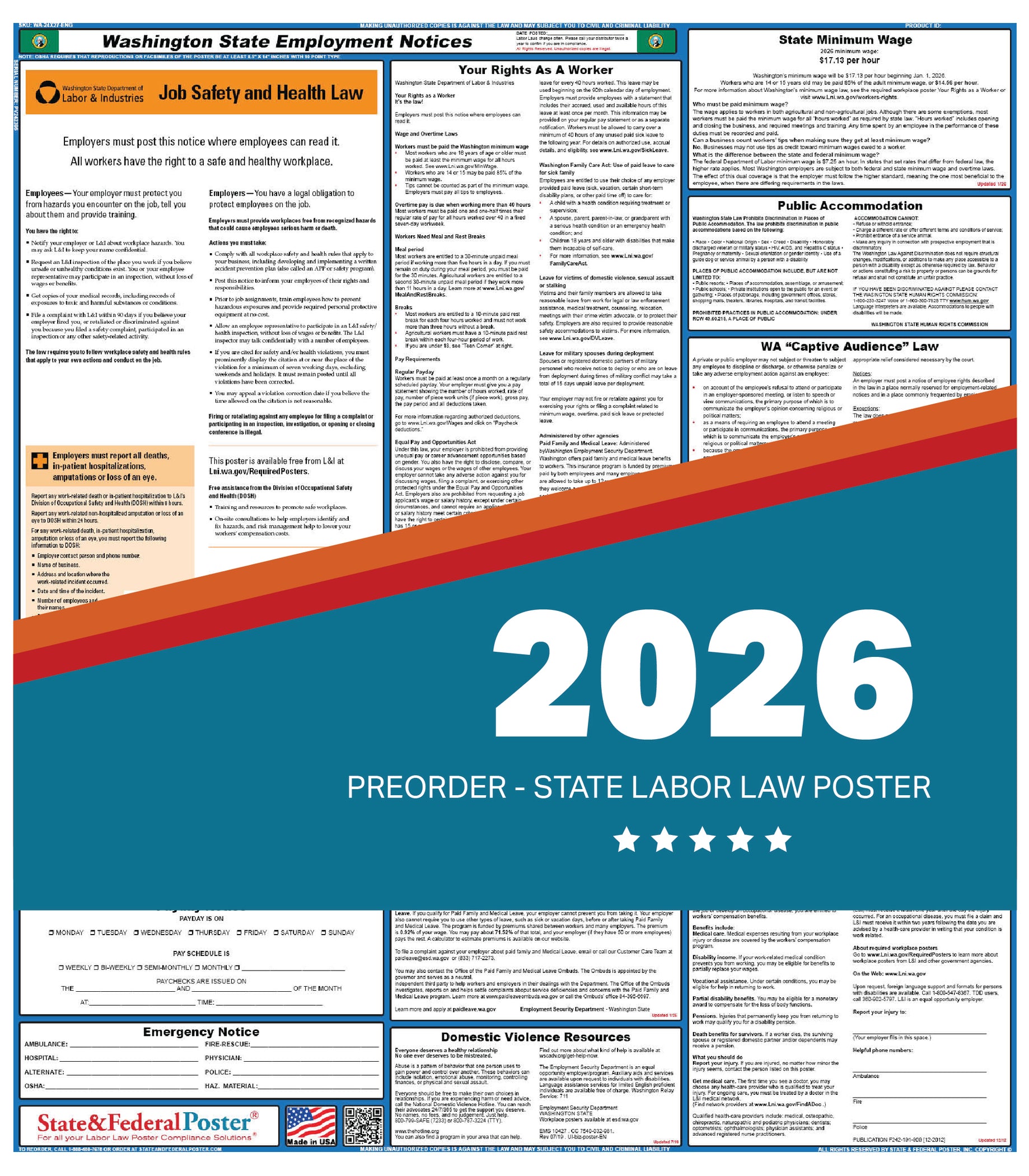
The primary posters required by the state include "Your Rights as a Worker," "Job Safety and Health Law," and "Notice to Employees—If a Job Injury Occurs." While many employers choose to purchase an "all-in-one" poster from a third-party vendor, it is important to know that these posters are available for free directly from the Washington Department of Labor & Industries.
In addition to L&I requirements, the Employment Security Department (ESD) requires posters regarding Unemployment Benefits and the Paid Family and Medical Leave (PFML) program. As of 2026, the WA Cares Fund (the state's long-term care insurance program) also maintains specific notification requirements that are often bundled into labor law displays.
Selecting the Right Location for Physical Displays
The legal standard for "displaying" a poster is that it must be placed where it can be "readily observed" by employees. This means you cannot tuck the posters away in a manager’s office or a locked filing cabinet. The goal is to ensure that an employee does not have to ask permission to see their rights.
High-Traffic Areas
Commonly accepted locations include:
- Employee Breakrooms: This is the most common location because employees naturally congregate there during non-working hours, providing ample time to read the fine print.
- Near Time Clocks: If your employees punch in and out at a physical station, this is a prime location for mandatory notices.
- Central Hubs or Hub Rooms: For industrial or warehouse settings, a central bulletin board near the main entrance or the safety equipment locker is appropriate.
- Lobbies or Reception Areas: If your business is a retail or service environment where employees frequently pass through the front entrance, a back-of-house hallway leading to the lobby is a strong choice.
Lighting and Visibility
Visibility involves more than just location; it involves accessibility. The posters must be at a height where they can be comfortably read (usually eye level, approximately 5 feet from the floor). Furthermore, the area must be well-lit. If a breakroom is dim or the posters are placed behind a vending machine, the employer may be found in non-compliance because the information is not "readily observable."
Addressing Remote and Hybrid Workforces in 2026
By 2026, the definition of a "workplace" has significantly evolved. Washington state law recognizes that a physical poster in an empty office does nothing to inform a remote workforce. However, the requirement to display posters remains tied to the location where the work is performed.
For Fully Remote Employees
If your company operates entirely virtually or has employees who never report to a physical office, you must provide the posters in an electronic format. The best practice is to:
- Host the posters on a company Intranet: Create a dedicated "Compliance" or "HR Resources" page where current versions of all state and federal posters are hosted as PDFs.
- Email the posters annually: Whenever a poster is updated (typically on January 1st of each year), send a digital copy to all remote staff.
- Include them in the Employee Handbook: While a handbook is not a substitute for a conspicuous display, it serves as an excellent secondary reference.
For Hybrid Employees
For staff that report to the office at least occasionally, you must maintain physical posters in the office and provide electronic access. This "dual notification" strategy ensures that no matter where the employee is working, they have access to their rights under the Washington Industrial Insurance Act and the Minimum Wage Act.
Language and Accessibility Requirements
Washington is a linguistically diverse state. If you have a significant portion of your workforce that speaks a language other than English, you have additional responsibilities.
According to L&I guidelines, if 5% or more of your workforce at a specific location speaks a language other than English as their primary language, you should display the posters in those languages as well. L&I provides Spanish versions of all mandatory posters. For other languages, such as Vietnamese, Russian, or Chinese, employers should check the Washington L&I website for available translations.
Furthermore, posters must be accessible to employees with visual impairments. In some cases, this may mean providing a large-print version or ensuring that electronic versions are compatible with screen-reading software.
The Annual Update Cycle: What Changes in 2026?
Washington state is known for its frequent adjustments to labor laws, particularly concerning the minimum wage and the Paid Family and Medical Leave premium rates. These changes almost always trigger a mandatory poster update.
| Poster Name | Agency | Typical Update Frequency | Key 2026 Focus |
|---|---|---|---|
| Your Rights as a Worker | L&I | Annual (January 1) | Updated minimum wage and sick leave accrual rates. |
| Job Safety and Health Law | L&I/WISHA | Occasional | New safety standards for heat and smoke exposure. |
| Unemployment Benefits | ESD | Rare | Procedural changes in filing claims. |
| Paid Family and Medical Leave | ESD | Annual | Updated premium rates for the 2026 calendar year. |
| WA Cares Fund | ESD | Occasional | Updates on exemption status and benefit eligibility. |
| Federal Minimum Wage/EEOC | DOL/EEOC | Rare | Federal parity and discrimination protections. |
Employers should establish a "Compliance Audit" every December. Because Washington’s minimum wage is adjusted based on the Consumer Price Index (CPI), the "Your Rights as a Worker" poster is virtually guaranteed to change every year on January 1st. Using an outdated poster is one of the easiest ways for a business to fail a spot inspection.
Federal vs. State Posters: The Overlap
Displaying the Washington state labor law poster is only half of the requirement. Employers must also display federal posters mandated by the U.S. Department of Labor (DOL). In most cases, the physical display should include both state and federal notices side-by-side.
Key federal posters include:
- Fair Labor Standards Act (FLSA): Federal minimum wage.
- Family and Medical Leave Act (FMLA): For employers with 50 or more employees.
- Equal Employment Opportunity (EEO): "Know Your Rights" poster.
- Occupational Safety and Health Act (OSHA): Federal safety standards.
While some information overlaps (such as minimum wage), you must display both. If the state minimum wage is higher than the federal wage (which is the case in Washington), the state poster dictates the rate, but the federal poster must still be visible to comply with federal law.
Common Mistakes to Avoid
Even well-intentioned employers often make errors that lead to non-compliance. Avoiding these pitfalls will ensure your business remains protected.
1. Using "All-in-One" Posters From Previous Years
Many companies sell laminated "all-in-one" posters. While convenient, these posters become obsolete the moment a single law changes. A common mistake is keeping a 2024 or 2025 poster on the wall well into 2026. Always check the revision date in the bottom corner of the poster.
2. Placing Posters Behind Glass or Plastic
While it is acceptable to frame posters to keep them clean, the glass or plastic must not be reflective to the point of being unreadable. If an employee has to squint or move to avoid a glare to read the text, the "conspicuous" requirement is not met.
3. Forgetting Secondary Locations
If your business has multiple buildings or separate floors that do not share a common break area, you must have a set of posters on every floor or in every building. You cannot expect an employee in Building B to walk to Building A to read their rights.
4. Relying Solely on Digital Postings for On-Site Workers
Some employers believe that putting the posters on the company's internal server is enough for everyone. However, for employees who physically report to a job site, a physical poster is still legally required. Digital versions are a supplement for hybrid workers and a requirement for remote workers, not a replacement for the physical board in the breakroom.
How to Verify Authenticity and Avoid Scams
Employers often receive official-looking mail pieces or phone calls warning them of massive fines if they don't buy a new "2026 Labor Law Poster" immediately for $100 or more.
It is important to remember that posters are free. You can download them as PDFs from the Washington L&I website and print them on standard 8.5" x 11" paper. As long as the font is legible and all required posters are present, this is perfectly legal. You do not need to buy the expensive, laminated versions from private vendors unless you prefer the aesthetic and convenience of a single sheet.
To verify if your posters are current, visit the L&I Required Posters page. They provide a checklist that allows you to compare the "Last Updated" date on your wall with the most recent version available on their server.
FAQs
Do I need to display posters if I only have one employee?
Yes. Washington labor laws apply even if you have only one employee. The requirement to inform workers of their rights under the Minimum Wage Act and the Industrial Insurance Act does not have a minimum employee threshold for the basic mandatory posters.
Can I print the posters myself, or do they have to be a specific size?
You can print them yourself. While many vendors sell large 24" x 36" posters, Washington law does not mandate a specific size for the "Your Rights as a Worker" or "Job Safety" posters, provided they are legible. However, federal OSHA posters often have specific size requirements (usually 8.5" x 14"), so it is best to print them in their original scale.
What happens if an employee defaces or removes the poster?
The employer is responsible for maintaining the posters. If a poster is defaced or removed, you must replace it as soon as you become aware of the issue. Periodically checking your "Compliance Corner" or bulletin board should be a standard part of your facility maintenance or HR audit.
Are there separate posters for different industries in Washington?
Yes. Certain industries, such as agriculture or construction, may have additional specific requirements. For example, agricultural employers must display the "Notice to Agricultural Workers" poster, which addresses specific pesticide safety and field sanitation rules that do not apply to office workers.
Is the Paid Family and Medical Leave poster different from the L&I poster?
Yes. The Paid Family and Medical Leave (PFML) program is managed by the Employment Security Department (ESD), not L&I. You must ensure you have both the L&I "Your Rights as a Worker" poster and the ESD "Paid Family and Medical Leave" notice.
Final Recommendation
For 2026, the most effective way to ensure compliance is to use a "Hybrid Display Strategy." Physically mount the latest posters in a high-visibility area like the breakroom for your on-site staff, and simultaneously upload the digital versions to your company's internal communication platform (like Slack, Microsoft Teams, or an Intranet). Check the Washington L&I and ESD websites every December to download the new versions that take effect on January 1st. This proactive approach eliminates the risk of fines and ensures your employees are properly informed of their rights.
Image Gallery