How Consumer Reports Recommends Saving on Auto Insurance
Consumer Reports helps drivers lower auto insurance costs by exposing how non-driving factors influence rates, analyzing price variances across hundreds of carriers, and identifying high-performing regional insurers. By evaluating cred...
Consumer Reports helps drivers lower auto insurance costs by exposing how non-driving factors influence rates, analyzing price variances across hundreds of carriers, and identifying high-performing regional insurers. By evaluating credit-score impacts, optimizing deductibles, and re-evaluating bundling strategies, policyholders can secure substantial annual savings without sacrificing necessary coverage protections.
Contents
The Consumer Reports Approach to Auto Insurance Savings
Consumer Reports (CR), an independent, nonprofit research organization, has conducted extensive investigations into the auto insurance market. Unlike traditional insurance comparison tools that rely on paid broker partnerships or lead generation, CR analyzes rate filings, regulatory data, and large-scale member satisfaction surveys to evaluate auto insurance value.
Their research consistently demonstrates a primary market reality: premium prices for the exact same coverage profile can vary by hundreds or even thousands of dollars per year depending on the insurer. Insurers utilize complex proprietary algorithms that weight risk factors differently. Consequently, a driver who receives an expensive rate quote from one national carrier may secure a significantly lower rate from another reputable company.
Saving money on auto insurance through CR recommendations does not require stripping away essential liability coverage. Instead, it relies on understanding how rating algorithms work, shopping strategically across different types of carriers, adjusting deductibles intelligently, and eliminating redundant policy add-ons.
Disclaimer: Auto insurance regulations, rating factors, and minimum coverage requirements vary significantly by legal jurisdiction. The guidance provided here serves general educational purposes. Drivers should consult licensed insurance professionals and state insurance commissioners for personalized legal and financial advice.
Uncovering Hidden Rating Factors: Credit Scores and Socioeconomic Data
One of Consumer Reports' most impactful findings is the heavy reliance by insurance companies on non-driving factors to determine premiums. In many states, insurers construct a "credit-based insurance score" derived from credit bureau reports. CR investigations revealed that a driver's credit score can influence their auto insurance rates as much as—or sometimes more than—their actual driving record.
| Driving Factors | Non-Driving Factors |
|---|---|
| Moving violations | Credit-based insurance score |
| At-fault accidents | ZIP code / location |
| Annual mileage | Marital status |
| Driving experience | Education & occupation |
The Impact of Credit-Based Insurance Scores
Insurance carriers argue that credit history correlates with financial responsibility and the statistical likelihood of filing a claim. However, CR's data analysis highlights that a poor credit score can increase an individual's premium by over 100%, even if the driver maintains a completely clean driving record free of accidents or moving violations.
While state legislation in jurisdictions such as California, Hawaii, Massachusetts, and Washington places restrictions or outright bans on using credit scores to set auto rates, credit remains a dominant factor across most of the United States.
How to Mitigate Non-Driving Penalty Costs
To counter the impact of credit-based rating models, CR recommends several actionable steps:
- Audit Credit Reports Regularly: Check credit reports for errors, delinquent accounts, or fraudulent items. Removing incorrect negative marks can swiftly raise a credit score, which should then be reported to the auto insurer for a policy rate re-evaluation.
- Shop Insurers That Weight Credit Less Heavily: Different carriers weight credit history differently. If your credit score is compromised, obtaining quotes from mutual insurers or companies that focus primarily on driving history can yield significantly lower rates.
- Update Life Milestones Promptly: Factors such as getting married, reaching age 25, or moving to a low-crime ZIP code alter an insurer’s risk calculation. Notify your insurance agent immediately when these changes occur rather than waiting for annual policy renewals.
Beyond the Big Names: Regional vs. National Insurers
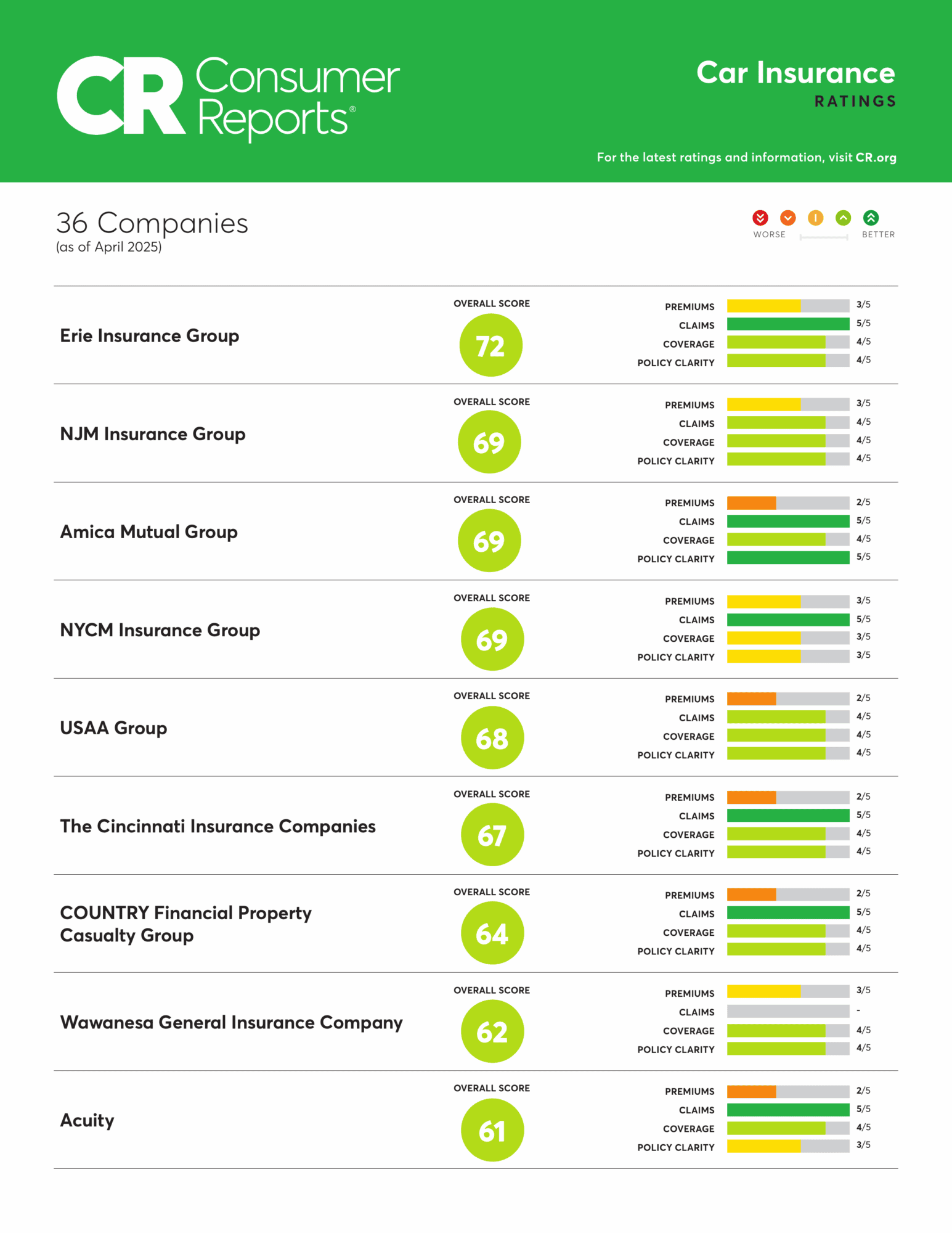
Consumers are constantly inundated with advertising from large national auto insurers. However, Consumer Reports’ extensive ratings show that smaller regional carriers, mutual companies, and member-owned insurers frequently outperform major national brands in customer satisfaction, claim settlement fairness, and pricing transparency.
Why Regional Insurers Frequently Win on Value
Regional insurance companies often focus on specific geographic territories where they maintain localized underwriting expertise. Because they incur lower national advertising overhead and possess direct knowledge of regional repair costs and weather risks, their operating expenses are frequently lower.
CR surveys consistently highlight top-tier ratings for regional and specialized insurers, including companies such as Amica Mutual, NJM Insurance, Auto-Owners Insurance, Erie Insurance, and USAA (which serves military members and their families).
| National Mega-Carriers | Regional & Mutual Insurers |
|---|---|
| Massive advertising overhead | Lower marketing expenses |
| Broad national footprint | Deep local market expertise |
| Standardized customer service | High satisfaction ratings |
| Often higher base rates | Competitive customized rates |
Navigating Distribution Channels
Understanding how insurance is sold helps policyholders locate the best pricing structures:
- Direct Writers: Insurers that sell policies directly to consumers online or over the phone, cutting out independent agent commissions.
- Captive Agents: Agents who represent a single insurance company (e.g., State Farm or Allstate). They can offer deep knowledge of their carrier's proprietary discounts but cannot present competing options.
- Independent Agents: Brokers who represent multiple regional and national insurance carriers. An independent agent can quote several regional insurers simultaneously to find the most competitive rate for your profile.
Step-by-Step Guide to Implementing CR’s Savings Strategies
Executing a structured auto insurance review using Consumer Reports' guidelines can substantially lower annual vehicle operating costs. Follow this step-by-step process to optimize coverage without taking on unmanageable financial risk.
- Step 1: Audit Current Coverage & Vehicle Valuation
- Step 2: Solicit Quotes Across 3–5 Distinct Carriers
- Step 3: Optimize Deductible Thresholds Intentionally
- Step 4: Analyze Bundling vs. Unbundling Economics
- Step 5: Evaluate Telematics and Mileage Reductions
Step 1: Audit Current Coverage and Apply the "10% Rule"
Begin by pulling your current policy’s Declarations Page. Review your bodily injury liability, property damage liability, comprehensive, and collision limits.
For older vehicles, CR suggests applying the 10% Rule: If the annual cost of comprehensive and collision coverage exceeds 10% of the vehicle’s current market value (determined via reliable pricing guides like Kelley Blue Book or NADA), carrying physical damage coverage may no longer be cost-effective.
Example: If an older car has an equity value of $3,000, and comprehensive/collision coverage costs $400 per year, paying that premium plus a $500 deductible means an owner would recover very little financial benefit in the event of a total loss. Dropping physical damage coverage and retaining robust liability protection frees up capital immediately.
Step 2: Request Quotes from at Least 3 to 5 Insurers
Do not limit your quote search to online aggregators, which frequently exclude regional carriers and mutual companies. Obtain direct quotes from:
- At least two major national direct writers.
- At least two regional or mutual insurers (via an independent insurance agent or direct site).
- Specialty carriers if eligible (such as USAA).
Ensure that every quote uses identical coverage limits and deductibles so you can evaluate prices on an apples-to-apples basis.
Step 3: Select Deductible Levels Intentionally
Increasing your deductible—the out-of-pocket amount paid before insurance coverage applies to physical damage—is one of the fastest ways to lower premiums.
Shifting a deductible from $250 or $500 up to $1,000 can reduce comprehensive and collision premium costs by 15% to 30%. However, this strategy requires maintaining an accessible emergency savings fund of at least $1,000 to cover out-of-pocket obligations should an accident occur.
Step 4: Compare Multi-Policy Bundling Against Unbundled Rates
Insurers frequently promote multi-policy discounts (combining auto with homeowners or renters insurance) as the ultimate savings strategy. While bundling often produces discounts of 5% to 25%, Consumer Reports notes that bundling is not automatically the cheapest solution.
In some cases, a specialized home insurer plus a separate, highly competitive regional auto insurer yields a lower total annual cost than a bundled package from a national carrier. Always calculate the combined total expense of both policies before deciding to bundle.
Step 5: Leverage Telematics and Mileage Adjustments
If you work remotely, commute via public transportation, or log low annual mileage (typically under 7,500 miles per year), ensure your insurer reflects your actual usage.
Many carriers offer usage-based insurance (UBI) programs powered by mobile apps or OBD-II vehicle plug-in devices that track real-time driving behaviors, including braking, acceleration, time of day, and total miles. Drivers with calm driving habits and low annual mileage can secure discounts of 10% to 40%. Be sure to review each carrier's privacy policy regarding data collection before enrolling.
Auto Insurance Savings Tactics Comparison
The table below outlines common auto insurance adjustment strategies recommended by Consumer Reports, detailing their typical impact, financial requirements, and operational considerations.
| Savings Strategy | Estimated Premium Impact | Financial / Practical Requirement | Operational Considerations |
|---|---|---|---|
| Shopping Regional Insurers | High (15% – 35% savings) | Time to request quotes from non-national brands | Regional availability varies by state; may require using an independent agent. |
| Raising Deductible ($500 to $1,000) | Moderate to High (15% – 30% on physical damage) | Liquid emergency savings equal to the deductible | Increases immediate out-of-pocket cost during a claim. |
| Dropping Comprehensive/Collision | High (Varies; removes physical damage costs) | Vehicle value must be low enough to justify self-insuring | Only advisable when vehicle market value is low and the loan is paid off. |
| Auditing Credit & Correcting Errors | Moderate to High (10% – 50% in applicable states) | Periodic credit monitoring and dispute filings | Excludes states that prohibit credit-based insurance scoring (e.g., CA, HI, MA). |
| Telematics / Usage-Based Tracking | Moderate (5% – 40% discount) | Willingness to monitor driving habits via app/device | Hard braking or night driving can trigger rate penalties with select carriers. |
| Updating Annual Mileage Records | Low to Moderate (5% – 15% savings) | Validating actual odometer readings with insurer | Requires prompt notification to the carrier if commute patterns permanently change. |
Common Pitfalls When Shopping for Auto Insurance
While seeking lower auto insurance rates, drivers occasionally make missteps that compromise financial protection or lead to long-term costs.
- Drop Required Liability Limits: Reducing bodily injury limits to state minimums leaves assets vulnerable to major legal lawsuits after severe accidents.
- Ignore Policy Fine Print & Exclusions: Failing to check rental reimbursement, OEM parts riders, or step-down provisions can create unexpected out-of-pocket costs.
- Accept Automatic Policy Renewals: Relying on automatic renewal often leads to "price optimization" surcharges that quietly increase premiums year over year.
1. Dropping Liability Limits to State Minimums
State legal minimum liability requirements are frequently inadequate to cover catastrophic accidents. For instance, several states set property damage liability minimums as low as $15,000 to $25,000—amounts easily exceeded in an accident involving modern vehicles. Consumer Reports strongly advises carrying liability coverage well above state minimums (such as $100,000/$300,000/$100,000 or a combined single limit of $300,000) to protect personal savings and home equity.
2. Falling Victim to "Price Optimization"
Some insurance companies utilize an analytical strategy known as "price optimization." This technique evaluates a customer's loyalty history and shopping habits to determine how high their rate can be increased upon renewal before the policyholder will switch to a competitor. Drivers who stay with the same insurer for decades without re-quoting often end up paying significantly higher rates than newly acquired policyholders with identical risk profiles.
3. Ignoring Policy Exclusions and Add-On Fees
When comparing policies, ensure you are not losing key policy protections such as roadside assistance, rental car reimbursement, or original equipment manufacturer (OEM) parts coverage if those are important to you. Conversely, verify that you aren't paying twice for roadside assistance if you already hold a membership through a credit card or auto club.
Frequently Asked Questions
How often should policyholders re-evaluate their auto insurance rates?
Consumer Reports recommends reviewing auto insurance coverage and shopping quotes at least once every one to two years, or whenever a major life event occurs. Events such as buying a new car, relocating, getting married, paying off an auto loan, or seeing a child move out of the household alter risk profiles and open up new opportunities for savings.
Does checking auto insurance quotes damage your credit score?
No. When an insurance company or comparison platform checks your credit to generate a rate quote, it performs a "soft inquiry." Soft inquiries do not affect credit scores or appear on consumer-facing credit reports used by prospective lenders.
Is it safe to drop comprehensive and collision coverage on an older vehicle?
Dropping physical damage coverage is generally safe if the car is fully paid off (no active lienholder requiring coverage) and its market value has dropped significantly relative to the premium cost. However, policyholders must ensure they have enough savings to replace the vehicle or cover repairs out-of-pocket if an accident occurs.
How does telematics tracking affect insurance privacy?
Telematics apps and plug-in devices track real-time location data, driving speeds, braking force, and phone interaction while driving. While this data helps insurers reward safe drivers with lower rates, it involves sharing personal movement data. Drivers concerned about privacy should carefully read the insurer's telematics data-sharing disclosures before participating.
Does bundling home and auto insurance always guarantee the best price?
No. While bundling yields a multi-policy discount, it does not guarantee the lowest combined price. A specialized insurer offering low individual rates on auto insurance combined with a separate homeowners insurer can sometimes cost less overall than a bundled package from a single national carrier. Always sum the total annual cost of both policies to evaluate actual savings.
Practical Action Plan
To reduce your auto insurance expenditure without compromising coverage quality, execute the following plan:
- Review Your Declarations Page: Identify current liability coverage limits, deductibles, annual mileage figures, and physical damage coverages.
- Determine Your Vehicle's Value: Check your car's market value using standard vehicle valuation resources to decide whether comprehensive and collision protections remain cost-effective.
- Check Credit Reports: Review reports from the major bureaus to ensure no inaccuracies are suppressing your credit-based insurance score.
- Obtain 3 to 5 Quotes: Request quotes with matching coverage limits from direct-writing national carriers, top-rated regional mutual insurers, and an independent agent.
- Adjust Options: Increase your collision and comprehensive deductibles to $500 or $1,000 if your emergency fund allows, and ask about low-mileage or telematics savings options.
For additional regulatory resources, policy guidelines, and consumer protection information in your area, consult the National Association of Insurance Commissioners (NAIC) or your local state insurance department.
Image Gallery