Slow Cooked Beef Ribs in the Oven: A Precise Bake Method
To achieve perfectly slow-cooked beef ribs in the oven, bake them at a consistent 275°F (135°C) until they reach an internal temperature of 203°F (95°C). This process typically takes 5 to 7 hours, involving an initial uncovered roast f...
To achieve perfectly slow-cooked beef ribs in the oven, bake them at a consistent 275°F (135°C) until they reach an internal temperature of 203°F (95°C). This process typically takes 5 to 7 hours, involving an initial uncovered roast for bark development followed by a tightly wrapped phase to ensure tenderness and moisture.
Contents
Understanding the Anatomy of Beef Ribs
Before applying a precise bake method, it is essential to identify the specific cut of beef ribs you are preparing. In the culinary world of 2026, transparency in meat labeling has improved, but the two primary cuts remains distinct: Plate Short Ribs and Back Ribs.
Plate Short Ribs (typically bones 6, 7, and 8) are the gold standard for slow cooking. They contain a significant amount of intramuscular fat and connective tissue, which transforms into gelatin during a long, controlled bake. These are often referred to as "dino ribs" due to their massive size. Chuck Short Ribs (bones 1 through 5) are a slightly smaller but equally viable alternative, offering excellent marbling.
In contrast, Beef Back Ribs are the bones removed from a ribeye roast. While flavorful, they have very little meat on top of the bone; most of the meat is located between the bones. Back ribs cook significantly faster—usually in 3 to 4 hours—and are more prone to drying out if the precise bake method for short ribs is applied to them without adjustment. For the purpose of this guide, we focus on the Short Rib, as it requires the most technical precision to master.
The Science of "Low and Slow" Heat Transfer
The objective of a precise bake is not merely to "cook" the meat but to facilitate a biochemical transformation. Beef ribs are tough because they are held together by collagen, a structural protein. At standard cooking temperatures, collagen is rubbery and inedible. However, when held at temperatures between 160°F and 180°F for an extended period, collagen undergoes a process called denaturing, where it converts into gelatin.
Gelatin is what gives slow-cooked beef its silky, melt-in-the-mouth texture. The challenge lies in the "stall." As the meat heats up, moisture evaporates from the surface, cooling the rib and causing the internal temperature to plateau (often around 160°F-170°F). A precise bake method anticipates this stall and uses a technique known as the "Texas Crutch"—wrapping the meat—to power through the temperature plateau while preserving internal juices.
Essential Equipment for Precision Roasting
You cannot achieve a precise bake using the analog dial on a standard oven. Most home ovens in 2026 still fluctuate by as much as 25°F from the set temperature. To ensure success, the following tools are required:
- Digital Dual-Probe Thermometer: One probe monitors the ambient oven temperature (placed on the rack next to the meat), while the other stays inserted in the thickest part of the rib meat.
- Heavy-Duty Rimmed Baking Sheet: To catch rendered fat and prevent oven fires.
- Wire Cooling Rack: Placed inside the baking sheet to allow hot air to circulate 360 degrees around the ribs.
- Heavy-Duty Aluminum Foil or Peach Butcher Paper: Foil provides a tighter seal and more "steaming" effect, while butcher paper breathes slightly, better preserving the crust (bark).
Phase 1: Preparation and the Seasoning Strategy
Preparation begins with the removal of the silverskin or membrane on the bone side of the ribs. While some argue that leaving it on helps hold the meat to the bone, it generally acts as a barrier to seasoning and becomes unpleasantly leathery. Use a butter knife to pry up a corner of the membrane, then grip it with a paper towel and pull it away in one motion.
The Binder and the Rub
In 2026, the use of a "binder" remains a standard practice among pitmasters and home chefs alike. A thin coating of yellow mustard or olive oil helps the dry rub adhere to the meat. The mustard flavor evaporates during the bake, leaving no trace.
For the rub, a "Texas Style" approach is recommended for beef:
- Kosher Salt: Essential for moisture retention and flavor.
- Coarse Ground Black Pepper: (16-mesh is ideal) to create a textured "bark."
- Garlic Powder: Adds savory depth without burning like fresh garlic.
Apply the rub generously on all sides. Unlike pork, beef can handle a heavy coating of seasoning due to the richness of the fat.
Phase 2: The Initial Bake (Setting the Bark)
Set your oven to 275°F (135°C). Ensure your ambient probe confirms the oven has stabilized at this temperature before the ribs go in.
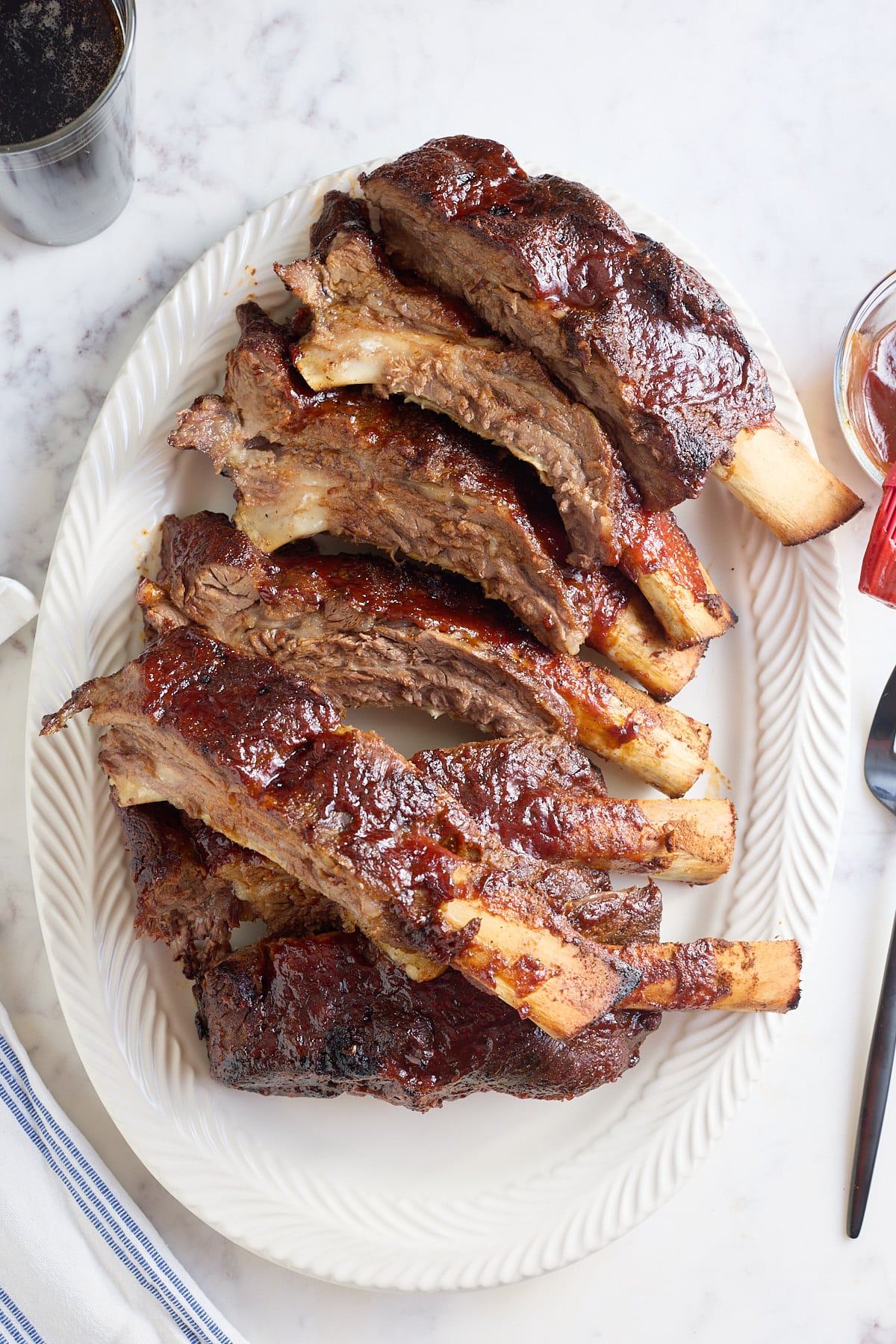
Place the seasoned ribs on the wire rack over the baking sheet, bone-side down. The initial phase of the bake is performed uncovered. This allows the Maillard reaction—a chemical reaction between amino acids and reducing sugars—to occur on the surface of the meat. This creates the dark, flavorful crust known as "bark."
This phase typically lasts 3 to 4 hours. During this time, do not open the oven door. Every time the door opens, the ambient temperature drops, extending the cook time and disrupting the precise heat flow. You are looking for an internal temperature of approximately 165°F to 170°F and a surface that has turned a deep mahogany or "meteorite" black.
Phase 3: The Wrap (The Precision Pivot)
Once the ribs reach the 165°F-170°F range and the bark is well-set, it is time to wrap. Lay out two large sheets of heavy-duty aluminum foil. You may add a small amount of liquid—such as beef broth, apple cider vinegar, or even a splash of stout beer—to the foil before sealing. This creates a localized humid environment that accelerates the breakdown of remaining connective tissues.
Wrap the ribs as tightly as possible. Air pockets inside the foil can lead to uneven steaming. Return the wrapped ribs to the oven, re-inserting the internal temperature probe through the foil into the meat.
| Cooking Phase | Target Internal Temp | Duration (Est.) | Visual/Tactile Cue |
|---|---|---|---|
| Initial Roast | 160°F - 170°F | 3 - 4 Hours | Dark, dry crust (Bark) |
| The Wrap | 203°F | 2 - 3 Hours | Meat pulling back from bone |
| The Rest | N/A | 1 Hour | Probe slides in like butter |
Phase 4: Reaching Probe Tenderness
The most critical aspect of a precise bake is knowing that temperature is a guide, but tenderness is the goal. While 203°F (95°C) is the standard target for beef ribs, some racks may be ready at 200°F, while others need to reach 205°F.
Test for "probe tenderness" by inserting a toothpick or the probe of your thermometer into the meat between the bones. It should slide in and out with absolutely no resistance, similar to the feeling of a needle going into a jar of room-temperature peanut butter. If you feel any "tug" or resistance, the collagen has not fully melted. Close the foil and continue baking in 15-minute increments.
Phase 5: The Essential Rest
One of the most common mistakes in home cooking is slicing the meat immediately after removing it from the oven. At 203°F, the muscle fibers are tight, and the juices are highly pressurized. Slicing now will cause the moisture to pour out onto the cutting board, leaving the meat dry.
Transfer the wrapped ribs to a room-temperature area and let them rest for at least 60 minutes. For even better results, wrap the foiled ribs in a large towel and place them in an empty, insulated cooler (without ice). This slow deceleration of temperature allows the muscle fibers to relax and reabsorb the rendered fats and juices, ensuring every bite is succulent.
Troubleshooting Common Precise Bake Issues
The Meat is Tough: If the ribs are difficult to chew, they are likely undercooked. This occurs when the cook is stopped based on time rather than internal temperature or probe tenderness. Collagen requires time and specific heat to melt; if you pull them at 190°F, they will be tough.
The Meat is Dry: This can happen if the ribs were overcooked (reaching 210°F+) or if the wrap was not tight enough, allowing too much moisture to escape as steam. Selecting a cut with poor marbling (too little internal fat) can also contribute to a dry result.
The Bark is Mushy: This is a side effect of the "Texas Crutch." If you prefer a crunchier bark, remove the ribs from the foil once they hit 200°F and bake them uncovered for the final 10–15 minutes of the process.
Frequently Asked Questions
Can I cook beef ribs at 225°F instead of 275°F? Yes, but the total cook time will increase by several hours. Modern culinary research suggests that 275°F is the "sweet spot" for beef ribs, providing enough heat to render fat efficiently without drying out the exterior meat.
Do I need to add liquid smoke to the oven? Since an oven does not provide the natural wood smoke of a barbecue pit, a small amount of high-quality liquid smoke can be added to the binder or the wrap liquid. However, it is not necessary for tenderness or the "precise bake" mechanics.
Why did my ribs pull back so far from the bone? This is a positive sign. As the meat cooks and the proteins contract, the meat naturally recedes from the bone ends. A 1/2-inch to 1-inch pullback is a classic visual indicator that the ribs are nearing completion.
Is it safe to leave ribs in the oven overnight? While some "low and slow" methods suggest very low temps (200°F) overnight, it is generally discouraged for home ovens due to safety concerns and the risk of the meat spending too much time in the bacterial "danger zone" (40°F–140°F). The 5-to-7-hour method at 275°F is safer and more predictable.
Final Recommendation
For the best results with this precise bake method, prioritize the quality of your meat. In 2026, sourcing USDA Prime or highly-marbled Wagyu beef short ribs will provide a significant margin of error, as the higher fat content protects the meat from drying out. Always use a calibrated digital thermometer, and never skip the one-hour resting period. By following these technical milestones, you can produce beef ribs in a standard kitchen oven that rival those from the world's best smokehouses.
Image Gallery