What Defines the New Middle Class? Economic Shifts, Income Benchmarks, and Financial Realities
The new middle class refers to a demographic defined less by stable, single-income homeownership and guaranteed pensions, and more by flexible earnings, tech-enabled employment, heavy reliance on self-directed investments, and heighten...
The new middle class refers to a demographic defined less by stable, single-income homeownership and guaranteed pensions, and more by flexible earnings, tech-enabled employment, heavy reliance on self-directed investments, and heightened exposure to systemic living costs like housing, healthcare, and higher education. Today, maintaining middle-class status requires proactive financial management rather than reliance on traditional economic structures.
Contents
Traditional vs. The New Middle Class: A Socioeconomic Shift
For decades following World War II, the middle class was defined by a predictable economic model. A high school diploma or a single mid-level corporate role could secure a single-family home, reliable health coverage, periodic wage growth, and a defined-benefit pension. Wealth accumulation occurred passively through real estate appreciation and long-term employer tenure.
Today, structural economic transformations have reshaped this framework. The shift from a manufacturing- and corporate-tenure economy to a service-, technology-, and knowledge-driven market altered how income is generated and preserved.
| Traditional Middle Class | The New Middle Class |
|---|---|
| Single-income stability | Dual-income requirement |
| Passive home equity wealth | Active multi-asset investing |
| Employer-funded pensions | Self-directed 401(k)/IRAs |
| Predictable career ladder | Continuous skill re-tooling |
The modern middle-class landscape reflects several distinct changes:
- Income Multiplicity: Single-earner households capable of supporting a standard middle-class lifestyle are increasingly rare. Most contemporary middle-class households depend on dual incomes or supplementary revenue streams.
- Shift in Benefit Structures: Defined-benefit pension plans have largely been replaced by defined-contribution plans, such as 401(k) and 403(b) accounts. This transfers investment risk, portfolio management, and market volatility directly to individual workers.
- Escalating Baseline Expenses: While consumer electronics, apparel, and general goods have become relatively cheaper adjusted for inflation, essential pillars of middle-class stability—housing, high-quality childcare, medical services, and tertiary education—have outpaced broader income growth.
As a result, belonging to the new middle class is defined less by earning a specific salary and more by how effectively a household manages net cash flow against rising fixed overhead.
Key Indicators and Income Benchmarks
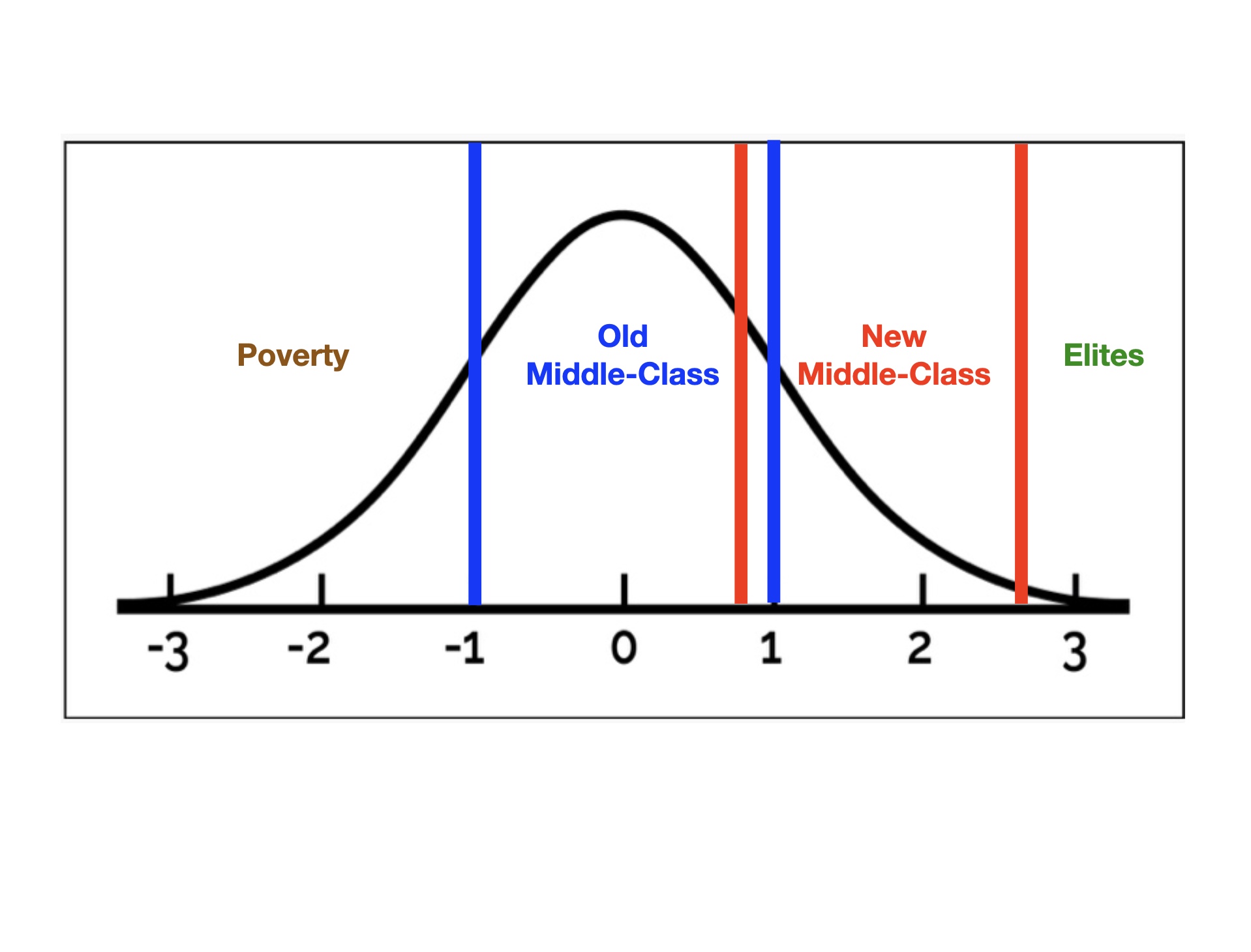
Quantifying the middle class requires looking at both income thresholds and regional purchasing power. The Pew Research Center historically defines middle-income households as those earning between two-thirds and double the national median household income, adjusted for household size.
- MEDIAN INCOME
- Lower Income: 66% of median income
- The New Middle Class
- Upper Income: 200% of median income
However, income alone fails to capture the full economic picture due to drastic regional variations in the cost of living.
Income Ranges by Household Size
Middle-class status varies depending on the number of dependents supported by a household budget. Based on national median figures, representative income bands align roughly with the following parameters:
- Single Individual: $32,000 to $96,000
- Two-Person Household: $45,000 to $135,000
- Three-Person Household: $55,000 to $165,000
- Four-Person Household: $65,000 to $195,000
Geographic Adjustments and Purchasing Power
National averages do not reflect localized costs. An annual household income of $100,000 yields vastly different outcomes depending on location:
- High-Cost Urban Centers: In cities characterized by high real estate costs and localized taxation, an income of $120,000 may barely cover baseline living costs, essential insurance, debt obligations, and modest savings.
- Secondary and Rural Markets: In areas with lower housing costs, an equivalent income allows for substantial wealth accumulation, real estate equity, and discretionary spending.
Consequently, modern sociologists and economists evaluate the new middle class using structural solvency metrics—such as savings rates, debt-to-income (DTI) ratios, and asset accumulation—alongside simple income totals.
Structural Differences: Traditional vs. New Middle Class
The operational differences between the traditional middle class and today's landscape highlight why modern financial stability requires a different approach.
| Economic Parameter | Traditional Middle Class (Mid-to-Late 20th Century) | The New Middle Class (Current Reality) |
|---|---|---|
| Primary Wealth Driver | Residential real estate home equity | Diversified investment portfolios, liquid equities, real estate |
| Retirement Security | Employer-funded defined-benefit pensions | Self-directed 401(k), IRA accounts, personal taxable brokerage accounts |
| Employment Structure | Long tenure with single/few corporate employers | Frequent job transitions, hybrid/remote work, specialized consulting |
| Primary Financial Risk | General economic recessions, industrial downsizing | Asset illiquidity, medical debt, rapid inflation, technological displacement |
| Education vs. Income Ratio | Low-to-moderate educational debt yield high relative stability | High upfront educational investment with variable income security |
| Healthcare Overhead | Fully covered employer healthcare plans | High-deductible health plans (HDHPs), co-pays, substantial out-of-pocket maximums |
Core Economic Challenges Facing the Modern Middle Class
Members of the new middle class face several economic pressures that make long-term financial security harder to maintain than in previous generations.
- Core Middle-Class Economic Pressures:
- Housing Scarcity & Elevated Rates: High Mortgage Cost vs Rent
- Education & Debt: Student Loans, Retraining Need, Reduced Yield
- Healthcare Costs: HDHPs & Out-of-Pocket Maximums, Deductible Risks
1. Housing Affordability and Equity Access
Historically, homeownership served as the default engine for middle-class wealth accumulation. High home prices relative to median wages, combined with elevated mortgage interest rates, have created structural barriers to entry.
For many households, rent and mortgage payments exceed 35% of gross income, limiting the ability to allocate capital toward liquid investments or emergency funds.
2. Education Costs and Student Loan Liabilities
Higher education was historically a clear bridge to upward mobility. While post-secondary degrees remain vital for accessing professional positions, the cost of acquiring them has grown faster than starting salaries.
Carrying student debt into mid-career years delays traditional milestones like buying a home, starting a business, or committing capital to retirement accounts.
3. Healthcare Expenses and Insurance Deductibles
Even fully employed individuals with employer-sponsored health insurance face significant out-of-pocket costs. The rise of High-Deductible Health Plans (HDHPs) places the initial financial burden of care on the individual. A single major medical event can disrupt an otherwise stable household budget, making health-related costs a leading financial risk factor.
4. Job Automation and Skill Obsolescence
Technological shifts—including artificial intelligence, enterprise software automation, and globalized remote workforces—have reshaped professional white-collar roles. Middle management, administrative services, financial processing, and baseline technical writing face structural displacement, requiring professionals to continuously re-skill to protect their earning power.
Strategies for Building and Sustaining Wealth
Navigating the contemporary economy requires active balance sheet management. Households must move beyond standard budgeting and adopt disciplined asset-management practices.
- Gross Household Income
- Emergency Fund (3-6m)
- Employer Match (401k)
- High-Interest Debt $0
- Asset Allocation:
- HSA / Roth IRA: Tax-Advantaged Growth
- Taxable Stocks / Real Estate / Liquid Assets
Optimize Tax-Advantaged Vehicles
Without traditional pensions, building retirement security requires maximizing tax-advantaged accounts early in a career:
- Employer Matching: Contribute enough to corporate 401(k) or 403(b) programs to capture the full employer match before allocating funds elsewhere.
- Health Savings Accounts (HSAs): When paired with an HDHP, HSAs offer a triple tax advantage: tax-deductible contributions, tax-free growth, and tax-free withdrawals for qualified medical expenses.
- Roth IRAs: For households falling within the IRS income eligibility limits, Roth IRAs provide tax-free growth and tax-free distributions in retirement, creating a balance against future income tax obligations.
Manage Capital Allocation and Debt Structure
Maintaining financial security requires managing debt service costs relative to gross earnings:
- Target Debt-to-Income Limits: Keep total fixed debt payments—including mortgages, student loans, and auto loans—below 36% of gross monthly income.
- Eliminate Consumer Debt: Credit card balances and high-interest consumer loans quickly compound against wealth accumulation goals. Prioritize paying off debts with interest rates exceeding 7%.
- Maintain Liquid Cash Reserves: Keep three to six months of baseline operational expenses in high-yield savings accounts or short-term treasury bills to insulate investments during unexpected job transitions.
Continuous Professional Skill Development
Given the rapid pace of technological change, relying on a static degree or skill set creates financial risk. Sustained earning power requires ongoing professional adaptation:
- Acquire specialized credentials in data analysis, software tools, or industry-specific technologies.
- Build personal professional equity through industry publications, speaking engagements, or advisory work.
- Maintain cross-industry versatility to switch roles if automation or market consolidation impacts a primary sector.
Frequently Asked Questions
What net worth defines the modern middle class?
While income measures annual cash flow, net worth measures financial resilience. According to Federal Reserve data, a household in the middle 20% to 80% bracket typically holds a net worth ranging from $100,000 to $500,000, including home equity, liquid investments, and retirement accounts.
Is homeownership still required to be part of the middle class?
No. High purchase costs and elevated interest rates have led many middle-class households to choose renting while investing capital in liquid equities, index funds, and tax-advantaged retirement accounts instead of real estate.
How does inflation specifically impact the new middle class?
Inflation directly impacts core middle-class costs like housing, groceries, insurance premiums, and utilities. Unlike lower-income segments that may access targeted safety-net benefits, or high-net-worth households with large capital buffers, the middle class often faces higher out-of-pocket costs without immediate wage adjustments.
What is the target emergency fund size for a modern household?
Financial planners generally recommend maintaining three to six months of core living expenses in accessible, high-yield liquid accounts. Independent contractors, gig economy workers, or single-income families should consider targeting six to twelve months of reserves.
How does dual-income status affect middle-class stability?
Dual-income status provides essential revenue protection against sudden job loss or industry shifts. However, it also brings higher overhead costs for childcare, commuting, and taxation. Efficiently managing dual incomes requires careful tax optimization and shared financial planning.
Action Plan: Securing Your Socioeconomic Position
Achieving stable middle-class status today requires deliberate management of debt, cash flow, and assets. Take these practical steps to audit and strengthen your financial position:
- Calculate Your True Net Worth: List all assets (retirement accounts, liquid cash, equity, vehicles) and subtract all liabilities (mortgages, student loans, consumer debt). Track this metric annually rather than relying solely on your income level.
- Audit Fixed vs. Variable Cash Outflow: Ensure non-discretionary baseline spending—housing, utilities, minimum debt payments, baseline groceries—remains below 50% of net take-home pay.
- Automate Asset Accumulation: Set up automatic monthly transfers into investment and tax-advantaged accounts immediately after receiving your paycheck to prioritize savings.
- Review Insurance and Health Coverage: Evaluate your health plans annually during open enrollment. Pair High-Deductible Health Plans with maxed-out HSA accounts whenever possible to build a dedicated medical emergency fund.
- Diversify Your Earning Potential: Build skills outside your primary job responsibilities to maintain personal earnings resilience as industries evolve.
Image Gallery