How Objective Articles Shape News Reporting: Principles, Impact, and Modern Practice
Objective articles shape news reporting by establishing structural standards—such as the inverted pyramid, neutral tone, multi-source verification, and clear separation of fact from opinion—that govern how newsrooms gather and present...
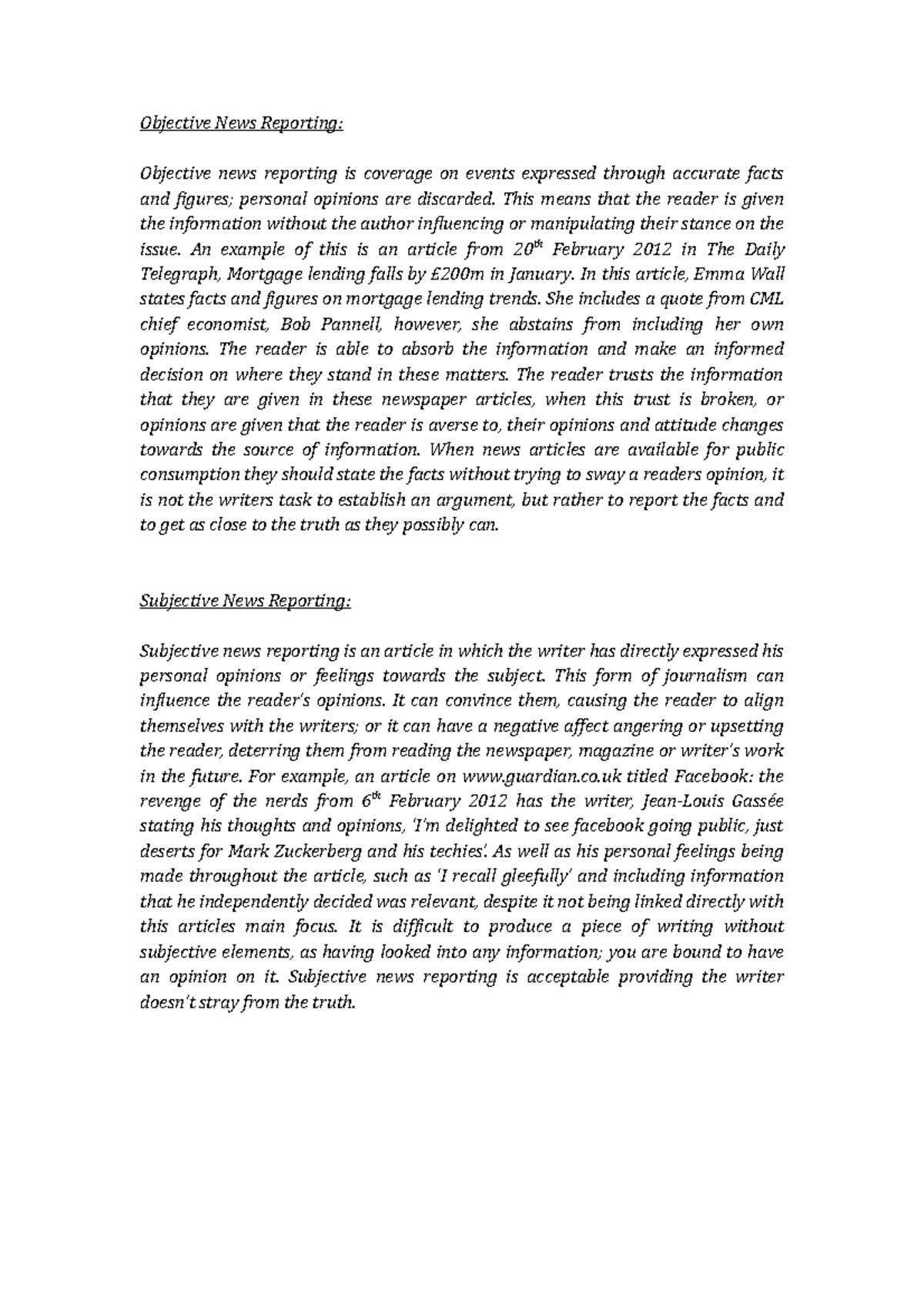
Objective articles shape news reporting by establishing structural standards—such as the inverted pyramid, neutral tone, multi-source verification, and clear separation of fact from opinion—that govern how newsrooms gather and present information. This standard builds institutional trust, minimizes reporter bias, and provides a benchmark against which emerging media formats are evaluated.
Contents
The Core Architecture of Objective Journalism
Objective journalism is not the absence of perspective; it is the application of a systematic, repeatable method for verifying facts without allowing personal bias to dictate the conclusion. The discipline of objectivity emerged as a formal standard in the early 20th century, largely driven by the growth of wire services like the Associated Press. Wire services needed non-partisan stories that could be syndicated across newspapers with diverse political leanings.
The structural model created to support this requirement fundamentally transformed how news reporting functions. At its core, an objective article relies on three foundational elements:
- The Inverted Pyramid: Placing the most essential facts—who, what, where, when, why, and how—in the lead paragraph, followed by supporting evidence, context, and secondary details.
- Attribution and Neutral Lexicon: Attributing all claims, assertions, and evaluative statements to named sources while using emotionally neutral verbs (e.g., "stated," "reported," "said") rather than loaded alternatives (e.g., "claimed," "insisted," "admitted").
- Verified Evidence over Conjecture: Grounding statements in verifiable documents, official records, or direct eyewitness accounts rather than reporter speculation.
[ Lead Paragraph ] --> Critical Facts (Who, What, Where, When, Why) [ Supporting Detail ] --> Primary Evidence & Direct Attribution [ Context & History ] --> Secondary Background & Nuance [ Operational Details ] --> Technical Specs & Minor Context
By prioritizing verified facts over narrative flair, objective articles create a common baseline of reality for public discourse. When news outlets adhere to these conventions, they establish a predictable format that allows readers to distinguish between reported facts and commentary.
Key Structural Components That Shape News Production
The practices embedded in objective article writing directly dictate newsroom workflows, editing protocols, and editorial decision-making. Objective reporting is maintained through several key structural components:
1. Dual-Source Verification and Attribution Protocols
Objective reporting requires that unverified claims undergo independent verification. News organizations typically enforce a multi-source rule, requiring at least two independent sources before publishing controversial or unconfirmed claims. Attribution serves as a defensive boundary: it clarifies precisely who holds accountability for an assertion, separating the publisher's voice from the source's claims.
2. The Separation of Fact and Value Judgments
A defining characteristic of objective news reporting is the strict boundary maintained between news gathering and opinion commentary. Newsrooms implement structural separation between reporting staff and editorial boards to prevent opinion from influencing news coverage. Within individual articles, reporters avoid evaluative adjectives—such as "devastating," "heroic," or "shocking"—unless those words are contained within direct quotes attributed to specific sources.
3. Contextual Balance versus False Equivalence
Traditional objectivity emphasized giving equal space to competing viewpoints. However, modern news standards have evolved to distinguish between balanced reporting and false balance (sometimes called "bothsidesism").
True objectivity requires weight-of-evidence reporting: presenting opposing arguments proportional to their factual backing and empirical support. For example, reporting on scientific consensus around atmospheric data does not require equal weight for unsupported counterclaims.
Comparative Framework of News Reporting Models
To understand how objective articles influence news reporting, it is helpful to compare the objective model with alternative editorial methodologies commonly used in contemporary media:
| Reporting Model | Primary Goal | Structural Approach | Source Strategy | Primary Risk |
|---|---|---|---|---|
| Objective News Reporting | Deliver verifiable facts neutrally to inform public decision-making | Inverted pyramid; strict factual neutrality; third-person narrative | Balanced representation of credible sources proportional to evidence | Risk of passive stenography or false balance if unvetted |
| Analytical/Contextual Journalism | Explain complex events by interpreting underlying trends | Explanatory narrative; thematic grouping; historical contextualization | High reliance on subject-matter experts, data analysts, and records | Risk of subtle analytical bias or over-interpretation |
| Opinion & Viewpoint Columnism | Persuade readers or advocate for a specific ideological position | Argumentative structure; persuasive thesis supported by selective evidence | Purposeful selection of sources that support the author's thesis | Confirmation bias and selective omission of counter-arguments |
| Solutions Journalism | Investigate and report on evidence-based responses to social problems | Problem-response-result structure; focus on scalability and limitations | Focus on practitioners, affected communities, and outcome metrics | Risk of slipping into advocacy or public relations narratives |
The Societal and Institutional Influence of Objective Reporting
The widespread adoption of objective reporting standards extends far beyond individual newsrooms. It shapes legal protections, subscription models, and public media literacy in several distinct ways.
Establishing Legal and Ethical Benchmarks
Objective reporting practices provide news organizations with crucial legal protections. Media law in many democratic jurisdictions differentiates between statements of fact and expressions of opinion.
By adhering to rigorous attribution, neutral phrasing, and documented fact-checking, newsrooms build a defensible shield against libel and defamation claims. Ethics frameworks, such as the Society of Professional Journalists (SPJ) Code of Ethics, explicitly anchor ethical journalism in accuracy, minimization of harm, independence, and accountability.
Mitigating Audience Polarization
When news outlets consistently publish objective articles, they provide a shared factual foundation for communities with divergent political views. Objective reporting isolates facts from ideological spin, allowing readers from different backgrounds to agree on what happened, even if they disagree on how to respond.
Without objective news reporting, media ecosystems tend to fragment into partisan echo chambers, where news products are designed primarily to confirm pre-existing audience biases.
Protecting Editorial Independence from Commercial Pressures
Objective guidelines protect newsrooms from external pressures exerted by advertisers, political actors, and corporate owners. Standardized reporting protocols make it difficult for commercial sponsors to influence coverage undetected. When an article follows established objective norms, any attempt to insert promotional copy or suppress inconvenient facts becomes immediately obvious to editors and readers.
Contemporary Challenges and Modern Criticisms
Despite its structural importance, the traditional model of objective news reporting faces significant scrutiny from media theorists, digital publishers, and audiences.
The Problem of "Bothsidesism" and Passive Stenography
Critics argue that traditional objectivity can degenerate into passive stenography—where reporters simply quote two opposing sides without evaluating the truth of their statements. When political actors make demonstrably false statements, repeating those statements alongside factual corrections in the name of "balance" can confuse the public.
Modern editorial standards address this issue through truth-seeking journalism, where reporters actively fact-check claims within the text rather than leaving validation entirely to the reader.
Traditional Balance: Source A makes a claim <---> Source B denies the claim (Result: Reader is left neutral, but uninformed about truth) Modern Truth-Seeking: Source A makes a claim <---> Documented Data / Fact-Check Verification (Result: Context establishes factual accuracy directly)
Speed Demands in Digital Publishing
The digital news environment rewards publishing speed. This push for immediacy can undermine the time-intensive processes required for objective reporting—such as multi-source verification, document retrieval, and editorial review.
The pressure to publish breaking news immediately often leads to reliance on single-source reports or unverified social media claims, weakening adherence to objective standards.
Algorithmic Amplification of Outrage
Social media algorithms and search discovery systems frequently prioritize emotional engagement, conflict, and sensationalism over neutral reporting. Because objective articles avoid emotionally charged language and sensational framing, they may experience lower initial engagement metrics compared to opinion pieces or partisan commentary.
Newsrooms must balance the financial necessity of digital reach with the editorial duty to maintain objective reporting standards.
Actionable Guidelines for Implementing Objective Standards
For reporters, editors, and corporate communications teams committed to maintaining objective reporting standards, implementing clear operational guidelines is essential.
Step 1: Establish Strict Source Identification Protocols
- Default to On-the-Record Sourcing: Anonymous sourcing should be reserved exclusively for instances where disclosure poses physical, legal, or professional risk to the source, and where the information cannot be obtained through official records.
- Verify Source Motivation: Require reporters to document potential conflicts of interest for every key source cited in an article.
- Require Multi-Point Authentication: Cross-reference interview statements with primary documents, financial filings, or public datasets available through official repositories like the U.S. National Archives.
Step 2: Audit Article Lexicon for Impartiality
- Remove Evaluative Modifiers: Strip articles of subjective adverbs and adjectives (e.g., unexpectedly, tragically, controversial) unless they are part of a direct quote.
- Standardize Neutral Verbs: Use neutral attribution verbs like stated, said, documented, or wrote. Avoid verbs that imply emotion or guilt, such as insisted, claimed, or admitted.
- Check Framing Equality: Ensure that opposing viewpoints are described using comparable language and structural weight.
Step 3: Enforce Transparent Correction Policies
- Standardize Correction Notices: When an objective article contains a factual error, publish a clear, timestamped correction note detailing what was changed and why.
- Maintain Revision Histories: For digital publications, maintain clear audit trails of substantial updates to breaking news stories.
- Distinguish Corrections from Clarifications: Use "Correction" for factual inaccuracies and "Clarification" when original phrasing was ambiguous or incomplete.
Frequently Asked Questions
What is the primary difference between objective articles and analytical reporting?
Objective articles focus on presenting verified facts, events, and direct statements neutrally using structures like the inverted pyramid. Analytical reporting builds on those facts by providing broader context, exploring historical patterns, and explaining the implications of an event through subject-matter expertise, while still maintaining an impartial tone.
Does objective news reporting mean giving equal space to all sides of an issue?
No. True objective reporting requires weight-of-evidence presentation. Giving equal space to unsupported claims alongside empirically verified facts creates false balance. Objective reporting presents viewpoints proportional to their factual backing and credible evidence.
How do objective articles protect newsrooms from legal liability?
Objective articles rely heavily on documented evidence, multi-source verification, precise attribution, and neutral language. By adhering to these standards, news organizations can demonstrate adherence to standard journalistic practices, providing a strong defense against libel and defamation claims.
Why do some critics claim that pure objectivity is impossible?
Critics argue that every stage of news production—deciding which stories to cover, which sources to call, and which facts to highlight—involves human choices influenced by social context and institutional constraints. Modern guidelines acknowledge these factors, defining objectivity as a method of systematic verification rather than an absolute absence of human perspective.
How can readers identify whether an article follows objective reporting standards?
Readers can assess objectivity by looking for direct attribution of facts to identifiable sources, third-person neutral phrasing, clear separation of reported facts from opinion, proportional presentation of evidence, and visible correction policies when errors occur.
Editorial Recommendation and Strategic Next Steps
Maintaining objective article standards requires clear processes, continuous staff training, and rigorous editorial oversight. Organizations looking to strengthen their reporting accuracy should institute mandatory pre-publication checklists covering sourcing, tone, and verification.
Media consumers should actively seek news outlets that publish clear correction standards, distinguish news from opinion, and link directly to primary documents.
By demanding adherence to verifiable reporting standards, both publishers and audiences help preserve the essential role that objective news reporting plays in an informed society.
Image Gallery