The Statue of Liberty Significance Revealed: Uncovering Her Original Meaning and Symbols
The Statue of Liberty significance centers on her original role as a monument celebrating the abolition of slavery, the union victory in the American Civil War, and the enduring alliance between France and the United States. Designed b...
The Statue of Liberty significance centers on her original role as a monument celebrating the abolition of slavery, the union victory in the American Civil War, and the enduring alliance between France and the United States. Designed by Frédéric-Auguste Bartholdi, the statue evolved over time into a universal symbol of freedom, democracy, and international immigration.
Contents
Dedicated on October 28, 1886, the statue—officially titled Liberty Enlightening the World (La Liberté éclairant le monde)—stands as one of the most recognizable structures on Earth. Yet, despite her global fame, popular memory often overlooks the specific political and human rights motivations that led to her creation. Understanding the monument requires uncovering the initial intentions of her French creators, decoding her intricate classical iconography, and tracing how her meaning shifted as millions of immigrants entered New York Harbor.
The Forgotten Roots: Abolition, Democracy, and Franco-American Solidarity
The idea for the Statue of Liberty was born in 1865 during a dinner party near Versailles, hosted by Édouard René de Laboulaye, a prominent French political thinker, law professor, and president of the French Anti-Slavery Society.
Laboulaye was a staunch admirer of the American republic. Following the end of the American Civil War and the ratification of the 13th Amendment abolishing slavery, Laboulaye proposed creating a monument jointly funded by the citizens of France and the United States. His motivation was twofold:
- Celebrating the Union Victory and Union Emancipation: Laboulaye saw the abolition of slavery in America as a monumental triumph for human liberty. He wanted to construct a gift that explicitly honored the end of chattel slavery and the preservation of the Union.
- Promoting Democracy within France: In 1865, France was ruled by the authoritarian regime of Emperor Napoleon III. By celebrating American democratic institutions and freedom, Laboulaye aimed to inspire the French public to push for a return to a democratic republic at home.
Laboulaye partnered with the Alsatian sculptor Frédéric-Auguste Bartholdi to turn this political concept into a physical monument. Bartholdi traveled to the United States in 1871 to select the location, choosing Bedloe's Island (now Liberty Island) in New York Harbor, recognizing it as the gateway to the nation.
To realize the ambitious colossal structure, Bartholdi enlisted civil engineer Gustave Eiffel, who designed the internal structural iron framework that allowed the thin copper skin to withstand oceanic winds and environmental expansion. Research compiled by the National Park Service on Statue History details how these abolitionist origins directly shaped the statue's design choices.
Decoding the Statuary Symbols: Chains, Torch, Tablet, and Crown
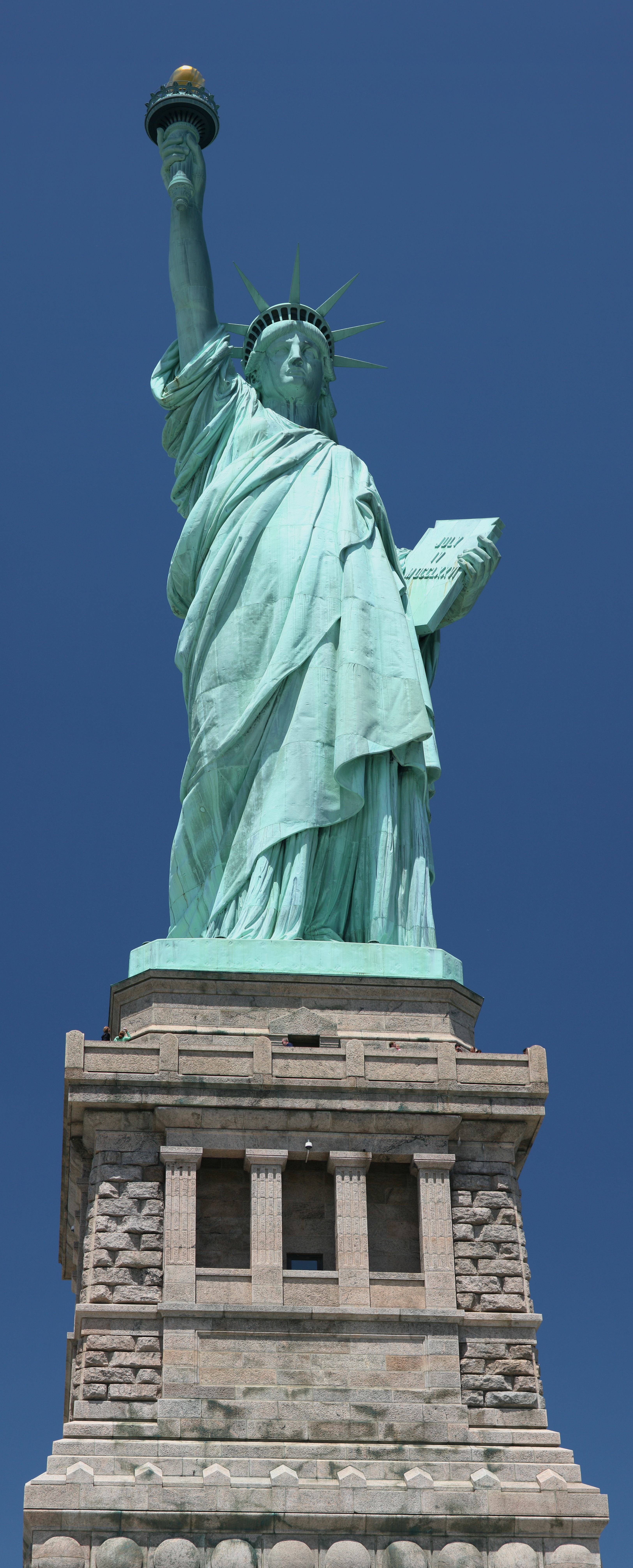
Every element of Liberty Enlightening the World was chosen by Bartholdi to convey explicit messages grounded in classical iconography, Enlightenment philosophy, and 19th-century abolitionism.
- The Crown: 7 Rays: Continents & Seas
- The Torch: Enlightenment & Liberty Leading the Way
- The Tablet: Rule of Law (July 4, 1776)
- Broken Chains: Abolition of Slavery & Servitude
1. The Broken Shackles and Chains
At the feet of Lady Liberty lie broken shackles and chains, with her right foot raised in mid-stride, moving forward. This is the most direct visual link to the statue's anti-slavery origin. While early design sketches showed Liberty holding broken chains in her hand, Bartholdi later adjusted the composition to make the message more subtle yet profound: Liberty is actively stepping out of the chains of bondage and tyranny toward progress.
2. The Torch and Flame
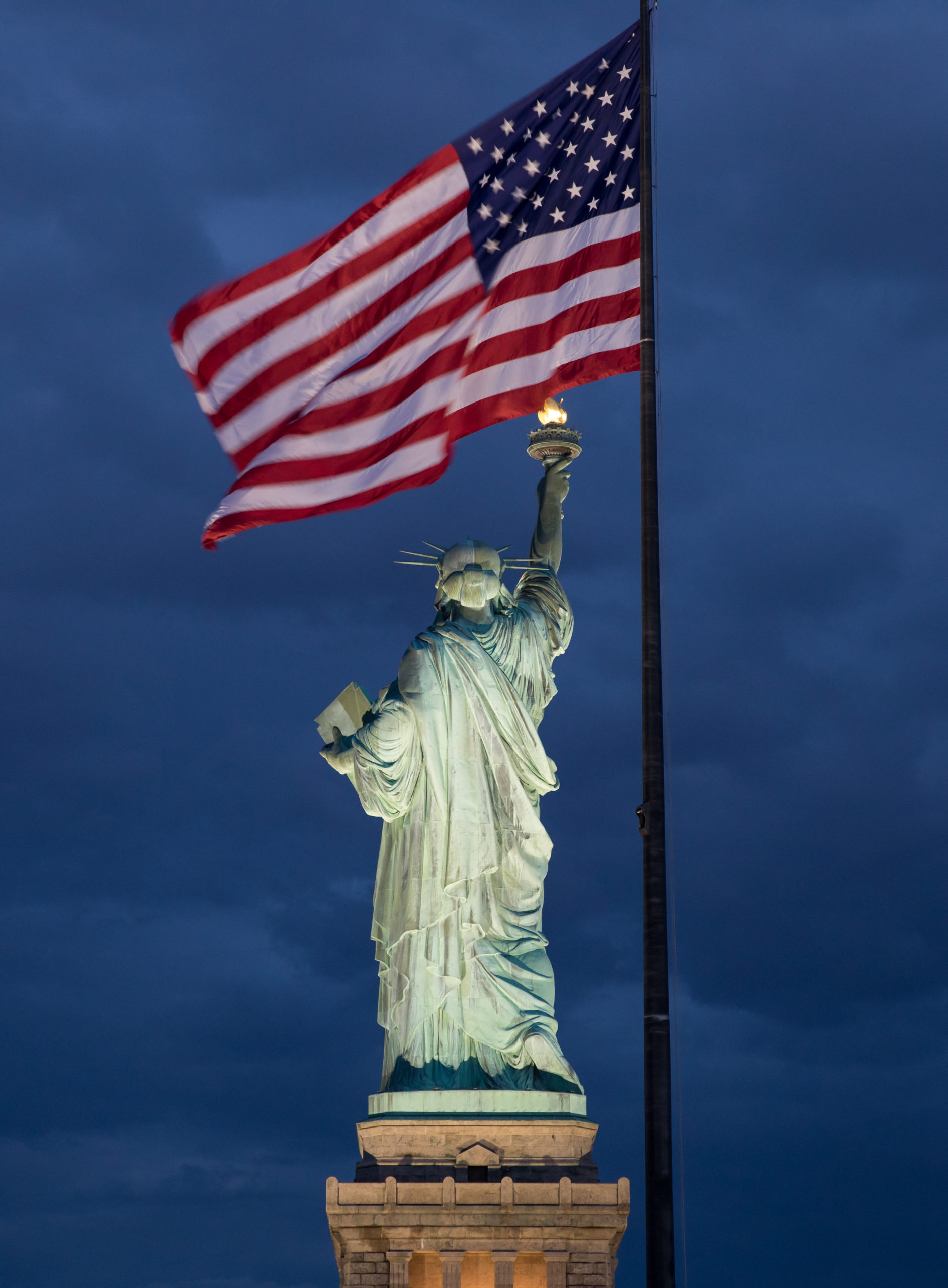
Held aloft in her right hand, the torch signifies enlightenment, illumination, and the path to freedom. Rather than representing conquest or military power, the torch reflects the Enlightenment ideal that reason, freedom, and knowledge dissipate the darkness of ignorance and oppression.
3. The Keystone Tablet (Tabula Ansata)
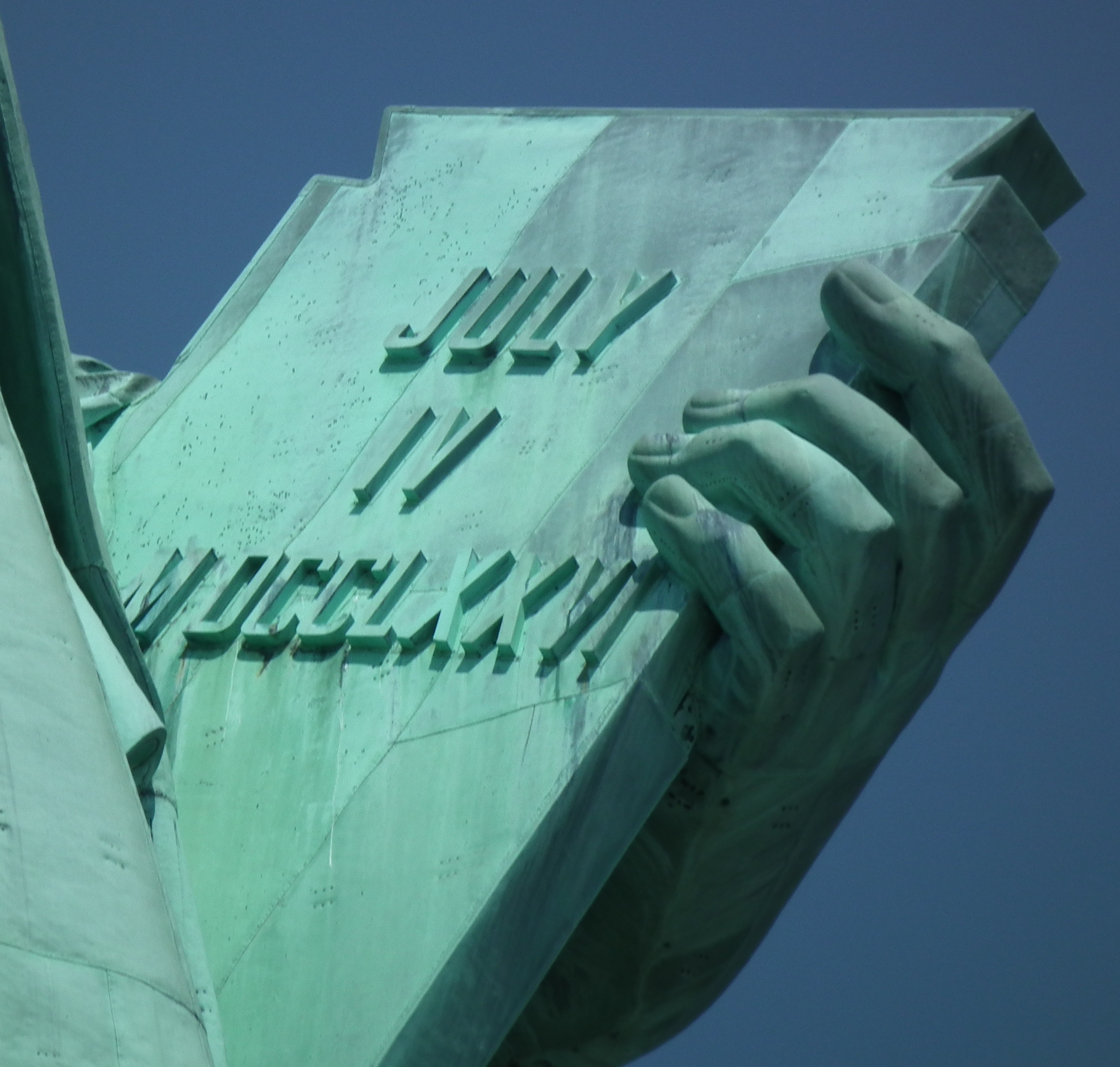
In her left hand, Liberty holds a rectangular tablet shaped like a tabula ansata (a tablet with dovetail handles used in antiquity for legal documents). The tablet is inscribed with the Roman numerals JULY IV MDCCLXXVI (July 4, 1776), referencing the American Declaration of Independence. This symbol highlights that true liberty cannot exist without the rule of law and constitutional governance.
4. The Seven-Rayed Crown
The crown worn by Lady Liberty features seven distinct spikes or rays. These rays represent the seven seas and seven continents of the world, emphasizing the universal nature of freedom. It signifies that the message of liberty is not restricted to the United States or France, but extends globally.
5. The Classical Robes and Copper Skin
Liberty is draped in a classical Roman stola and palla, linking the modern republic to the ancient Roman goddess Libertas. The copper skin of the statue is roughly 3/32 of an inch thick—about the thickness of two pennies pressed together. Over decades of exposure to ocean air and moisture, the natural oxidation of the copper created a green verdigris patina, which acts as a protective layer against corrosion.
| Feature / Symbol | Physical Description | Primary Historical Meaning |
|---|---|---|
| Broken Chains & Shackles | Located around her feet; broken links with central shackle | Abolition of slavery, end of servitude, and forward motion away from tyranny |
| Raised Torch | Held in right hand, copper flame gilded in 24k gold leaf | Enlightenment, truth, and illuminating the path to liberty |
| Inscribed Tablet | Keystone shape in left hand inscribed "JULY IV MDCCLXXVI" | Rule of law, constitutional democracy, and independence |
| 7-Rayed Crown | Aureole with seven distinct spikes and 25 windows | Universal reach across the 7 continents and 7 seas |
| Robes (Stola & Palla) | Flowing drapery styled after ancient classical dress | Connection to Roman goddess Libertas; timeless civic virtue |
| Forward Step | Right heel lifted, weight shifting forward | Active progress, ongoing work of liberty, and pushing past oppression |
From Democratic Ideal to Beacon of Immigration
While the statue's creators envisioned her primarily as an emblem of republican alliance and emancipation, her location in New York Harbor dramatically altered her primary public meaning during the late 19th and early 20th centuries.
In 1892, the U.S. government opened the federal immigration processing center on neighboring Ellis Island. Between 1892 and 1954, more than 12 million immigrants entered the United States by steamship, passing directly by the Statue of Liberty upon entering New York Harbor. For these arriving travelers, Lady Liberty was their very first sight of the New World, transforming her into an emotional symbol of hope, asylum, and a fresh start.
- Original Purpose (1865–1886)
- Abolition of Slavery
- Franco-American Alliance
- Celebration of Union Victory
- Evolving Meaning (1890s–Present)
- Welcome Beacon for Immigrants
- Global Symbol of Refuge
- Human Rights Icon
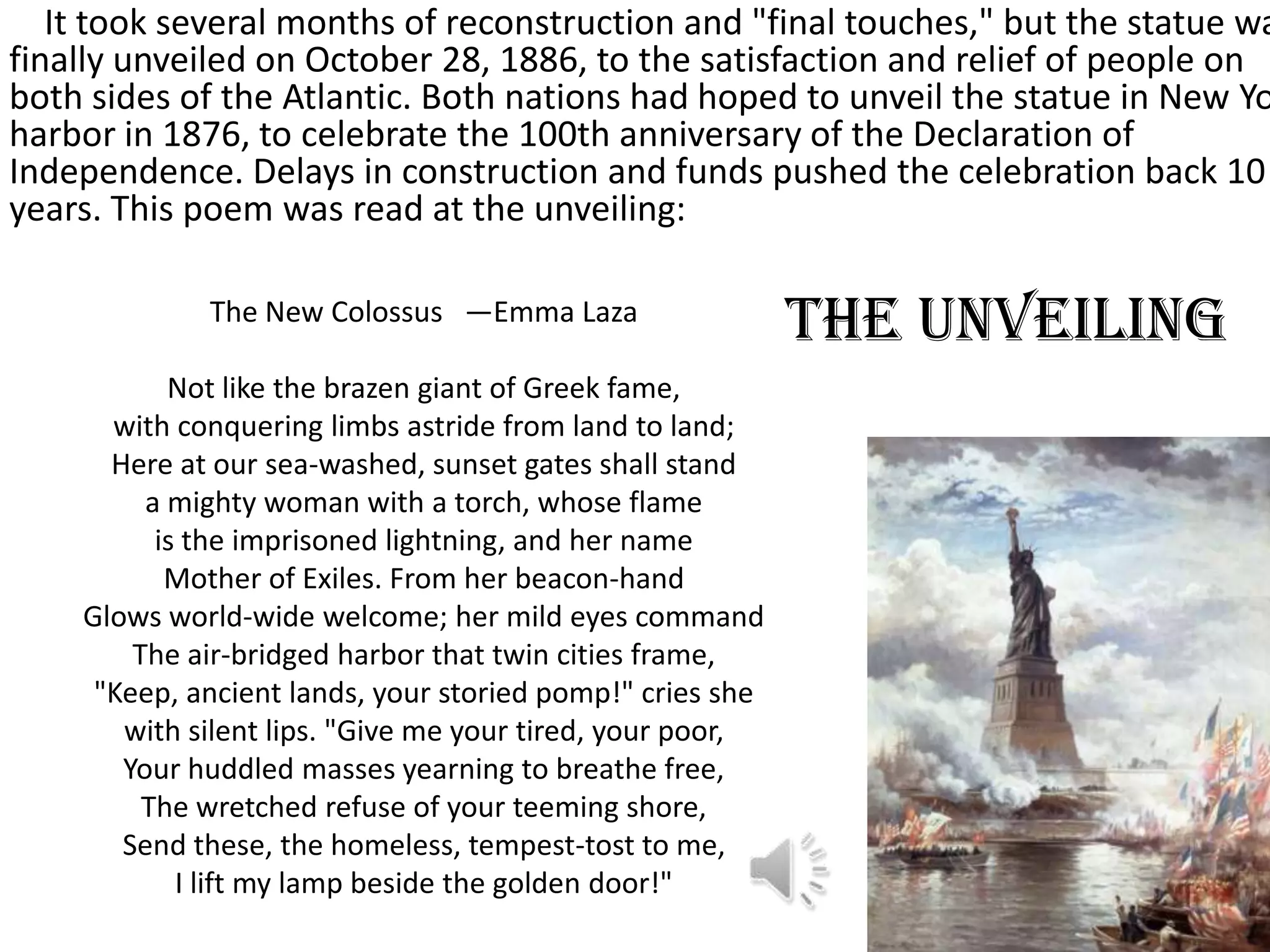
This transformation was solidified by the poem * "The New Colossus,"* written by American poet Emma Lazarus in 1883 to raise funds for the construction of the statue's pedestal. Lazarus contrasted the new monument with the ancient Colossus of Rhodes—a symbol of military dominance—and instead characterized Liberty as the "Mother of Exiles."
Lines from her famous sonnet, later mounted on a bronze plaque inside the pedestal in 1903, redefined the statue's global identity:
"Give me your tired, your poor,Your huddled masses yearning to breathe free,The wretched refuse of your teeming shore.Send these, the homeless, tempest-tost to me,I lift my lamp beside the golden door!"
Through Lazarus’s words and the lived experiences of millions of immigrants, the Statue of Liberty transitioned from a symbol celebrating national victory and constitutional law to an international beacon of refuge and human dignity. Historical records from the Library of Congress detail how media, art, and poetry accelerated this transformation throughout the 20th century.
Architectural and Engineering Specifications
The structural design of the Statue of Liberty was a major technical achievement of 19th-century engineering. Gustave Eiffel’s design anticipated modern skyscraper construction by separating the exterior load-bearing skin from the internal frame.
| Statue Structure Breakdown |
|---|
| Torch Height: 305 ft 1 in (Ground to Torch Tip) |
| Statue Height: 151 ft 1 in (Base to Torch Tip) |
| Pedestal & Base: Designed by Richard Morris Hunt |
| Internal Framing: Iron/Steel Pylon by Gustave Eiffel |
| Exterior Shell: 300+ Hand-Hammered Copper Sheets |
- Total Height: 305 feet, 1 inch (93 meters) from the ground base to the tip of the torch.
- Statue Height: 151 feet, 1 inch (46 meters) from the top of the pedestal to the torch.
- Total Weight: Approximately 225 tons (450,000 pounds), with copper accounting for roughly 31 tons and structural iron accounting for 125 tons.
- Construction Technique: The copper shell was created using repoussé, a technique where metal sheets are hand-hammered into wooden molds. Over 300 individual copper plates were riveted together.
- Flexibility: Eiffel used armature bars (flat iron strips) extending from the central pylon to the copper skin. This design allowed the statue to move slightly in high winds and adapt to temperature fluctuations without cracking the metal shell.
Visiting Liberty Island: Access, Regulations, and Planning
For modern visitors, Liberty Island is managed by the National Park Service. Access requires planning, as entry to specific parts of the monument is strictly regulated.
- Ferry Departure points
- Battery Park (NYC)
- Liberty State Park (NJ)
- Security Screening
- Access Levels Granted by Ticket
- General Admission (Grounds only)
- Pedestal Ticket (Includes Museum & Observation Deck)
- Crown Ticket (Requires advance reservation & stairs)
Ticket Types and Access Levels
- General Admission: Grants access to ferry transportation, grounds of Liberty Island, and self-guided audio tours.
- Pedestal Reserve: Includes access to the Fort Wood section, the Statue of Liberty Museum, and the outdoor pedestal observation deck (approx. 10 stories high).
- Crown Reserve: Allows visitors to climb the 162 narrow spiral steps from the pedestal level up into the crown of the statue. Crown tickets are limited and generally require booking months in advance.
Essential Visitor Rules
- Authorized Transportation: Official ferry passage is operated exclusively by Statue City Cruises. Private boats are not permitted to dock at Liberty Island.
- Security Screening: All visitors undergo airport-style security screening before boarding ferries at Battery Park (New York) or Liberty State Park (New Jersey).
- Pedestal and Crown Restrictions: Large bags, backpacks, food, and drinks (except water) are prohibited inside the pedestal and crown areas. Lockers are available for rent at the security checkpoint near the pedestal entrance. Official guidelines and reservation portals can be accessed at the National Park Service Liberty Island Visitor Page.
Frequently Asked Questions
Why is the Statue of Liberty green?
The statue is green due to natural oxidation. Her skin is made of thin copper plates. When copper is exposed to outdoor moisture, rain, and air pollution, it reacts chemically to form a layer of copper carbonate called a patina. This green patina was fully formed by approximately 1906 and acts as a protective shield that prevents the underlying metal from degrading.
What is the origin of the Statue of Liberty’s broken chains?
The broken chains at her feet were included at the insistence of creator Édouard René de Laboulaye and sculptor Auguste Bartholdi. They represent the abolition of slavery in the United States following the Civil War and the passage of the 13th Amendment. They also symbolize breaking free from general servitude, tyranny, and autocratic rule.
Who was the physical model for the Statue of Liberty?
While Bartholdi never officially confirmed a single model, historians generally believe the face of Lady Liberty was modeled after his mother, Charlotte Beysser Bartholdi. Some structural features and body proportions may have been influenced by Sarah Adeline Faches, the wife of Bartholdi’s friend.
Is the Statue of Liberty located in New York or New Jersey?
Liberty Island is an enclave of the City of New York and lies within the territorial limits of the State of New York, as established by an 1834 interstate compact between New York and New Jersey. However, the island sits entirely on the New Jersey side of the Hudson River water border, and the surrounding waters belong to New Jersey.
What poem is written on the Statue of Liberty?
The poem inscribed on a bronze plaque inside the statue's pedestal is * "The New Colossus,"* written by American poet Emma Lazarus in 1883. It contains the famous lines welcoming the "huddled masses yearning to breathe free," transforming the monument into a symbol of international refuge.
Final Guidance and Next Actions
To appreciate the significance of the Statue of Liberty, consider exploring both her physical monument and her historical documentation:
- Review Primary Source Documents: Examine the writings of Édouard René de Laboulaye and the original design notes of Auguste Bartholdi via digital archives at the Library of Congress to understand the post-Civil War context of emancipation.
- Plan Liberty and Ellis Island Visits Together: When booking tickets through the National Park Service, pair your visit to Liberty Island with the Ellis Island National Museum of Immigration to see how the physical monument intersects with America's immigration history.
- Reserve Crown Access Early: If you plan to climb to the crown, monitor ticket availability at least 3 to 4 months in advance, as access is strictly capped for safety and structural preservation.
Image Gallery