Understanding the Forex Currency Trading Market: A Comprehensive Guide
The foreign exchange market, commonly known as forex or FX, is a decentralized global network where national currencies are bought, sold, and exchanged. Operating 24 hours a day during weekdays, it serves as the financial backbone for...
The foreign exchange market, commonly known as forex or FX, is a decentralized global network where national currencies are bought, sold, and exchanged. Operating 24 hours a day during weekdays, it serves as the financial backbone for international trade, corporate hedging, cross-border investment, and speculative trading. Unlike traditional stock exchanges, forex functions through an over-the-counter (OTC) structure without a central clearinghouse.
Contents
What Is the Forex Market and How Does It Work?
The foreign exchange market is the largest and most liquid financial market in the world. According to data from the Bank for International Settlements (BIS) Triennial Survey, daily trading volume in global OTC foreign exchange markets exceeds $7.5 trillion.
Unlike exchange-traded equities or futures, forex trading does not take place on a centralized physical exchange like the New York Stock Exchange (NYSE) or the London Stock Exchange (LSE). Instead, participants trade directly with one another through an electronic interbank network.
The Interbank Network and OTC Structure
At the core of the foreign exchange market sits the interbank network—a tier-one system of major global banks, including JPMorgan Chase, Citi, UBS, Deutsche Bank, and HSBC. These institutions quote bid and ask prices to one another continuous throughout the trading week.
Retail traders, smaller commercial enterprises, and non-bank financial institutions access this market indirectly through retail forex brokers and liquidity aggregators. These intermediaries bridge the gap between individual retail accounts and tier-one liquidity providers.
Global Trading Sessions and 24-Hour Continuous Liquidity
Because international time zones overlap, the foreign exchange market operates continuously from Sunday evening (US Eastern Time) through Friday afternoon. The market is broadly divided into four primary trading sessions:
- Sydney Session: Establishes early weekly pricing across Asia-Pacific pairs.
- Tokyo (Asian) Session: Characterized by yen-denominated flows and regional economic data releases.
- London (European) Session: Accounts for the highest concentration of global FX volume, generating substantial volatility.
- New York (North American) Session: Intersects directly with the latter half of the European session, producing peak daily market liquidity and price momentum.
The period when the European and North American sessions overlap (typically 8:00 AM to 12:00 PM EST) represents the most liquid trading window of the day.
Key Components of Currency Pair Pricing
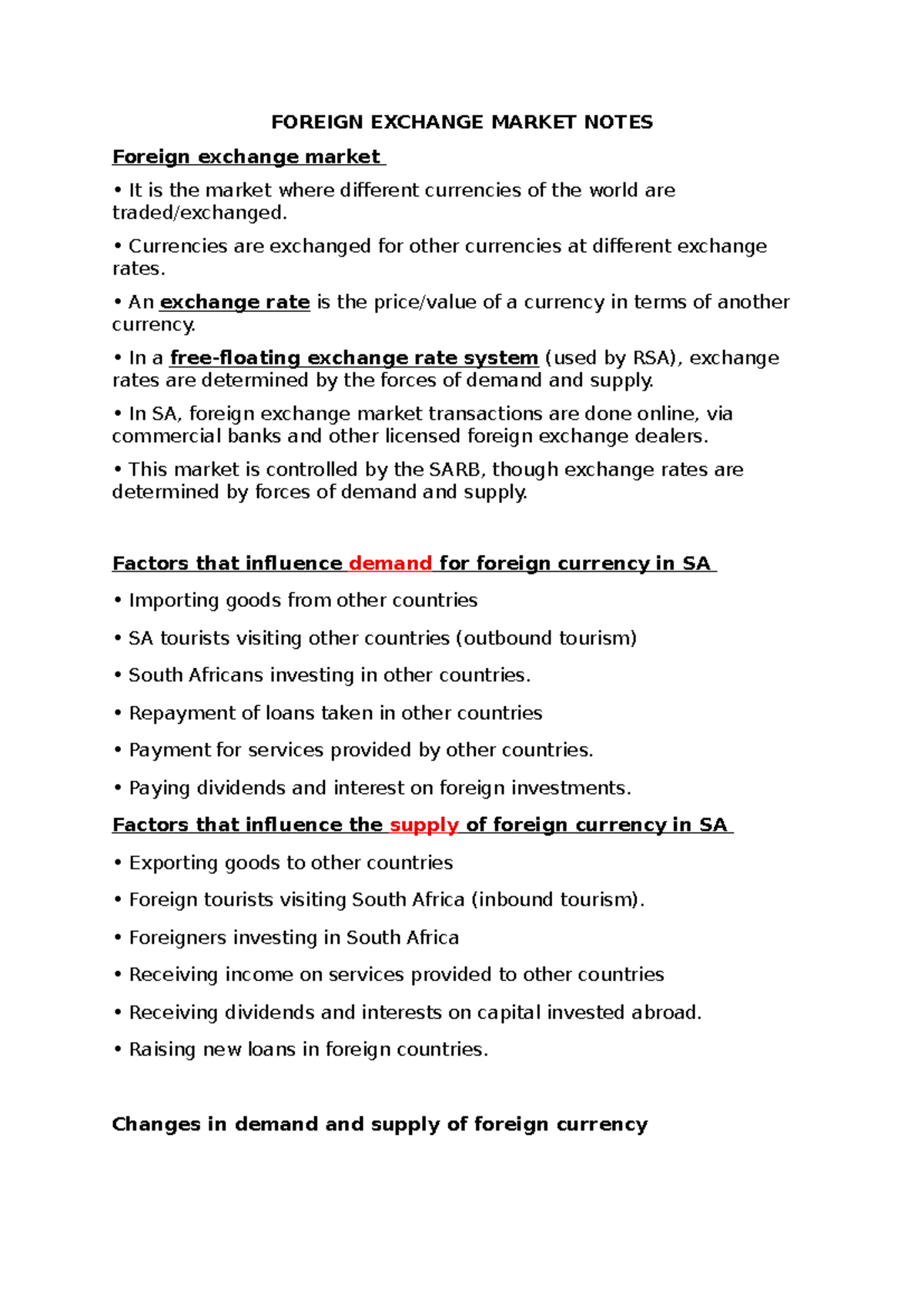
In the forex market, currencies are always traded in pairs. When a trader opens a position, they simultaneously purchase one currency and sell another. Every pair consists of a base currency (listed first) and a quote currency (listed second).
For instance, in the EUR/USD pair:
- Base Currency: Euro (EUR)
- Quote Currency: United States Dollar (USD)
If the EUR/USD pair is quoted at 1.0850, it means that 1 Euro can be exchanged for 1.0850 U.S. Dollars. If a trader expects the Euro to appreciate against the Dollar, they buy (go long) the EUR/USD pair. Conversely, if they expect the Euro to weaken relative to the Dollar, they sell (go short) the pair.
- EUR / USD = 1.0850
- Base Currency: EUR
- Quote Currency: USD
- Price: 1 EUR = $1.0850 USD
Understanding Bid, Ask, and the Spread
Brokers present two prices for any given currency pair:
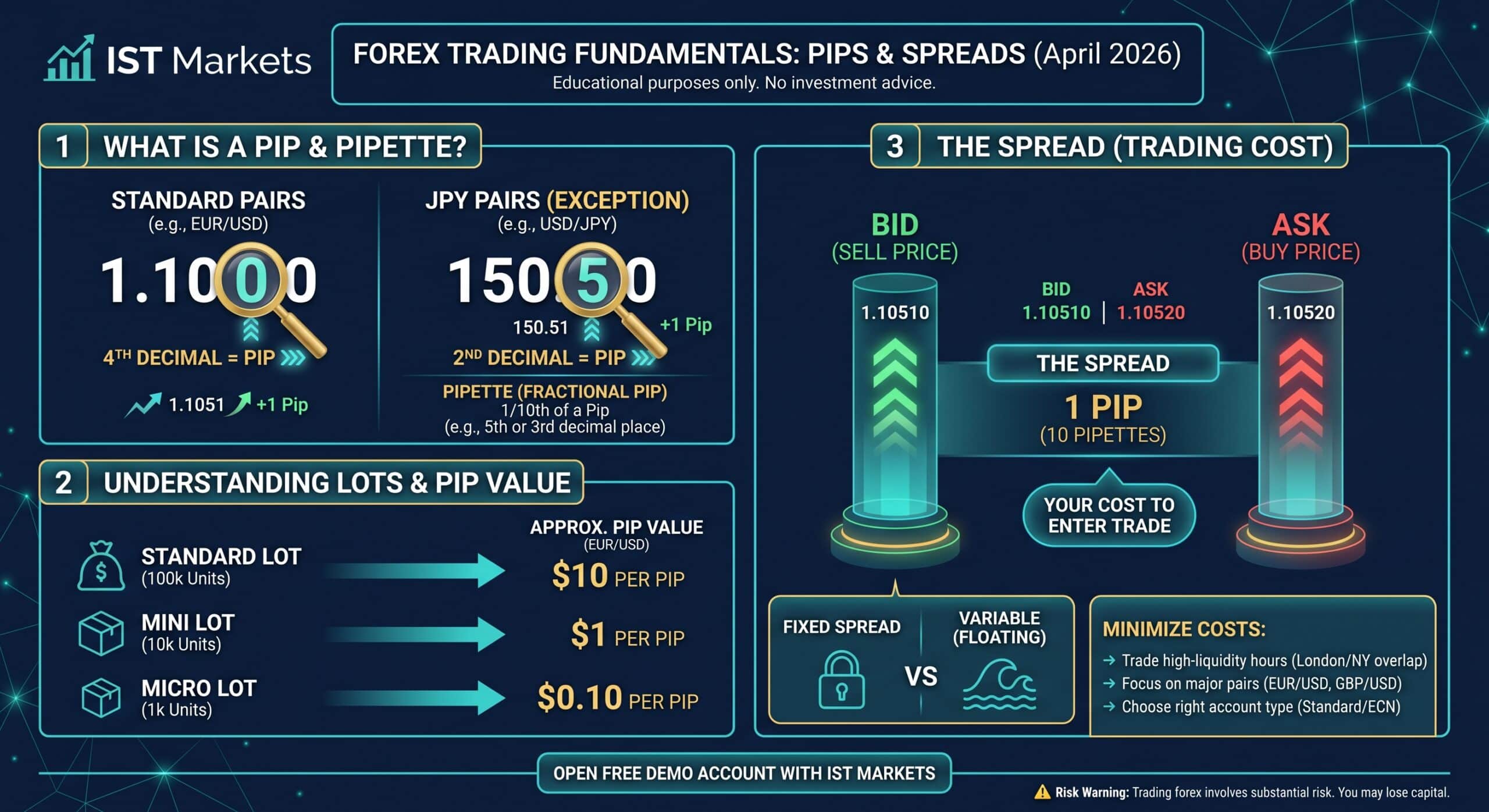
- Bid Price: The price at which the broker is willing to buy the base currency from you (the price you receive when selling).
- Ask (Offer) Price: The price at which the broker is willing to sell the base currency to you (the price you pay when buying).
The difference between the Ask price and the Bid price is the spread. The spread represents the primary transaction cost incurred when opening a trade, alongside any applicable commission fees charged by ECN (Electronic Communication Network) or STP (Straight-Through Processing) brokers.
Pips, Fractional Pips, and Lot Sizes
Price movements in foreign exchange are measured in percentage in points, universally referred to as pips.
- Standard Pip: For most pairs, a pip corresponds to the fourth decimal place (
0.0001). For instance, if EUR/USD moves from1.0850to1.0851, it has moved 1 pip. - Yen Pairs: For pairs involving the Japanese Yen (such as USD/JPY), a pip corresponds to the second decimal place (
0.01). - Pipettes: Modern brokers frequently use five-decimal pricing (or three decimal places for JPY pairs). The fifth digit represents a fractional pip, or pipette (
0.00001).
Positions are sized in lots:
- Standard Lot: 100,000 units of the base currency (1 pip on EUR/USD equals approximately $10 USD).
- Mini Lot: 10,000 units of the base currency (1 pip equals approximately $1 USD).
- Micro Lot: 1,000 units of the base currency (1 pip equals approximately $0.10 USD).
Primary Participants in the Global Foreign Exchange Market
The foreign exchange ecosystem comprises diverse participants operating with varying objectives, capital bases, and execution speeds.
- INTERBANK MARKET
- Central Banks, Tier-1 Global Banks, Sovereign Wealth Funds
- INSTITUTIONAL LAYER
- Hedge Funds, Multinational Corporations, Non-Bank Liquidity Providers
- RETAIL BROKERAGE LAYER
- Prime Brokers, ECN/STP Brokers, Retail Trading Platforms
- RETAIL TRADERS LAYER
- Individual Speculators, Algorithmic Retail Accounts
Central Banks and Government Authorities
Central banks—such as the Federal Reserve (Fed), European Central Bank (ECB), Bank of Japan (BoJ), and Bank of England (BoE)—exert profound influence over currency values. They set benchmark monetary policy, manage foreign exchange reserves, adjust interest rates, and occasionally intervene directly in currency markets to stabilize or devalue domestic currencies.
Commercial Banks and Liquidity Providers
Tier-one commercial banks conduct high-volume foreign exchange transactions to clear corporate international payments, manage balance sheet exposure, and facilitate interbank market-making. They supply continuous bid/ask quotes to institutional networks.
Multinational Corporations
Commercial enterprises participate in forex markets primarily for operational reasons rather than pure speculation. A company based in Germany importing electronics from Japan must convert Euros to Yen to settle supplier invoices. Corporations also use currency forward contracts and options to hedge against adverse exchange rate fluctuations.
Institutional Investors and Hedge Funds
Pension funds, sovereign wealth funds, and private asset managers rebalance portfolio holdings across international markets, requiring currency conversions. Hedge funds engage in speculative strategies, such as carry trades (borrowing low-yielding currencies to buy high-yielding ones) and macro-trend following.
Retail Forex Traders
Individual retail market participants account for a smaller percentage of global daily turnover. Retail traders speculate on short- to medium-term price fluctuations using margin accounts provided by online brokerages.
Key Drivers of Currency Valuation
Exchange rates fluctuate continuously due to macroeconomic fundamentals, technical supply-and-demand balances, market sentiment, and geopolitical developments.
1. Interest Rate Differential and Central Bank Policy
Interest rate policy is widely considered the dominant driver of exchange rates over medium- and long-term horizons. Capital generally flows toward economies offering higher real adjusted yields. When a central bank raises interest rates relative to another country, domestic bonds and money-market instruments yield higher returns, increasing global demand for that country's currency.
2. Inflation Rates
Inflation erodes purchasing power. Nations experiencing lower rate increases relative to their trading partners often see currency appreciation over time, as their domestic purchasing power remains relatively stable. Central bank reaction functions—such as raising rates to combat elevated inflation—frequently complicate short-term price responses.
3. Economic Data Releases
Market participants closely track economic indicators released by major government statistical agencies:
- Gross Domestic Product (GDP): Measures national economic health and growth velocity.
- Labor Market Data: Reports such as the U.S. Non-Farm Payrolls (NFP) influence interest rate expectations.
- Consumer Price Index (CPI) & Producer Price Index (PPI): Measure consumer and wholesale inflation trends.
- Purchasing Managers' Index (PMI): Gauges economic health across manufacturing and service sectors.
4. Sovereign Debt and Balance of Trade
Nations carrying high fiscal budget deficits and substantial public debt often struggle to attract foreign capital, placing downward pressure on currency values. Similarly, a persistent trade deficit (importing more goods than exporting) implies constant conversion of domestic currency into foreign currencies, which can weaken domestic exchange rates.
Currency Pair Classifications
Forex instruments are generally divided into major, minor, and exotic currency pairs based on daily trading volume and market liquidity.
| Pair Category | Example Pairs | Typical Characteristics | Average Spread Profile | Volatility Profile |
|---|---|---|---|---|
| Majors | EUR/USD, USD/JPY, GBP/USD, USD/CHF | Include the U.S. Dollar paired with foreign currencies from highly developed economies. | Very Low ( tightest spreads, high liquidity) | Moderate to High Liquidity; predictable trends |
| Minors / Crosses | EUR/GBP, EUR/JPY, GBP/JPY, AUD/CAD | Currency pairs excluding the U.S. Dollar, constructed between major global economies. | Moderate | Can exhibit sharp momentum, particularly Yen crosses |
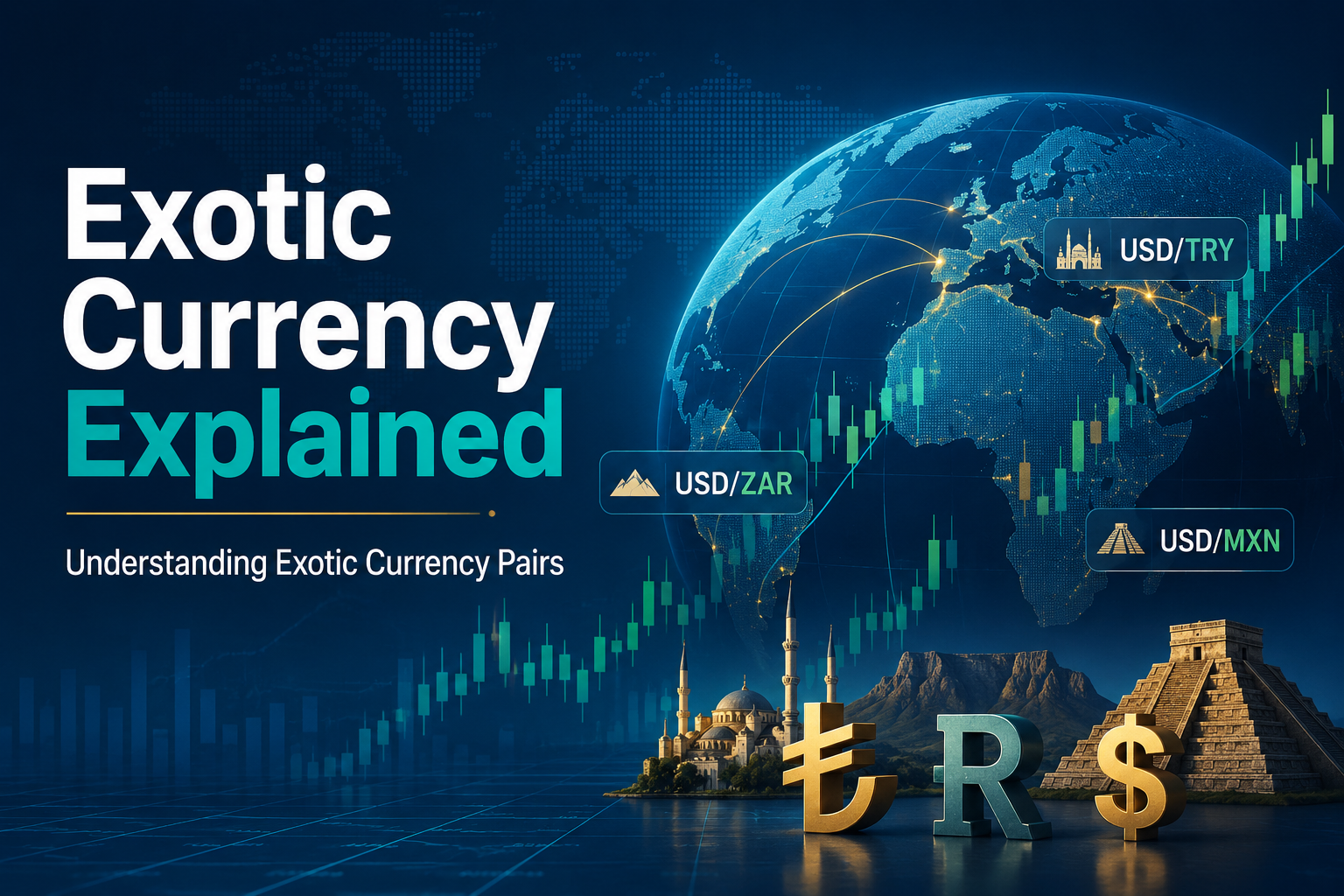
| Exotics | USD/TRY, USD/ZAR, EUR/PLN, USD/MXN | Consist of a major currency paired with a currency from an emerging or thin-market economy. | Wide to Very Wide | High volatility, elevated overnight rollover costs, jump-risk exposure |
Risk Management, Leverage, and Regulatory Rules
While high liquidity makes the forex market accessible, trading currency derivatives carries high financial risk. Effective operational discipline and risk management are essential.
Understanding Financial Leverage and Margin Requirements
Leverage allows a trader to control large position sizes with a relatively small cash outlay (margin). A leverage ratio of 30:1 means that $1,000 of account margin can open a position worth $30,000.
- Margin Call: Occurs when account equity drops below the required margin threshold, prompting the broker to demand additional capital deposit.
- Stop-Out Level: The threshold at which a broker's trading platform automatically liquidates open positions to prevent the account balance from falling into negative territory.
Caution: While leverage amplifies potential gains on successful trades, it equally multiplies losses on adverse market movements. High leverage combined with inadequate risk management remains the primary cause of retail account liquidations.
- Account Equity: $1,000 (Leverage 30:1)
- Market Exposure: $30,000
- 1% Market Gain = +$300 Return (+30% on Account Equity)
- 1% Market Loss = -$300 Loss (-30% on Account Equity)
Essential Risk Control Tools
Professional traders utilize core risk parameters on every order:
- Stop-Loss Orders: Pre-set orders that automatically close a position at a designated price boundary to restrict losses.
- Take-Profit Orders: Orders that close a trade automatically once a specific price target and profit level are reached.
- Position Sizing: Calculating lot sizes so that no individual trade exposes more than a small fraction (e.g., 1% to 2%) of total account equity to risk.
Regulatory Oversight by Jurisdiction
To protect retail traders, financial regulatory bodies set rules regarding leverage limits, capital reserves, and account segregation:
- United States: Supervised by the Commodity Futures Trading Commission (CFTC) and National Futures Association (NFA). Retail leverage is capped at
50:1for major pairs and20:1for minor pairs. - United Kingdom: Regulated by the Financial Conduct Authority (FCA). Retail leverage is restricted to a maximum of
30:1for major pairs. - European Union: Regulated under European Securities and Markets Authority (ESMA) directives. Maximum retail leverage is capped at
30:1. - Australia: Governed by the Australian Securities and Investments Commission (ASIC). Capped at
30:1maximum leverage for retail traders.
Common Pitfalls to Avoid in Forex Trading
Understanding forex market mechanics requires recognizing common systemic and psychological operational traps:
- Over-Leveraging Accounts: Attempting to achieve outsized returns by utilizing maximum permissible leverage on small balance accounts.
- Ignoring Overnight Swap Rates: Holding positions across midnight (Server Time) incurs daily rollover interest charges (swap rates), which can accumulate into significant trade drag over long periods.
- Trading Unregulated Brokers: Depositing funds with offshore brokerages operating outside established regulatory oversight exposes capital to operational risk and withdrawal difficulties.
- Failing to Account for Slippage: During major economic announcements, order execution can experience slippage—the difference between the requested order price and the actual execution price caused by rapid price gaps.
Step-by-Step Overview: How Traders Execute FX Trades
- Broker Selection and Account Verification: Open a trading account with an officially regulated broker in your home jurisdiction. Complete mandatory Know Your Customer (KYC) identity checks.
- Trading Platform Setup: Access standard trading terminals (such as MetaTrader 4/5, cTrader, or proprietary WebTrader interfaces) and establish demo environment practice.
- Market Analysis: Execute fundamental analysis (economic data schedules, central bank policy directions) and technical analysis (support/resistance structures, moving averages, trendline breaks).
- Risk Calculation: Establish position size based on stop-loss distance relative to allocated account risk limits.
- Order Execution: Place market orders for instant entry, or limit/stop orders for pending entry based on preferred price setups.
- Trade Monitoring and Journaling: Monitor trade execution, manage stop-loss adjustments, and log market observations in a structured trading journal.
Frequently Asked Questions
What is the minimum capital required to trade forex?
Many modern retail brokers allow micro accounts to be opened with initial deposits as low as $50 to $100. However, starting with adequate capitalization allows for proper risk management and position sizing, as micro-lot trading requires sufficient margin coverage to sustain normal intraday market volatility.
How does forex trading differ from stock trading?
Forex trading involves trading currency pairs over-the-counter 24 hours a day during weekdays, characterized by continuous global liquidity and low transaction spreads. Stock trading involves buying shares of specific companies listed on centralized exchanges (such as the NYSE or Nasdaq) with fixed daily operating hours.
What are swap rates in forex?
A swap rate is the interest rate differential paid or earned for holding a currency position overnight. Because every currency trade involves borrowing one currency to buy another, the trader either pays or receives interest based on the short-term benchmark rates of the respective central banks involved.
Is forex trading tax-deductible or subject to specific tax rules?
Tax obligations for forex trading vary by country and jurisdiction. In the United States, retail forex trading is typically taxed under Section 988 of the Internal Revenue Code (IRC) by default, or under Section 1256 if opted into by the trader. Traders must consult qualified tax professionals in their domestic jurisdiction.
Can beginners practice forex trading without risking real money?
Yes. Nearly all regulated brokers offer free paper-trading demo accounts. Demo accounts mirror live interbank feeds, allowing beginners to learn platform navigation, execution mechanics, and risk management strategies using virtual money.
Practical Next Steps for Navigating the FX Market
To enter foreign exchange trading safely, focus first on operational security and foundational market concepts:
- Verify Broker Licensing: Confirm that any prospective broker holds active regulatory registration with established local regulatory bodies (such as the CFTC, FCA, ESMA, or ASIC).
- Master Risk Management Principles: Never risk more than 1% to 2% of total trading account capital on a single trade setup.
- Establish a Risk-Free Demo Practice: Spend dedicated time practicing trade entry, lot calculation, order management, and platform navigation on a demo platform before allocating real money.
- Maintain an Economic Calendar: Keep track of macro release dates to protect open market positions from news-driven volatility gaps.
Disclaimer: Foreign currency trading on margin carries a high level of risk and may not be suitable for all investors. High leverage can work against you as well as for you. Before deciding to trade foreign exchange, carefully consider your investment objectives, level of experience, and risk appetite. Seek independent financial advice if necessary.
Image Gallery