Selecting the Best Vacuum for Long-Haired Dogs: Engineering and Performance Requirements for 2026
The best vacuum for long-haired dogs must feature a tangle-free brush roll, high airflow (measured in CFM), and sealed HEPA filtration to prevent mechanical failure and manage dander. In 2026, leading models such as the Dyson Gen5outsi...
The best vacuum for long-haired dogs must feature a tangle-free brush roll, high airflow (measured in CFM), and sealed HEPA filtration to prevent mechanical failure and manage dander. In 2026, leading models such as the Dyson Gen5outsize and Shark Stratos are the primary recommendations due to their advanced hair-detangling technologies and superior suction.
Contents
Why Specialized Vacuums for Long-Haired Dogs are Essential
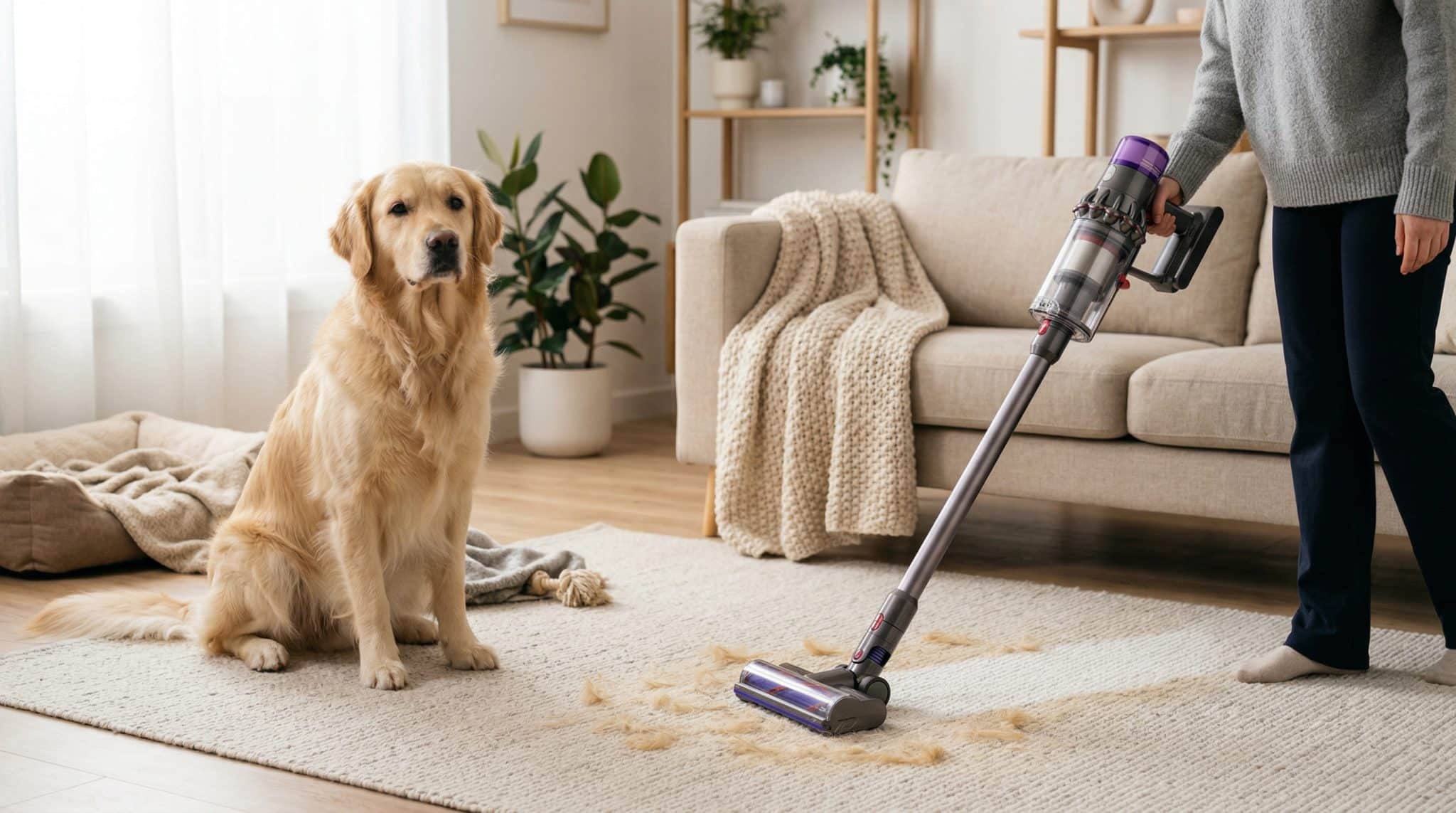
Owning a long-haired breed, such as a Golden Retriever, Afghan Hound, or Siberian Husky, introduces specific mechanical challenges that standard household vacuums are rarely equipped to handle. The primary issue is not just the volume of hair, but the physical properties of long keratin fibers. Unlike short hair, which is easily pulled into a dustbin, long hair behaves like a rope. When it encounters a rotating brush roll, it wraps tightly around the cylinder, creating a "hair wrap" that can cause significant damage.
The Physics of Hair Wrap and Motor Strain
When hair wraps around a brush roll, it creates friction. This friction generates heat, which can melt plastic components or cause the vacuum’s drive belt to snap. Furthermore, as the hair builds up, it acts as a barrier between the bristles and the carpet, drastically reducing the vacuum’s agitation efficiency. A vacuum designed for long-haired dogs utilizes specialized geometries—such as combs or conical rollers—to ensure hair is directed into the suction path before it can complete a full rotation around the brush.
Airflow vs. Raw Suction
Many consumers focus on "suction" (measured in kilopascals or water lift), but for long dog hair, airflow (measured in Cubic Feet per Minute, or CFM) is often more critical. Suction is the ability to lift a weight, but airflow is the volume of air moving through the system. High airflow is required to keep long, lightweight strands of hair moving through the hose and into the bin without settling in the "elbows" or tight bends of the vacuum's internal plumbing, which leads to clogs.
Critical Features to Evaluate in 2026
By 2026, the market has bifurcated into high-end cordless sticks and heavy-duty corded uprights. Regardless of the form factor, several non-negotiable features define the "best" in this category.
1. Active Hair Removal Systems
The most significant advancement in recent years is the transition from passive brush rolls to active hair-clearing systems. These systems usually involve a series of polycarbonate vanes or "combs" located just above the brush roll. As the brush spins, these vanes physically untangle hair and send it straight to the suction duct. Without this, pet owners are forced to manually cut hair off the roller with scissors—a process that is both unhygienic and damaging to the bristles over time.
2. HEPA Filtration and Completely Sealed Systems
Long hair is rarely the only byproduct of a shedding dog; it is almost always accompanied by dander (dried skin flakes) and dried saliva, both of which are potent allergens. A vacuum for long-haired dogs must have a High-Efficiency Particulate Air (HEPA) filter. However, a filter is only as good as the seals around it. A "completely sealed system" ensures that 99.9% of particles as small as 0.3 microns are trapped inside the machine and not exhausted back into the living room.
3. Bin Capacity and Emptying Mechanics
Long hair is incredibly voluminous. A small bin will reach capacity within minutes when cleaning a home with a heavy-shedding dog. Furthermore, hair tends to "nest" or clump inside the bin, making it difficult to empty. Look for vacuums with a "hygienic ejector" or a "point-and-shoot" mechanism that uses a silicone ring to scrape the hair out of the bin, preventing the need for the user to reach in and pull the hair out manually.
Top Vacuum Recommendations for 2026
Based on technical specifications and long-term durability tests, the following models represent the peak of pet hair management technology in 2026.
| Model | Primary Technology | Best Use Case | Filtration Type |
|---|---|---|---|
| Dyson Gen5outsize | Digital Motorbar & Hair Screw Tool | Large homes with mostly carpet | HEPA (Whole-machine) |
| Shark Stratos Upright | DuoClean PowerFins & Odor Neutralizer | High-traffic homes with mixed floors | HEPA (Complete Seal) |
| Miele Complete C3 Cat & Dog | Electro Plus Floorhead & Charcoal Filter | Longevity and allergy sufferers | Active AirClean |
| Bissell Pet Hair Eraser Turbo | Tangle-Free Brush Roll & Febreze Filter | Budget-conscious pet owners | HEPA-grade |
| Roborock S8 MaxV Ultra | DuoRoller Riser & 10,000Pa Suction | Daily maintenance/Automation | Washable E11 |
Dyson Gen5outsize: The Powerhouse
The Gen5outsize remains the benchmark for cordless performance. Its "Digital Motorbar" cleaner head uses de-tangling vanes that automatically clear wrapped hair from the brush bar as you clean. For long-haired dog owners, the Hair Screw Tool is the standout feature; its conical brush bar spirals hair off and into the bin in seconds, making it the most effective tool for upholstered furniture and dog beds.
Shark Stratos: The Practical Choice
Shark’s Stratos series utilizes "DuoClean PowerFins HairPro" technology. Unlike traditional bristles, the PowerFins maintain continuous contact with the floor, digging deep into carpets to pull out long hair that has been "weaved" into the fibers. The Stratos also includes an Odor Neutralizer Technology cartridge, which is vital for managing the "wet dog" smell that can often permeate vacuum filters over time.
Miele Complete C3 Cat & Dog: The Gold Standard for Longevity
For those who prefer a bagged canister vacuum, the Miele C3 is unmatched. Bagged vacuums are often superior for long hair because the hair is compressed into a self-sealing bag, preventing dander from escaping during disposal. The C3’s SEB 228 Electro Plus floorhead is a heavy-duty motorized tool that can be adjusted to five different heights, allowing it to navigate the dense "shag" of some long-haired breeds' fur that has settled into high-pile rugs.
Maintenance Strategies for High-Shedding Environments
Even the most advanced vacuum requires specific maintenance when dealing with long dog hair. Following these steps will extend the life of the machine's motor and maintain peak airflow.
- Pre-Vacuum Grooming: The most effective way to protect your vacuum is to reduce the load. Regular deshedding with tools like a Furminator reduces the amount of loose hair that reaches the floor.
- Check the Intake Port: Long hair can often "bridge" across the intake port (where the wand meets the vacuum body). Check this area every three to four uses to ensure no clogs are forming.
- Wash Filters Monthly: High volumes of dander can clog a HEPA filter faster than standard dust. In 2026, most filters are washable, but they must be completely dry (usually 24–48 hours) before being reinserted to prevent mold growth.
- Sensor Cleaning: Modern "smart" vacuums use infrared sensors to detect dirt levels. Fine dander can coat these sensors, leading the vacuum to believe the floor is dirtier than it is, which drains the battery unnecessarily.
Frequently Asked Questions
Can a robot vacuum actually handle long dog hair?
Most standard robot vacuums struggle with long hair because of their small bins and narrow brush rolls. However, by 2026, high-end models like the Roborock S8 or iRobot Roomba j9+ have implemented dual rubber rollers that resist tangling. They are excellent for maintenance (picking up daily shed), but they cannot replace a deep-cleaning upright or stick vacuum for weekly sessions.
Is a bagged or bagless vacuum better for long-haired dogs?
Bagged vacuums are generally better for households with heavy shedders or allergy sufferers. The bag acts as an extra layer of filtration and prevents a "dust cloud" when emptying the machine. Bagless vacuums offer the convenience of no recurring costs, but they require more frequent filter washing and more careful emptying.
How does hair length affect vacuum motor life?
Long hair increases the resistance on the brush roll. If the vacuum does not have an anti-tangle system, the motor has to work harder to spin the brush against the friction of the wrapped hair. This leads to overheating and can shorten the motor’s lifespan by 30-50% compared to use in a pet-free home.
Why does my vacuum smell like dog even after I empty it?
The smell is caused by organic material—dander and oils—trapped in the filters and the internal plastic hoses. To fix this, you must wash the filters and consider using a vacuum with an integrated odor neutralizer or a charcoal-lined HEPA filter, which chemically absorbs scent molecules.
What is the difference between a "Pet Pro" model and a standard model?
"Pet Pro" or "Animal" designations usually indicate three specific upgrades: a motorized upholstery tool for hair on couches, a tangle-free brush roll design, and a higher-grade filtration system (often HEPA) compared to the base model.
Practical Recommendation
If you live in a multi-pet household with long-haired breeds, prioritize a corded upright like the Shark Stratos or a Miele C3 for your primary cleaning. The unlimited runtime and high-capacity bins are necessary for the volume of hair produced. For quick daily pickups, a high-end cordless stick with a dedicated de-tangling head, such as the Dyson Gen5outsize, provides the best balance of convenience and mechanical reliability. Always verify that the model you choose offers a "completely sealed" filtration system to ensure that your efforts to clean the floor aren't degrading your home's air quality.
Image Gallery