The Secrets of the Mona Lisa Revealed: Scientific Discoveries and Hidden Layers
For over five centuries, Leonardo da Vinci's Mona Lisa (La Gioconda) has captured global fascination. Beyond her ambiguous smile, non-invasive scientific imaging, X-ray spectroscopy, and archival discoveries have revealed unprecedented...
For over five centuries, Leonardo da Vinci's Mona Lisa (La Gioconda) has captured global fascination. Beyond her ambiguous smile, non-invasive scientific imaging, X-ray spectroscopy, and archival discoveries have revealed unprecedented details about the painting. These modern diagnostic tools show that beneath the darkened, yellowed varnish lies a complex history of structural modifications, lost charcoal underdrawings, groundbreaking chemical formulations, and precise optical glazes.
Contents
Through high-resolution multispectral analysis, synchrotron radiation studies, and historical document verification, researchers have answered longstanding questions about the portrait's subject, Leonardo's experimental painting methods, and the hidden preparatory work invisible to the naked eye.
Identity and Provenance: Resolving the Subject's History
For centuries, art historians debated the true identity of the woman depicted in the portrait, proposing theories that ranged from noblewomen of the Italian Renaissance courts to idealized figures or even a disguised self-portrait. Historical consensus firmly establishes the sitter as Lisa Gherardini, the wife of Florentine cloth and silk merchant Francesco del Giocondo.
The primary evidence confirming her identity was discovered in 2005 at the Heidelberg University Library. Scholar Armin Schlechter uncovered a 1503 handwritten marginal note in an incunabulum written by Agostino Vespucci, a Florentine city clerk. In this marginalia, Vespucci compared Leonardo da Vinci to the ancient Greek painter Apelles, explicitly noting that Leonardo was currently working on three paintings, including a portrait of "Lisa del Giocondo."
1503 Archival Discovery (Agostino Vespucci Note):
- Sitter Identity: Lisa Gherardini (wife of Francesco del Giocondo)
- Date Range: Commenced circa 1503 in Florence
- Subsequent Path: Kept by Leonardo, moved to France (1516), Royal Collection (Francis I)
Leonardo began the portrait around 1503 in Florence. Rather than delivering the completed work to Francesco del Giocondo, he retained the poplar panel throughout his life, taking it to France when he entered the service of King Francis I in 1516. The painting entered the French Royal Collection after Leonardo’s death in 1519 at Château du Clos Lucé, eventually making its home at the Musée du Louvre.
Multispectral Imaging and the Hidden Underdrawing
In the early 2000s, French optical engineer Pascal Cotte performed ultra-high-resolution multispectral scans of the Mona Lisa using a multispectral camera capable of measuring 13 individual light spectra from ultraviolet to infrared. This technology, known as the Layer Amplification Method (LAM), allows scientists to penetrate surface paint layers and isolate distinct structural stages in the painting's creation.
The scans uncovered a crucial technique: spolverato, or pouncing. Pouncing was a Renaissance technique where an artist transferred a full-scale paper charcoal drawing (cartoon) to a panel substrate by pricking holes along the design's outlines and dusting charcoal dust through the punctures.
- Preparatory Cartoon (Paper): pricked with fine needle along contour lines
- Poplar Panel Ground Layer: dusted with charcoal powder through holes
- Spolverato Dots (Visible via Infrared Reflectography): connected by Leonardo using fine brush ink
- Final Paint Glazes (Sfumato)
The infrared scans revealed faint rows of tiny dot patterns beneath the surface layers, particularly along the hairline and hand positions. This discovery confirmed that Leonardo used a preparatory cartoon to draft the initial composition on paper before transferring it onto the prepared wood panel.
Multispectral scans also revealed several modifications made by Leonardo during the painting process:
- Compositional Adjustments: The position of the left hand’s fingers originally held a slightly different angle, pressed more firmly against the armrest of the pozzetto chair.
- Garment Details: Infrared reflectography revealed that Lisa’s head was originally painted with a fine hairnet or decorative hairpin (guarnello) that was later veiled under a sheer, dark veil.
- Underlying Drafts: Trace outlines beneath the visible glaze show early charcoal positioning of eyebrows and subtle facial shifts that were subsequently covered during glaze application.
Sfumato and Nanometer-Thin Paint Layers
Leonardo’s signature painting technique, sfumato (derived from the Italian word fumo, meaning "smoke"), creates soft, imperceptible transitions between light and shadow without visible lines or brushstrokes. For centuries, the exact physical application of this technique remained an artistic mystery.
A landmark study conducted by the Centre de Recherche et de Restauration des Musées de France (C2RMF) in collaboration with the European Synchrotron Radiation Facility (ESRF) used non-destructive X-ray fluorescence spectroscopy (XRF) to analyze the facial shadows of the Mona Lisa. The findings quantified Leonardo’s technique at a microscopic scale:
- Microscopic Layering: Leonardo applied dozens of ultra-thin paint glazes over a primed poplar surface. Individual glaze layers measure between 1 to 2 micrometers (0.001 to 0.002 millimeters) thick.
- Pigment Composition: The dark glazes consist of translucent oil and resin vehicles mixed with minute concentrations of manganese oxides and iron oxides.
- Cumulative Application: To build up deep shadows under the eyes, nose, and chin, Leonardo applied up to 30 to 40 individual glaze coats, building a total thickness of less than 40 micrometers.
Because each micro-layer required months to dry due to the high oil-to-pigment ratio, constructing the three-dimensional depth of the subject's face required years of patient work. This deliberate, slow layering explains why Leonardo carried the panel with him across Italy and France for over a decade.
Chemical Analysis and Ground Layer Discoveries
Modern chemical diagnostics have provided insight into the physical structure of the panel's ground coat—the preparatory primer applied directly to the raw wood. In a study published in the Journal of the American Chemical Society, a research team led by scientist Victor Gonzalez analyzed a micro-sample extracted from the upper-right edge of the painting using high-resolution synchrotron X-ray diffraction and micro-Fourier transform infrared spectroscopy.
| Layer | Component Description |
|---|---|
| Surface Glazes | Sfumato: Manganese/Iron Oxides in Oil Resin, ~40 µm |
| Primer Ground Layer | Lead White + Plumbonacrite / Litharge Oil Mixture |
| Preparation Layer | Gesso / Calcium Sulfate |
| Substrate | Poplar Wood Panel - Populus alba, 13 mm thick |
The analysis revealed a rare chemical compound: plumbonacrite ($\text{Pb}_5(\text{CO}_3)_3\text{O}(\text{OH})_2$), a lead carbonate derivative.
Plumbonacrite forms only when lead white pigment ($\text{2PbCO}_3\cdot\text{Pb(OH)}_2$) reacts under alkaline, high-temperature conditions with lead monoxide (litharge, $\text{PbO}$) in drying oil. This discovery provided direct physical evidence that Leonardo dissolved lead monoxide powder into heated linseed or walnut oil to formulate an extraordinarily thick, fast-drying, protective ground layer.
While Rembrandt was previously known to have used this chemical formulation in the 17th century, this finding proves Leonardo developed and tested lead-infused oil recipes more than a century earlier.
Atmospheric Perspective and Background Geometry
The background landscape of the Mona Lisa plays an integral role in the visual balance and spatial depth of the composition. Leonardo employed prospettiva aerea (aerial perspective), an optical concept he documented extensively in his notebooks (Codex Urbinas).
Visual Illusion Mechanisms in the Landscape:
- Left Background (Lower Horizon): Forces eye inward toward subject
- Right Background (Higher Horizon): Creates dynamic vertical tilt
- Combined Effect: Perceptual shift enhances subject's scale
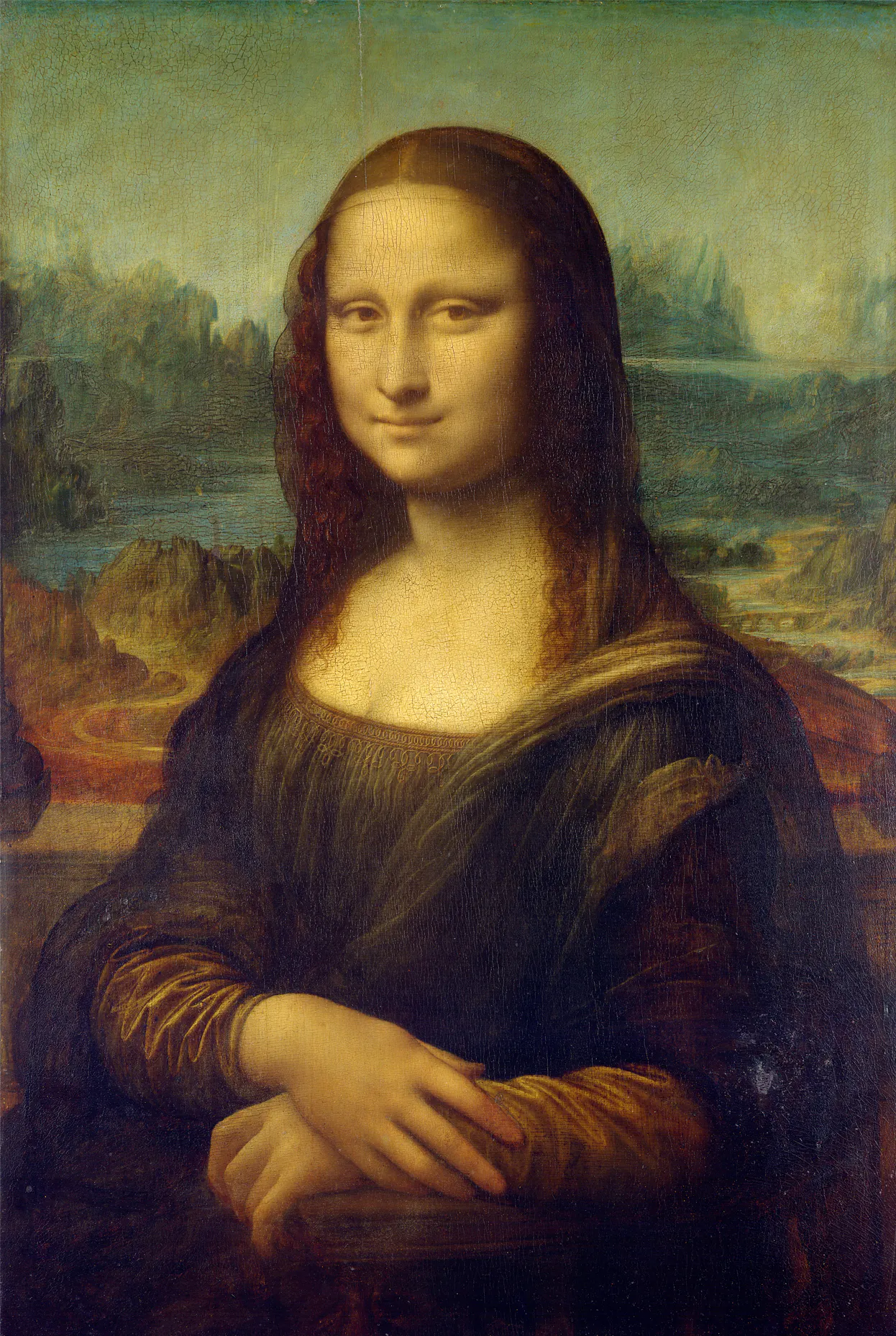
The landscape presents two distinct regions divided by the subject's head:
- Left Side: Features a lower horizon line, showing a winding path, warm earthy tones, and a low valley floor.
- Right Side: Features a elevated horizon line, detailing a rugged mountain chain, a high aqueduct or bridge, and cooler blue-green water systems.
Art historical surveys, including landscape field analyses in the Valdarno region of Tuscany, suggest the four-arched bridge over the sitter's left shoulder resembles the Ponte Buriano or the Ponte Romito over the Arno River.
However, Leonardo intentionally manipulated the perspective. By setting the left horizon noticeably lower than the right, he created a subtle visual imbalance. When a viewer’s gaze shifts from left to right across the canvas, the horizon appears to rise, making Mona Lisa appear taller, more dominant, and emotionally dynamic within the frame.
Summary of Major Technical Discoveries
The following table summarizes the key analytical techniques used by scientists, the specific features revealed, and their significance to art history.
| Technical Method | Key Scientific Finding | Physical Component Examined | Art Historical Significance |
|---|---|---|---|
| Infrared Reflectography (IRR) | Pouncing marks (spolverato) beneath facial contours | Charcoal dust on gesso ground | Confirms the use of a transferred paper cartoon prior to painting. |
| Layer Amplification Method (LAM) | Hidden hairpins, veil revisions, and hand shifts | Intermediate paint layers | Shows Leonardo's continuous structural revisions over several years. |
| X-Ray Fluorescence (XRF) | Glaze layers 1–2 micrometers thick containing manganese oxide | Sfumato shading around eyes and mouth | Explains the physical mechanics behind smooth tonal gradations without brush marks. |
| Synchrotron X-Ray Diffraction | Presence of plumbonacrite ($\text{Pb}_5(\text{CO}_3)_3\text{O}(\text{OH})_2$) | Ground layer oil-pigment interface | Proves Leonardo experimented with litharge (lead monoxide) to accelerate oil drying times. |
| Archival Palaeography | 1503 Vespucci marginalia in Heidelberg library | Historical paper manuscript | Formally identifies the subject as Lisa Gherardini, wife of Francesco del Giocondo. |
| Digital Color Reconstruction | Original lapis lazuli blues and warm skin undertones | Yellowed varnish layer subtraction | Reveals that centuries of oxidation altered the painting's original vivid colors. |
Preservation Status and Structural Vulnerabilities
The physical condition of the Mona Lisa requires specialized conservation protocols. Unlike many Renaissance works executed on canvas, the painting is rendered on a thin poplar wood panel (Populus alba) measuring 77 cm × 53 cm and approximately 13 mm thick.
Poplar is susceptible to hygroscopic expansion and contraction, swelling and shrinking in response to ambient moisture. Over centuries, this movement caused a vertical crack to develop from the top center edge of the panel down to the sitter’s hair line.
Cross-Section of Modern Enclosure at the Louvre:
- Ambient Gallery (20°C - 21°C)
- Bulletproof Optical Glass Shield
- Sealed Hermetic Inner Chamber
- Humidity: Constant 50% RH (±2%)
- Temperature: Constant 20°C
- Internal Desiccant: Silica Gel Beds
- Frame Support: Flexible Maple Cradling
- Sealed Hermetic Inner Chamber
- Bulletproof Optical Glass Shield
To maintain structural stability, the Louvre implements strict physical controls:
- Climate Control: The panel is housed inside a custom-built, bulletproof glass enclosure maintained at a constant 20°C (68°F) and 50% relative humidity to prevent further wood expansion.
- Structural Support: The back of the panel features a flexible maple cradle installed to reinforce the wood without constraining its natural micro-movements.
- Conservation Policy: Conservators avoid full varnish stripping or chemical restoration of the paint layer. Removing the darkened yellow varnish carries a high risk of stripping the nanometer-thin sfumato glazes that define the portrait's features.
Frequently Asked Questions
What is the secret charcoal sketch hidden beneath the Mona Lisa?
Infrared reflectography revealed tiny black dots (spolverato) along the hairline and hands. These dots demonstrate that Leonardo transferred an initial charcoal drawing from a paper cartoon onto the wood panel using a pouncing technique, establishing the initial compositional framework before painting.
Did the Mona Lisa originally have eyebrows and eyelashes?
High-resolution multispectral scans by engineer Pascal Cotte revealed tiny traces of hair pigments around the eye region. Over centuries of cleaning, surface varnish wipe-downs, and natural chemical oxidation, these ultra-fine brushstrokes faded or were removed, giving the sitter her current eyebrow-less appearance.
Why is the Mona Lisa painted on wood rather than canvas?
During the Italian High Renaissance, wood panels—specifically poplar—were the standard substrate for easel paintings in Florence. Canvas became widely adopted later in Venice due to the humid climate, but Florentine workshops prepared seasoned wood panels coated with gesso ground for stability and smooth paint application.
What rare chemical compound was discovered in the ground layer of the paint?
Researchers identified plumbonacrite, a lead carbonate compound formed when lead white pigment interacts with lead monoxide (litharge) heated in oil. This discovery proves Leonardo experimented with high-temperature lead additive formulas to create a dense, fast-drying base layer.
Why does the landscape background look mismatched?
Leonardo intentionally placed the left horizon line lower than the right horizon line. This dual-perspective technique creates a subtle visual tension, causing the viewer's eye to perceive the sitter as dynamic, taller, and visually striking when shifting focus across the composition.
Guidance for Art Scholars and Researchers
To study the scientific and structural analyses of the Mona Lisa effectively, consult primary academic and museum resources:
- Review High-Resolution Scans: Access the official online databases of the Musée du Louvre Collections to examine high-resolution digital imaging of the painting's current state and historical restoration records.
- Examine Peer-Reviewed Literature: Read publications from the Centre de Recherche et de Restauration des Musées de France (C2RMF) and the European Synchrotron Radiation Facility (ESRF) regarding non-invasive XRF spectroscopy and micro-diffraction findings.
- Analyze Notebook Drafts: Cross-reference physical findings with Leonardo's written notes in the Codex Urbinas and the Codex Windsor to understand his theoretical writings on optics, light refraction, and pigment chemistry.
Image Gallery