How to Configure Solar Panel Installation in Series and Parallel
To configure solar panels in series, connect the positive terminal of one panel to the negative terminal of the next to increase total voltage. To configure them in parallel, connect all positive terminals together and all negative ter...
To configure solar panels in series, connect the positive terminal of one panel to the negative terminal of the next to increase total voltage. To configure them in parallel, connect all positive terminals together and all negative terminals together using branch connectors to increase total current (amperage) while maintaining the same voltage.
Contents
Choosing the correct configuration for your solar array is one of the most critical steps in designing an efficient renewable energy system. The wiring method determines how much power reaches your battery bank or inverter and dictates the thickness of the cables you must use. By 2026, solar technology has advanced to offer higher-wattage panels and more sophisticated Maximum Power Point Tracking (MPPT) controllers, making the decision between series and parallel wiring more nuanced than ever.
Understanding the Fundamentals: Volts, Amps, and Watts
Before diving into the physical wiring, it is essential to understand the electrical relationship at play. Every solar panel has two primary ratings: Voltage (V) and Amperage (A). When you multiply these two together, you get Wattage (W), which represents the total power output.
In any solar configuration, the goal is to reach a specific wattage to satisfy your energy demands. However, how you reach that wattage—whether through high voltage and low current or low voltage and high current—depends entirely on your wiring configuration. As of 2026, most residential systems aim for higher voltages to reduce energy loss during transmission, but specific portable or off-grid setups may still benefit from parallel configurations.
How to Configure Solar Panels in Series
Wiring in series is the most common method for grid-tie systems and larger off-grid arrays. In a series circuit, electricity flows through one continuous path.
The Physical Connection
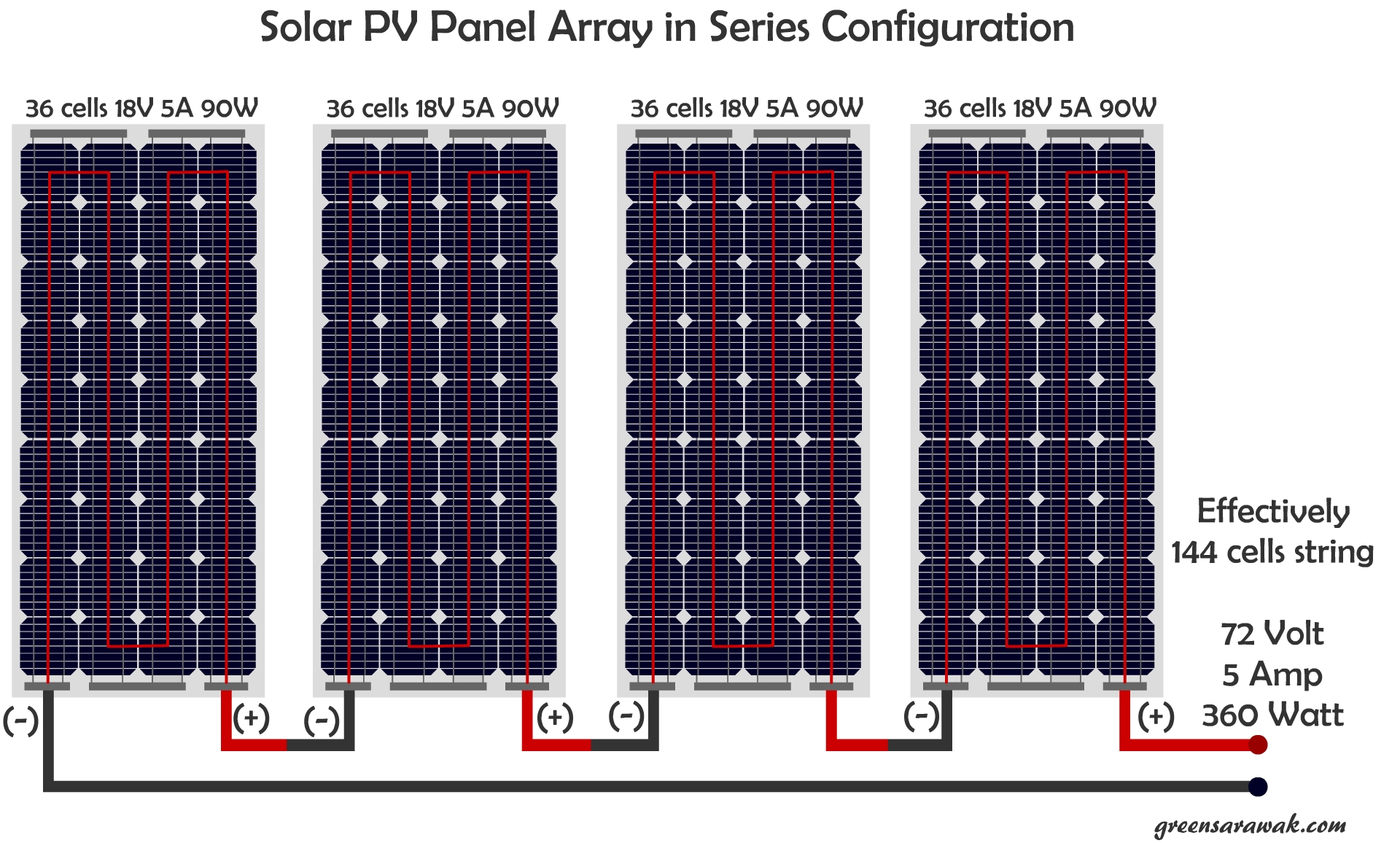
To wire panels in series, you take the positive (male) MC4 connector from the first panel and plug it into the negative (female) MC4 connector of the second panel. You continue this "daisy chain" until you are left with one open positive lead at one end of the string and one open negative lead at the other. These two remaining leads are then connected to your charge controller or inverter.
The Electrical Result
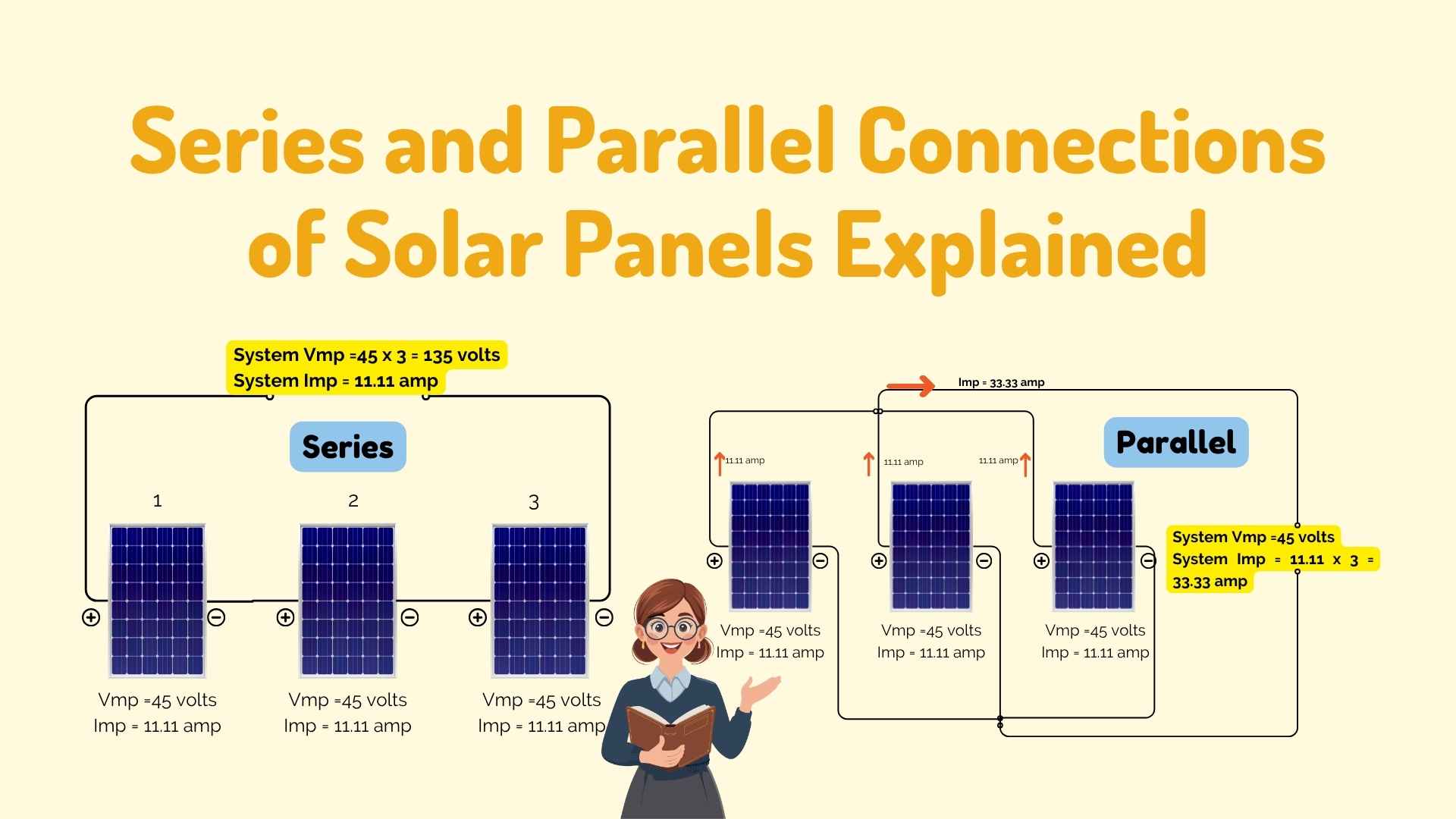
When panels are connected in series, their voltages add up, while their amperage stays the same. For example, if you have three 400-watt panels, each rated at 40V and 10A:
- Total Voltage: 40V + 40V + 40V = 120V
- Total Amperage: 10A
- Total Power: 120V x 10A = 1,200W
Advantages of Series Wiring
- Efficiency over Distance: Higher voltage allows the use of thinner, less expensive wires over long distances without significant "voltage drop" or energy loss.
- MPPT Compatibility: Modern MPPT charge controllers require the solar array voltage to be significantly higher than the battery voltage to function optimally. Series wiring helps achieve this threshold easily, even in low-light conditions.
- Simpler Hardware: You do not need additional branch connectors or combiners for a single string of panels.
Disadvantages and Limitations
The primary drawback of series wiring is its sensitivity to shading. Because the current must pass through every panel in the string, if one panel is shaded by a tree or chimney, the current of the entire string drops to the level of the weakest panel. While modern 2026-era panels often feature advanced bypass diodes to mitigate this, partial shading still significantly impacts a series-wired array.
How to Configure Solar Panels in Parallel
Parallel wiring is often preferred for smaller 12V or 24V systems, such as those found on RVs, boats, or small cabins, where shading is frequent or where the charge controller has a low maximum input voltage.
The Physical Connection
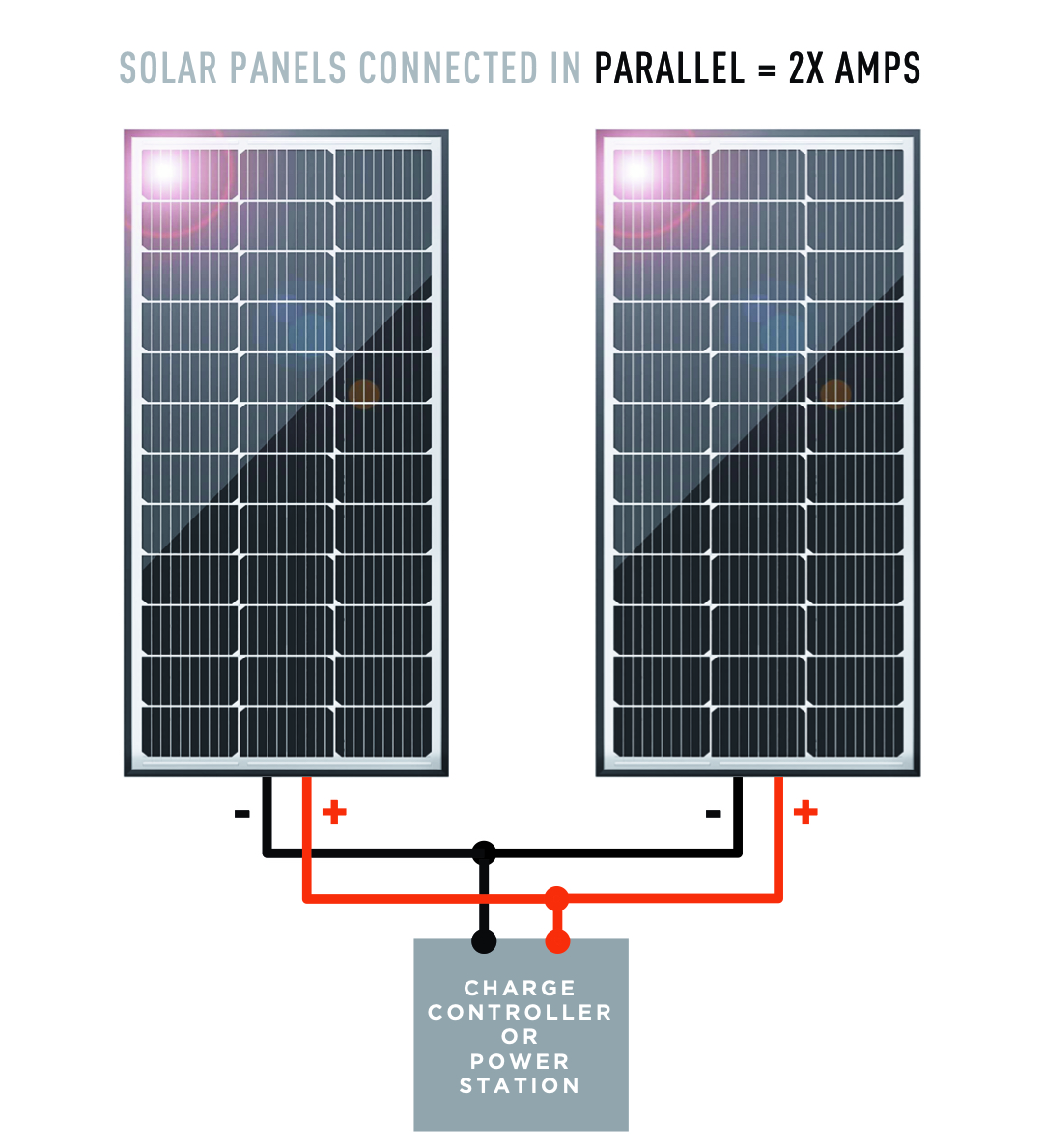
To wire panels in parallel, you connect all the positive terminals together and all the negative terminals together. Because standard MC4 connectors are designed for daisy-chaining, you must use MC4 branch connectors (often called Y-connectors) or a combiner box to join the leads. All positive leads meet at one junction, and all negative leads meet at another, which then travel to the controller.
The Electrical Result
In a parallel circuit, the amperage adds up, while the voltage stays the same. Using the same three 400-watt panels (40V, 10A):
- Total Voltage: 40V
- Total Amperage: 10A + 10A + 10A = 30A
- Total Power: 40V x 30A = 1,200W
Advantages of Parallel Wiring
- Shade Tolerance: Because each panel has its own path to the controller, a shaded panel only affects its own output. The other panels in the parallel array continue to produce at their full capacity.
- Safety in Low-Voltage Systems: Keeping the voltage low (under 50V–60V) can be safer for DIY installers, as it stays below certain regulatory thresholds for high-voltage DC equipment.
- Mixed Panel Flexibility: While not ideal, parallel wiring is generally more forgiving if you are forced to use panels with slightly different wattage ratings, provided their voltages are similar.
Disadvantages and Limitations
The biggest challenge with parallel wiring is the high current. A 30A or 40A flow requires much thicker copper wiring (lower gauge) to prevent overheating and energy loss. As of 2026, copper prices remain a significant factor in installation costs, making parallel wiring for large arrays significantly more expensive than series wiring.
The Hybrid Approach: Series-Parallel Configuration
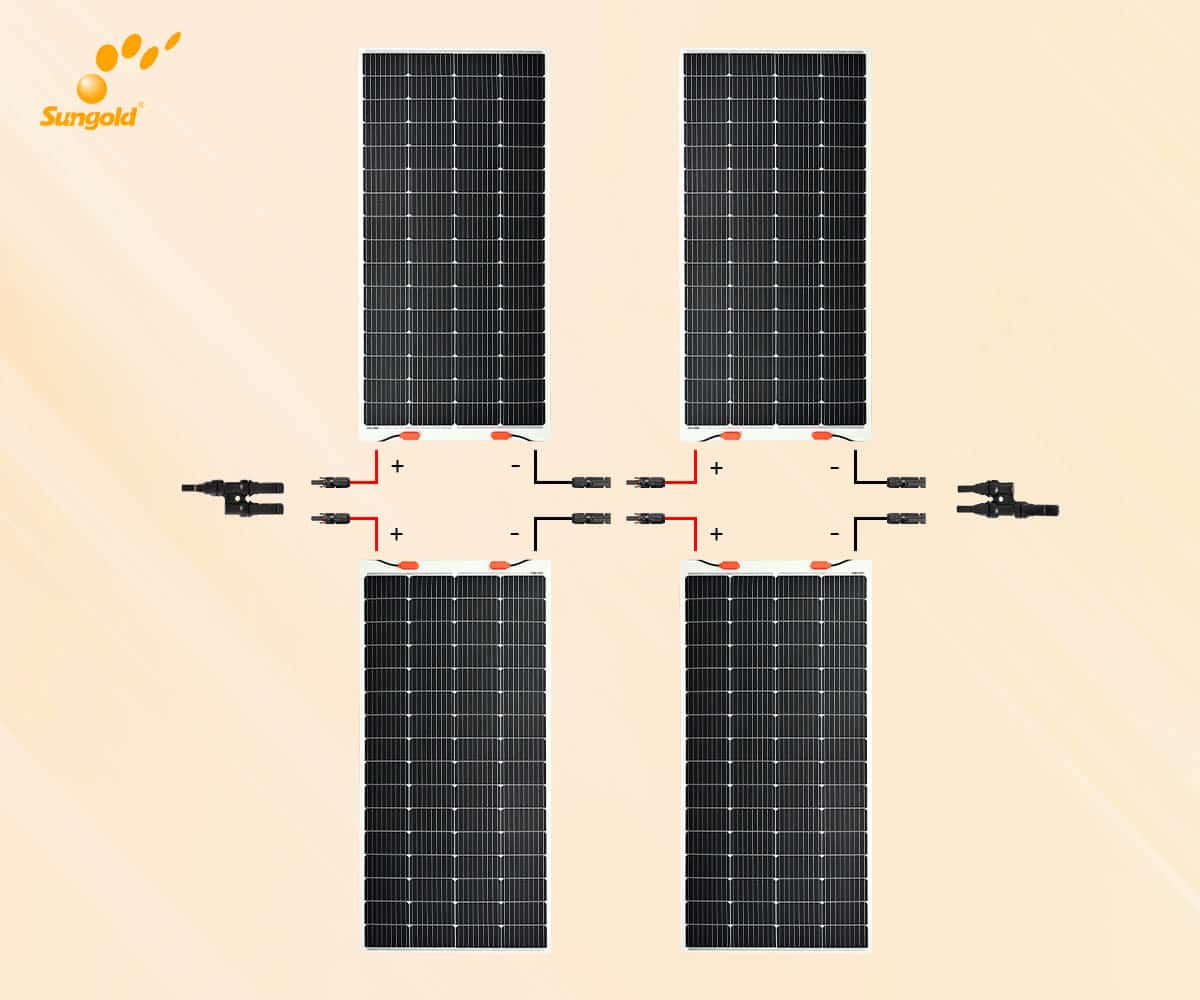
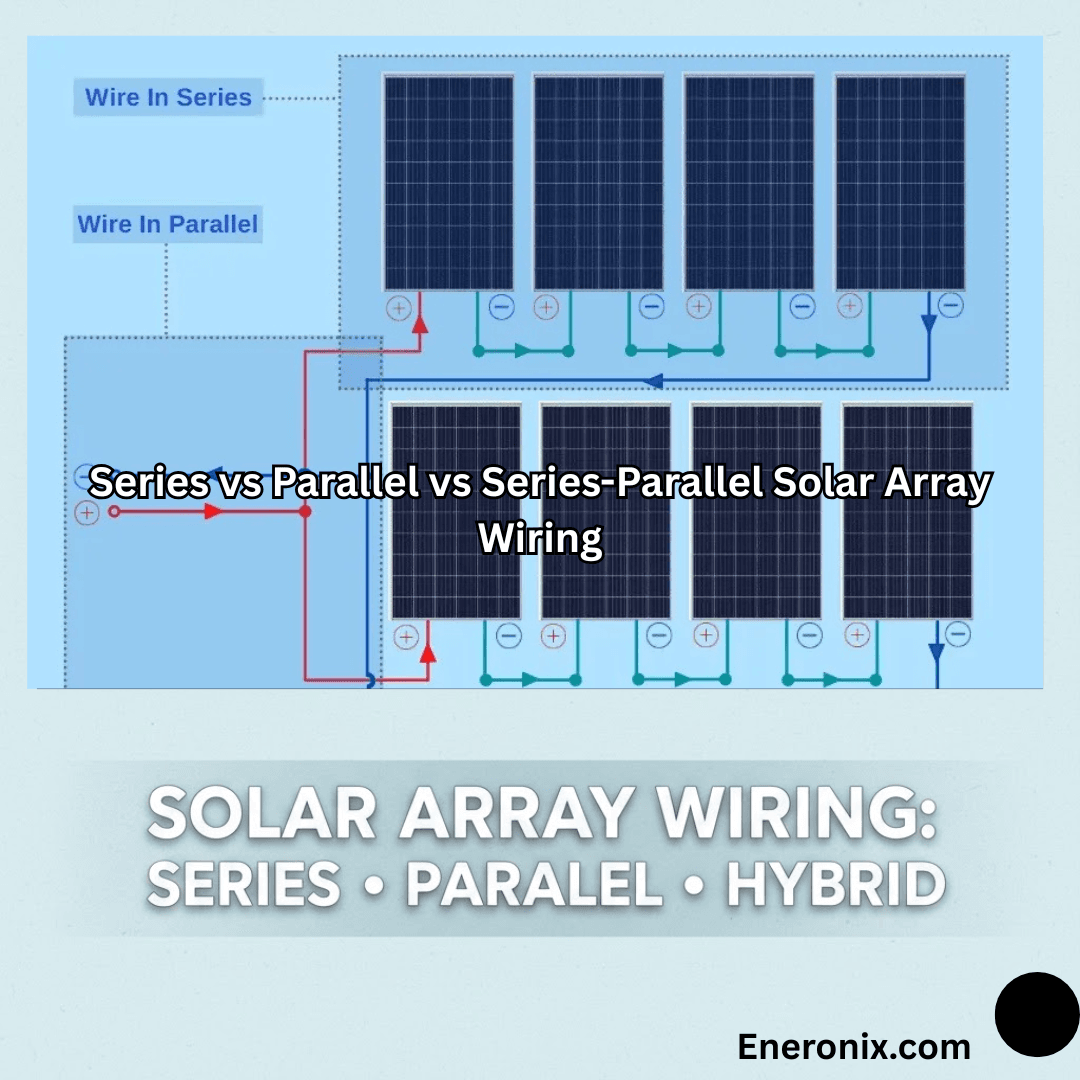
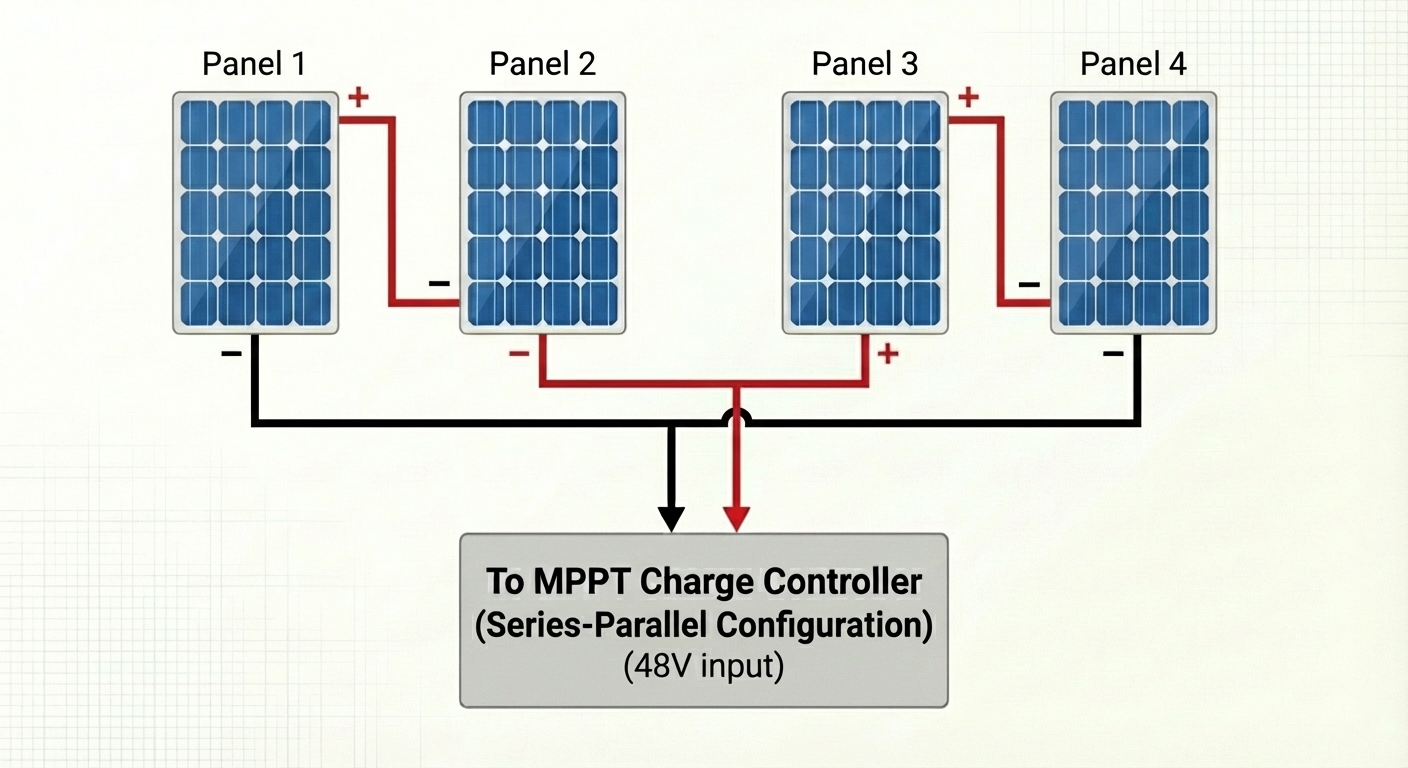
For mid-to-large scale installations, a series-parallel configuration is often the "Goldilocks" solution. This involves creating multiple strings of panels wired in series and then connecting those strings in parallel.
For instance, if you have eight panels, you might create two strings of four. Each string of four is wired in series to boost the voltage to an efficient level. Then, those two strings are joined in parallel using a branch connector. This allows you to increase the total wattage significantly while keeping the voltage within the safe operating limits of your charge controller and the amperage within the capacity of your wiring.
| Feature | Series Configuration | Parallel Configuration | Series-Parallel (Hybrid) |
|---|---|---|---|
| Primary Goal | Increase Voltage | Increase Amperage | Increase Both V and A |
| Wiring Complexity | Low (Daisy Chain) | Moderate (Needs Y-Connectors) | High (Needs Combiner Box) |
| Shade Performance | Poor (One affects all) | Excellent (Isolated impact) | Moderate (String-level impact) |
| Required Wire Gauge | Thinner (Lower Amps) | Thicker (Higher Amps) | Medium |
| Best For | Grid-tie, High-V MPPT | RVs, Boats, Small PWM | Large Home Off-Grid Systems |
| Max Distance | Long distances possible | Short distances preferred | Variable |
Technical Requirements and 2026 Safety Standards
When configuring your solar installation, you must adhere to the latest safety guidelines, such as those found in the 2023 or 2026 National Electrical Code (NEC) in the United States or equivalent international standards.
Charge Controller Limits
Your choice of wiring is dictated by your Charge Controller. Every controller has a "Maximum Input Voltage" and a "Maximum Charging Current."
- Voltage Overload: If you wire too many panels in series and exceed the controller's voltage limit (e.g., 150V), the controller will be permanently damaged, often instantly.
- Amperage Overload: Most modern MPPT controllers will simply "clip" or ignore excess amperage from a parallel array, but the excessive heat generated by high current can still reduce the lifespan of the unit if the wiring is undersized.
Fusing and Circuit Protection
In parallel configurations involving more than two strings, the NEC requires overcurrent protection (fuses) for each string. If one panel shorts out in a massive parallel array, the current from all other panels could rush into the shorted panel, causing a fire. Inline MC4 fuses are the standard 2026 solution for preventing this hazard.
Wire Sizing (AWG)
In 2026, the use of high-quality, UV-rated PV wire is non-negotiable. For series strings, 10 AWG or 12 AWG wire is typically sufficient due to the low current. However, for parallel arrays exceeding 30A, you may need to step up to 8 AWG or even 6 AWG wire to ensure the system operates coolly and efficiently.
Practical Steps for Configuration
- Map the Roof/Ground Space: Identify potential shading issues. If half your roof is shaded in the afternoon, consider two parallel strings rather than one long series string.
- Check the Controller Specs: Look at the "Voc" (Open Circuit Voltage) of your panels. Multiply this by the number of panels in series. Ensure this total is at least 15% below the controller's max rating to account for cold weather (solar panels produce higher voltage in cold temperatures).
- Use MC4 Tools: Do not attempt to hand-tighten MC4 connectors. Use a dedicated MC4 wrench tool to ensure a watertight seal, which is vital for preventing corrosion and "arc faults" over the 25-year lifespan of the panels.
- Verify with a Multimeter: Before plugging the final array into your expensive inverter or battery, use a multimeter to check the voltage and polarity of the leads. A reversed polarity connection is one of the most common causes of equipment failure in 2026 solar setups.
Frequently Asked Questions
Can I mix different brands of panels in series?
Technically, yes, but it is not recommended. In series, the entire string is limited by the panel with the lowest amperage. If you mix a 10A panel with an 8A panel, the 10A panel will be forced to operate at 8A, wasting 20% of its potential.
What happens to voltage in series when it gets cold?
Solar panels are more efficient in the cold. In freezing temperatures, the voltage can spike 10-25% above the rated "Voc." When wiring in series, you must calculate the "Cold Weather Voltage" to ensure you don't fry your charge controller on a bright, freezing winter morning.
Do I need a combiner box for parallel wiring?
If you are only connecting two panels or two strings in parallel, a simple MC4 Y-branch connector is usually sufficient. If you are connecting three or more strings, a fused combiner box is highly recommended for safety and organized cable management.
Is series wiring better than parallel for MPPT?
Yes, generally. MPPT (Maximum Power Point Tracking) controllers function by "stepping down" high voltage to the lower voltage needed by the battery. They are most efficient when the input voltage is significantly higher (usually 2-3 times higher) than the battery voltage.
How does shading affect parallel vs series?
In series, a shadow on one panel acts like a kink in a garden hose, slowing the flow for everything. In parallel, a shadow on one panel is like a single slow lane on a multi-lane highway; the other lanes (panels) continue to move at full speed.
Final Recommendation
For most residential installations in 2026, a series-heavy hybrid configuration is the best choice. Aim to keep your voltage high enough to satisfy your MPPT controller's requirements (typically 60V–120V for a 48V battery system) while staying safely below the device's maximum limits. Only resort to full parallel wiring if you are working with a low-voltage PWM controller or if your installation site suffers from unavoidable, frequent partial shading. Always prioritize high-quality MC4 connectors and correct wire gauges to ensure your system remains a safe, productive asset for decades.
Image Gallery