StarCraft II APM Explained: Mastering Actions Per Minute for Competitive Success
In StarCraft II, Actions Per Minute (APM) is a metric that measures the total number of commands a player issues within sixty seconds. It serves as a primary indicator of mechanical speed, reflecting how efficiently a player can manage...
In StarCraft II, Actions Per Minute (APM) is a metric that measures the total number of commands a player issues within sixty seconds. It serves as a primary indicator of mechanical speed, reflecting how efficiently a player can manage unit production, base expansion, and tactical combat simultaneously during a match.
Contents
Understanding APM is often the first step toward moving from casual play to competitive ladder rankings. While high speed does not automatically guarantee a victory, the ability to perform more meaningful actions than an opponent provides a significant strategic advantage. In this guide, we will break down how APM is calculated, the difference between "spam" and effective actions, and how you can systematically increase your speed in 2026.
The Mechanics of APM: How the Game Tracks Your Speed
At its core, APM counts every click and keypress that results in a game command. This includes selecting units, giving movement orders, building structures, training units from production facilities, and using special abilities like "Psi Storm" or "Stimpack."
In the early years of StarCraft II, there was a discrepancy between "Blizzard time" and real-time seconds. For much of the game's history, the "Faster" game speed setting—the standard for competitive play—ran approximately 1.4 times faster than real-time. This meant that a player with a displayed APM of 140 was actually performing closer to 200 actions in a real-time minute. However, following the Legacy of the Void expansion and subsequent updates, Blizzard synchronized the in-game clock with real-time, making APM readings more transparent and accurate for modern players.
APM vs. EPM: Identifying Efficiency
While APM tracks every single action, EPM (Effective Actions Per Minute) is a more refined metric used by analysts and high-level players. EPM attempts to filter out "redundant" actions. For example, if you right-click the same spot on the ground ten times in one second, your APM will spike by ten, but your EPM will likely only register one or two actions, as the subsequent clicks did not change the unit's pathing or behavior.
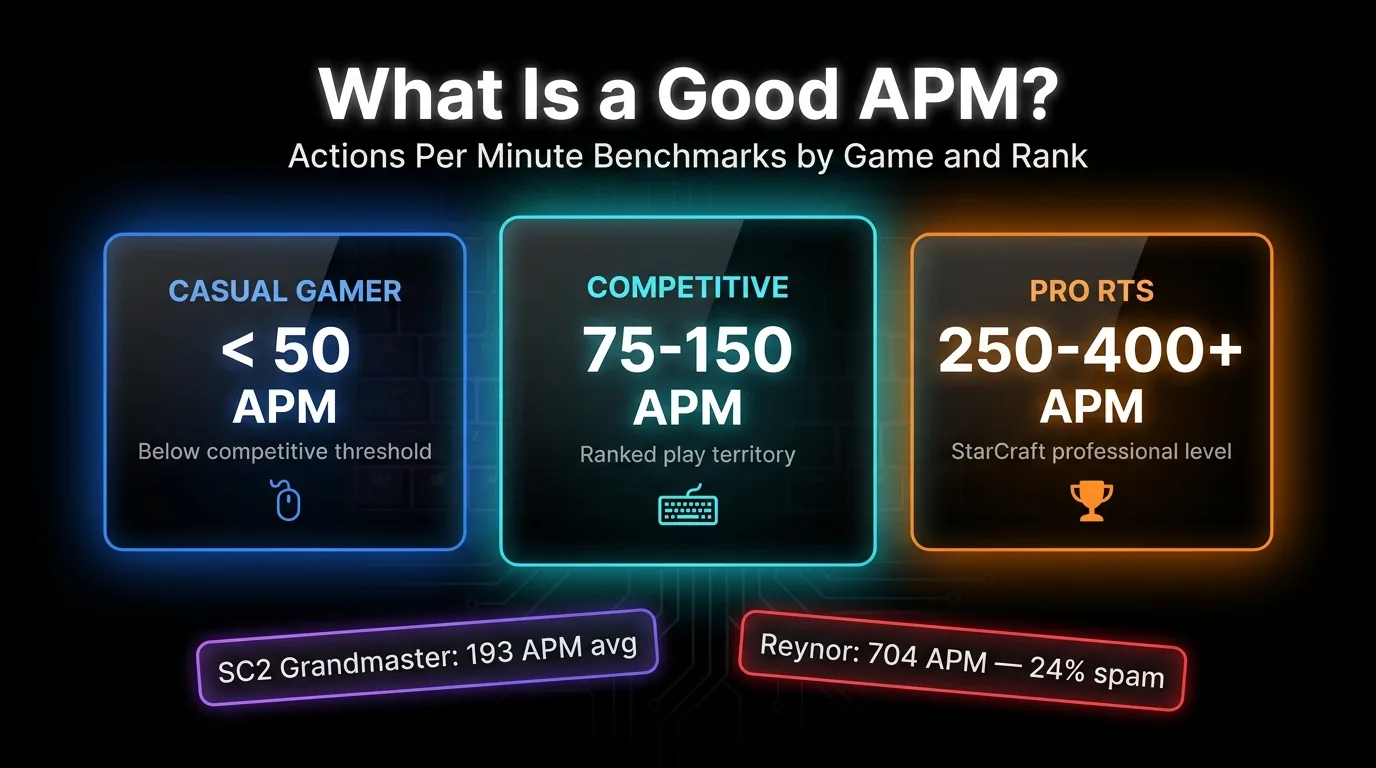
EPM is often considered a better reflection of a player's actual skill because it measures the commands that actually impact the game state. A player with 300 APM but only 100 EPM is likely "spamming"—clicking rapidly to keep their hands warm or out of habit—whereas a player with 180 APM and 160 EPM is playing with extreme precision and minimal wasted movement.
Why APM Matters: The "Mental Stack"
StarCraft II is often described as "speed chess." To be successful, you must manage several distinct areas of the game at once, a concept often referred to as the "mental stack." High APM allows you to clear this stack faster, preventing "bottlenecks" in your strategy.
- Macro-management: This involves consistently building workers, ensuring you aren't "supply blocked," and keeping your production facilities active. A high APM allows you to jump back to your base, start a new round of units, and return to the front lines in less than a second.
- Micro-management: This refers to the fine control of individual units during combat. High APM enables "stutter-stepping" (moving and shooting), focusing fire on high-priority targets, and splitting units to minimize damage from area-of-effect (AoE) attacks like Banelings or High Templar storms.
- Map Awareness and Scouting: You must constantly move your camera to check for enemy movements. High APM facilitates frequent use of the minimap and camera hotkeys to maintain total vision of the battlefield.
StarCraft II APM Benchmarks by League
While APM requirements vary by race (Zerg typically requires higher APM due to the "Larva Inject" mechanic, while Protoss often has lower, more deliberate APM), the following table provides a general guideline for the average APM seen across the 2026 ladder leagues.
| League | Average APM Range | Focus Area |
|---|---|---|
| Bronze / Silver | 30 – 70 | Basic unit production and moving units across the map. |
| Gold / Platinum | 70 – 120 | Consistent worker production and basic hotkey usage. |
| Diamond | 120 – 180 | Multitasking between basic micro and macro cycles. |
| Master | 180 – 250 | Refined micro-management and rapid response to harassment. |
| Grandmaster | 250 – 350+ | Optimized EPM, nearly perfect macro, and elite-level unit control. |
| Professional | 300 – 500+ | Maximum efficiency and simultaneous multi-front harassment. |
How to Effectively Increase Your APM
Increasing your APM isn't just about moving your fingers faster; it is about developing "muscle memory" so that your brain can process commands without conscious thought. If you have to think about which button builds a Pylon, you are losing valuable milliseconds.
1. Optimize Your Hotkey Layout
The "Standard" hotkey layout is often inefficient because it spreads commands across the entire keyboard. Many competitive players use The Core or a customized "Grid" layout to keep all essential keys within reach of their left hand's resting position. Minimizing the distance your fingers travel is the most direct way to increase speed.
2. Master Control Groups and Camera Hotkeys
You should never click the icons at the bottom of the screen. Use control groups (Ctrl + 0-9) to bind your army and production buildings. Furthermore, camera hotkeys (typically F1-F8) allow you to jump instantly between your different bases. Instead of scrolling across the map, a single tap of F1 brings you to your main base, and F2 to your natural expansion. This saves seconds of "screen travel" time.
3. The Macro Cycle
Develop a rhythmic "cycle" that you repeat every 15 to 20 seconds. For a Zerg player, this might look like:
- Inject Larva on all Hatcheries.
- Check supply (build Overlords if needed).
- Spend Larva on units or drones.
- Spread Creep.
- Check the minimap. By turning these tasks into a repetitive loop, you increase your APM naturally through consistency.
4. Rapid Fire Hotkeys
"Rapid fire" is a technical trick where you bind the "Choose Ability Target" command to the same key as the ability itself. This allows you to hold down a key (like 'C' for Corrosive Bile) and move your mouse to unleash dozens of abilities instantly, rather than clicking for every single one. This is a legitimate way to inflate your APM while drastically increasing your combat effectiveness.
The Limits of Speed: Quality Over Quantity
It is a common trap for intermediate players to focus so much on their APM counter that their actual gameplay suffers. This is often called "fast for the sake of being fast." If you are clicking 300 times a minute but forgetting to build workers or walking your army into a trap, your high APM is a liability.
The legendary pro player Serral is often cited as a model of efficiency. While he can reach over 400 APM, his EPM remains incredibly high, meaning almost every click serves a purpose. Conversely, some players "spam" in the early game—clicking their workers repeatedly while waiting for resources—to keep their hands warm and their heart rate up. While this helps maintain a rhythm, it shouldn't be confused with actual skill.
Physical Health and High APM
Pushing for 300+ APM places significant strain on the hands, wrists, and forearms. Repetitive Strain Injury (RSI) and Carpal Tunnel Syndrome are serious risks for StarCraft II players. To sustain a high APM over years of play, you must incorporate:
- Proper Ergonomics: Ensure your chair, desk height, and keyboard position allow for a neutral wrist angle.
- Hand Stretches: Perform dynamic stretches before and after sessions to maintain flexibility.
- Rest Periods: Avoid "grinding" for eight hours straight; take ten-minute breaks every hour to allow your tendons to recover.
Frequently Asked Questions
Does a higher APM always mean a better player?
Not necessarily. While professional players almost always have high APM, a player with 150 purposeful APM can often beat a player with 300 "spammy" APM. Strategy, positioning, and decision-making (game sense) are ultimately more important than raw speed, though speed provides the tools to execute those strategies.
Why do pros click so much at the very beginning of the game?
In the first minute of a match, there are very few units to control. Pros click rapidly (spamming) to "warm up" their hands and establish a fast rhythm. This ensures that when the game becomes complex ten minutes later, their hands are already moving at the necessary speed to handle the workload.
How can I check my APM in StarCraft II?
During a replay, you can toggle the "APM" or "EPM" tab in the dropdown menu to see real-time stats for both players. In the post-game score screen, Blizzard provides an average APM and a graph showing how your speed fluctuated throughout the match.
Is APM different for each race?
Yes. Zerg typically has the highest APM because they must manually "Inject" Larva and spread "Creep" across the map. Terran often follows due to the micro-intensity of bio-armies. Protoss players generally have the lowest average APM because their units are more expensive and durable, requiring more deliberate, precise commands rather than mass-repetition.
Can hardware improve my APM?
A mechanical keyboard with a high polling rate and a high-quality gaming mouse with an accurate sensor can help. However, hardware is rarely the bottleneck for APM; the limitation is almost always the player's muscle memory and mental processing speed.
Practical Recommendation
If you are looking to improve your StarCraft II performance in 2026, do not start by trying to click faster. Instead, focus on eliminating downtime. Use a replay analysis tool to see when your production facilities are idle or when your resources are climbing too high. By focusing on "never being idle," your APM will naturally increase as you fill those gaps with productive actions. Speed is a byproduct of mastery, not a prerequisite for it.
Image Gallery