Why Companies Use NetSuite for Growth: Scaling Operations in 2026
Companies use NetSuite for growth because it provides a unified, cloud-native platform that replaces fragmented systems with a single source of truth. By integrating financials, inventory, CRM, and e-commerce, businesses gain the real-...
Companies use NetSuite for growth because it provides a unified, cloud-native platform that replaces fragmented systems with a single source of truth. By integrating financials, inventory, CRM, and e-commerce, businesses gain the real-time visibility and automated workflows necessary to scale operations globally, improve decision-making, and reduce operational overhead.
Contents
As of 2026, the mid-market and enterprise landscapes are more competitive than ever. For organizations transitioning out of the startup phase or moving away from limited entry-level accounting software, the choice of an Enterprise Resource Planning (ERP) system is a pivotal strategic decision. NetSuite has remained a dominant leader in this space by specifically targeting the "growth" pain points: complexity, lack of visibility, and international barriers.
The Shift from Fragmented Systems to a Unified Platform
Many growing companies hit a "plateau of inefficiency" when they rely on what industry experts call a "software hairball." This refers to a collection of disconnected applications—such as QuickBooks for accounting, Salesforce for CRM, and Excel for inventory—linked by manual data entry or fragile, custom-coded integrations.
When a company attempts to grow with a fragmented tech stack, data silos emerge. The finance team sees one set of numbers, while sales and warehouse teams see another. This discrepancy leads to delayed shipments, inaccurate forecasting, and significant time wasted on manual reconciliations. NetSuite solves this by offering a unified data model. Because every module shares the same database, a sales order placed in the CRM automatically updates inventory levels and populates the finance department’s billing queue. This seamless flow of information allows companies to process higher volumes of business without a linear increase in administrative headcount.
Accelerating Global Expansion with NetSuite OneWorld
For companies in 2026, "growth" is rarely limited by geography. However, expanding into international markets introduces immense regulatory and operational complexity. NetSuite OneWorld is the specific module that many companies cite as the primary reason for choosing the platform. It enables organizations to manage multiple subsidiaries, business units, and legal entities from a single account.
NetSuite OneWorld facilitates growth through several core functions:
- Multi-Currency Management: Automating exchange rate updates and handling transactions in over 190 currencies.
- Global Tax Compliance: Pre-configured tax engines that account for local variations, including VAT, GST, and sales tax across hundreds of jurisdictions.
- Consolidated Reporting: Providing a "top-down" view of the entire global organization in real-time, while still allowing for localized reporting at the subsidiary level.
- Multi-Language Support: The interface supports 27+ languages, ensuring that local teams can work efficiently while maintaining corporate standards.
By removing the friction of local compliance and financial consolidation, companies can enter new markets in weeks rather than months.
Enhancing Operational Efficiency through Automation
Growth often creates a burden on internal processes. If a company doubles its order volume but still relies on manual invoicing, it will eventually collapse under its own weight. NetSuite focuses on automating the "Lead-to-Cash" and "Procure-to-Pay" lifecycles.
In the 2026 version of NetSuite, AI-driven automation has become deeply embedded in these workflows. For example, the system can now predict potential supply chain disruptions and automatically suggest alternative vendors or shipping routes. Smart billing features automate complex recurring revenue models, which is essential for the "subscription economy" that many modern businesses have embraced. By automating these repetitive, high-volume tasks, a company’s workforce can shift from data entry to strategic analysis, directly fueling further growth.
Real-Time Visibility and Strategic Decision Making
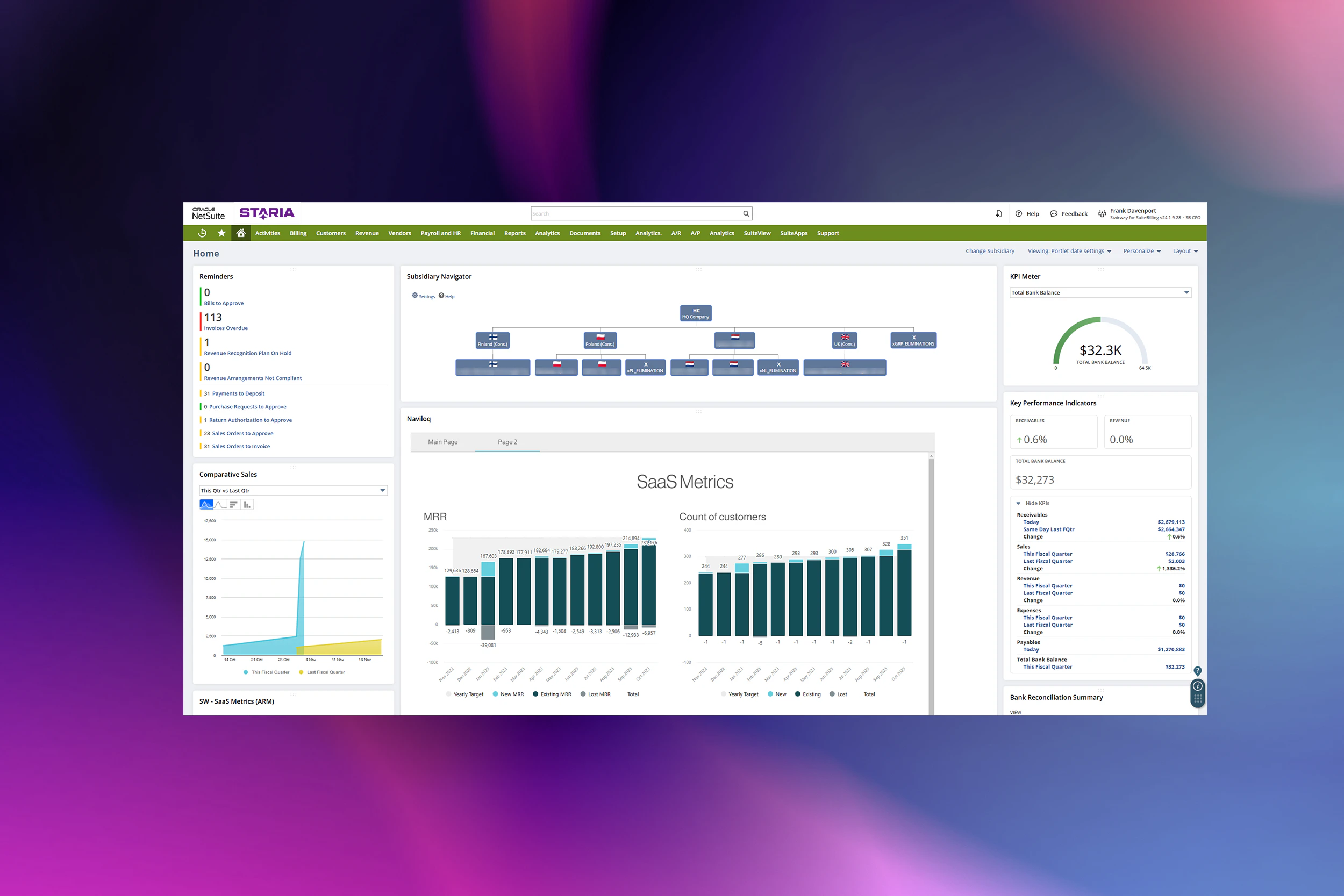
One of the greatest risks to a growing company is flying blind. Without real-time data, executives are forced to make decisions based on month-old reports. NetSuite provides role-based dashboards that give every employee—from the warehouse manager to the CEO—an instant view of the Key Performance Indicators (KPIs) that matter most to them.
For a CFO, this might mean real-time visibility into Days Sales Outstanding (DSO) and aging receivables. For a Sales VP, it could be a live view of the pipeline weighted by probability. This transparency ensures that growth is sustainable. When management can see a cash flow dip or an inventory surplus coming before it happens, they can pivot strategies proactively rather than reactively.
Comparing NetSuite to Other Solutions in 2026
To understand why companies choose NetSuite for growth, it is helpful to compare it against the alternatives available in the 2026 market.
| Feature | Entry-Level (e.g., QuickBooks) | Legacy On-Premise ERP | NetSuite (Cloud-Native) |
|---|---|---|---|
| Scalability | Limited; breaks at high transaction volumes. | High, but requires expensive hardware upgrades. | Infinite; scales automatically with cloud resources. |
| Data Integrity | High risk of manual errors across silos. | High, but data is often trapped in old silos. | Single source of truth across all modules. |
| Global Capabilities | Minimal; requires third-party plugins. | Difficult and costly to localize. | Built-in (OneWorld) for 190+ currencies. |
| Maintenance | Low, but offers limited functionality. | Very high; requires dedicated IT staff and servers. | Included in subscription; automatic bi-annual updates. |
| Implementation | Fast (Days). | Very slow (12–24 months). | Moderate (3–6 months via SuiteSuccess). |
Technical Flexibility: The SuiteCloud Platform
A common mistake growing companies make is choosing a "rigid" software that forces them to change their business processes to fit the tool. NetSuite avoids this through the SuiteCloud Platform. This is a developer-friendly environment that allows companies to customize the software without breaking the core codebase.
As a company evolves, its requirements change. It might launch a new product line that requires a specific workflow or integrate with a proprietary logistics provider. SuiteCloud enables:
- SuiteScripts: Tailored logic to automate unique business rules.
- SuiteTalk: Robust APIs for integrating with third-party applications.
- SuiteBuilder: Point-and-click tools for modifying forms, records, and roles.
Crucially, because NetSuite is a true multi-tenant SaaS provider, these customizations "carry forward" during the twice-yearly system updates. This eliminates the "version lock" that plagued older ERP systems, where companies would refuse to update their software for years because they feared breaking their custom code.
The Role of "SuiteSuccess" in Rapid Deployment
Historically, ERP implementations were feared as long, expensive failures. NetSuite addressed this by introducing SuiteSuccess, a market-leading deployment methodology. Instead of starting with a blank slate, SuiteSuccess provides pre-configured templates based on 20+ years of industry best practices.
Whether a company is in manufacturing, wholesale distribution, or software, they can start with a "Leading Practice" version of NetSuite that already includes the relevant KPIs, reports, and workflows for their industry. This allows companies to get up and running in as little as 90 days, realizing the benefits of the system much faster and ensuring the software supports growth rather than delaying it.
Addressing Potential Challenges
While NetSuite is a powerful engine for growth, it is not without challenges. The primary barrier is usually the total cost of ownership (TCO). NetSuite is a premium product with a subscription-based pricing model that increases as a company adds users and modules. For very small businesses, the cost might outweigh the immediate benefits.
Furthermore, a NetSuite implementation requires a significant commitment from internal stakeholders. If a company does not have a clear vision of its processes or fails to invest in proper training, the system will not yield the desired ROI. Companies that successfully use NetSuite for growth treat the implementation as a business transformation project, not just an IT installation.
FAQ
Is NetSuite suitable for startups or only large enterprises? NetSuite is highly suitable for "high-growth" startups that expect to scale quickly. While the initial cost is higher than basic accounting software, it prevents the need for a painful and expensive data migration later when the company outgrows its first system. Many startups choose NetSuite specifically to impress investors and prepare for an IPO.
How does NetSuite handle security and data privacy in 2026? NetSuite employs enterprise-grade security, including multi-factor authentication, end-to-end encryption, and rigorous SOC 1 and SOC 2 compliance. As a cloud provider, Oracle (NetSuite's parent company) manages the infrastructure security, which is typically much stronger than what a mid-sized company could maintain on its own servers.
Can NetSuite integrate with my existing specialized software? Yes. Through SuiteTalk (Web Services) and a vast network of "Built for NetSuite" (BFN) partners, the platform can integrate with specialized tools for payroll, marketing automation, or industry-specific CAD and PLM software.
What is the average timeline for a NetSuite implementation? Using the SuiteSuccess methodology, a standard implementation typically takes between 3 to 6 months. However, more complex global organizations with significant customization requirements may take 9 months or longer.
Does NetSuite support subscription-based business models? Yes. NetSuite SuiteBilling is specifically designed to handle complex recurring revenue, tiered pricing, and usage-based billing models. It automates the entire renewal process, which is a major driver of growth for modern SaaS and service companies.
Strategic Recommendation
For companies targeting aggressive expansion in 2026, the transition to NetSuite should be viewed as a foundational investment. To maximize the impact on growth, organizations should:
- Prioritize Clean Data: Before migrating, audit and clean your existing customer and financial data to ensure the new system starts with a "high-integrity" foundation.
- Adopt Leading Practices: Avoid the temptation to over-customize. Start with the SuiteSuccess standard workflows and only customize where your business has a truly unique competitive advantage.
- Invest in Training: The platform is only as effective as the people using it. Continuous training for staff ensures that the advanced automation and reporting features are fully utilized.
By consolidating operations into a single, scalable cloud environment, companies can move away from reactive troubleshooting and focus entirely on strategic market expansion.
Image Gallery