The Difference Between Term Whole and Universal Life Insurance Policies Explained
The primary difference between term, whole, and universal life insurance lies in the duration of coverage and the accumulation of cash value. Term life provides temporary protection for a set period without a savings component. Whole l...
The primary difference between term, whole, and universal life insurance lies in the duration of coverage and the accumulation of cash value. Term life provides temporary protection for a set period without a savings component. Whole life offers permanent coverage with fixed premiums and guaranteed cash value growth. Universal life provides permanent protection with flexible premiums and adjustable death benefits.
Contents
Understanding these three pillars of financial protection is essential for long-term estate planning and family security. As of 2026, the life insurance landscape has evolved to offer more granular riders and digital management tools, yet the fundamental mechanics of these three policy types remain the bedrock of the industry. Choosing the right one requires an analysis of your current cash flow, your long-term legacy goals, and your tolerance for investment risk.
Term Life Insurance: Pure Protection for a Specific Window
Term life insurance is often described as the "purest" form of life insurance because it functions strictly as a death benefit. It does not include an investment account or a cash value component. When you purchase a term policy, you are buying a promise from the insurance company to pay a specific amount to your beneficiaries if you pass away within a designated timeframe, such as 10, 20, or 30 years.
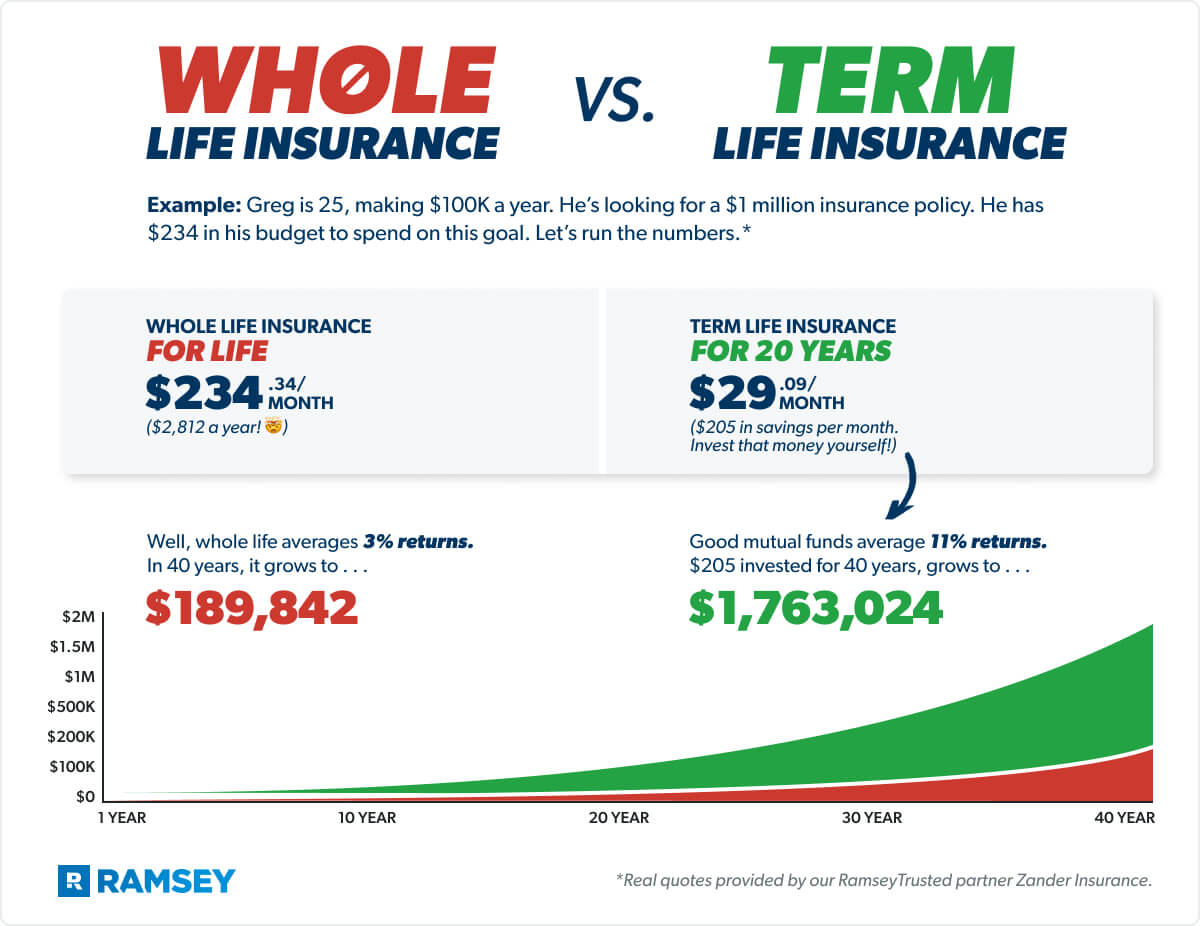
In 2026, term life remains the most affordable option for the vast majority of consumers. Because the policy is temporary and has no "living benefits" (like cash withdrawal), the premiums are significantly lower than permanent alternatives. This makes it ideal for young families who need high coverage amounts to replace income, pay off a mortgage, or fund college tuition but have limited discretionary income.
The "term" aspect is its defining feature. If the policyholder outlives the term, the coverage simply expires. While some policies offer a "return of premium" rider or the option to convert to a permanent policy without a medical exam, these features typically increase the initial cost. For most, the goal of term insurance is to cover a period of high financial vulnerability that eventually ends—such as when children reach adulthood or the mortgage is paid in full.
Whole Life Insurance: Permanent Coverage with Guaranteed Growth
Whole life insurance is a type of permanent life insurance designed to cover the insured for their entire life, provided the premiums are paid. Unlike term insurance, whole life includes a "cash value" component that grows over time. A portion of every premium payment is funneled into this cash value account, which grows at a guaranteed rate set by the insurance provider.
One of the most significant advantages of whole life insurance in 2026 is its predictability. The premiums are level, meaning they will never increase, regardless of your aging or changes in your health. This makes it a stable line item in a long-term retirement budget. Furthermore, many whole life policies issued by mutual insurance companies are "participating" policies, meaning they may pay out annual dividends to policyholders based on the company's financial performance. These dividends can be taken as cash, used to reduce premiums, or reinvested to increase the death benefit.
However, this level of certainty comes at a price. Whole life premiums can be five to ten times more expensive than term insurance for the same death benefit amount. The complexity of the cash value—which can be borrowed against or used as collateral—requires a deep understanding of the policy's surrender charges and tax implications. According to the Internal Revenue Code Section 7702, the tax-deferred growth of the cash value is a major draw for high-net-worth individuals looking for tax-efficient ways to transfer wealth.
Universal Life Insurance: The Flexible Permanent Solution
Universal life (UL) insurance is often viewed as a middle ground between the rigidity of whole life and the simplicity of term life. Like whole life, it is a permanent policy with a cash value component. However, universal life is built on a modular structure that allows policyholders to adjust their premium payments and death benefits as their financial circumstances change.
In a universal life policy, the "cost of insurance" (the actual price of the death benefit) is unbundled from the savings element. If the cash value grows sufficiently, policyholders can use that value to pay their monthly premiums, effectively making the policy "self-funding" for a period. Conversely, if you face a financial hardship, you may be able to lower or skip premium payments by drawing down the accumulated cash value.
As of 2026, several sub-types of universal life have become prominent:
- Indexed Universal Life (IUL): The cash value growth is tied to a market index, such as the S&P 500, often with a "floor" to prevent losses and a "cap" on maximum gains.
- Variable Universal Life (VUL): Allows the policyholder to invest the cash value in sub-accounts similar to mutual funds, offering higher growth potential but also the risk of losing principal.
- Guaranteed Universal Life (GUL): Focuses less on cash accumulation and more on providing a permanent death benefit with fixed premiums that are lower than whole life.
The primary risk with universal life is that if the underlying interest rates or market returns underperform, the policyholder may need to inject significantly more cash into the policy later in life to prevent it from lapsing.
Side-by-Side Comparison of Policy Features
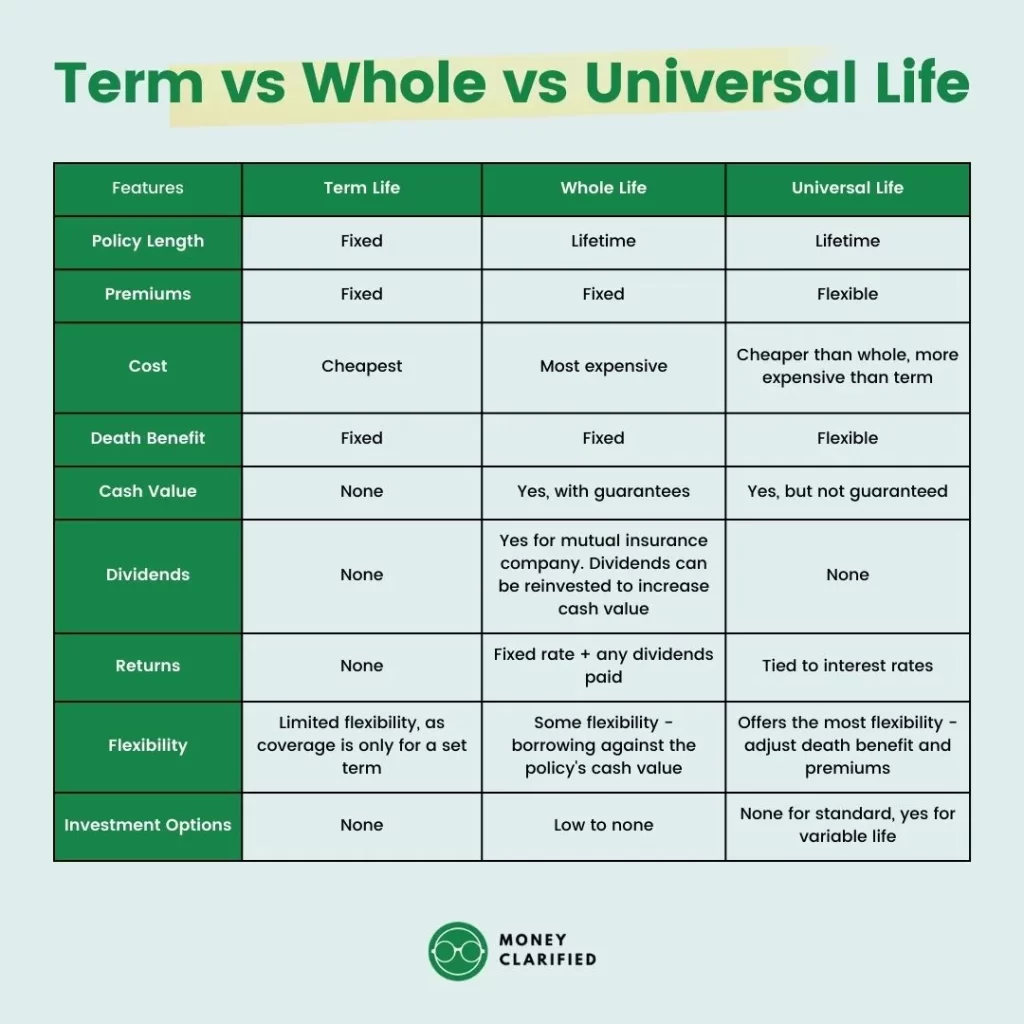
To help visualize the structural differences, the following table compares the core attributes of term, whole, and universal life insurance as they stand in 2026.
| Feature | Term Life Insurance | Whole Life Insurance | Universal Life Insurance |
|---|---|---|---|
| Duration of Coverage | Fixed Period (10–30 years) | Lifelong (Permanent) | Lifelong (Permanent) |
| Premium Costs | Lowest (Initially) | Highest (Fixed) | Moderate (Flexible) |
| Cash Value Component | None | Yes (Guaranteed Growth) | Yes (Market/Interest-Based) |
| Death Benefit | Fixed | Fixed | Adjustable |
| Complexity | Low | Moderate | High |
| Dividends | No | Yes (Participating Policies) | No (Interest Credits instead) |
| Best For | Temporary income replacement | Lifetime legacy & tax planning | Flexible protection & growth |
Key Differences in Cost and Cash Value Accumulation
When evaluating the difference between term whole and universal life insurance policies explained, the financial mechanics of the "living benefits" are the most complex factor.
Premium Allocation: In a term policy, 100% of your premium goes toward the cost of insurance and administrative fees. In a whole life policy, a significant portion of the early years' premiums goes toward commissions and administrative costs, with cash value building slowly but predictably. In a universal life policy, the premiums are credited to the cash value account first, and the cost of insurance is then deducted from that balance.
Accessing Funds: Policyholders can access the cash value in whole and universal policies through loans or withdrawals. Under current tax laws in 2026, loans are generally tax-free as long as the policy remains in force. However, unpaid loans reduce the death benefit. If a policy "lapses" or is surrendered with an outstanding loan, the loan amount may be treated as taxable income.
Surrender Value: If you decide you no longer need the insurance, a term policy simply ends with no value. A whole life or universal life policy has a "surrender value," which is the cash value minus any surrender charges imposed by the carrier. In the early years of a permanent policy, the surrender charges are often high, meaning it may take 10 to 15 years before the surrender value is significant.
Strategic Suitability: Which Policy Fits Your 2026 Goals?
Choosing between these three types of insurance is not about finding the "best" product, but the one that aligns with your specific financial stage.
The Young Family Scenario: For a couple in their 30s with a mortgage and two children, a 20-year or 30-year term policy is almost always the recommendation. It provides the largest "bang for the buck," ensuring that if a breadwinner passes away, the family can remain in their home and the children can attend college.
The Estate Planning Scenario: For individuals with high net worth who are concerned about estate taxes or leaving a specific legacy to a charity, whole life insurance provides the necessary certainty. The guaranteed death benefit ensures that liquidity is available to pay taxes or settle an estate without forcing the sale of illiquid assets like real estate or a family business.
The Flexible Professional Scenario: For an individual whose income fluctuates—such as a small business owner or a commission-based professional—universal life offers the necessary breathing room. The ability to pay more into the policy during "flush" years and less during "lean" years provides a level of financial agility that term and whole life cannot match.
Common Mistakes to Avoid in Life Insurance Selection
The complexity of permanent insurance often leads to common pitfalls. One of the most frequent mistakes is treating a life insurance policy primarily as an investment. While the cash value is a benefit, the primary purpose of insurance is risk mitigation. As noted by the National Association of Insurance Commissioners (NAIC), consumers should ensure they can afford the premiums of a permanent policy for the long haul; surrendering a policy early due to cost can result in a total loss of the "investment" portion.
Another mistake is underestimating the "cost of insurance" increases within universal life policies. As the insured person ages, the internal cost of the death benefit rises. If the cash value is not growing fast enough to cover these rising costs, the policy can enter a "death spiral" where the cash value is depleted until the policy lapses. Regular "in-force illustrations"—yearly reports showing the projected performance of the policy—are vital for universal life owners to monitor this risk.
Frequently Asked Questions
Can I convert my term life policy into a whole life policy?
Yes, most term life insurance policies include a conversion rider. This allows the policyholder to switch to a permanent policy (whole or universal) without undergoing a new medical exam. This is particularly valuable if you develop a health condition during your term that would make it difficult or expensive to get a new policy later. However, the premium will increase significantly to reflect the permanent nature of the new coverage.
What happens to the cash value in a whole life policy when I die?
Generally, the insurance company keeps the cash value and pays the face amount (the death benefit) to your beneficiaries. The cash value is essentially a part of the death benefit that the company has already "pre-funded." However, some policies or riders allow for the "face amount plus cash value" to be paid out, though these policies come with higher premium costs.
Is the death benefit from these policies taxable for my heirs?
In most cases, life insurance death benefits are received by beneficiaries income-tax-free. This applies to term, whole, and universal life. However, if the death benefit is paid to the deceased person's estate rather than a named beneficiary, it may be subject to estate taxes if the total estate value exceeds federal or state thresholds. In 2026, estate tax laws remain a critical consideration for permanent insurance planning.
Which policy is better for retirement planning?
Whole and universal life insurance are often used as supplemental retirement tools because of their tax-deferred cash growth and the ability to take tax-free loans. However, they should generally only be considered for retirement after more traditional vehicles, like 401(k)s or IRAs, are maximized. Term insurance has no retirement utility other than protecting your family during your income-earning years.
What is "guaranteed" in a universal life policy?
Unlike whole life, where the premium and growth are guaranteed, universal life guarantees vary. A "Guaranteed Universal Life" policy guarantees the death benefit remains in place as long as a specific premium is paid. In Indexed or Variable Universal Life, the growth is not guaranteed and depends on the performance of the chosen indices or sub-accounts.
Taking the Next Step
To determine the best path forward, begin by calculating your "human life value"—the total income you would earn between now and retirement. Use this as a baseline for how much coverage you need. If your budget is tight, prioritize a high-limit term policy to ensure your family is protected. If you have discretionary income and a need for lifelong protection or tax-advantaged growth, consult with a financial advisor to compare specific whole and universal life illustrations tailored to your age and health profile.
Image Gallery