What MSTR Means for Investors: Analyzing the MicroStrategy Bitcoin Proxy Model in 2026
For investors, MSTR (MicroStrategy Incorporated) represents a unique financial vehicle that functions as a high-beta play on Bitcoin through the traditional equity market. It combines a legacy enterprise software business with a massiv...
For investors, MSTR (MicroStrategy Incorporated) represents a unique financial vehicle that functions as a high-beta play on Bitcoin through the traditional equity market. It combines a legacy enterprise software business with a massive, leveraged Bitcoin treasury, offering investors exposure to digital assets with the liquidity and regulatory framework of a Nasdaq-listed stock.
Contents
MicroStrategy’s transformation from a standard business intelligence firm into a "Bitcoin Development Company" has fundamentally altered how the market values the entity. By 2026, the company has solidified its position as the largest corporate holder of Bitcoin in the world, utilizing a sophisticated "flywheel" of debt and equity issuance to accumulate the asset. To understand what MSTR means for a modern portfolio, one must look beyond traditional price-to-earnings ratios and instead evaluate the company through the lens of its Bitcoin yield, capital markets strategy, and its premium to Net Asset Value (NAV).
The Dual Identity: Software Operations and Digital Assets
MicroStrategy remains a functional enterprise software company, but for the average investor, the software arm acts primarily as a cash-flow engine to support the Bitcoin strategy. The core product, MicroStrategy ONE, provides AI-powered business intelligence (BI) and analytics. While the software revenue remains relatively stable, it is no longer the primary driver of the stock price.
For an investor, the software business provides two distinct advantages:
- Operating Cash Flow: The revenue from software licenses and subscriptions helps cover interest payments on the company's various debt instruments.
- Institutional Legitimacy: Unlike a pure-play crypto fund, MicroStrategy is an operating company with decades of history, a board of directors, and SEC-compliant reporting. This structure allows certain institutional funds—which might be restricted from holding "commodities" like Bitcoin or spot ETFs—to gain exposure via an operating company’s equity.
By 2026, the integration of generative AI into MicroStrategy's BI tools has helped stabilize the software segment, ensuring that the company is not solely reliant on external financing to maintain its operations. However, the market capitalization of MSTR is overwhelmingly tied to the market value of its Bitcoin holdings.
The Bitcoin Yield: A New Metric for Performance
Perhaps the most critical evolution in what MSTR means for investors is the concept of Bitcoin Yield. Pioneered by Executive Chairman Michael Saylor, this metric measures the percentage change over a period in the ratio between the company’s Bitcoin holdings and its diluted shares outstanding.
Traditionally, share issuance (dilution) is viewed negatively by investors. However, MicroStrategy’s model seeks to use dilution as a tool for growth. If the company issues new shares at a significant premium to its Net Asset Value (the value of the BTC it already holds) and uses that capital to buy more BTC, the amount of "Bitcoin-per-share" actually increases for existing shareholders.
- Accretive Dilution: When MSTR trades at a premium (e.g., 1.5x or 2.0x the value of its BTC), the company can sell $1 billion in stock to buy $1 billion in BTC. Because the stock was sold at a premium, the new BTC acquired adds more value to the "Bitcoin-per-share" count than the new shares subtract from the ownership percentage.
- The Compounding Effect: This creates a cycle where, in a bull market, the company can aggressively expand its treasury without necessarily needing the underlying software business to grow at the same pace.
For investors in 2026, monitoring the Bitcoin Yield is often more important than monitoring quarterly earnings per share (EPS), as it indicates whether management is successfully growing the underlying "hard asset" value of each share.
Leveraging Capital Markets: Debt as a Catalyst
MicroStrategy’s use of leverage is the primary reason the stock often outperforms Bitcoin during price rallies. The company frequently issues Convertible Senior Notes—a form of debt that can be converted into shares of common stock under certain conditions.
These notes typically carry low interest rates because they offer the lender the potential upside of MSTR stock. MicroStrategy takes the proceeds from these debt offerings and immediately purchases Bitcoin. This creates a "leveraged" effect:
- If Bitcoin prices rise, the value of the assets held by MicroStrategy increases significantly faster than the cost of the debt.
- Because the debt is often long-term and unsecured (not requiring Bitcoin as collateral for most tranches), the company avoids the "margin call" risk that plagues individual traders using high leverage on crypto exchanges.
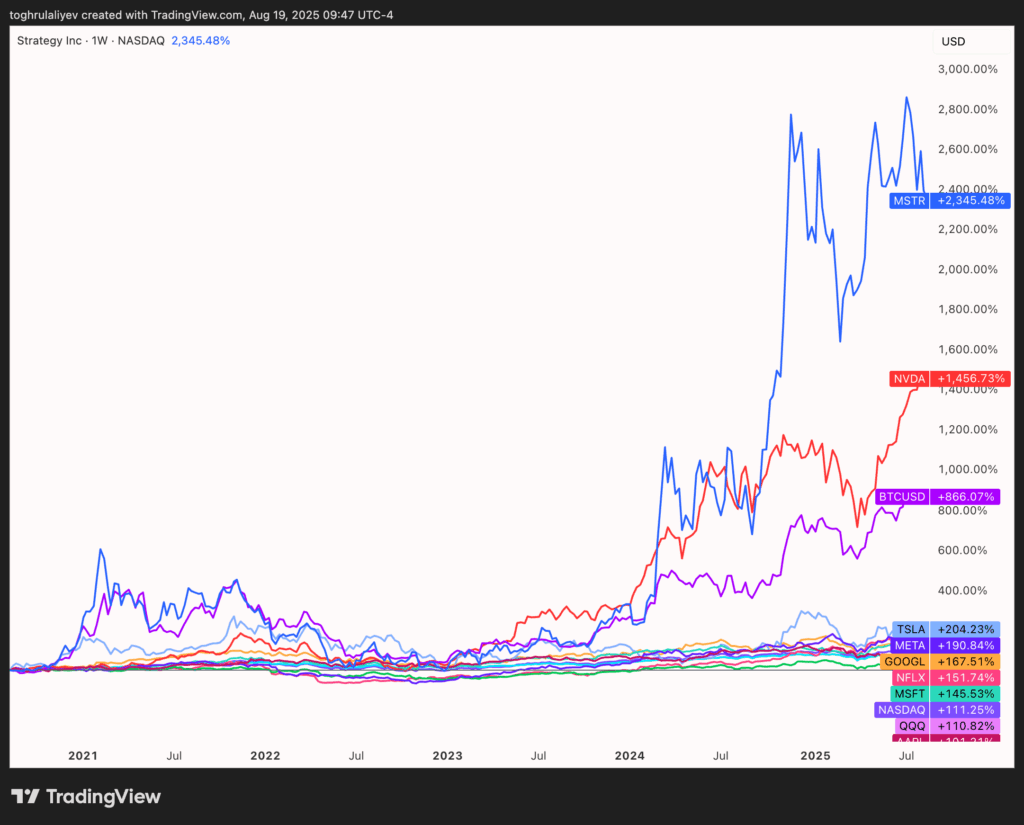
Investors must understand that while this leverage amplifies gains in a rising market, it also amplifies losses during a downturn. MSTR typically exhibits a higher beta than Bitcoin itself, meaning if Bitcoin drops 10%, MSTR may drop 15% or 20%.
Comparing Investment Vehicles: MSTR vs. Spot ETFs vs. Direct Ownership
With the maturation of Bitcoin Spot ETFs by 2026, investors have multiple ways to access the asset class. Choosing MSTR involves a specific trade-off between volatility, management fees, and potential "alpha" (excess returns).
| Feature | MicroStrategy (MSTR) | Bitcoin Spot ETFs | Direct BTC Ownership |
|---|---|---|---|
| Management Fee | 0% (Operating Co.) | 0.20% - 0.90% | 0% (Storage costs vary) |
| Leverage | Yes (Corporate Debt) | No | Optional (via exchanges) |
| Premium to NAV | Variable (often high) | Minimal (Market makers) | None |
| Tax Efficiency | Standard Equity rules | Standard ETF rules | Capital Gains (Form 8949) |
| Complexity | High (Debt/Equity mix) | Low | Medium (Self-custody) |
| Regulatory Risk | SEC Regulated | SEC Regulated | Regulatory uncertainty |
The primary reason an investor would choose MSTR over a spot ETF is the premium and leverage. If you believe MicroStrategy will continue to successfully trade its own volatility by issuing shares at a premium to buy more BTC, MSTR offers a way to "stack sats" (accumulate Bitcoin) at a rate faster than holding the asset directly. However, if the premium collapses, MSTR can underperform Bitcoin even if the price of BTC remains stable.
Risk Factors for the MSTR Investor
Investing in MSTR is not without significant risk. By 2026, the market has seen several "crypto winters" and understands the following pressures:
1. The Premium Collapse
MSTR often trades at a significant premium to its Net Asset Value. If the market decides that this premium is no longer justified—perhaps due to the ease of access to low-fee ETFs or a change in management—the stock price could fall even if Bitcoin’s price stays flat. Investors are essentially betting that MicroStrategy's "intelligent capital allocation" is worth more than the raw Bitcoin it holds.
2. Debt Maturity and Refinancing
While MicroStrategy has been masterful at staggering its debt maturities, a prolonged bear market could make it difficult to refinance debt at favorable terms. If the company is forced to sell Bitcoin to pay back bondholders—something it has avoided doing thus far—it could trigger a negative feedback loop for the stock price.
3. Regulatory and Governance Risk
As a "Bitcoin Development Company," MicroStrategy is navigating uncharted regulatory waters. Changes in accounting standards (such as the FASB rules regarding fair value accounting for digital assets) can cause massive swings in reported "paper" profits or losses, which can confuse traditional investors and lead to increased volatility.
Strategic Allocation: How MSTR Fits in a 2026 Portfolio
For most investors, MSTR is viewed as a speculative growth component rather than a core holding. Because of its extreme volatility, it is often used as a "satellite" position to boost overall portfolio returns during expected Bitcoin bull cycles.
- Institutional Usage: Hedge funds often use MSTR for arbitrage strategies, trading the premium against spot Bitcoin or ETFs.
- Retail Usage: For retail investors in tax-advantaged accounts (like an IRA or 401k), MSTR remains one of the few ways to gain leveraged Bitcoin exposure without using complex derivatives or margin accounts.
The key for any investor is to size the position appropriately. Given that MSTR can experience 50-70% drawdowns during Bitcoin bear markets, it requires a high risk tolerance and a long-term time horizon.
FAQ
Does MicroStrategy pay a dividend?
No. MicroStrategy does not pay a cash dividend. The company’s strategy is to reinvest all available capital and cash flow into the acquisition of Bitcoin. Investors looking for income should look toward traditional yield-bearing stocks or Bitcoin-covered call ETFs.
What happens to MSTR if Michael Saylor leaves?
Michael Saylor is the primary architect of the Bitcoin treasury strategy. While the company has a full executive team, Saylor’s vision is a significant driver of investor confidence and the stock's premium. His departure would likely be viewed as a major risk factor and could lead to a contraction of the MSTR premium.
Is MSTR safer than holding Bitcoin directly?
"Safety" is relative. MSTR is safer in terms of custody risk, as investors don't have to manage private keys or worry about exchange hacks. However, it is arguably riskier in terms of market volatility due to the corporate leverage and the fluctuations in its premium to NAV.
How does the Bitcoin halving affect MSTR?
The Bitcoin halving (the most recent occurring in 2024) reduces the issuance of new BTC. Historically, this leads to supply-side pressure that increases the price over the following 12–18 months. Since MSTR is a leveraged play on that price, the halving cycles are often the periods of highest performance for MSTR investors.
Can MicroStrategy be "margin called" on its Bitcoin?
Most of MicroStrategy's debt is in the form of unsecured convertible notes, which do not have margin call triggers based on the price of Bitcoin. While a few smaller loans in the past were collateralized, the vast majority of their treasury is "unencumbered," meaning they are not forced to sell if the price drops to a certain level.
Final Recommendation for Investors
What MSTR means for investors in 2026 is an opportunity to own a piece of a "capital-markets machine" that is purpose-built to accumulate Bitcoin. If you are bullish on the long-term adoption of digital assets and want a vehicle that aggressively seeks to outperform the asset itself through financial engineering, MSTR is a powerful tool. However, investors must be prepared for the inherent volatility and should monitor the Bitcoin Yield and the NAV premium as their primary health indicators. Always ensure that MSTR occupies a position size that you can hold through a multi-year bear market without being forced to liquidate.
Image Gallery