How Do Spike Strips Work: The Science and Engineering Behind Tire Deflation Devices
Spike strips work by embedding hollow, detachable metal spikes into a moving vehicle's tires. As the tire rolls over the device, the spikes puncture the rubber tread, detach from the base housing, and allow compressed air to escape thr...
Spike strips work by embedding hollow, detachable metal spikes into a moving vehicle's tires. As the tire rolls over the device, the spikes puncture the rubber tread, detach from the base housing, and allow compressed air to escape through their hollow centers, deflating the tires predictably over 20 to 40 seconds.
Contents
The Mechanical Engineering of Tire Deflation Devices
Tire Deflation Devices (TDDs), commonly known as spike strips, are specialized law enforcement tools designed to safely disable fleeing vehicles during pursuits. Unlike movies or television portrayals, where spike strips trigger dramatic tire explosions and violent vehicle flips, real-world TDDs rely on controlled pneumatic decompression. The fundamental goal of a spike strip is to immobilize a vehicle by removing tire inflation without causing immediate loss of vehicle control.
Standard automotive tires are pressurized structural components, typically containing compressed air at 30 to 35 pounds per square inch (psi), while heavy transport tires can range from 80 to 110 psi. If a tire suffers a massive, sudden tear, the rapid equalization of pressure causes a blowout. Blowouts compromise the structural integrity of the tire carcass, causing the tire to shred violently, separate from the rim, and potentially throw the vehicle into an uncontrollable skid or rollover.
Spike strips bypass this failure mode through carefully engineered puncture mechanics that govern how air escapes from the tire chamber.
Hollow vs. Solid Piercing Mechanisms
The critical distinction between a dedicated tire deflation device and random road debris is the use of cannulated (hollow) quills.
- Vehicle Tire Tread
- Inner Liner: Punctured by hollow quill
- Hollow Shaft: Trapped air escapes through central orifice
- Controlled Pressure Release
When a standard solid nail punctures a modern radial tire, two physical phenomena prevent rapid air loss:
- Elastic Seal: Modern tire tread compounds are composed of vulcanized synthetic and natural rubber polymers blended with carbon black and silica. These polymers exhibit high elasticity. When a solid metal object pierces the rubber, the surrounding material tightly hugs the shaft, effectively sealing the hole.
- Friction Bonding: High-speed rotation generates friction heat. This heat softens the rubber around a solid puncture pin, causing it to adhere to the shaft and restrict airflow even if the nail shifts.
Spike strips utilize hollow steel, stainless steel, or hard-drawn aluminum shafts. When the hollow spike penetrates the tire's outer tread layer, steel belts, and inner butyl rubber liner, compressed air rushes directly into the open tip of the quill and vents through its hollow center shaft out into the atmosphere. The solid wall of the hollow quill prevents the surrounding elastic rubber from collapsing inward and sealing the breach.
Detachable Design and Structural Separation
A static pin fixed permanently to a heavy ground bar would snap off or tear a wide, uncontrolled gouge into a high-speed tire, risking a sudden blowout. To prevent this, TDD spikes are designed to separate cleanly from their holding substrate upon impact.
When a moving tire strikes a spike strip frame:
- The tip of the hollow quill penetrates the tread rubber.
- The momentum and downward force of the vehicle seat the spike deeply into the tire structure.
- As the wheel continues to rotate, the rotational friction force overcomes the mechanical friction holding the spike inside the base unit.
- The spike detaches completely from the frame, remaining embedded vertically within the rotating tire.
Because the spike travels with the tire, it creates a clean, uniform passage for air venting without tearing adjacent rubber layers or ripping open steel cord belts.
Fluoropolymer Coatings and Heat Resistance
During high-speed chases, tires operate at elevated thermal states due to mechanical flex and high ambient air friction. When a spike enters a hot tire, the synthetic inner liner can melt and form a viscous sealant around the quill orifice.
To counteract this, premium commercial spike strips treat their hollow quills with a slick fluoropolymer coating, such as polytetrafluoroethylene (PTFE, commonly known as Teflon). The non-stick coating serves two vital operational functions:
- Insertion Efficiency: It reduces the force required for the spike to slice through tough steel-belted radial layers, ensuring reliable penetration even on lightweight or low-profile performance tires.
- Orifice Protection: It prevents hot, soft rubber and tire sealant compounds from adhering to the inside or outside of the hollow shaft, guaranteeing an unobstructed air exhaust path.
Tactical Deployment and Frame Architecture
The physical housing of a spike strip dictates how quickly law enforcement officers can deploy, position, and recover the device under high-stress pursuit conditions. Manufacturers utilize several distinct physical structures optimized for speed, safety, and lane coverage.
Accordion Metal Grids vs. Modular Foam Systems
The two predominant engineering designs used by law enforcement agencies worldwide are scissor-action metal frames and modular triangular foam sleeves.
- Accordion Scissor Frame (Collapsible metal lattice)
- Modular Foam Block Sleeve (Triangular self-righting block)
Accordion Scissor Frames
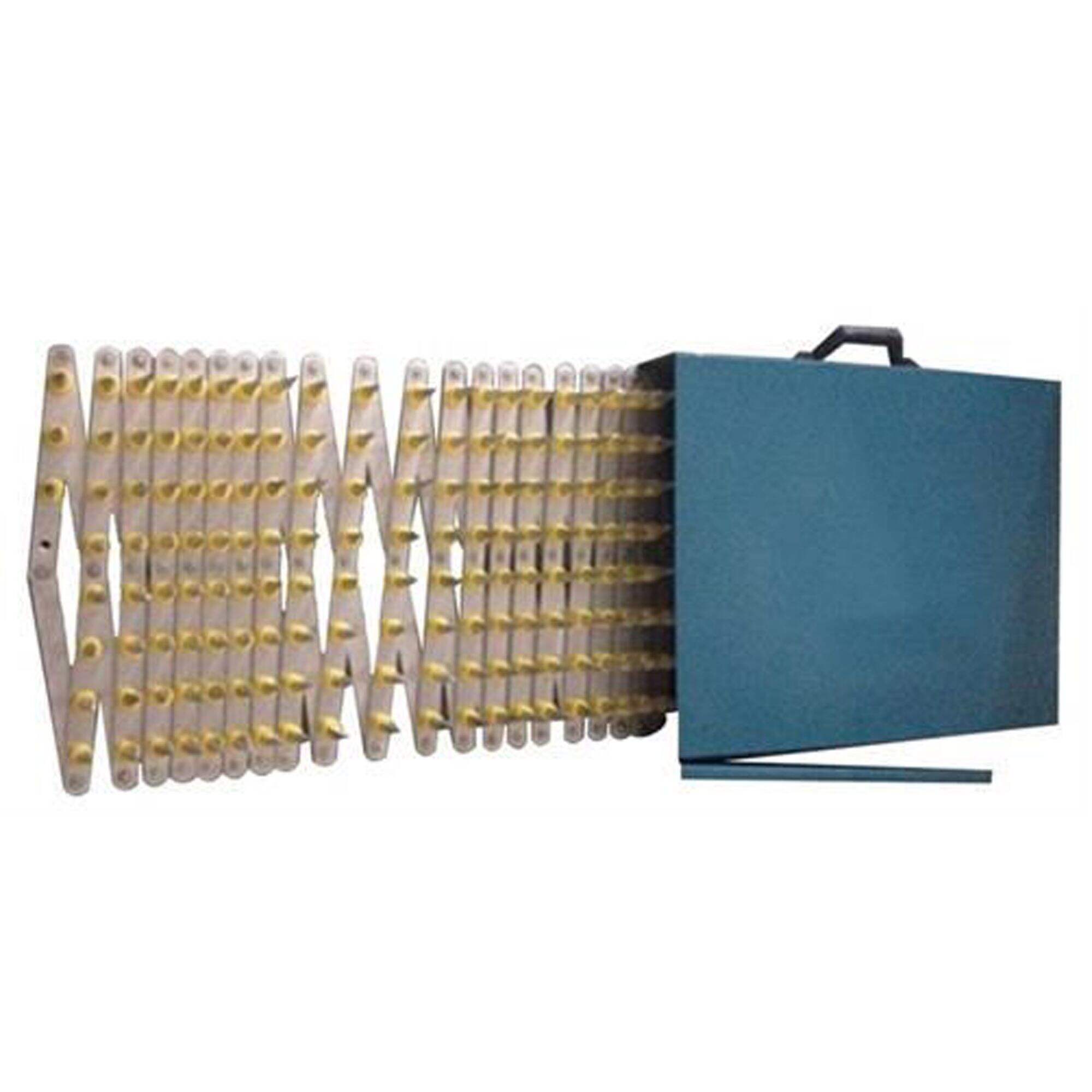
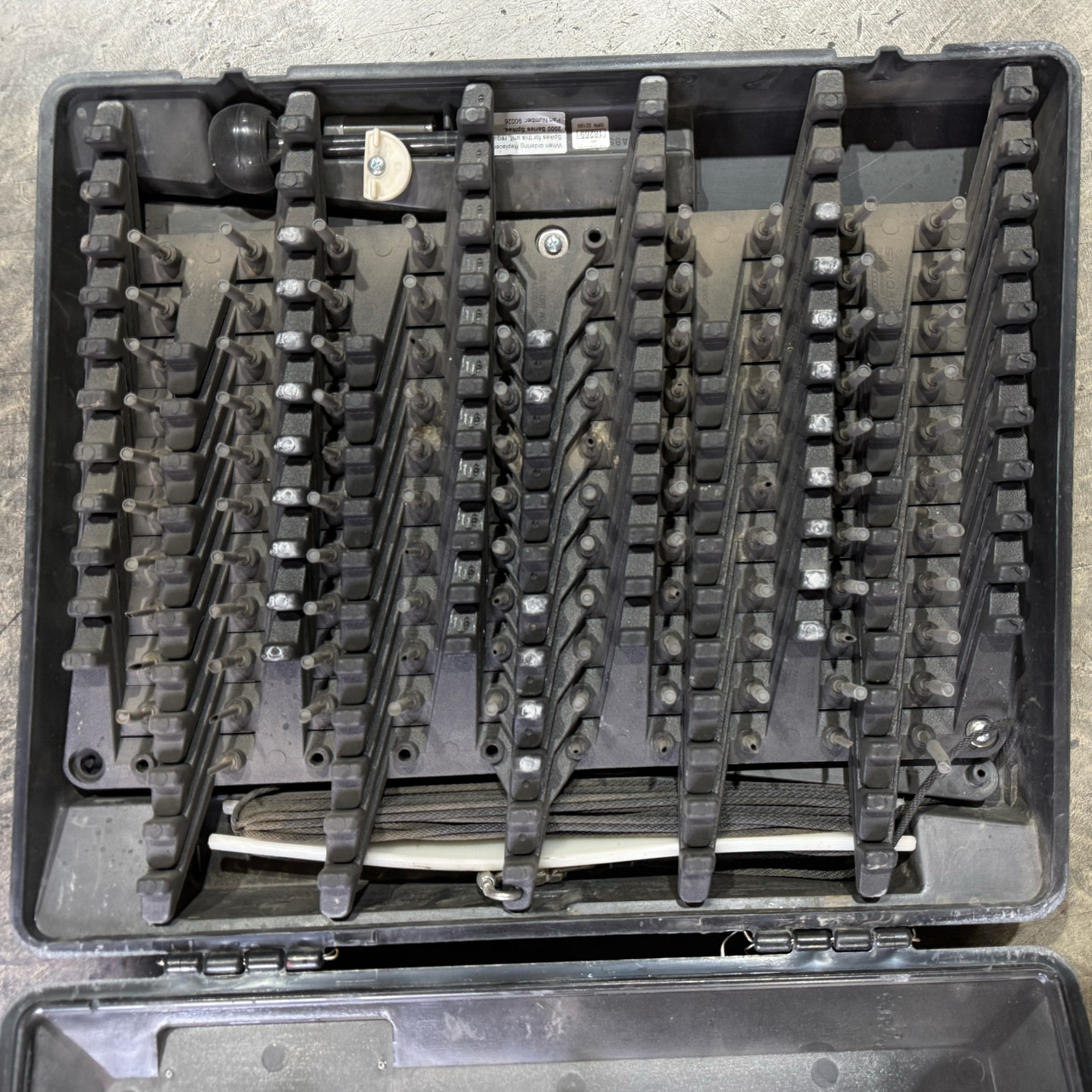
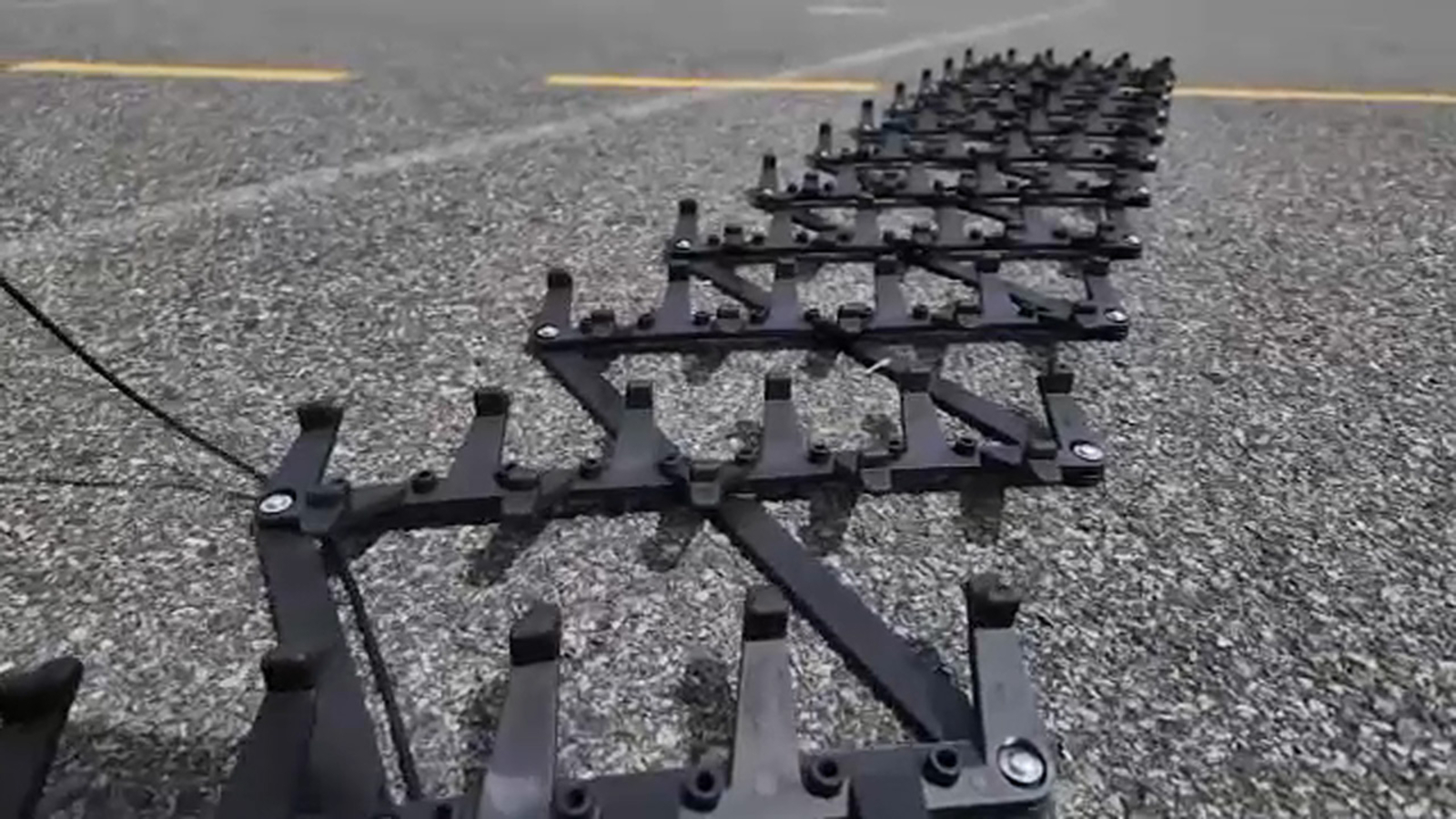
Accordion-style systems utilize lightweight, collapsible aluminum or high-impact polymer lattice frames.
- Mechanism: In its stored state, the frame collapses into a compact briefcase-sized unit. When deployed, an officer throws or pulls the frame across the road, expanding the scissor joints to span multiple traffic lanes (typically extending up to 15 to 25 feet).
- Spike Orientation: Spikes are mounted vertically in rigid nylon or rubber caps across the grid. The frame holds the spikes perpendicular to the roadway, ensuring optimal penetration angles as tires pass over the lattice.
Modular Foam and Composite Sleeves
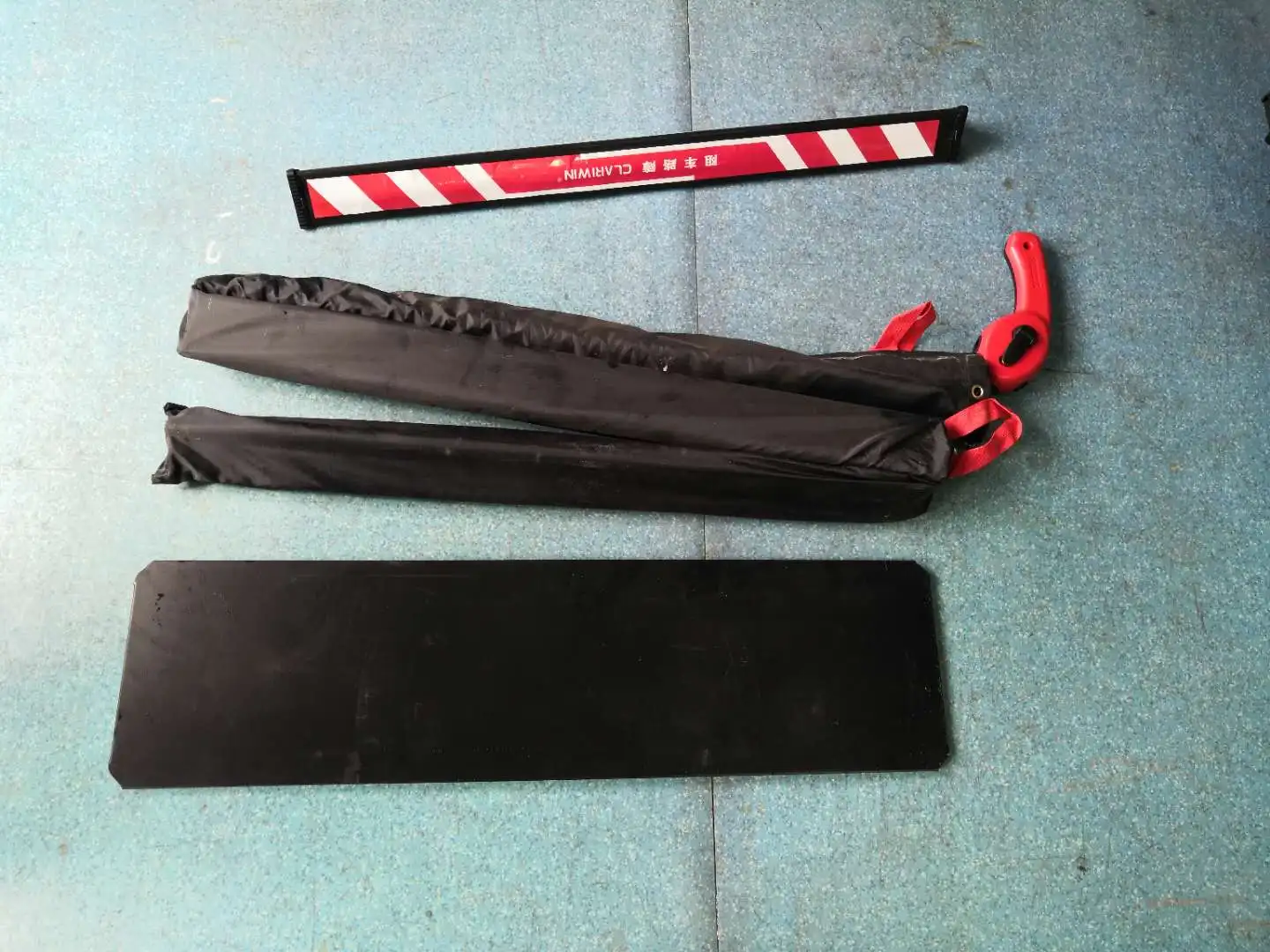
Modular systems discard expanding mechanical joints in favor of lightweight composite or foam triangular housings containing embedded spike arrays.
- Mechanism: These units are pre-assembled in long, lightweight sections enclosed in durable plastic or fabric sleeves. Because the housing features a triangular or multi-sided cross-section, the unit is inherently self-righting: no matter how it lands on the pavement, a row of spikes always points upward toward oncoming traffic.
- Impact Absorption: The protective foam or plastic body crushes smoothly beneath the weight of a multi-ton vehicle, absorbing kinetic shock while leaving the inner quills intact and positioned to enter the passing tires.
Operational Deployment Dynamics
Deploying a spike strip requires strict adherence to tactical protocols established by public safety agencies and guidelines set by organizations like the National Institute of Justice. Officers must manage vehicle timing, traffic positioning, and personal safety simultaneously.
- Pre-Positioning: An officer positions their patrol vehicle safely downstream from the pursuing units, choosing a location with clear sightlines, adequate street illumination, and available cover (such as guardrails, large trees, or engine blocks).
- Cord-Line Extension: The officer tosses the collapsed or compact strip onto the shoulder or lane edge. Attached to the strip is a high-tensile deployment cord coiled on a handheld reel.
- Lane Coverage: As the suspect vehicle approaches, the officer pulls the cord from a safe distance behind cover, sliding the expanded spike strip directly into the target vehicle's path of travel.
- Targeted Retraction: Immediately after the suspect vehicle's tires pass over the strip—and before the pursuing police cruisers reach the location—the officer yanks the retrieval cord to snatch the strip out of the active lane. This rapid retraction prevents cross-contamination (damaging secondary police vehicles).
Comparing Common Spike Strip Systems and Technologies
Different tactical scenarios call for specialized spike strip equipment. The table below compares the core engineering specifications, deployment methods, and performance characteristics of standard law enforcement tire deflation systems.
| System Type | Structural Design | Piercing Mechanism | Average Deflation Rate | Primary Tactical Advantage | Operational Limitations |
|---|---|---|---|---|---|
| Accordion Scissor Frame (e.g., Stinger Spike System) | Expanding aluminum lattice frame | Teflon-coated hollow steel quills with rubber tips | 15 – 30 seconds | Wide lane coverage; high structural stability on uneven pavement | Requires manual extension via cord; heavier storage footprint |
| Modular Foam Block (e.g., Stop Stick) | Triangular plastic/foam sleeve holding internal quill matrix | Teflon-coated hollow steel pins in breakaway caps | 20 – 40 seconds | Lightweight; self-righting orientation; rapid single-lane toss | Shorter overall length per unit; may require connecting multiple blocks |
| Roll-Out Belt System | Flexible synthetic canvas or rubber strip | Pre-positioned short directional quills | 20 – 45 seconds | Ultra-compact storage; quiet deployment for stationary surveillance setups | Can shift or bunch up if struck at sharp entry angles |
| Remote-Activated System | Road-embedded or roadside-housed electromechanical bay | Concealed retracting mechanical spike bed | 10 – 20 seconds | Zero officer exposure; remote wireless activation | High installation/equipment cost; fixed geographic location |
Vehicle and Tire Limitations: Modern Engineering Challenges
While tire deflation devices are effective against standard passenger vehicles, advances in automotive engineering and tire design present physical challenges to traditional spike strip mechanics.
Run-Flat Tires and Self-Sealing Compounds
Modern luxury and performance vehicles frequently come equipped with run-flat tire (RFT) technologies or self-sealing inner liners.
- Standard Tire Construction:
- Rubber Tread
- Steel Belt Layer
- Thin Synthetic Liner
- Run-Flat Tire Construction:
- Rubber Tread
- Steel Belt Layer
- Reinforced Heavy Rubber Sidewall Insert Core
- Self-Sealing Tires: These tires feature a viscous polymer sealant layer coated along the interior crown of the tire casing. When a small nail punctures the tread, the sealant flows into the void and cures quickly under air pressure. However, spike strips overcome self-sealing tires because the embedded hollow quill creates a physical conduit larger than the liquid sealant can bridge, while the PTFE coating prevents the adhesive polymer from bonding to the quill orifice.
- Reinforced Sidewall Run-Flats: Self-supporting run-flat tires utilize heavy structural rubber inserts molded directly into the tire sidewalls. Even when a spike strip completely vents internal air pressure down to 0 psi, the reinforced sidewalls support the vehicle weight, preventing the rim from grinding against the pavement. While the vehicle's top speed, cornering stability, and ride quality drop significantly, a driver on run-flat tires can often maintain basic directional control for several miles after a spike strike.
Commercial Transport and Heavy Reinforced Tread
Commercial transport vehicles, including semi-trucks, heavy utility vehicles, and armored vans, present secondary engineering hurdles for TDDs:
- Tread Depth and Steel Plies: Commercial truck tires feature deep tread lugs and multi-layer steel belts designed for high load capacities. Standard 1.5-inch police quills may fail to reach the inner air chamber of a heavily lugged commercial tire. Tactical law enforcement units utilize specialized heavy-vehicle TDDs fitted with longer (2.5 to 3.5 inch) extended spikes to ensure deep penetration past heavy steel belts.
- Dual Rear Axles: Heavy trucks utilize dual-wheel configurations on rear axles. If a short spike strip punctures only the outer tire of a dual set, the inner tire continues to carry the load, minimizing speed reduction. Effective deployment against commercial vehicles requires multi-block deployments spanning the entire track width.
High-Speed Dynamics and Loss of Control Risks
The physics of tire deflation change dramatically above 100 mph (160 km/h). Even with controlled venting through hollow quills, a vehicle traveling at extreme speeds experiences high rotational forces and severe weight transfer.
When tires lose pressure at high speeds:
- The effective rolling radius of the tire shrinks, altering final drive ratios.
- Drag increases sharply on the deflated side of the vehicle, generating a yaw moment (turning force) toward the disabled tire.
- Electronic Stability Control (ESC) systems attempt to compensate by applying individual brakes, which can cause erratic vehicle response if the tire loses bead contact with the wheel rim.
Because of these dynamic instability risks, standard operating procedures generally advise against deploying spike strips on high-center-of-gravity vehicles (such as lifted SUVs) traveling at extreme speeds, or on two-wheeled vehicles.
Legal Guidelines, Safety Protocols, and Tactical Policies
Because spike strips alter vehicle handling, public safety agencies treat TDD deployment as a use-of-force tactic governed by strict policy frameworks and departmental guidelines.
Authorization and Pursuit Thresholds
Most law enforcement agencies operate under pursuit policies aligned with standards recommended by the International Association of Chiefs of Police. Spike strip deployments typically require explicit authorization from a field supervisor based on several criteria:
- Severity of the Offense: Pursuit policies increasingly limit TDD deployments to cases involving violent felonies, active threats to public safety, or severe reckless driving, rather than minor traffic infractions or property crimes.
- Roadway Environment: Deployments are generally restricted to straight stretches of road with clear visibility. Agencies prohibit deployments on sharp curves, narrow bridges, steep embankments, or active construction zones where tire loss would almost certainly precipitate a severe crash.
- Vehicle Exclusion Zones: TDDs are strictly prohibited against motorcycles, motor-driven cycles, all-terrain vehicles (ATVs), and three-wheeled vehicles due to the extreme probability of fatal rider ejection upon tire deflation.
Officer Safety and Struck-by Hazards
Historically, the greatest physical risk during a spike strip operation falls on the deploying officer. Standing near an active roadway during a high-speed pursuit exposes personnel to severe "struck-by" hazards from both the suspect vehicle and pursuing police cruisers, as well as flying debris.
To mitigate operational risk, modern training protocols emphasize key safety principles:
- Approaching Suspect
- Target Zone / Roadway
- Spike Strip Extended Across Traffic Lane
- Position of Advantage (Solid Protective Barrier / Guardrail / Engine Block)
- Cord Line Pull
- Deploying Officer
- Position of Advantage: Officers must never stand directly in the line of travel or rely solely on distance for safety. Deployments must occur from behind hard cover, such as concrete median barriers, guardrails, or large stationary objects.
- Target Isolation: Officers wait to extend the cord-line until the suspect vehicle is within visual range, minimizing the time the device sits unattended on the pavement and reducing the risk of uninvolved civilian motorists striking the spikes.
- Immediate Disposal: Used spike strips containing embedded or sheared fragments are treated as hazardous debris. After the pursuit clears, officers bag and inspect the units to account for missing quills and prevent secondary punctures during roadway cleanup.
Frequently Asked Questions
Do spike strips cause sudden tire blowouts?
No. Spike strips are specifically engineered not to cause sudden blowouts. They use hollow metal pins that pierce the tire and detach from the frame, acting as vent tubes. Air escapes in a controlled manner over 20 to 40 seconds, allowing the driver to maintain basic steering control while the vehicle decelerates safely.
How do spike strips affect run-flat tires?
Spike strips penetrate run-flat tires and release their internal air pressure just like standard tires. However, because run-flat tires feature reinforced sidewalls or solid internal ring inserts, the vehicle can continue moving at reduced speeds even after pressure drops to zero. Driving distance and directional handling remain significantly degraded.
Can a vehicle keep driving after hitting a spike strip?
Yes, but only for a short distance and at much lower speeds. Once the tires lose air, driving on bare wheel rims severely limits traction, increases braking distances, and degrades steering response. Attempting to drive at high speeds on flat tires eventually causes the rubber tread to shred completely, forcing the vehicle to a stop as the metal rims grind against the pavement.
Why are spike strips rarely deployed against motorcycles?
Deploying spike strips against motorcycles or ATVs is classified in most jurisdictions as an application of deadly force. Because two-wheeled vehicles rely on tire pressure and contact patch geometry for balance, sudden or gradual air loss at speed almost inevitably leads to catastrophic loss of balance and high-velocity rider ejection.
How do police avoid hitting their own spike strips during a pursuit?
Deploying officers use a handheld reel attached to a long cord connected to the spike strip. As soon as the suspect vehicle's tires pass over the strip, the officer manually pulls the cord to yank the device off the active roadway before trailing police cruisers reach the location.
Operational Summary and Best Practices
Tire deflation devices represent a balance of physical engineering and tactical safety, designed to end dangerous vehicle pursuits by replacing violent tire blowouts with controlled pneumatic decompression.
For public safety agencies, law enforcement professionals, and emergency response teams evaluating TDD protocols, key operational recommendations include:
- Mandate Hands-On Tactical Training: Ensure all field officers conduct routine physical drills using training units (spike strips fitted with dummy non-piercing pins) to master deployment timing, line retraction, and barrier positioning under simulated stress.
- Verify Equipment Matching: Equip patrol fleets with TDD configurations suited to local infrastructure—modular foam blocks for dense urban environments with tight lanes, or accordion scissor systems for multi-lane highway corridors.
- Conduct Post-Incident Inspections: Following any operational strike, perform a complete equipment audit to inspect for missing quills, structural frame fatigue, or line wear, replacing spent component modules prior to returning the system to active service.
Image Gallery