How to Use the Post Office Travel Money Card: A Comprehensive 2026 Guide
To use the Post Office Travel Money Card, first activate it via the Post Office Travel app or website, then load your desired currency using a debit card. Once funded, use it like a standard Mastercard at international ATMs, shops, and...
To use the Post Office Travel Money Card, first activate it via the Post Office Travel app or website, then load your desired currency using a debit card. Once funded, use it like a standard Mastercard at international ATMs, shops, and restaurants. Always choose to pay in the "local currency" at terminals to avoid unnecessary conversion fees.
Contents
The Post Office Travel Money Card remains one of the most popular prepaid solutions for international travelers in 2026. As a multi-currency Mastercard, it allows users to carry up to 22 different currencies on a single piece of plastic, providing a secure, budget-friendly alternative to carrying large amounts of cash or using a primary high-street bank card that might incur heavy foreign transaction fees.
Understanding the technical nuances of how this card functions—from the initial "purse" hierarchy to the intricacies of Dynamic Currency Conversion (DCC)—is essential for any traveler looking to maximize their holiday budget. This guide provides a deep dive into the setup, daily usage, and advanced management of your Post Office Travel Money Card.
What is the Post Office Travel Money Card?
The Post Office Travel Money Card is a prepaid Mastercard designed specifically for international use. Unlike a credit card, you can only spend what you have previously loaded onto the card. It is not linked to your UK bank account, which offers an inherent layer of security; if the card is compromised, your main bank funds remain untouched.
In 2026, the card supports a wide array of currencies, including:
- Euro (EUR)
- US Dollars (USD)
- Australian Dollars (AUD)
- Canadian Dollars (CAD)
- New Zealand Dollars (NZD)
- South African Rand (ZAR)
- Swiss Francs (CHF)
- Thai Baht (THB)
- United Arab Emirates Dirham (AED)
- Turkish Lira (TRY)
If you travel to a country whose currency is not supported (for example, Japan or Iceland), the card will still work. It will simply deduct funds from your Great British Pound (GBP) balance or another available currency "purse" using the Mastercard wholesale exchange rate, subject to a cross-currency fee.
Getting Started: Activation and Initial Loading
Before you can use the card at a departure lounge or an overseas bistro, you must complete the registration and activation process.
1. Purchase and Registration
You can pick up a card instantly at most Post Office branches or order one online. When purchasing in person, you must provide a valid form of ID (usually a passport or driving license). If ordering online, the card typically arrives within 3 to 5 business days.
2. The Activation Process
Once the card is in your possession, you must activate it before it can be used for transactions.
- Via the App: Download the Post Office Travel app (available on iOS and Android). Enter the card details and follow the biometric or SMS verification steps.
- Via the Website: Log in to the Post Office Travel Money portal. You will need the 16-digit card number and your activation code, which is often provided at the time of purchase or via email.
- The PIN: Your PIN is not sent in the post. You must obtain it through the app or by calling the automated phone line. It is vital to memorize this, as many European and Asian terminals still require a PIN for transactions over the contactless limit.
3. Loading Funds
Loading your card is the act of converting your GBP into a foreign currency "purse." In 2026, the most efficient way to do this is via the mobile app, which offers real-time exchange rates. You can pay for these funds using a UK debit card. Note that most credit card providers will treat a "load" as a cash advance, potentially charging you interest and fees from the moment of purchase.
How to Use the Card Abroad
Using the card overseas is technically identical to using a standard debit card, but there are specific "best practices" to ensure you aren't overcharged.
Point of Sale (POS) Transactions
Whether you are at a boutique in Milan or a grocery store in Florida, you can tap or insert your card. The card's internal logic will automatically detect the currency of the transaction. If you have Euros loaded and you are in Spain, it will pull directly from your Euro purse.
The Golden Rule: Pay in Local Currency When the card machine asks if you want to pay in "GBP" or the "Local Currency" (e.g., EUR), always choose the local currency. Choosing GBP triggers Dynamic Currency Conversion (DCC), where the merchant's bank sets the exchange rate. This rate is almost always significantly worse than the rate provided by the Post Office. By choosing the local currency, you ensure the transaction is settled against your pre-loaded balance at the rate you locked in when you bought the currency.
ATM Withdrawals
The Post Office Travel Money Card allows for cash withdrawals at millions of ATMs worldwide displaying the Mastercard acceptance mark.
- Fees: While the Post Office does not charge a fee for some currencies when withdrawn in their native country, many ATM operators (the banks owning the machines) will charge a "convenience fee."
- Withdrawal Limits: Standard security limits apply, usually restricting withdrawals to around £450 (equivalent) per 24 hours.
Contactless and Mobile Wallets
As of 2026, the card fully supports Apple Pay and Google Pay. Adding your Travel Money Card to your digital wallet allows you to leave the physical card in your hotel safe. This adds a layer of security, as mobile transactions are tokenized and require biometric authentication (FaceID or Fingerprint).
Managing Your Card via the Post Office Travel App
The app is the "command center" for your travel finances. In 2026, the interface has been streamlined to allow for rapid adjustments while on the move.
- Wallet Transfers: If you have $50 left over from a trip to New York and you are now heading to Paris, you can move those funds from your USD purse back to GBP, and then into EUR. While this involves two exchange movements, it is a convenient way to reuse leftover balances.
- Freezing the Card: If you misplace your card in a taxi, you can "freeze" it instantly in the app. If you find it later under your hotel bed, you can "unfreeze" it without needing to call customer service.
- Balance Checks: Avoid the "balance inquiry" fee at overseas ATMs by checking your balance for free within the app.
Costs, Fees, and Operational Limits
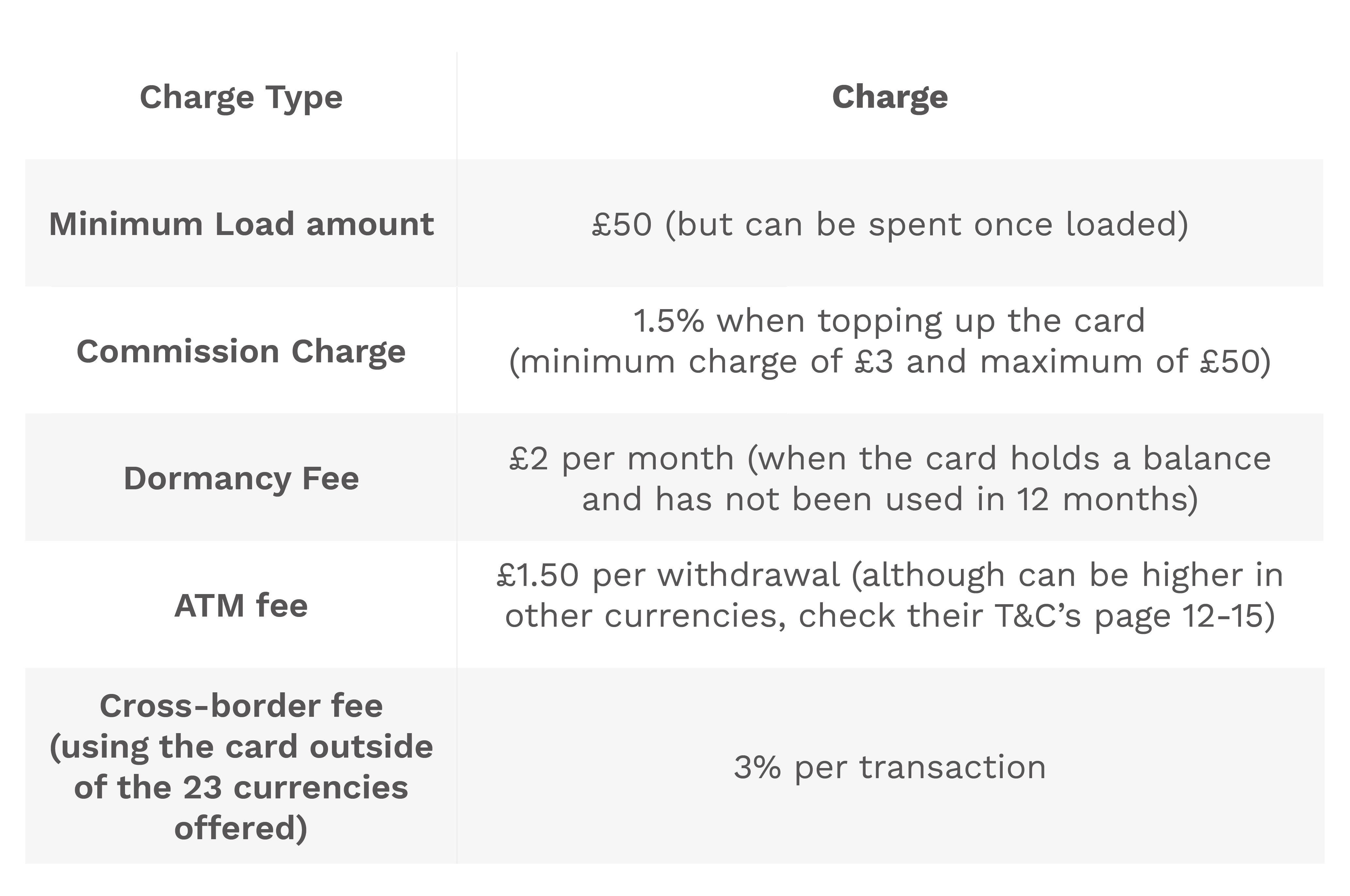
While the card is marketed as "commission-free," it is important to understand that the Post Office makes money on the "spread" (the difference between the wholesale exchange rate and the rate offered to the consumer). Additionally, there are specific administrative fees.
| Fee Type | Cost (2026 Estimate) | Notes |
|---|---|---|
| Initial Card Issue | Free | Usually requires a minimum initial load (e.g., £50). |
| ATM Withdrawal | Variable | Typically £1.50 / €2.00 / $2.50 depending on the currency. |
| Cross-Currency Fee | 3.00% | Applied if spending in a currency you haven't loaded. |
| Inactivity Fee | £2.00 per month | Charged after 12–18 months of no card activity. |
| Refund/Redemption | £5.00 | Charged if you want to withdraw the remaining balance to your bank account. |
| Card Replacement | £5.00 | Fee for shipping a new card if lost or stolen. |
Note: Always check the latest "Terms and Conditions" document provided with your card, as fee structures can be adjusted by the issuer.
Troubleshooting Common Issues
Card Declined at a Petrol Station or Hotel
Prepaid cards are often declined at "unattended" terminals, such as automated petrol pumps, or used for "pre-authorizations" at hotels and car rental agencies. This is because these merchants "lock" a certain amount of funds as a deposit. If you use your Travel Money Card for a hotel deposit, those funds may be unavailable for several weeks after you check out. It is better to use a standard credit card for deposits and the Post Office card for the final bill.
What to Do if Your Card is Lost or Stolen
If your card is stolen, you must act quickly.
- Freeze the card immediately via the app.
- Call the 24/7 Assistance Team. The Post Office provides a dedicated global assistance number.
- Emergency Cash: In some circumstances, the issuer can arrange for emergency cash to be sent to you via a Western Union or similar wire service if you are stranded without funds.
- Use the Back-up Card: When you purchase a Post Office Travel Money Card, you are often given the option to have a second "linked" card. Keep this card in a separate location (e.g., your suitcase) so you can continue your trip if the primary card is lost.
Comparison: Post Office Card vs. Neobanks (Revolut/Starling)
In 2026, the landscape of travel finance is highly competitive.
- The Post Office Card is ideal for those who prefer "locking in" an exchange rate before they travel. If the pound is strong today, you can buy your Euros now, and you are protected if the pound drops before your holiday. It is also backed by the physical presence of Post Office branches for face-to-face support.
- Neobanks (like Starling or Monzo) typically offer the "interbank" or Mastercard wholesale rate at the moment of the transaction. They do not allow you to "lock in" rates in the same way (unless you hold a specific currency account), but they often have lower ATM fees.
The Post Office card remains the superior choice for travelers who want to strictly segregate their holiday budget from their daily living expenses.
Frequently Asked Questions
Can I use the Post Office Travel Money Card for online shopping?
Yes, you can use the card for online purchases in foreign currencies. For example, if you are booking a tour on a French website in Euros, the card will work perfectly. However, it is not recommended for subscriptions (like Netflix), as the card is intended for travel use and recurring payments may fail if the balance is low.
Does the card expire?
Yes, the physical card has an expiry date printed on the front (usually valid for 2 to 3 years). When the card expires, your funds do not disappear, but you will need to order a replacement card to access them. It is important to renew the card before it expires to avoid being unable to access your money while abroad.
What happens to leftover money when I return?
You have three main options:
- Keep the money on the card for your next trip.
- Spend the remaining balance in UK shops (though a cross-currency fee will apply if the balance is in a foreign currency).
- Withdraw the balance back to your bank account via the app or website (subject to a redemption fee).
Can I use the card in the UK?
Technically, yes. If you have a GBP balance on the card, you can use it in UK shops like a regular debit card. If you only have foreign currency balances, the card will convert the funds back to GBP at the point of sale, but this will incur the 3% cross-currency fee, making it an expensive way to shop at home.
How do I check my balance without the app?
If you do not have a smartphone, you can check your balance by logging into the Post Office Travel Money website or by calling the automated telephone service. You can also see your balance at most UK ATMs, though some international ATMs may not display it correctly or may charge a fee for the inquiry.
Final Recommendation
For travelers in 2026, the Post Office Travel Money Card is a robust tool for financial management. To get the most out of it, users should download the app immediately upon receiving the card, load funds during periods of favorable exchange rates, and always select the local currency at payment terminals. By keeping the secondary back-up card in a secure, separate location, you ensure that your holiday remains stress-free, even if the unexpected happens.
Image Gallery