Life Path Number Equation Explained: How to Calculate Your Core Numerology
To calculate your Life Path Number, you must sum the individual digits of your full birth date—month, day, and year—reducing each component to a single digit (or a Master Number: 11, 22, or 33) before adding them together for a final r...
To calculate your Life Path Number, you must sum the individual digits of your full birth date—month, day, and year—reducing each component to a single digit (or a Master Number: 11, 22, or 33) before adding them together for a final reductive sum between 1 and 9.
Contents
In the study of numerology, the Life Path Number is widely considered the most significant indicator of an individual's nature, strengths, and primary challenges. While many online calculators provide a quick result, understanding the mathematical "equation" behind the number is essential for accuracy, especially regarding the identification of Master Numbers. As we navigate the personal and professional landscapes of 2026, many individuals are returning to these foundational calculations to gain clarity on their developmental trajectories and inherent talents.
The Mathematical Foundation of the Life Path Equation
The Life Path Number equation is rooted in the Pythagorean system of numerology, which posits that everything in the universe vibrates at a specific frequency corresponding to a number. The equation essentially extracts a single-digit "vibrational essence" from the linear time of your birth.
There are two primary methods for calculating this number: the Grouping Method and the Long Addition Method. Most professional numerologists insist on the Grouping Method because it preserves the integrity of the three "periods" of a person's life (represented by the month, day, and year) and ensures that Master Numbers (11, 22, and 33) are correctly identified.
The Grouping Method Step-by-Step
To execute the grouping equation, you must treat the month, the day, and the year as three distinct mathematical entities.
- Reduce the Month: Convert the month of birth into a single digit. For example, October (10) becomes 1 + 0 = 1. If the month is November (11), it is a Master Number and is generally not reduced at this stage.
- Reduce the Day: Convert the day of birth into a single digit. For example, the 28th becomes 2 + 8 = 10, which then becomes 1 + 0 = 1. If the day is the 11th or 22nd, it remains as is.
- Reduce the Year: Add all four digits of the birth year together. For example, 1995 becomes 1 + 9 + 9 + 5 = 24. Then, reduce 24 to a single digit: 2 + 4 = 6.
- The Final Sum: Add the resulting three numbers together. If the final sum is a double-digit number (other than 11, 22, or 33), reduce it one last time to reach a single digit between 1 and 9.
The Significance of Master Numbers (11, 22, 33)
In the life path equation, the numbers 11, 22, and 33 are known as Master Numbers. These are not reduced to 2, 4, or 6 during the intermediate steps because they are believed to possess a higher vibrational frequency and a more intense set of challenges and opportunities.
When you encounter these numbers during the initial reduction of the month, day, or year, you should keep them as double digits. For instance, if someone is born on the 22nd of the month, that "22" is carried into the final sum as 22, not as 4. This distinction is vital because a Life Path 22 is fundamentally different from a Life Path 4, despite sharing some underlying structural traits. In 2026, numerological practitioners emphasize that these numbers represent a "double dose" of the single-digit energy, requiring greater responsibility and self-awareness from the individual.
Comparing Calculation Methods: Why Accuracy Matters
It is a common mistake to simply add all the digits of a birth date in a single string (e.g., 1+0+1+2+1+9+9+0). While this often yields the same final single digit, it can completely obscure the presence of a Master Number.
| Feature | Grouping Method (Pythagorean) | Long Addition Method |
|---|---|---|
| Process | Reduces month, day, and year separately. | Sums all digits in one continuous string. |
| Master Numbers | Accurately identifies 11, 22, and 33. | Often overlooks Master Numbers by reducing too early. |
| Life Cycles | Reflects the three distinct cycles of life. | Treats the birth date as a single, flat event. |
| Accuracy | Highest (Industry Standard). | Lower (Prone to errors in nuance). |
| Complexity | Moderate (Requires three steps). | Low (Simple addition). |
Calculation Example: A Deep Dive
To illustrate the equation, let’s use the birth date December 15, 1988.
Step 1: Reduce the Month (December) December is the 12th month. Equation: 1 + 2 = 3
Step 2: Reduce the Day (15th) Equation: 1 + 5 = 6
Step 3: Reduce the Year (1988) Equation: 1 + 9 + 8 + 8 = 26 Reduce 26: 2 + 6 = 8
Step 4: Final Sum Equation: 3 (Month) + 6 (Day) + 8 (Year) = 17 Final Reduction: 1 + 7 = 8
In this example, the individual has a Life Path Number 8. This number suggests a journey focused on material mastery, authority, and understanding the balance between the spiritual and physical worlds.
Interpreting the Core Numbers 1–9
Once the equation is solved, the resulting number provides a blueprint for the individual's life purpose. Each number from 1 to 9 carries a specific archetype.
- Number 1 (The Leader): Represents independence, innovation, and the drive to start new projects. These individuals are often pioneers.
- Number 2 (The Diplomat): Focuses on harmony, cooperation, and sensitivity. They excel in partnerships and mediation.
- Number 3 (The Communicator): Centered on self-expression, creativity, and social interaction. They are often artists or speakers.
- Number 4 (The Builder): Symbolizes stability, hard work, and discipline. They provide the foundation for any organization or family.
- Number 5 (The Adventurer): Represents freedom, change, and versatility. These individuals thrive on variety and experience.
- Number 6 (The Nurturer): Focused on responsibility, family, and service to others. They are the "caregivers" of the numerological spectrum.
- Number 7 (The Seeker): Represents analysis, intuition, and a quest for hidden truths. They are often drawn to spirituality or science.
- Number 8 (The Executive): Centered on power, finance, and material success. They learn how to manifest abundance through ethical effort.
- Number 9 (The Humanitarian): Represents compassion, idealism, and global consciousness. They are focused on giving back to the world.
Troubleshooting Common Calculation Errors
Even with a clear equation, errors can occur. One of the most frequent mistakes is failing to reduce the final sum correctly or miscounting the year's digits.
Handling "10"
When reducing, many wonder what to do with the number 10. In numerology, 10 is almost always reduced to 1 (1+0=1). However, some advanced practitioners view 10 as a "higher octave" of 1, suggesting a person who has already mastered the basics of independence and is now leading with greater wisdom.
Leap Year Considerations
The equation for a Life Path Number remains the same regardless of whether the year is a leap year. The calendar date (February 29) is treated exactly like any other date: 2 (Month) + 2+9 (Day) + Year. The unique nature of the leap day is inherently baked into the numerical vibration.
Conflicting Results from Online Tools
If you find that an online calculator gives you a different result than your manual grouping calculation, check if the calculator uses the "Long Addition" method. If it does, discard that result. The Grouping Method is the mathematically sound approach used by the American Federation of Astrologers and professional numerological societies to ensure the three life cycles are represented.
Why the Life Path Equation Matters in 2026
In the current year of 2026, there is an increased emphasis on data-driven self-discovery. While numerology is an ancient practice, its application today is often used as a psychological tool for identifying cognitive biases and natural inclinations. By understanding the "why" behind the equation, you are better equipped to analyze your personal timing and the broader "Universal Year" cycles that interact with your individual Life Path.
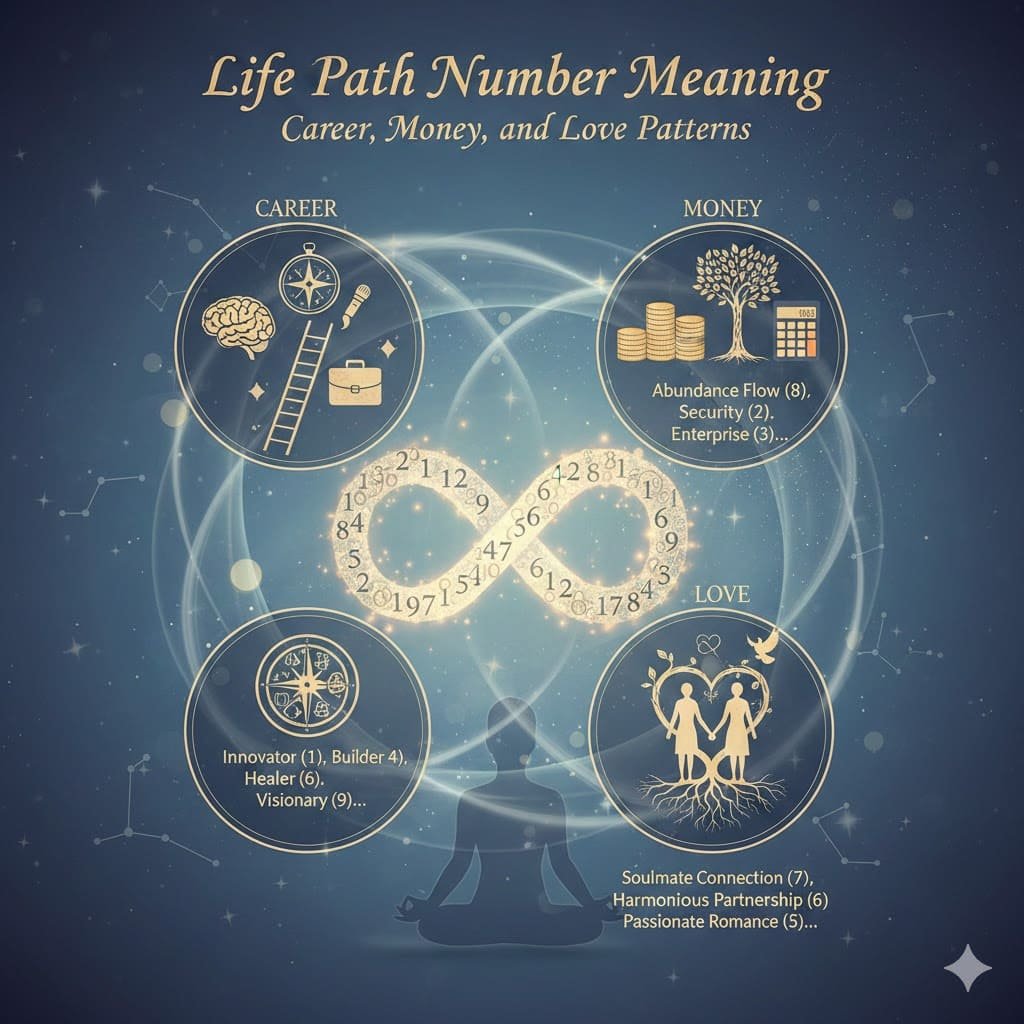
Knowing your number allows you to align your career choices and relationship dynamics with your inherent strengths. For example, a Life Path 1 might find the corporate restructuring trends of 2026 to be an opportunity for leadership, whereas a Life Path 6 might use the same period to focus on community rebuilding and domestic stability.
Frequently Asked Questions
Can my Life Path Number change over time?
No. Your Life Path Number is derived from your date of birth, which is a fixed historical event. While your circumstances, maturity, and other numerological markers (like your Expression Number or Heart's Desire) may shift your perspective, your core Life Path remains the same throughout your life.
What if my calculation results in 11, 22, or 33?
If your final sum is 11, 22, or 33, you do not reduce it further. You have a Master Number Life Path. This suggests a life of high potential but also significant pressure. You are meant to work with the qualities of the reduced digit (2, 4, or 6) but on a much larger, more impactful scale.
Is the Life Path Number more important than my Zodiac sign?
In numerology, yes. While astrology provides a map of planetary influences, the Life Path Number is considered the "central theme" of your existence. Many people find that their Life Path Number provides a more direct explanation of their life's recurring challenges than their Sun sign alone.
Does the equation work for all calendars?
The standard Life Path equation used in the West is based on the Gregorian calendar. If your birth records use a different calendar system (such as the Lunar or Hebrew calendar), the numerical vibrations will differ. Most modern practitioners recommend using the calendar that was legally in use at your place of birth at the time of your delivery.
What should I do if I have two different birth dates?
In cases where a birth certificate differs from an actual birth date, or for those who were adopted and are unsure of their exact date, numerologists often suggest calculating both. However, the date you "vibrate" with most—the one that has been used to identify you throughout your life—often carries the strongest influence.
Final Recommendation
To get the most out of your numerology, perform your calculation manually using the Grouping Method to ensure you don't miss a Master Number. Once you have your number, reflect on how its core traits have manifested in your major life decisions. If you are a Master Number (11, 22, or 33), research the specific responsibilities associated with that "Master" status to better navigate the complexities of 2026 and beyond.
Image Gallery