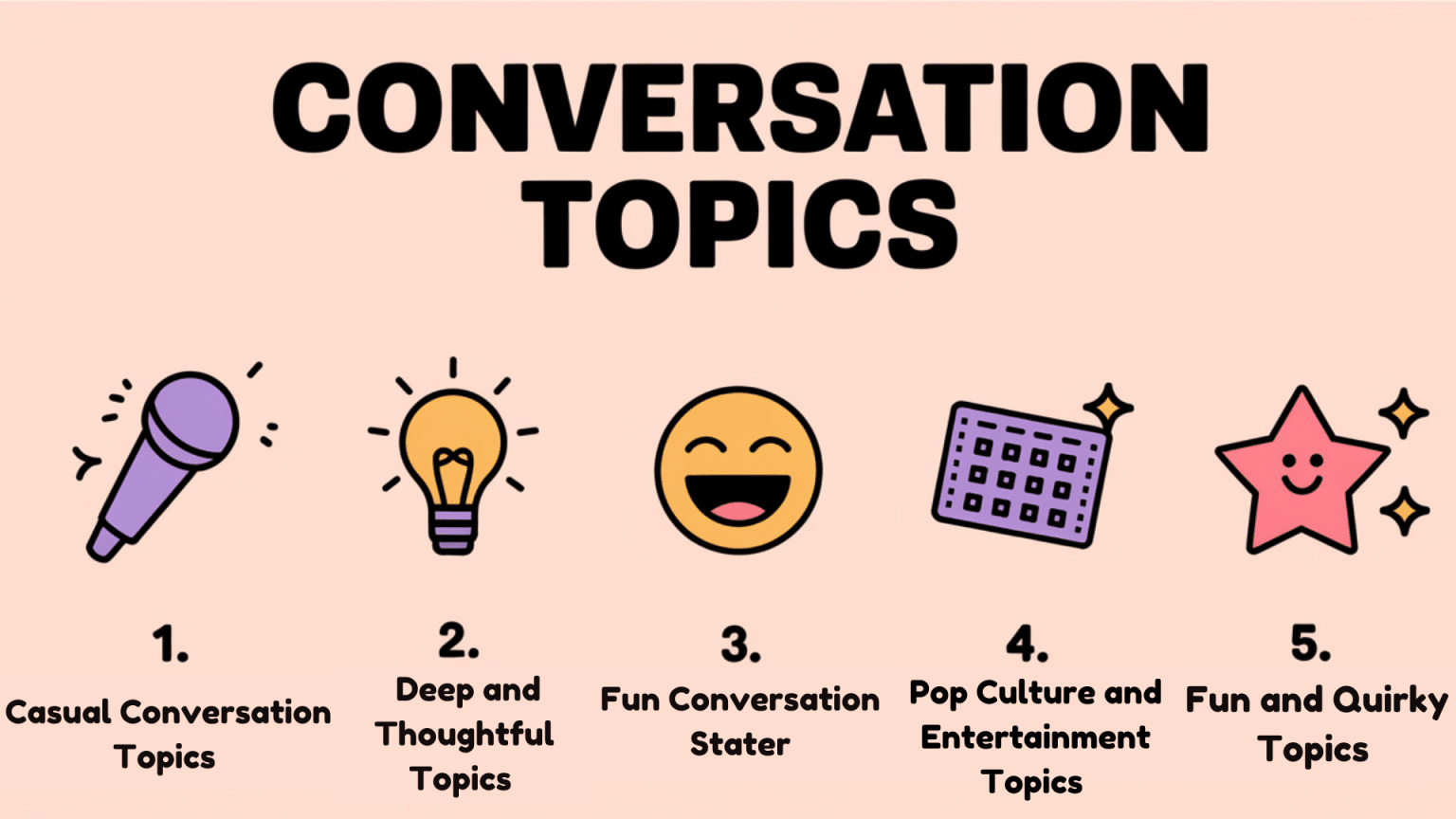
How to Pick Conversation Topics for Any Setting
Selecting effective conversation topics involves assessing the social context, gauging the emotional temperature of your audience, and utilizing a framework that transitions from broad, low-stakes questions to deeper, connection-buildi...
Selecting effective conversation topics involves assessing the social context, gauging the emotional temperature of your audience, and utilizing a framework that transitions from broad, low-stakes questions to deeper, connection-building exchanges. By balancing situational awareness with active listening, you can navigate diverse social environments—from high-stakes professional networking to informal gatherings—with clarity and confidence.
Contents
The Foundation of Social Calibration
The primary challenge in any conversation is determining the appropriate level of intimacy and formality. Before introducing a topic, you must perform a brief situational audit. This involves observing the environment, the body language of participants, and the existing energy levels. In a professional setting, the focus should remain on shared goals, industry observations, or workplace culture, while informal settings permit a wider breadth of personal anecdotes and leisure-related queries.
To pick the right topic, consider the "proximity principle." Start with topics that are physically or situationally immediate—the current event, the setting, or shared surroundings. These subjects act as neutral ground. Once a rapport is established, you can move toward "shared experience" topics, such as mutual interests or professional goals, before eventually exploring individual perspectives or opinions.
Categorizing Topics by Social Context
Different environments demand different types of engagement. A common mistake is using highly personal or controversial topics in professional settings, or defaulting to overly formal business inquiries during social leisure events.
Professional and Networking Environments
In professional settings, the goal is to establish professional competence and mutual value. Stick to topics that reveal character and career trajectory without infringing on privacy.
- Industry Trends: Discussing the current 2026 technological shifts or regulatory changes in your field.
- Project Origins: Asking about how someone started a specific initiative or their motivations behind a project.
- Professional Development: Discussing skill-building, productivity tools, or industry conferences.
Social and Informal Gatherings
In social settings, the goal is to build rapport and uncover shared interests. The focus shifts from "what do you do?" to "what do you enjoy?"
- Leisure Activities: Hobbies, travel, or recent cultural experiences such as books, film, or local events.
- Local Observations: If at a restaurant or an event, commenting on the venue, the atmosphere, or the specific occasion that brought everyone together.
- Food and Culture: Asking for recommendations is a classic, low-pressure way to engage people, as it allows them to share their personal tastes.
Comparison of Conversation Strategies
| Strategy | Primary Goal | Best Used In | Risk Level |
|---|---|---|---|
| Observation | Breaking the ice | Any public setting | Very Low |
| Active Inquiry | Building rapport | Networking/Meetings | Low |
| Storytelling | Establishing depth | Informal groups | Medium |
| Opinion Exchange | Deep connection | Close acquaintances | High |
Mastering the Art of the Open-Ended Question
The most effective way to pick a conversation topic is to frame it as an open-ended question. A binary question (Yes/No) often results in a conversation stall, whereas an open-ended question provides the other person with the agency to steer the dialogue toward a subject they find comfortable.
Instead of asking "Did you have a good time at the conference?", opt for "What was the most unexpected insight you gained from the conference sessions?" This forces the respondent to reflect and provides you with follow-up material. When you hear their answer, identify a "hook"—a specific keyword or concept in their response—and use that as the basis for your next inquiry.
Avoiding Common Conversation Pitfalls
Even with the best intentions, certain topics can derail a conversation. Awareness of these "no-go" zones is essential for maintaining social cohesion.
- The Controversy Trap: Avoid politics, religion, or polarizing social issues unless you are in a setting specifically designed for such debate. These topics often create defensive postures.
- The Interrogation Mode: If you ask too many questions in a row, the conversation will feel like an interview. Balance your inquiries with self-disclosure. Share a brief anecdote or opinion after you receive an answer to demonstrate vulnerability and reciprocity.
- The "One-Upping" Habit: If someone shares a success or an experience, resist the urge to immediately follow up with a story that "tops" theirs. Instead, validate their experience by asking for more detail.
How to Pivot When a Topic Fails
If a topic falls flat or the other person shows signs of discomfort—such as brief, clipped answers or avoiding eye contact—do not push further. Acknowledging the shift is often the most graceful exit. Phrases such as "I’ve been curious about [Topic] lately, but perhaps we have a different perspective on that," or "I realize that’s a bit of a heavy topic for a coffee break; tell me, what have you been working on lately?" effectively reset the conversation.
The ability to pivot is a technical skill. It requires you to detach from your desire to "win" a conversation and prioritize the comfort of the group. Always keep a list of "safe" topics in your mental toolkit—such as upcoming holiday plans, recent positive news, or general project updates—to use as a life raft when a conversation hits a lull.
Frequently Asked Questions
How do I start a conversation with someone I don't know at all? Start with the environment. If you are at a workshop, ask what brought them to the event. If you are in a common space, a simple, polite observation about the surroundings is sufficient to test the waters for further interaction.
What should I do if the person I am talking to is shy or unresponsive? Focus on open-ended questions that are very low-stakes. Instead of asking about their life story, ask about their preference regarding the current setting—such as, "Have you been to this venue before?" This requires minimal emotional labor from the other person.
Is it ever appropriate to discuss personal challenges in a casual setting? Generally, avoid heavy personal challenges until you have established a significant level of trust. If you feel the need to share, keep it brief and ensure the focus of the conversation remains mutual, rather than turning the interaction into an emotional dumping ground.
How do I exit a conversation gracefully? Use a "bridge" statement. Acknowledge the value of the interaction, such as, "It has been great hearing your thoughts on this, but I should probably go check in with [other person/task]." This provides a clear, respectful end point.
How many topics should I have prepared? You don't need a script, but having three "go-to" topics—something about your current work, a recent positive hobby experience, and a question about current local events—is usually sufficient for most standard social interactions.
Final Recommendation
To improve your ability to pick conversation topics, practice "active observation." In your next three social interactions, refrain from planning your next question while the other person is speaking. Instead, focus entirely on the content of their words. You will find that the best topic for the next phase of the conversation is usually embedded within their last sentence. By listening for these "hooks," you naturally move from being a person who "picks" topics to a person who facilitates effortless dialogue.
Image Gallery