What is the Difference Between the Money Market and the Capital Market?
The primary difference between the money market and the capital market lies in the maturity period of the financial instruments traded. The money market is designed for short-term borrowing and lending, typically for periods of one yea...
The primary difference between the money market and the capital market lies in the maturity period of the financial instruments traded. The money market is designed for short-term borrowing and lending, typically for periods of one year or less, while the capital market facilitates long-term financing through the trade of shares, bonds, and other securities with maturities exceeding one year.
Contents
Financial markets act as the circulatory system of the global economy, moving capital from those who have an excess of it (savers and investors) to those who need it for productive use (corporations and governments). To understand how these markets function in 2026, one must distinguish between the mechanisms used for immediate liquidity and those used for long-term wealth creation.
Understanding the Money Market: The Engine of Liquidity
The money market is a specialized segment of the financial system that deals exclusively with short-term debt instruments. It is often described as a "wholesale" market because the transactions typically involve large denominations of money, often in the millions of dollars.
The fundamental purpose of the money market is to provide liquidity. Businesses often face timing mismatches between their cash inflows (revenue) and outflows (payroll, inventory, taxes). Similarly, governments may need to bridge a temporary gap between tax collection cycles. The money market allows these entities to borrow funds quickly at a relatively low interest rate.
Key Characteristics of the Money Market
The money market is characterized by several distinct features:
- Short Duration: Most instruments have a maturity ranging from overnight to one year.
- High Liquidity: Because the instruments are short-term and usually issued by high-credit-quality entities, they can be converted into cash almost instantly with minimal loss in value.
- Low Risk: While no investment is entirely risk-free, money market instruments are generally considered the safest financial assets because of their short time horizons and the institutional strength of the issuers.
- Institutional Dominance: This market is primarily populated by commercial banks, central banks (like the Federal Reserve), insurance companies, and large corporations.
Common Money Market Instruments
- Treasury Bills (T-Bills): Issued by the federal government to finance its short-term expenditures. They are sold at a discount to their face value and are widely considered the "risk-free" benchmark for the economy.
- Certificates of Deposit (CDs): Time deposits offered by banks with a fixed maturity date and interest rate. In 2026, digital "high-yield" CDs continue to be a staple for institutional cash management.
- Commercial Paper: Unsecured, short-term debt issued by large corporations to meet immediate liabilities such as payroll or accounts payable.
- Repurchase Agreements (Repos): Short-term loans—often overnight—where one party sells securities to another and agrees to buy them back at a slightly higher price later. This is a critical tool for central bank monetary policy.
Exploring the Capital Market: The Engine of Growth
Unlike the money market, the capital market is built for long-term investment. It is the venue where equity (ownership) and long-term debt (bonds) are traded. When a company wants to build a new factory, conduct massive R&D, or acquire a competitor, it turns to the capital market to raise the necessary funds.
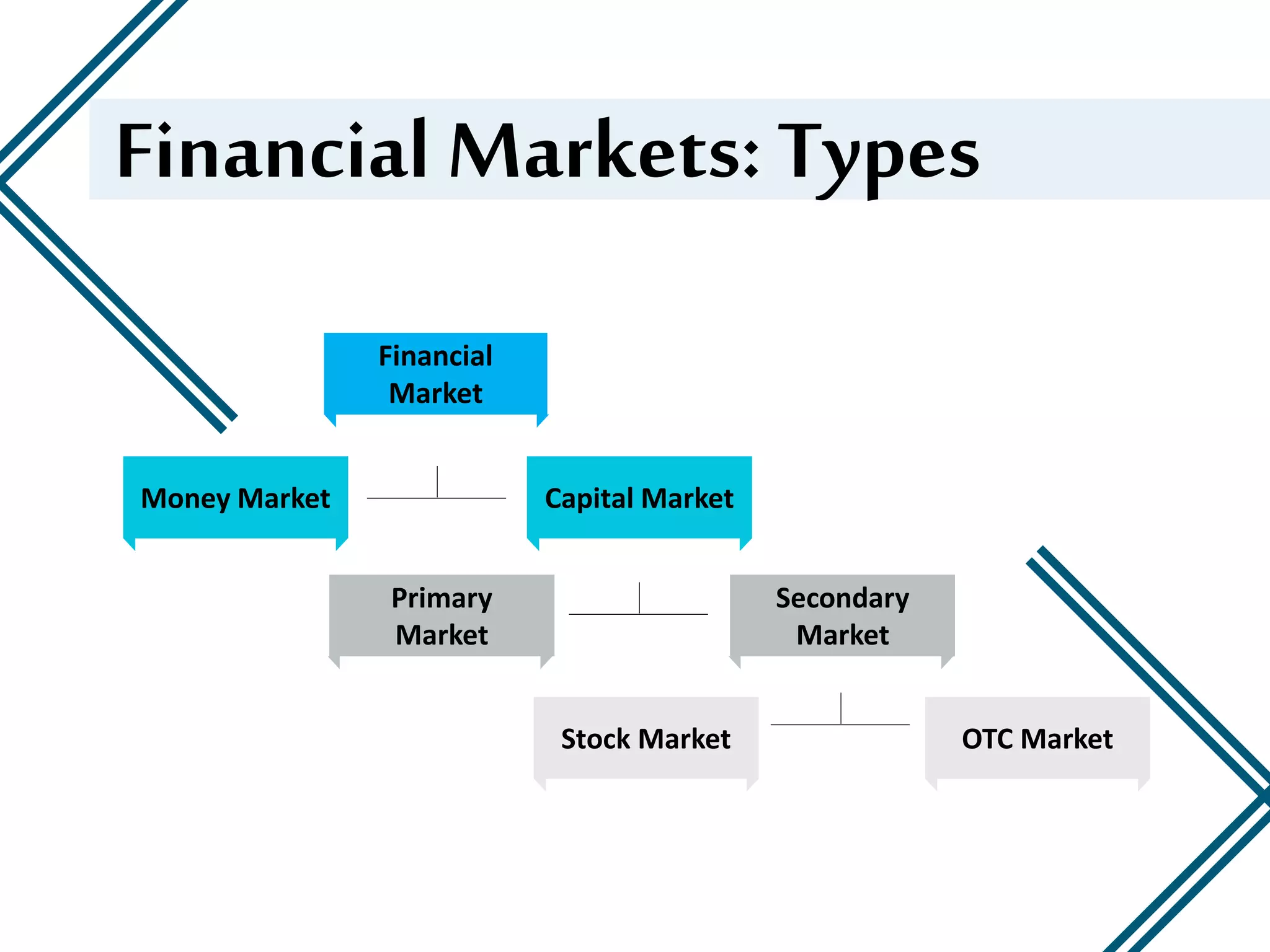
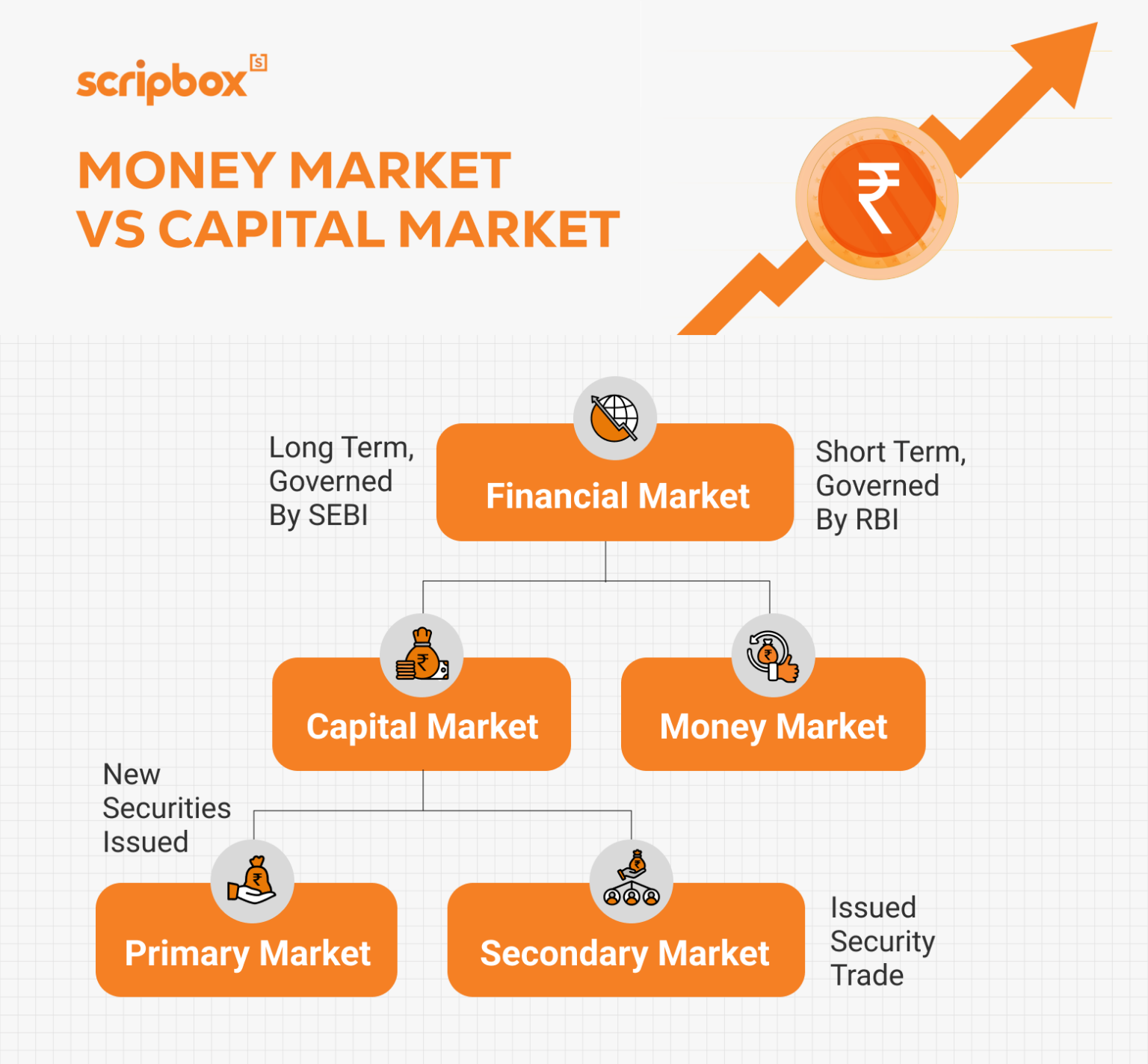
The capital market is divided into two functional layers:
- Primary Market: This is where new securities are created and sold for the first time. An Initial Public Offering (IPO) is the most famous example of a primary market transaction.
- Secondary Market: This is where investors trade existing securities among themselves. The New York Stock Exchange (NYSE) and the NASDAQ are secondary markets. The issuing company does not receive any new funds from trades in the secondary market; rather, it provides a venue for investors to find "exit liquidity."
Key Characteristics of the Capital Market
- Long Duration: Instruments here have maturities of several years, decades, or, in the case of stocks, no maturity date at all.
- Higher Risk and Return: Because the time horizon is longer, there is more uncertainty. Investors demand higher potential returns to compensate for the risk of market volatility or corporate failure.
- Wider Participation: While institutional investors dominate the volume, the capital market is highly accessible to individual retail investors through brokerage accounts, 401(k) plans, and ETFs.
Common Capital Market Instruments
- Stocks (Equity): Representing partial ownership in a corporation. Shareholders may benefit from capital appreciation and dividends but stand last in line during a liquidation.
- Corporate Bonds: Long-term debt issued by companies. The company pays regular interest (coupons) and returns the principal at maturity.
- Government Bonds: Long-term debt issued by the Treasury (e.g., 10-year or 30-year Treasury Notes and Bonds) to fund infrastructure or long-term debt obligations.
- Derivatives: Complex instruments like options and futures that derive their value from an underlying asset in the capital market.
Direct Comparison: Money Market vs. Capital Market
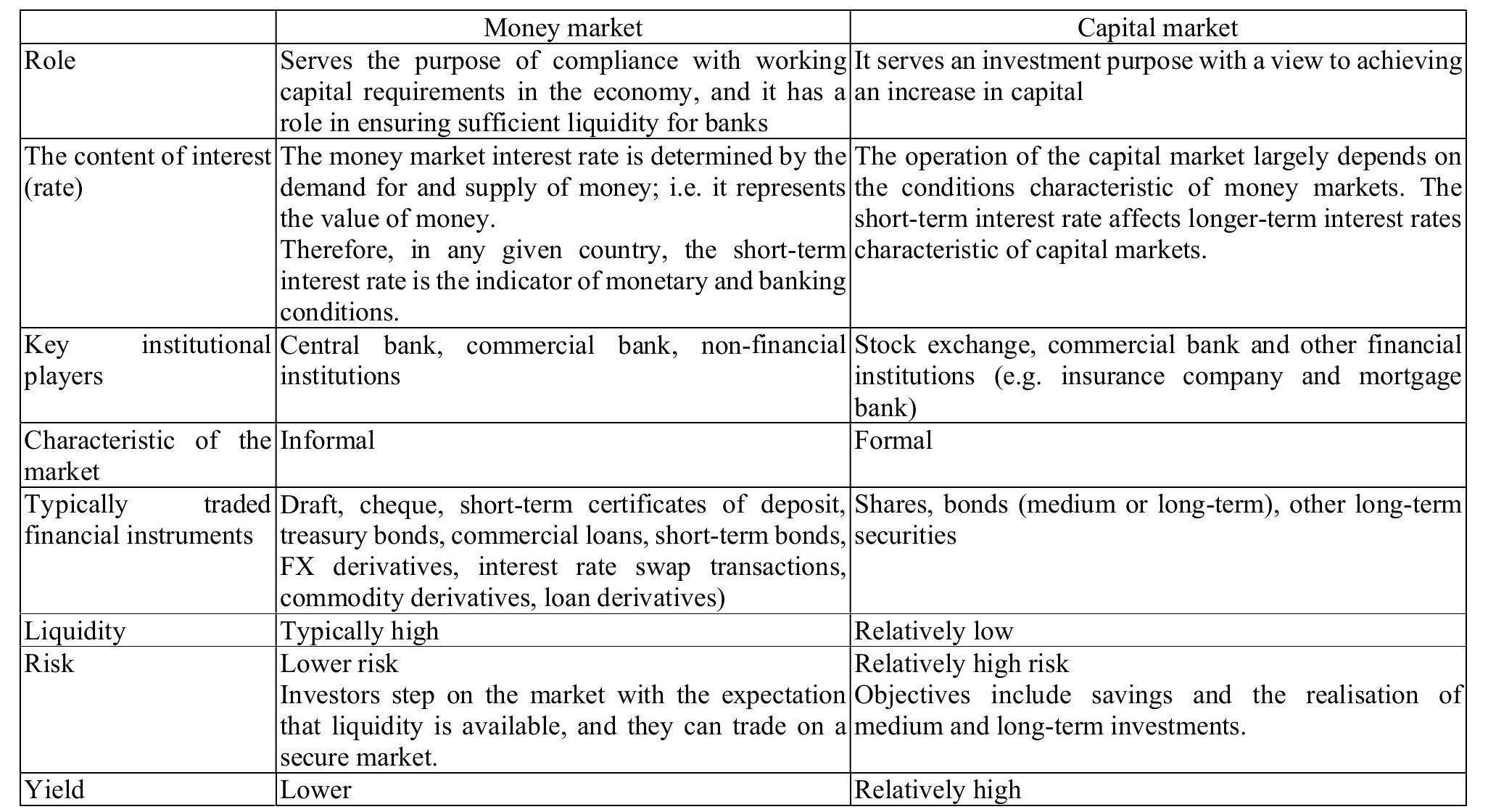
To clarify the distinctions, the following table summarizes the operational and structural differences between these two financial pillars.
| Feature | Money Market | Capital Market |
|---|---|---|
| Primary Goal | Maintaining liquidity and cash flow. | Long-term capital appreciation and growth. |
| Time Horizon | Short-term (under 1 year). | Long-term (over 1 year/Indefinite). |
| Risk Level | Low (Stable value). | High (Price volatility). |
| Liquidity | High (Easily converted to cash). | Moderate to Low (Depends on market demand). |
| Typical Instruments | T-Bills, Commercial Paper, CDs, Repos. | Stocks, Corporate Bonds, Gov Bonds. |
| Main Participants | Central banks, Commercial banks, Large corps. | Retail investors, Mutual funds, Institutional investors. |
| Regulatory Body | Often overseen by Central Banks/Treasury. | SEC, FINRA, and Stock Exchanges. |
| Yield/Returns | Generally low, tied to short-term rates. | Potentially high, tied to company/economic growth. |
The Role of Participants and Institutions
In both markets, the participants play specific roles that ensure the stability of the financial system.
In the Money Market
Commercial banks are the most active participants. They use the money market to manage their reserve requirements. If a bank has excess reserves, it lends them out in the "Federal Funds Market" (a subset of the money market). If it is short on reserves, it borrows. The Federal Reserve uses the money market as its primary theater for monetary policy, adjusting the federal funds rate to control inflation and employment.
In the Capital Market
Investment banks act as the "gatekeepers." When a company needs to raise capital, investment banks underwrite the deal, helping to price the securities and find buyers in the primary market. Institutional investors, such as pension funds and sovereign wealth funds, provide the massive pools of capital necessary to fund global infrastructure and corporate expansion.
Operational Limitations and Risks
Understanding the difference also requires acknowledging the unique risks associated with each market.
Money Market Risks: The primary risk in the money market is Reinvestment Risk. Because these instruments mature quickly, an investor may find that when their money is returned, the current interest rates have dropped, forcing them to reinvest at a lower return. There is also a small degree of Credit Risk, as seen during the 2008 financial crisis when some commercial paper "broke the buck," meaning it fell below its face value.
Capital Market Risks: The capital market is subject to Market Risk (the risk that the entire market declines) and Inflation Risk (the risk that rising prices erode the real value of fixed bond payments). Furthermore, because the time horizon is long, Interest Rate Risk is significant for bondholders; when market interest rates rise, the price of existing bonds falls.
Regulatory Oversight and Compliance
As of 2026, financial regulations have become increasingly harmonized across these markets, but specific oversight remains distinct. The Securities and Exchange Commission (SEC) is the primary regulator for the U.S. capital markets, ensuring that companies provide transparent financial disclosures to the public.
In the money market, while the SEC regulates Money Market Mutual Funds, much of the structural oversight comes from banking regulators like the Office of the Comptroller of the Currency (OCC) and the Federal Reserve, who monitor the liquidity ratios of the banks participating in these short-term exchanges.
Choosing Between the Two: A Strategic Approach
For a business or an individual, the choice between utilizing the money market or the capital market depends on the intended use of the funds.
If you are a corporate treasurer with $50 million in cash that is earmarked for a tax payment due in three months, the money market is the appropriate destination. Investing that money in the stock market (capital market) would be irresponsible, as a sudden market downturn could leave you without the full principal needed for the tax liability.
Conversely, if you are a 30-year-old individual saving for a retirement that is 35 years away, the capital market is the logical choice. While the money market is safer, its returns historically struggle to outpace inflation over long periods. Stocks and long-term bonds provide the compounding growth necessary to build a retirement nest egg.
Frequently Asked Questions
Can individual investors participate in the money market?
Yes. While the primary money market involves large institutional trades, individuals can access it through Money Market Mutual Funds or Money Market Deposit Accounts (MMDAs) at their local bank. These vehicles pool individual capital to purchase high-denomination instruments like T-Bills and Commercial Paper.
Which market is more sensitive to interest rate changes?
Both are sensitive, but in different ways. The money market responds immediately to central bank rate hikes, changing the yield on new instruments almost overnight. However, the capital market (specifically bonds) suffers more significant price fluctuations when rates change, because the interest rate impact is "compounded" over the many years remaining until the bond matures.
Are "Money Market Funds" the same as "Capital Market Funds"?
No. A Money Market Fund invests in short-term, low-risk debt to maintain a stable Net Asset Value (NAV) of $1.00 per share. A capital market fund (like an Equity Mutual Fund or a Bond Fund) invests in stocks or long-term debt where the value of the shares fluctuates daily based on market performance.
Is the stock market a money market or a capital market?
The stock market is a capital market. It deals with equity securities that have no expiration date and are intended for long-term holding and wealth generation.
Why do governments use both markets?
Governments use the money market (via T-Bills) to manage daily cash flow and short-term "bridge" financing. They use the capital market (via 10-year and 30-year Bonds) to fund long-term infrastructure projects, social programs, and to manage the overall national debt structure.
Summary of Next Actions
Understanding the distinction between these markets is the first step toward effective financial management.
- For Personal Finance: Evaluate your "emergency fund" needs versus your "wealth-building" goals. Keep emergency funds in money market instruments for instant access and safety. Direct long-term savings into capital market instruments like diversified stock ETFs.
- For Business Owners: Use the money market for managing working capital and payroll reserves. Look to the capital market for business expansion, such as issuing corporate bonds or seeking venture capital if your growth horizon is five to ten years.
- For Students and Analysts: Monitor the "yield curve," which is the relationship between money market rates and capital market rates. A "flattening" or "inverted" yield curve often provides a signal about future economic shifts that will impact both markets.
Image Gallery