Sabu Retirement Overview of the Belgian Pension Scheme
Navigating the Belgian pension system requires a comprehensive understanding of its three core pillars—statutory pensions, supplementary occupational pensions, and private individual savings—which collectively ensure financial stabilit...
Navigating the Belgian pension system requires a comprehensive understanding of its three core pillars—statutory pensions, supplementary occupational pensions, and private individual savings—which collectively ensure financial stability for retirees based on their professional history and contributions.
Contents
The Belgian pension scheme is a foundational pillar of the nation's social security framework, designed to provide financial security to individuals once they exit the workforce. For expatriates, locals, and international professionals—sometimes exploring options under specialized frameworks or administrative shorthand like "sabu retirement"—comprehending how these benefits are calculated, qualified for, and distributed is critical for long-term financial planning. The system operates on a multi-tiered architecture that balances mandatory state support with employer-sponsored plans and private incentives. This structured guide delivers an exhaustive overview of the Belgian pension scheme, detailing its pillars, calculation methodologies, eligibility criteria, and practical considerations for future retirees.
The Architectural Framework of Belgian Pensions
Belgium structures its retirement landscape around three distinct tiers, often referred to as pillars. Each tier serves a unique purpose, moving from mandatory state-managed provisions to voluntary, tax-advantaged private arrangements. Understanding how these pillars interact is essential for estimating total post-retirement income.
The first pillar forms the bedrock of the entire structure. Managed entirely by the state, the statutory pension (wettelijk pensioen in Dutch, pension légale in French) guarantees a basic income for qualifying individuals who have completed a career as employees, self-employed workers, or civil servants. Because the first pillar is funded on a pay-as-go basis—meaning current worker contributions pay for current retiree benefits—its long-term financial sustainability is a frequent topic of legislative adjustment.
The second pillar consists of supplementary pensions tied to professional activity. These are occupational pensions organized by an employer or through a sectoral agreement for self-employed individuals, such as the Free Supplementary Pension for the Self-Employed (VAPZ/PCLI). While not mandatory for all individual employers to set up independently, collective bargaining agreements have made second-pillar coverage nearly ubiquitous for salaried employees across Belgium.
The third pillar comprises individual, voluntary private savings. It allows residents to build an additional nest egg through private pension savings accounts or long-term life insurance products. The Belgian federal government incentivizes participation in this pillar by offering notable personal income tax reductions on contributions made up to statutory annual ceilings.
First Pillar: The Statutory Pension System
The statutory pension is the primary source of income for the majority of Belgian retirees. Eligibility and payout amounts depend heavily on professional status, career length, and historical earnings.
Employee, Self-Employed, and Civil Servant Schemes
Historically, Belgium maintained distinct calculation rules for employees (werknemers / salariés), self-employed individuals (zelfstandigen / indépendants), and civil servants (ambtenaren / fonctionnaires). While ongoing legislative reforms aim to harmonize these systems, distinct differences remain:
- Employees: Payouts are calculated using a career-average salary formula, capped at a maximum ceiling per year, multiplied by a fraction (usually 45ths for a full career) and adjusted based on household status (cohabiting vs. household rate).
- Self-Employed: Historically, self-employed pensions yielded lower returns due to lower mandatory social contributions, though recent decades have seen systematic reforms to bridge this gap and align self-employed benefits closer to those of salaried employees.
- Civil Servants: Civil servant pensions are traditionally calculated based on the average salary earned during the last 5 to 10 years of service rather than the full career average, often resulting in higher replacement rates, subject to specific caps and career length requirements.
Career Length and Retirement Age
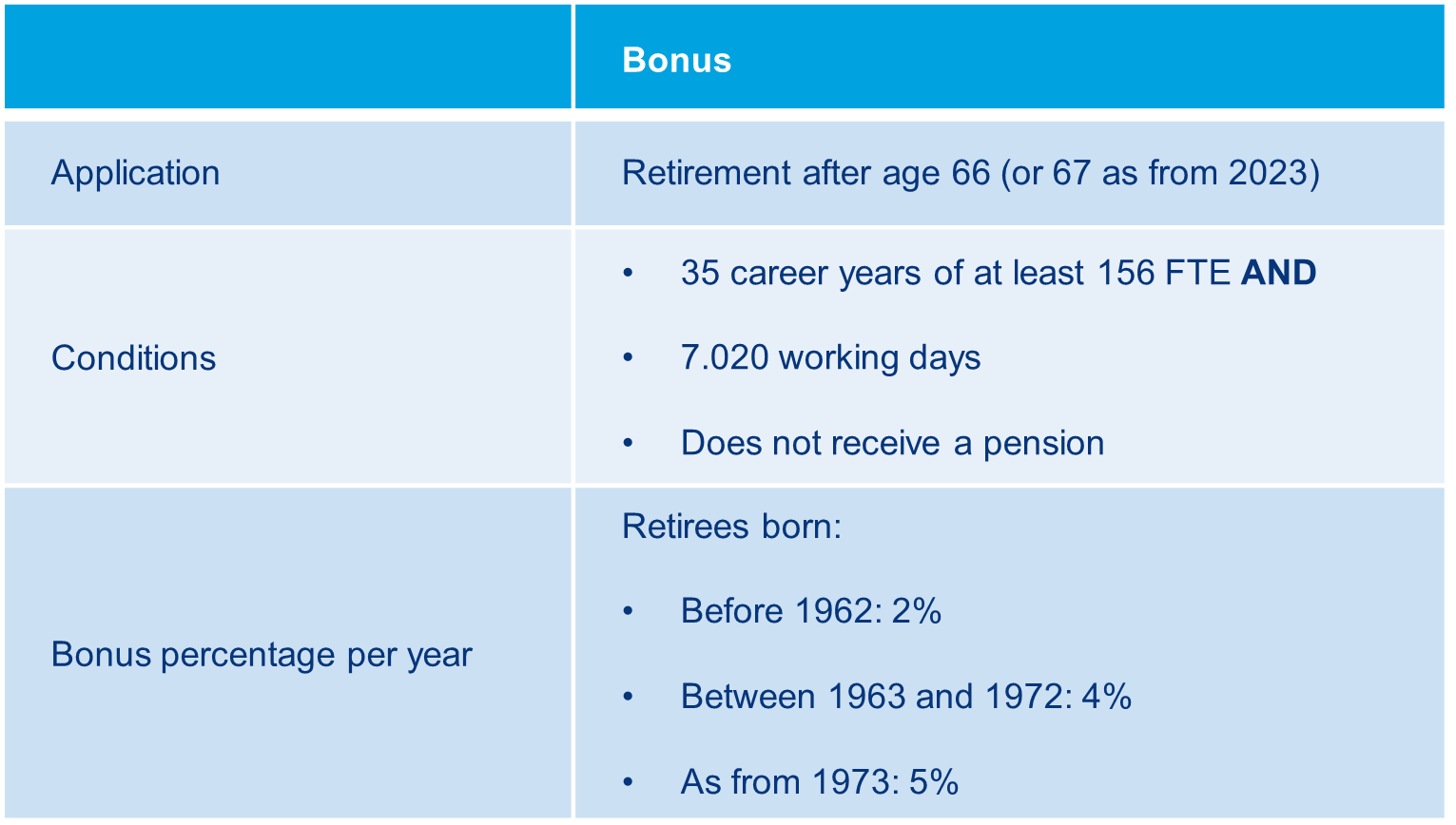
The statutory retirement age in Belgium is standardized at 65 years, with progressive statutory increases to 66 in 2025 and 67 by 2030. However, early retirement remains possible under strict conditions regarding historical career length.
To qualify for a full pension without penalties, workers generally must demonstrate a career spanning 45 years. Individuals who started working at a very young age or have accumulated a high number of validated working years may access early retirement options prior to reaching the standard statutory threshold, provided they meet specific career-fraction milestones set by the Federal Pension Service (Federale Pensioendienst / Service fédéral des Pensions).
Second Pillar: Supplementary Occupational Pensions
The second pillar bridges the gap between basic state provisions and pre-retirement living standards. For employees, this is typically established via group insurance (groepsverzekering / assurance de groupe) or a pension fund (pensioenfonds / fonds de pension).
Contributions are financed by the employer, the employee, or a combination of both. Employers frequently use these schemes as a tool for talent retention and executive compensation. Legally, pension funds and insurance providers in Belgium must guarantee a minimum legal return on contributions—historically tied to linear bonds, currently fixed within statutory boundaries—mitigating market downside risks for beneficiaries.
| Pension Pillar | Management / Provider | Funding Source | Primary Objective |
|---|---|---|---|
| First Pillar | Federal Government (FPD) | Mandatory social security contributions | Provide a foundational basic income floor for all resident retirees. |
| Second Pillar | Employers, Sector Funds, Insurers | Employer and/or employee contributions | Maintain pre-retirement living standards via occupational plans. |
| Third Pillar | Banks, Insurance Companies | Voluntary individual contributions | Supplement retirement income with tax-advantaged private savings. |
Self-employed professionals without a traditional corporate structure can build a second pillar via the Free Supplementary Pension for the Self-Employed (VAPZ). Contributions to a VAPZ are tax-deductible as professional expenses, reducing both personal income tax and social security contribution bases, making it one of the most tax-efficient savings vehicles available to entrepreneurs in Belgium.
Third Pillar: Private Savings and Tax Incentives
The third pillar gives individuals direct control over supplemental retirement assets. It is divided into two primary categories: classical pension savings (pensioensparen / épargne-pension) and long-term savings (langetermijnsparen / épargne à long terme).
For traditional pension savings, savers can choose between two tax-advantage ceilings:
- Standard Ceiling: Allows a higher tax reduction percentage (typically 30%) on contributions up to a lower maximum annual amount.
- Increased Ceiling: Allows a slightly lower tax reduction percentage (typically 25%) on contributions up to a higher maximum annual amount.
Withdrawals from third-pillar accounts are subject to a final exit tax (the "single tax"), which is typically levied on the participant's 60th birthday, regardless of whether they continue working past that age. Once paid, subsequent returns on those funds remain tax-exempt, providing an efficient post-60 liquidity pool.
International Mobility and Cross-Border Pensions
Because Belgium sits at the heart of the European Union and hosts a large international workforce, cross-border pension coordination is a critical operational consideration for many retirees.
EU Regulations and Bilateral Treaties
For individuals who have worked in multiple European Union member states, European coordination regulations ensure that career years accumulated across borders are aggregated when determining eligibility for a statutory pension. Each country where an individual worked for at least one year will pay a pro-rata portion of the pension corresponding to the length of service in that jurisdiction, provided minimum vesting criteria are met.
Non-EU nationals must look to bilateral social security agreements signed between Belgium and their home countries. These treaties determine whether foreign insurance periods count toward Belgian eligibility and dictate taxation rights under double-taxation treaties (DTTs).
Tax Residency Implications
Retirees living in Belgium are taxed on their worldwide income, including foreign pensions, subject to relief under double-taxation treaties. Conversely, individuals who retire abroad after building a career in Belgium must verify how foreign tax authorities treat Belgian source pensions. Generally, statutory pensions paid to non-residents may still be subject to withholding taxes in Belgium unless a specific tax treaty allocates exclusive taxation rights to the new country of residence.
Practical Steps to Claim and Verify Your Belgian Pension
Preparing for retirement within the Belgian administrative ecosystem requires proactive engagement with official state portals well ahead of the target exit date.
- Audit Career Records: Access the official portal MyPension.be using a digital ID (such as Itsme or an electronic eID card reader) to review your complete professional history, check for missing career years, and simulate projected payout amounts.
- Identify Missing Periods: If periods of military service, higher education, or foreign employment are missing from the digital dossier, gather official documentation and submit a correction request to the Federal Pension Service.
- Initiate the Application: Submit a formal retirement application approximately 6 to 12 months before your intended departure date. This lead time prevents cash-flow gaps during the administrative transition from active employment to pension disbursement.
- Evaluate Second-Pillar Payout Options: Upon reaching retirement age, review the payout choices for your group insurance or VAPZ funds. Beneficiaries can typically choose between a lump-sum payment, periodic annuity payments, or a hybrid structure, each carrying distinct tax implications (such as a 10% or 16.5% final withholding tax on capital lump sums).
Frequently Asked Questions
Can I combine a Belgian statutory pension with income from working?
Yes, pensioners who have reached the statutory retirement age or met specific career length thresholds (usually a 45-year career or age 65) can earn an unlimited supplementary income from professional activities without reducing their pension. For individuals retiring earlier, strict annual earnings caps apply; exceeding these limits will result in a proportional reduction or suspension of pension payments.
What happens to my pension if my spouse passes away?
Surviving spouses may qualify for a survivor’s pension (overlevingspensioen / pension de survie) provided they meet minimum age criteria (typically starting at age 48, increasing progressively) and the deceased spouse had an active career or statutory pension. If the surviving spouse does not meet the age requirement, they may temporarily receive a transition allowance (overgangsuitkering / indemnité de transition).
Are Belgian pensions indexed to inflation?
Yes, statutory pensions in Belgium are legally linked to the health index. When the smoothed consumer price index crosses specific pivot thresholds (spilindex / pivot d'indexation), state pensions are automatically increased by 2%, protecting retirees against the erosion of purchasing power caused by inflation.
How are second-pillar lump sums taxed in Belgium?
Lump-sum payouts from employer-sponsored group insurance plans are generally taxed at a favorable flat rate of 10% (if taken at the statutory retirement age while remaining active until that point, or meeting active career conditions) or 16.5% (if taken earlier), plus local municipal surtaxes and INAMI/RIZIV health contributions.
What is the best time to request a pension simulation?
It is advisable to check MyPension.be annually during the last decade of your career. Running simulations at ages 55, 60, and 63 allows you to model the exact financial impact of retiring early versus continuing to work until the statutory age limit.
Conclusion and Next Actions
Securing a stable financial future within the Belgian pension scheme demands early assessment, careful management of all three retirement pillars, and active verification of administrative records via MyPension.be. Prospective retirees should audit their career history, evaluate the tax implications of lump-sum versus annuity payouts for second-pillar funds, and consult official channels or independent financial advisors to align their personal savings strategy with legislative thresholds.
Image Gallery