Street Parking NYC Rules for Drivers: The Complete Regulations Guide
Street parking in New York City is strictly regulated by the New York City Department of Transportation (NYC DOT) and enforced by the NYPD. Drivers must navigate complex sign hierarchies, Alternate Side Parking (ASP) schedules, metered...
Street parking in New York City is strictly regulated by the New York City Department of Transportation (NYC DOT) and enforced by the NYPD. Drivers must navigate complex sign hierarchies, Alternate Side Parking (ASP) schedules, metered zones, and clearance restrictions around fire hydrants and crosswalks to avoid expensive citations, vehicle booting, or towing.
Contents
Deciphering NYC Parking Signs: Priority, Hierarchy, and Rules
Understanding how to read parking signs in New York City is the primary line of defense against receiving a traffic ticket. NYC street poles often display multiple, contradictory-looking signs stacked vertically. The legal framework governing these signs is set forth under Title 34, Chapter 4 of the Rules of the City of New York (34 RCNY § 4-08).
The Order of Sign Precedence
When multiple signs appear on a single post, drivers must follow the most restrictive rule that applies at any given time. If a conflict exists between two active signs, the restrictive sign supersedes the permissive one:
- Top Sign Priority: As a general rule of thumb on NYC streets, signs placed higher on the pole take precedence over lower signs, though all active restrictions posted on the block face must be satisfied.
- Red Signs vs. Green Signs: Red signs indicate absolute or conditional prohibitions (e.g., No Stopping, No Standing, No Parking). Green signs indicate permitted, paid, or time-limited parking privileges. Red signs always override green signs during their operational hours.
- Specific vs. General Rules: A sign designating a specific restriction—such as a Loading Zone or Truck Loading Only—overrides general parking allowances for standard passenger vehicles.
Reading Days and Hours Correctly
NYC parking signs must be read strictly within their stated windows. If a sign states No Parking 8 AM - 6 PM Monday through Friday, the restriction expires at exactly 6:00:01 PM on Friday and remains inactive until 8:00:00 AM on Monday.
If no days of the week are listed on a restrictive sign, the rule is enforced seven days a week. Furthermore, when arrow directions appear on a sign, the rule applies only to the section of the curb extending in the direction of the arrow until the next sign or the end of the block.
Alternate Side Parking (ASP): Regulations and Holiday Schedules
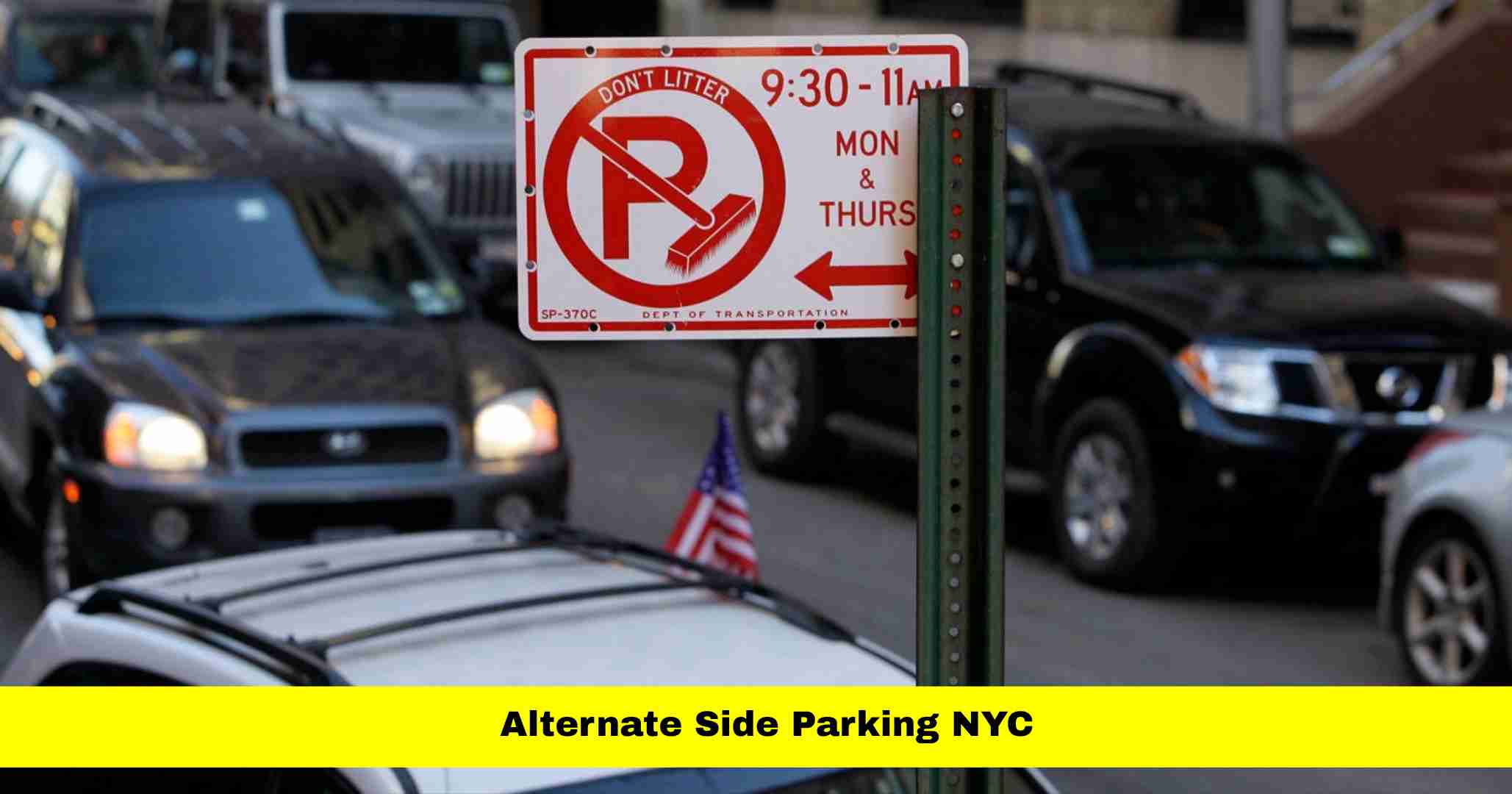
Alternate Side Parking (ASP) is the municipal system that allows New York City Department of Sanitation (DSNY) sweepers to clean streets. ASP is widely known as one of the most frequently ticketed parking regulations in NYC.
TYPICAL ASP SIGN INTERPRETATION:
- [ Sanitation Broom Symbol ]
- NO PARKING
- 8:30 AM - 10:00 AM
- TUESDAY & FRIDAY
- Applies ONLY during stated hours (8:30 AM - 10 AM)
- Applies ONLY on specified days (Tue/Fri)
- Vehicle must be completely clear of the curb space
How ASP Works
On designated ASP days and hours, parking is prohibited on one side of the street to allow street sweepers clear passage. ASP windows typically range from 90 minutes to 3 hours, although many residential zones utilize 90-minute windows (e.g., 8:30 AM to 10:00 AM or 11:30 AM to 1:00 PM).
Key operational nuances include:
- Staying in the Vehicle: Sitting inside your running motor vehicle during ASP hours on a active restriction curb does not protect you from a ticket. Traffic Enforcement Agents (TEAs) can issue a fine even if the driver is behind the wheel.
- Moving After the Sweeper Passes: Legally, drivers are not allowed to park back along the curb as soon as the street sweeper vehicle passes. The rule remains technically enforceable for the entire duration listed on the sign. While enforcement officers occasionally move past blocks after cleaning, parking prior to the posted expiration time carries legal risk.
- Frequency Guidelines: Most residential blocks operate under single-day or double-day ASP rules per side (e.g., Tuesday/Friday on one side, Monday/Thursday on the other).
ASP Suspensions and Calendar
The NYC DOT regularly suspends ASP rules for major legal holidays, religious observances, and severe winter weather events. You can check daily status updates on the official NYC DOT Alternate Side Parking Suspension Calendar.
When ASP is suspended:
- Street cleaning rules are waived.
- Parking meter rules, No Stopping zones, and No Standing zones remain fully enforced unless the calendar explicitly notes that meter rules are also suspended (which typically occurs only on major holidays like New Year's Day, Memorial Day, Independence Day, Labor Day, Thanksgiving, and Christmas Day).
Distinguishing No Parking, No Standing, and No Stopping
NYC traffic laws make precise distinctions between three levels of curb restrictions. Misunderstanding these terms leads to thousands of misissued or unexpected citations annually.
| RESTRICTION LEVEL | EXPEDITIOUS PASSENGERS | EXPEDITIOUS MERCHANDISE | WAITING/PARKING |
|---|---|---|---|
| No Parking | YES | YES | NO |
| No Standing | YES | NO | NO |
| No Stopping | NO | NO | NO |
1. No Parking
In a designated No Parking zone, drivers are permitted to stop temporarily to drop off or pick up passengers, or to load and unload personal luggage or commercial goods.
- Condition: The loading or unloading process must be continuous and expeditious.
- Restriction: Drivers may not leave the vehicle unattended for extended periods or wait for passengers to arrive.
2. No Standing
A No Standing zone is significantly stricter than a No Parking zone.
- Allowed: Drivers may stop only to drop off or pick up passengers.
- Prohibited: Drivers cannot wait for passengers, load or unload merchandise, packages, or luggage, or leave the vehicle idling.
3. No Stopping
No Stopping is the strictest curb restriction under NYC municipal law.
- Prohibited: Drivers cannot stop their vehicle for any reason, including loading passengers, idling, or answering phone calls.
- Exceptions: Stopping is permitted only when directed by a police officer, traffic signal, or to avoid an immediate collision.
Metered Parking Rates, Time Limits, and ParkNYC
Metered parking in New York City regulates curb space turnover in high-density commercial corridors. NYC DOT has shifted entirely from physical coin-and-card meters to digital pay-by-plate parking management systems.
Commercial vs. Residential Metered Zones
Meter rates and maximum time limits vary depending on borough and commercial density:
- Manhattan Central Business District (CBD): Metered zones below 60th Street feature progressive meter pricing where rate costs step up incrementally for subsequent hours to encourage short-term turnover.
- Outer Boroughs and Upper Manhattan: Neighborhood commercial districts (such as Downtown Brooklyn, Astoria, or Flushing) generally charge lower base rates with standard 1-hour to 2-hour maximum stays.
Operating ParkNYC
Drivers can pay for street parking using physical meters located on the block or via the official ParkNYC Portal and Mobile Application.
When paying through ParkNYC:
- Locate the 6-digit Zone Number posted on street signs on the block face.
- Enter your vehicle license plate number accurately.
- Select the desired session length up to the posted maximum time limit.
Note on Session Extensions: You cannot extend a parking session beyond the maximum time limit posted on the street sign for that specific zone. Once the maximum limit expires, the vehicle must be moved to another block face.
The 5-Minute Grace Period Rule
Under 34 RCNY § 4-08(a)(9), NYC drivers are granted a 5-minute grace period at the end of paid metered parking sessions and time-limited parking sign periods. Enforcement agents cannot issue a ticket until 5 minutes after the purchased time or posted limit has officially expired. This grace period applies to both paper meter receipts and digital ParkNYC sessions.
Critical Parking Prohibitions: Fire Hydrants, Double Parking, and Curb Cuts
Certain traffic rules in NYC are active 24 hours a day, 7 days a week, across all five boroughs, regardless of whether explicit signage is present.
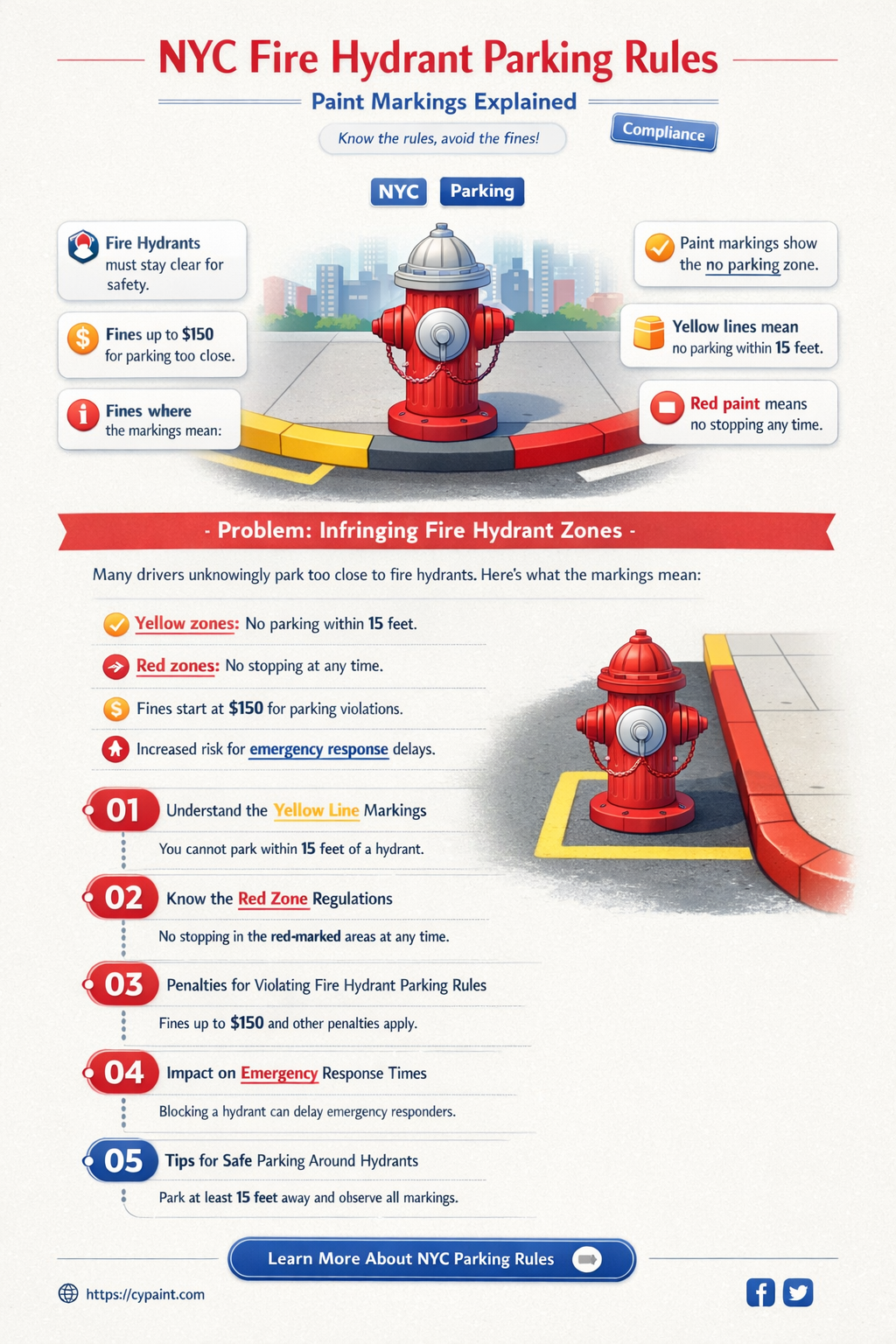
Fire Hydrant Rules (The 15-Foot Rule)
It is illegal to park, stand, or stop a vehicle within 15 feet of a fire hydrant on any public street.
15 Feet: NO PARKING ZONE
[ FIRE HYDRANT ]
15 Feet: NO PARKING ZONE
Measurement: The distance is measured radially from the edge of the curb directly adjacent to the hydrant out 15 feet in both directions.
Attended Exception: Between sunrise and sunset, a driver may stand a passenger car within 15 feet of a hydrant only if the driver remains in the front seat ready to move the vehicle immediately if emergency personnel arrive.
Double Parking Regulations
Double parking (parking on the roadway side of a vehicle parked at the curb) is illegal at all times for passenger vehicles under 34 RCNY § 4-08(f)(1).
- No ASP Exception for Personal Vehicles: Contrary to popular belief, passenger vehicles are not legally allowed to double-park across the street to avoid alternate side parking sweepers.
- Commercial Vehicle Allowance: Commercial vehicles engaged in active delivery or service operations may double-park for up to 30 minutes, provided no empty curb space is available within 100 feet on either side of the street, and the double parking occurs on a street where stopping or standing is not explicitly banned.
Driveways, Crosswalks, and Corner Curb Cuts
- Driveways: Blocking any public or private driveway is prohibited. Homeowners are permitted to park their own personal vehicle in front of their own private, legal driveway, provided the vehicle is registered to that address and the driveway serves a 1- to 2-family residence.
- Crosswalks: Parking inside marked or unmarked crosswalks is strictly forbidden. An unmarked crosswalk exists at every intersection where sidewalks terminate at the curb line, regardless of whether painted lines are drawn across the pavement.
- Pedestrian Ramps: Parking in front of a sidewalk curb ramp cut designed for accessibility is illegal across all five boroughs.
The 7-Day Continuous Parking Limit
According to NYC traffic code, vehicles left parked on any public street in the same exact location for more than seven consecutive days are considered abandoned. Even in non-metered residential areas without ASP restrictions, drivers must move their vehicles at least once every seven calendar days to avoid receiving an abandoned vehicle notice or impoundment.
Automated Camera Enforcement: Bus Lanes, Bike Lanes, and Curb Zones
New York City operates extensive automated enforcement camera programs to keep transit corridors clear.
Automated Bus Lane Enforcement (ABLE / ACE)
The Metropolitan Transportation Authority (MTA) and NYC DOT operate automated cameras mounted on city buses and street infrastructure. These cameras document vehicles that illegally block Dedicated Bus Lanes or Bus Stops.
- Dedicated Bus Lanes: Vehicles may enter a dedicated bus lane only to make an immediate right turn at the next available intersection or to quickly drop off/pick up passengers. Driving, standing, or parking in a bus lane triggers automated citations mailed directly to the registered vehicle owner.
- Bus Stops: Vehicles are barred from stopping, standing, or parking within a designated bus stop zone at all times.
Bike Lane Infringements
Parking or standing in a designated bike lane poses safety hazards for cyclists and is subject to aggressive enforcement. In addition to NYPD TEAs, city infrastructure uses remote cameras and mobile reporting to penalize drivers occupying protected or painted bike paths.
Comprehensive Summary of NYC Parking Rules and Fine Structures
The following table summarizes common street parking rules in NYC, including distance limits, enforcement rules, and baseline monetary penalties managed by the NYC Department of Finance.
| Restriction Type | Minimum Clearance / Limit | Enforced Window | Standard Penalty Range | Key Rule Nuances |
|---|---|---|---|---|
| Fire Hydrant | 15 Feet (30 feet total zone) | 24/7 / 365 Days | $115 | Driver may stay in front seat between sunrise/sunset to move if needed. |
| Alternate Side Parking (ASP) | Entire curb length indicated | Posted hours (90 min - 3 hrs) | $65 | Must clear vehicle for DSNY sweepers; sitting inside does not prevent tickets. |
| Double Parking | N/A | 24/7 / 365 Days | $115 | Illegal for passenger cars at all times; limited exceptions for commercial delivery. |
| Bus Lane Violation | Clear path of lane | Active posted hours | $50 - $250 (escalating) | Enforced via automated bus-mounted and stationary cameras. |
| Expired Meter | Paid time frame + 5 min grace | Posted hours (usually 8 AM-7 PM) | $35 - $90 | Manhattan CBD carries higher rates; 5-minute grace period legally applies. |
| No Standing Zone | Indicated by sign arrows | Posted hours or 24/7 | $115 | Expeditious passenger drop-off only; no merchandise loading or waiting. |
| No Stopping Zone | Indicated by sign arrows | Posted hours or 24/7 | $115 | No stopping under any circumstances unless directed by police or traffic flow. |
| Blocked Driveway | Full driveway opening | 24/7 / 365 Days | $95 | Owner of 1-2 family home may block own driveway if vehicle matches address. |
| 7-Day Rule | Must move vehicle location | 7 Consecutive Days | $65 + Towing/Impound | Applies across all boroughs, even in non-restricted residential areas. |
Parking Violations: Fines, Disputing Tickets, Booting, and Towing
Failing to comply with NYC street parking regulations results in swift enforcement action. The enforcement system is managed jointly by the NYPD and the NYC Department of Finance (DOF).
Fines and Geographic surcharges
Fine amounts vary depending on the severity of the violation and the geographic location. Violations issued within the Manhattan Core (defined generally as Manhattan 96th Street and below) often carry higher monetary penalties than outer-borough tickets for identical offenses (e.g., expired meters or mobility obstruction violations).
Vehicle Booting and Towing Thresholds
If a vehicle accumulates more than $350 in unpaid parking tickets that have entered judgment status, it becomes eligible for immediate booting or towing by City Marshals or the NYPD.
- Accumulate $350+ in Tickets in Judgment
- Vehicle Placed on Marshal Tow List
- Vehicle Booted (Boot Fee: ~$185)
- Vehicle Towed (Tow Fee: ~$185+)
- Full Outstanding Judgment + Fees Must Be Paid
- Booting: An electronic clamp is attached to the wheel. To release the boot, the owner must pay all outstanding fines, interest, and a boot execution fee.
- Towing (Impoundment): Towed vehicles are taken to official NYPD Tow Pounds (such as Navy Pier in Manhattan or Brooklyn Navy Yard). Reclaiming an impounded vehicle requires clearing all judgment debts, paying a $185 tow fee, and paying daily storage fees.
How to Dispute a Violation
Drivers who receive an unjustified ticket have the right to request an administrative hearing through the NYC Department of Finance. Hearings can be conducted online via the NYC Pay or Dispute mobile application or web portal.
Valid grounds for a ticket dismissal include:
- Missing or Incorrect Mandatory Details: If the officer misstated the vehicle make, plate type, expiration date, location, or violation code on the physical ticket, the ticket is defective and must be dismissed upon request.
- Proof of Payment: Valid ParkNYC electronic logs or physical meter receipts showing active time (including the 5-minute grace period).
- Defective Signage: Providing photographic evidence showing that parking signs on the block face were unreadable, missing, or obscured by tree foliage at the time of ticket issuance.
Frequently Asked Questions
1. How far away must I park from a fire hydrant in NYC?
You must maintain a minimum distance of 15 feet in both directions from any fire hydrant along the curb line. Parking within 15 feet is illegal 24 hours a day, 7 days a week. The only exception allows a driver to stand a passenger vehicle within 15 feet between sunrise and sunset if the driver remains behind the steering wheel, ready to move the car immediately.
2. Is it legal to double-park on Alternate Side Parking (ASP) days while waiting for the street sweeper?
No. Under 34 RCNY § 4-08(f)(1), double parking personal passenger vehicles is illegal at all times in New York City, even during active ASP street cleaning hours. While some neighborhood blocks informally tolerate double parking during sweep hours, traffic enforcement agents retain full legal authority to issue $115 double-parking tickets.
3. Is street parking free on Sundays in New York City?
Metered parking rules are generally not enforced on Sundays, meaning drivers can park at most street meters free of charge. However, drivers must carefully check posted signage: all standard No Parking, No Standing, No Stopping, and specialized commercial loading zone rules remain enforced on Sundays unless the sign explicitly states otherwise.
4. What is the 5-minute grace period for parking meters in NYC?
Under NYC administrative rules, traffic enforcement agents must grant a 5-minute grace period past the expiration of a paid metered session or posted time-limit sign. For example, if your ParkNYC payment expires at 2:00 PM, an officer cannot lawfully issue an expired meter citation until 2:05:01 PM.
5. What happens when ASP is suspended for a holiday or snowstorm?
When the NYC DOT officially suspends Alternate Side Parking, drivers do not need to move their vehicles for street sweepers. However, all other parking regulations—including metered parking rules, No Standing zones, and fire hydrant clearances—remain fully active unless the city explicitly announces a combined suspension of both ASP and parking meter rules.
Recommended Action Steps for NYC Drivers
To prevent parking citations, vehicle damage, and municipal towing when parking on New York City streets, follow these steps:
- Verify Signage on the Entire Block: Always walk to both ends of the block segment where you park. Check every sign on the post and confirm that no restrictive red signs override the spot.
- Set Up Mobile Meter Alerts: Download the official ParkNYC mobile application and register your vehicle license plate. Utilize mobile push notifications to monitor session expiration times and account for the 5-minute grace period.
- Subscribe to DSNY / NYC DOT ASP Updates: Follow official NYC 311 or DOT notification channels to receive daily alerts regarding Alternate Side Parking suspensions caused by holidays or severe weather.
- Measure Fire Hydrant Distances Carefully: Never guess distances near a fire hydrant. Keep a minimum of one full car-length (15 feet) of clear space between your bumper and the hydrant base.
- Promptly Contest Incorrect Tickets: If you receive a ticket issued in error, gather photographic evidence immediately—showing your vehicle location, street signs, and dash cams—and submit a dispute within 30 days via the NYC Department of Finance portal to avoid late penalties.
Image Gallery