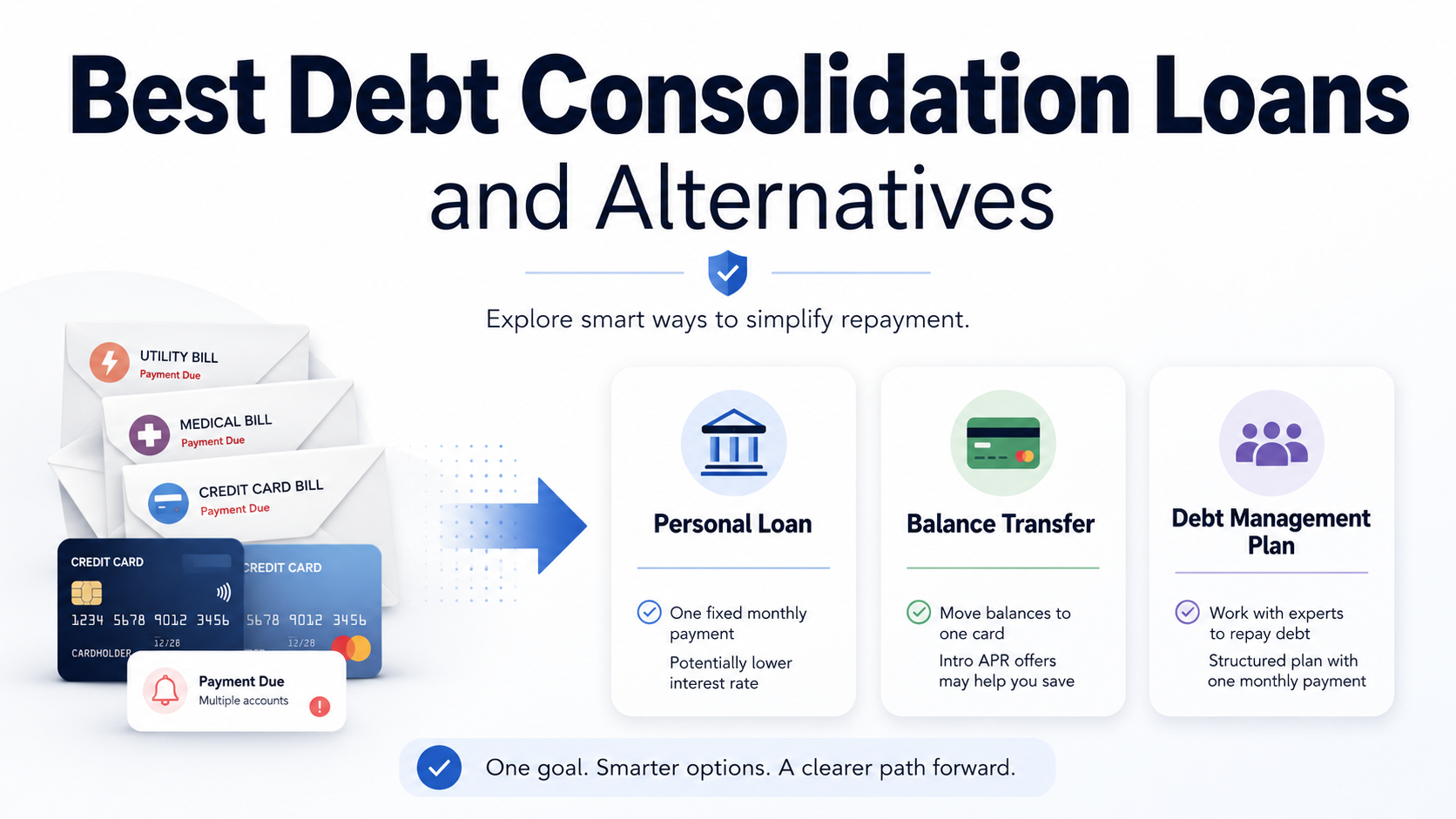
Top Rated Debt Consolidation: Choosing the Best Loan for Your Situation
Choosing the best debt consolidation loan in 2026 requires matching your specific credit profile and total debt amount with a lender that offers a lower Annual Percentage Rate (APR) than your current average. By moving high-interest ba...
Choosing the best debt consolidation loan in 2026 requires matching your specific credit profile and total debt amount with a lender that offers a lower Annual Percentage Rate (APR) than your current average. By moving high-interest balances into a single, fixed-rate installment loan, you can simplify your monthly finances and significantly reduce the total interest paid over the life of the debt.
Contents
Debt consolidation is a financial strategy that involves taking out a new loan to pay off multiple existing debts. As we navigate the economic landscape of 2026, this tool remains one of the most effective ways for consumers to regain control over their financial health. However, the "top rated" option is not a one-size-fits-all solution; the ideal choice depends on your credit score, the total amount you owe, and your ability to commit to a structured repayment plan.
The Evolution of Debt Consolidation in 2026
The lending market in 2026 is characterized by hyper-personalized loan products driven by advanced AI underwriting. Unlike the broader credit assessments of the past, modern lenders analyze a wider array of data points, including cash flow patterns and employment stability, to offer competitive rates.
When searching for the best loan for your situation, it is vital to distinguish between a simple personal loan and a dedicated debt consolidation product. Dedicated consolidation loans often feature direct payment options, where the new lender pays your creditors directly, removing the temptation to spend the loan proceeds elsewhere. This feature is a hallmark of top-rated services, as it streamlines the process and ensures the primary goal—debt elimination—is met immediately.
Evaluating Your Financial Profile Before Applying
Before you can identify the top-rated lender for your needs, you must perform a rigorous self-audit. Lenders categorize applicants based on several key metrics, and knowing where you stand will prevent unnecessary "hard" credit inquiries that could temporarily dip your score.
Credit Score Tiers
Your FICO or VantageScore remains the most significant factor in determining your APR. In 2026, the tiers generally break down as follows:
- Excellent (750+): Access to the lowest rates, often rivaling prime rates, with no origination fees.
- Good (700–749): Competitive rates and high approval limits; likely to qualify for most top-tier fintech lenders.
- Fair (640–699): May face origination fees (1% to 5%) and slightly higher APRs, but still lower than most credit card rates.
- Poor (Below 640): Limited to specialized lenders who may require collateral or a co-signer.
Debt-to-Income (DTI) Ratio
Lenders calculate your DTI by dividing your total monthly debt obligations by your gross monthly income. Most top-rated lenders prefer a DTI below 40%, though some specialized programs in 2026 allow for higher ratios if the borrower can demonstrate a consistent history of on-time payments. Reducing your DTI by closing small, unnecessary accounts or increasing income through secondary sources can improve your loan terms.
Identifying Key Features of Top-Rated Consolidation Loans
Not all loans are created equal. When comparing offers, look beyond the monthly payment amount and focus on the structural components of the loan agreement.
Annual Percentage Rate (APR) vs. Interest Rate
The APR is the most accurate measure of a loan's cost because it includes both the interest rate and any upfront fees, such as origination or administrative costs. In 2026, top-rated lenders are legally required to provide a clear APR disclosure early in the process. If a lender focuses solely on the interest rate while burying fees in the fine print, it is a significant red flag.
Fees and Penalties
The best debt consolidation loans in 2026 prioritize fee transparency. Key fees to watch for include:
- Origination Fees: A one-time deduction from your loan proceeds (typically 1% to 10%).
- Prepayment Penalties: Fees charged if you pay the loan off early. The highest-rated lenders never charge these, as they want to encourage financial freedom.
- Late Fees: While standard, the grace periods and fee structures vary significantly between lenders.
Funding Speed and Direct Creditor Pay
Speed is often a priority for those facing high-interest deadlines. Many fintech platforms now offer "same-day" or "next-day" funding. However, the most beneficial feature for consolidation is Direct Creditor Pay. This service allows the lender to send funds directly to your credit card companies or other lenders, ensuring the debt is settled without any manual intervention on your part.
Comparison of Top-Rated Loan Categories (2026 Data)
The following table outlines the typical characteristics of top-rated consolidation options available in 2026 based on different borrower profiles.
| Lender Category | Ideal Credit Score | Typical APR Range | Best Feature |
|---|---|---|---|
| Prime Fintechs | 720+ | 6.99% – 12.99% | Zero fees, high loan limits (up to $100k). |
| Credit Unions | 660+ | 8.99% – 18.00% | Personalized service and lower caps on APR. |
| Fair Credit Specialists | 600 – 660 | 15.99% – 29.99% | High approval rates and fast funding. |
| Balance Transfer Cards | 740+ | 0% (Intro Period) | No interest for 12–21 months. |
Strategic Steps to Choosing Your Loan
To secure the best possible terms, follow a systematic approach to the application process.
1. Prequalification
Most reputable lenders in 2026 offer a prequalification tool that uses a "soft" credit pull. This allows you to see your estimated rate and term without affecting your credit score. Prequalify with at least three different lenders to establish a baseline for what you are eligible for.
2. Compare the Total Cost of Borrowing
Do not just look at the monthly payment. A lower monthly payment often means a longer loan term, which might result in paying more total interest over time. Use a debt consolidation calculator to compare the total interest of your current debts against the total interest and fees of the new loan.
3. Verify Lender Reputation
Check the Consumer Financial Protection Bureau (CFPB) complaint database and reviews from independent financial watchdogs. Look for lenders with high marks for customer service and transparency. In 2026, online reputation is a strong indicator of a lender’s operational integrity.
4. Review the Terms and Conditions
Before signing, verify that the loan is "unsecured" (unless you have specifically opted for a secured loan using an asset like a car or home). Unsecured loans are standard for debt consolidation as they do not put your property at immediate risk if you encounter financial hardship.
Common Pitfalls to Avoid
While a consolidation loan is a powerful tool, it can be counterproductive if managed poorly. The most common mistake is continuing to use credit cards after they have been paid off by the loan. This leads to "double-dipping," where the consumer owes the loan payment plus new credit card balances.
Another pitfall is ignoring the root cause of the debt. A consolidation loan addresses the symptom of high-interest debt but not the habit of overspending. It is essential to pair your new loan with a strict budget to ensure that once the debt is gone, it stays gone.
Frequently Asked Questions
Will a debt consolidation loan hurt my credit score?
Initially, you may see a small dip in your score due to the "hard" credit inquiry and the opening of a new account. However, in the long term, a consolidation loan usually improves your score. It reduces your credit utilization ratio on your credit cards and adds to your "credit mix," both of which are positive factors in credit scoring models used in 2026.
Can I consolidate my debt if I have a low credit score?
Yes, but your options will be more limited and expensive. In 2026, some lenders specialize in "bad credit" consolidation. These loans often carry higher APRs and origination fees. In these cases, it is crucial to ensure the new APR is still lower than the rates on the debts you are consolidating. If the rates are similar, you might be better off seeking a debt management plan through a non-profit credit counseling agency.
How much can I save by consolidating?
The savings depend on the difference between your current weighted average interest rate and the APR of the new loan. For example, if you are moving $20,000 from credit cards with a 24% APR to a loan with a 10% APR, you could save thousands of dollars in interest and shorten your repayment period by years, provided you do not increase the term length excessively.
What is the difference between debt consolidation and debt settlement?
Debt consolidation involves paying back the full amount you owe but at a lower interest rate through a new loan. Debt settlement involves negotiating with creditors to pay back less than what is owed. Debt settlement significantly damages your credit score and often involves high fees, whereas consolidation is a proactive, credit-building strategy.
Are there any hidden costs I should look for in 2026?
Modern regulations have eliminated many "hidden" costs, but you should still look for "voluntary" add-ons like credit insurance or disability coverage. These are often unnecessary and can be added to your loan balance, increasing your total debt. Always opt-out of these additions unless you have a specific, calculated need for them.
Practical Recommendation
For most individuals in 2026, the best path forward is to prequalify with a top-rated fintech lender that offers direct creditor payment. This ensures the funds are used for their intended purpose and provides the most streamlined experience. If your credit score is below 660, check with a local credit union, as they often provide more flexible terms and lower interest rate caps than national banks. Once the loan is secured, immediately close or hide your high-interest credit cards to prevent new debt from accumulating while you pay down the consolidation loan.
Image Gallery