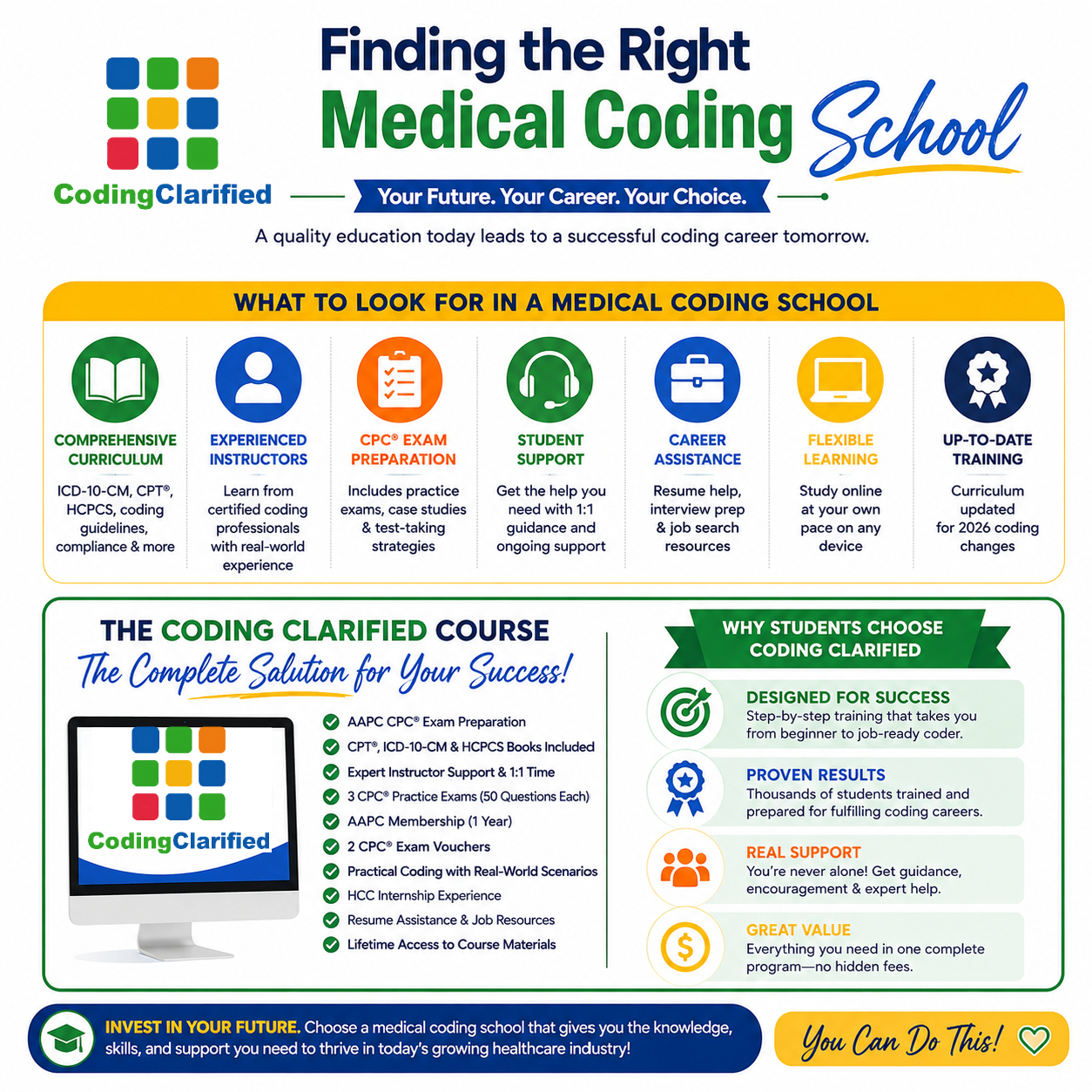
How to Choose the Right Medical Coder Colleges
Selecting the right medical coder college requires prioritizing institutions with recognized accreditation from CAHIIM or the AAPC to ensure your education meets national certification standards. Prospective students should evaluate th...
Selecting the right medical coder college requires prioritizing institutions with recognized accreditation from CAHIIM or the AAPC to ensure your education meets national certification standards. Prospective students should evaluate the curriculum's focus on ICD-10-CM and CPT coding, compare the long-term ROI of Associate degrees versus certificate programs, and verify the school’s recent graduate placement rates.
Contents
Choosing a medical coding program is a pivotal decision that dictates your eligibility for national certification and your eventual success in the healthcare revenue cycle. In 2026, the demand for skilled coders remains high as healthcare systems integrate more complex diagnostic data and transition toward refined reimbursement models. However, the proliferation of online "diploma mills" makes it essential to distinguish between a legitimate academic foundation and a program that leaves you unprepared for the workforce. This guide details the essential criteria for evaluating medical coder colleges to ensure your time and financial investment yield a professional return.
Understanding the Two Primary Educational Paths
Before selecting a specific college, you must decide which professional trajectory you intend to follow. The medical coding industry is largely governed by two major organizations: the American Academy of Professional Coders (AAPC) and the American Health Information Management Association (AHIMA). Most colleges align their curriculum with one of these two bodies.
Certificate Programs
Certificate programs are typically designed for rapid entry into the workforce. They focus almost exclusively on the technical aspects of coding, such as identifying codes in the International Classification of Diseases (ICD) and Current Procedural Terminology (CPT) manuals. These programs can often be completed in 6 to 12 months. While faster, they may lack the broader business and clinical background provided by a degree, which can sometimes limit upward mobility into management roles.
Associate Degrees in Health Information Management (HIM)
A two-year Associate of Applied Science (AAS) in Health Information Management offers a more comprehensive education. These programs include the core coding curriculum but supplement it with courses in healthcare law, data analytics, reimbursement methodologies, and leadership. An Associate degree from a CAHIIM-accredited program is often a prerequisite for the Registered Health Information Technician (RHIT) credential, which is highly valued for supervisory positions in hospital settings.
The Critical Importance of Accreditation
Accreditation is the most vital factor when choosing a medical coder college. Without proper accreditation, you may find yourself ineligible to sit for national certification exams, and your credits may not transfer to other institutions.
CAHIIM Accreditation
The Commission on Accreditation for Health Informatics and Information Management Education (CAHIIM) is the gold standard for degree-granting programs. If you are pursuing an Associate or Bachelor’s degree with the intent of earning AHIMA credentials, the program must be CAHIIM-accredited. This accreditation ensures the college meets rigorous academic and professional standards updated for the 2026 healthcare environment.
AAPC-Approved Programs
For those focusing on the Certified Professional Coder (CPC) designation, the AAPC offers a list of "AAPC-approved" or licensed educational partners. While these are often certificate-based, choosing a partner school ensures that the curriculum is perfectly mapped to the CPC exam. These programs use AAPC-authored textbooks and often include a membership to the organization, streamlining the transition from student to certified professional.
Regional Accreditation
Beyond specialized programmatic accreditation, ensure the college itself is regionally accredited. This is critical for the portability of your credits and for qualifying for federal financial aid (FAFSA). In the United States, regional accrediting bodies are recognized by the Department of Education and the Council for Higher Education Accreditation (CHEA).
Evaluating the 2026 Curriculum Standards
The medical coding landscape is not static. As of 2026, the integration of Artificial Intelligence (AI) in computer-assisted coding (CAC) and the ongoing refinements to ICD-10-CM and ICD-11 mean that a "standard" curriculum from five years ago is no longer sufficient. A high-quality college program should offer deep dives into the following areas:
- Medical Terminology and Anatomy: These are the prerequisites for all coding. You cannot accurately code a procedure if you do not understand the underlying physiological system or the specific surgical approach used.
- ICD-10-CM/PCS and ICD-11 Readiness: While ICD-10 remains the primary system for clinical modification in the U.S., leading colleges in 2026 are already introducing students to the structure of ICD-11 to future-proof their careers.
- CPT and HCPCS Level II: Essential for outpatient and physician-based coding. The curriculum should cover evaluation and management (E/M) leveling, which has seen significant documentation changes in recent years.
- Healthcare Compliance and Ethics: With increased federal scrutiny on "upcoding" and fraud, a modern coding program must emphasize the legal and ethical frameworks of the Office of Inspector General (OIG) and HIPAA.
- Revenue Cycle Management (RCM): Coding does not exist in a vacuum. Understanding how a code translates into a claim, and eventually a payment, is crucial for being a valuable asset to an employer.
Delivery Formats: Online vs. Campus-Based
In 2026, the majority of medical coding education has shifted to online or hybrid formats. However, not all online programs are created equal. When evaluating the delivery method, consider the following:
Self-Paced vs. Cohort-Based: Self-paced programs offer maximum flexibility but require immense self-discipline. Cohort-based programs, where you progress through classes with the same group of students, offer more networking opportunities and structured deadlines.
Synchronous vs. Asynchronous Learning: Synchronous learning involves live virtual lectures where you can interact with instructors in real-time. Asynchronous learning relies on recorded videos and message boards. If you struggle with complex topics like pathophysiology, a program with synchronous support is generally preferable.
Simulation Software Access: A reputable college will provide access to real-world coding software, such as 3M Encoder or similar platforms. Practicing on the software used in actual hospitals is a significant advantage when applying for entry-level roles.
Comparing Program Costs and Financial Aid
The cost of medical coding education varies wildly. A community college certificate might cost between $2,000 and $5,000, while a private for-profit university could charge upwards of $30,000 for an Associate degree.
| Program Type | Average Duration | Estimated Cost (2026) | Primary Credential Goal |
|---|---|---|---|
| Community College Certificate | 9–12 Months | $1,500 – $4,500 | CPC or CCA |
| AAPC Direct Online Training | 6–8 Months | $3,000 – $5,000 | CPC |
| Associate Degree (Public) | 2 Years | $6,000 – $15,000 | RHIT and CCS |
| Associate Degree (Private) | 2 Years | $20,000 – $40,000 | RHIT and CCS |
| Proprietary Trade School | 12 Months | $10,000 – $18,000 | CPC |
When calculating costs, look beyond tuition. Factor in the cost of coding manuals (which must be updated annually), certification exam fees, and required student memberships in professional organizations. Many accredited public colleges offer federal grants and loans, which are rarely available through unaccredited private coding boot camps.
Career Services and Placement Rates
A college is only as good as the career it helps you launch. Before enrolling, ask the admissions office for their "Gainful Employment" disclosures or their specific job placement rates for medical coding graduates over the last two years.
Externships and Practicums
Top-tier colleges often have established partnerships with local hospitals or national revenue cycle management firms. An externship allows you to perform real coding tasks under the supervision of a mentor. This hands-on experience is often the "tie-breaker" for employers who are wary of hiring someone with no prior experience.
Certification Pass Rates
Ask the program director for the percentage of students who pass the CPC or CCS exam on their first attempt. A high pass rate (above 80%) is a strong indicator that the curriculum is effectively aligned with the rigorous demands of the national exams.
Common Red Flags to Avoid
As you research, be wary of programs that make the following claims:
- "Guaranteed Job Placement": No reputable school can guarantee employment. They can provide resources, but the final hire depends on your performance and the local market.
- "Complete in 4 Weeks": Medical coding is a complex, technical field. It is impossible to master anatomy, medical law, and three different coding systems in a month. These programs are often "exam prep" courses rather than foundational education.
- Lack of Instructor Credentials: Ensure your instructors hold current credentials (CPC, CCS, RHIA, or RHIT). You should be learning from people who have actual experience in the field.
Frequently Asked Questions
Can I become a medical coder without a college degree?
While some individuals successfully enter the field by taking a standalone certificate course through the AAPC or AHIMA, many employers in 2026 prefer at least a post-secondary certificate from an accredited college. Large hospital systems frequently require an Associate degree for any position above entry-level.
Is financial aid available for medical coding programs?
Yes, provided the college is regionally accredited and participates in federal student aid programs. You can check a school's eligibility by looking for its OPE ID on the Federal Student Aid website. Private certificate-only schools often do not qualify for federal loans.
How do I know if a college is CAHIIM-accredited?
You can verify the status of any program directly on the CAHIIM program directory. This is the only way to be certain that a degree program meets the requirements for the RHIT or RHIA national exams.
Which is better: AAPC or AHIMA-aligned colleges?
Neither is inherently "better," but they serve different goals. AAPC-aligned programs are excellent for those wanting to work in physician offices or outpatient clinics. AHIMA-aligned programs are generally preferred for inpatient hospital coding and data management roles.
Do I need to learn ICD-11 in 2026?
Yes. While ICD-10-CM is currently the reporting standard in the United States, ICD-11 was adopted by the World Health Organization and is being integrated into global health informatics. A forward-thinking college will include ICD-11 concepts to ensure you remain relevant as the U.S. transitions toward this new system.
Can I work from home immediately after finishing college?
While remote work is common in medical coding, most employers require at least one to two years of in-office experience or a proven track record of high accuracy before allowing "coder from home" status. Some colleges have "remote-ready" practicums that can help bridge this gap.
Final Recommendation for Aspiring Students
To choose the right medical coder college, start by identifying your ultimate career goal. If you want a fast path to an outpatient coding role, a community college certificate or an AAPC-licensed program is the most cost-effective route. If you envision a long-term career in healthcare administration or hospital data management, invest the time in a CAHIIM-accredited Associate degree. Always verify accreditation through official channels—AAPC or AHIMA—and never enroll in a program that cannot provide verified graduate success data.
Image Gallery