Why Life Insurance for Parents of a Special Needs Child Matters
Life insurance for parents of a special needs child provides guaranteed financial resources to fund lifelong care, housing, and medical supervision after the parents pass away. When structured through a Special Needs Trust, policy payo...
Life insurance for parents of a special needs child provides guaranteed financial resources to fund lifelong care, housing, and medical supervision after the parents pass away. When structured through a Special Needs Trust, policy payouts preserve the child's eligibility for vital government assistance programs like Medicaid and Supplemental Security Income (SSI).
Contents
The Lifelong Financial Reality of Special Needs Care
Planning for a child with special needs differs fundamentally from traditional parenting financial goals. While standard financial planning typically focuses on supporting a child until they reach financial independence in early adulthood, parents of children with physical, cognitive, or developmental disabilities often prepare for lifelong care. This care frequently extends decades beyond the parents' own lifespans.
The costs associated with supporting an adult dependent with specialized needs can be substantial. Depending on the level of independence, costs may include:
- Residential Housing: Group homes, supported living arrangements, or specialized residential facilities.
- Daily Caregiving Services: In-home personal care aides, skilled nursing care, or occupational therapy.
- Out-of-Pocket Medical Expenses: Specialized therapies, adaptive equipment, assistive technology, and non-covered medications.
- Legal and Fiduciary Fees: Professional trustee management, guardianship accounting, and ongoing legal compliance.
Without careful advance planning, these expenses can quickly deplete a family's standard savings or retirement accounts. Life insurance serves as a specialized financial instrument designed to create an immediate, tax-free pool of capital upon the parents' death. This funding ensures that personal care services, therapeutic interventions, and quality-of-life enhancements remain uninterrupted.
Protecting Government Benefits: The Special Needs Trust Connection
A primary concern when leaving funds to a child with a disability is protecting their access to public benefits. Programs such as Supplemental Security Income (SSI) and Medicaid provide essential income, medical coverage, and community-based services. However, these programs enforce strict resource eligibility limits.
Under federal guidelines administered by the Social Security Administration (SSA), an individual generally cannot qualify for SSI if they hold more than $2,000 in countable liquid assets. Inheriting life insurance proceeds directly in the child's name instantly exceeds this asset ceiling, leading to the immediate suspension or termination of Medicaid and SSI benefits until the funds are entirely spent down.
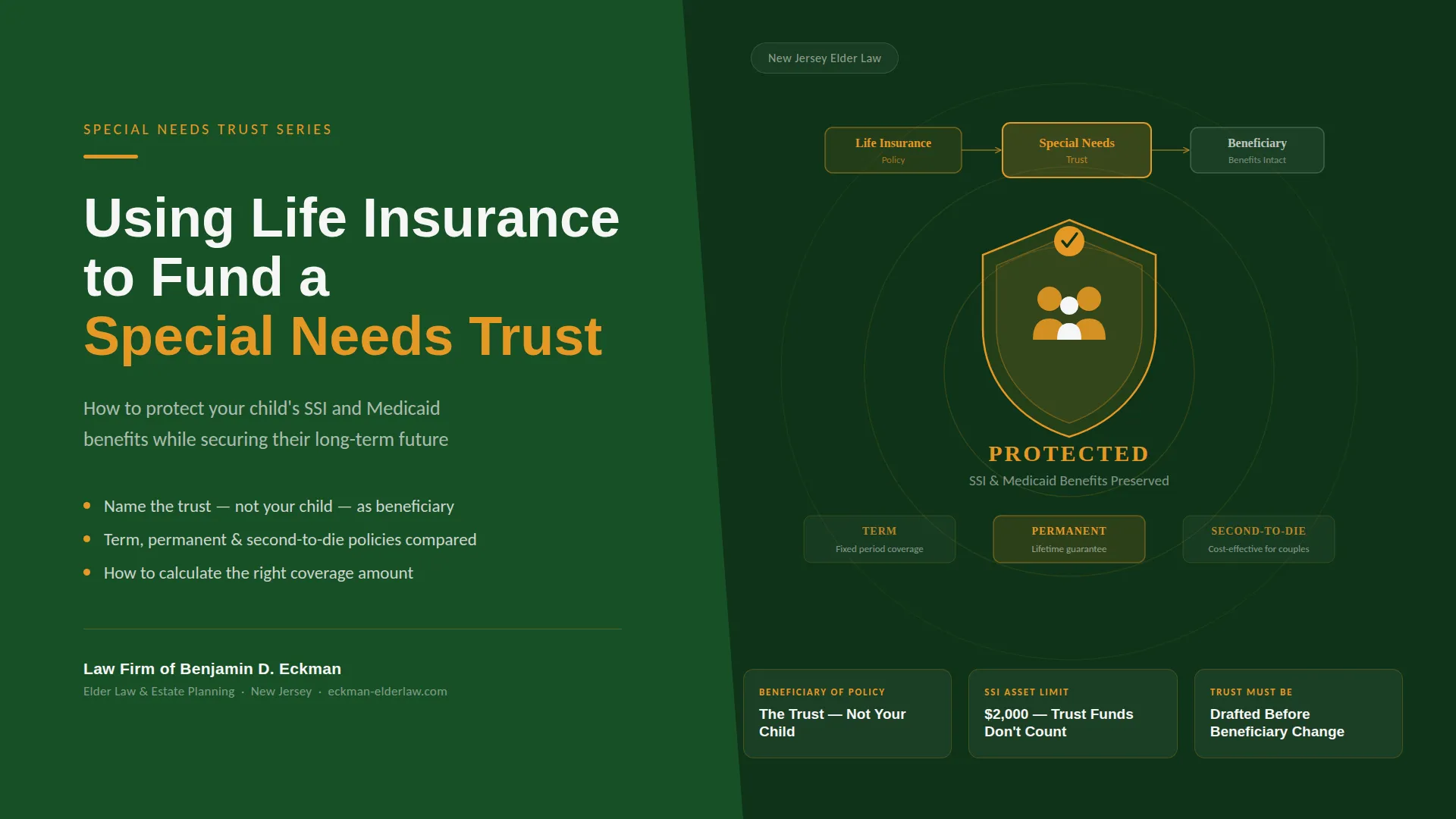
Direct Inheritance Path (High Risk): Parent Dies -> Life Insurance Payout -> Direct to Child -> Asset Limit Exceeded ($2,000+) -> Loss of SSI & Medicaid Trust-Funded Path (Protected): Parent Dies -> Life Insurance Payout -> Third-Party Special Needs Trust -> Managed by Trustee -> Benefits Preserved
The Role of a Third-Party Special Needs Trust (SNT)
To avoid benefit disqualification, life insurance policy payouts should be directed to a Third-Party Special Needs Trust (SNT) rather than to the child directly. A Third-Party SNT is an irrevocable legal structure created by a grantor (the parent) using third-party funds (such as life insurance proceeds) for the benefit of an individual with disabilities.
Key legal and operational advantages of a Third-Party SNT include:
- Asset Protection: Because the assets in the trust belong legally to the trust rather than the individual, the funds are not counted toward the beneficiary's $2,000 SSI resource limit.
- Supplemental Quality of Life: Trust funds can be used by the designated trustee to pay for goods and services not covered by public benefits, including education, recreation, personal electronics, travel, and specialized furniture.
- No Medicaid Payback Requirement: Unlike a First-Party (or Self-Settled) SNT, which requires any remaining funds at the beneficiary's death to be repaid to the state for Medicaid expenses incurred, a Third-Party SNT allows the parents to designate secondary beneficiaries (such as siblings or charities) to receive remaining trust assets after the child passes away.
Selecting the Right Type of Life Insurance Policy
Choosing the correct insurance structure depends on the family's overall financial profile, the child's expected level of lifelong dependency, and the timing of the payout.
Term Life Insurance vs. Permanent Life Insurance
Term Life Insurance provides coverage for a specific period (e.g., 10, 20, or 30 years). While term insurance offers lower initial premiums, it carries a significant structural limitation for special needs planning: if the policy expires while the child still requires lifetime support, the family loses coverage when it may be impossible or prohibitively expensive to re-insure the parents due to advancing age or health conditions.
Permanent Life Insurance—which includes Whole Life, Universal Life, and Variable Universal Life—remains active for the insured's entire lifetime, provided premiums are maintained. Permanent policies build cash value over time and guarantee a death benefit payout whenever the insured passes away. Because special needs care planning addresses a permanent need rather than a temporary financial obligation, permanent life insurance is generally the foundation of long-term estate strategy for these families.
Survivorship Life Insurance (Second-to-Die Policies)
For married parents, a Survivorship Life Insurance policy (often called a "Second-to-Die" policy) is frequently the most cost-effective permanent insurance vehicle available.
Unlike single-life policies that pay out upon the death of one individual, a survivorship policy covers two parents and pays out the death benefit only after both parents have passed away.
- Cost Efficiency: Because the insurer's payout obligation is deferred until the second death, premiums for survivorship policies are substantially lower than purchasing two separate permanent policies of equal face value.
- Underwriting Flexibility: Underwriting evaluates two lives jointly. If one parent has pre-existing health conditions that would make individual coverage expensive or unattainable, the healthier spouse's condition can help mitigate the underwriting risk, making overall coverage more accessible.
Comparing Life Insurance Options for Special Needs Planning
The table below outlines key features, cost structures, and practical application scenarios for insurance structures commonly used in special needs estate planning.
| Policy Type | Coverage Duration | Premium Cost Level | Primary Benefit in Special Needs Planning | Trust Integration Compatibility |
|---|---|---|---|---|
| Term Life Insurance | Fixed Period (10–30 yrs) | Low | Covers temporary needs (e.g., paying off a mortgage while child is young). | High (if designated to SNT during policy term) |
| Individual Whole Life | Lifetime | High | Provides guaranteed death benefit and cash value accumulation for single parent/guardian. | High (names SNT as primary beneficiary) |
| Universal Life (UL / GUL) | Lifetime (Guaranteed) | Moderate to High | Offers flexible premiums with lifetime coverage options locked in to age 100+. | High (ideal for predictable SNT funding) |
| Survivorship (Second-to-Die) | Lifetime (Triggers on 2nd death) | Lower than two individual permanent policies | Efficiently funds the SNT exactly when both primary caregivers are gone. | Excellent (standard standard choice for married parents) |
Critical Mistakes to Avoid in Special Needs Financial Planning
Improperly structured financial tools can unintentionally jeopardize a child's financial security and public benefit eligibility. Parents should guard against several frequent estate planning errors.
1. Naming the Child Directly as Primary or Contingent Beneficiary
Designating a child with special needs as a direct beneficiary on life insurance policies, retirement accounts (401k, IRA), or bank accounts bypasses the Special Needs Trust entirely. Upon the parent's death, the institution releases funds directly to the child or their legal guardian, immediately disqualifying the child from resource-tested programs like SSI and Medicaid.
Corrective Action: Ensure the primary beneficiary on all policies intended for the child’s care is explicitly listed as the formal legal name of the Third-Party Special Needs Trust, formatted according to legal guidelines established by the drafting attorney.
2. Disregarding Grandparents and Extended Family Intentions
Well-meaning relatives often leave direct inheritances or name grandchildren as contingent beneficiaries in their own life insurance policies or wills. If a grandparent leaves even a modest inheritance directly to a child with special needs, it triggers the same benefit-disqualification risks as a direct parental payout.
Corrective Action: Communicate estate plans clearly with extended family members. Instruct relatives to direct any gifts, bequests, or beneficiary designations to the established Third-Party Special Needs Trust rather than to the child directly.
3. Relying Solely on ABLE Accounts for Large Insurance Proceeds
Achieving a Better Life Experience (ABLE) accounts allow individuals with disabilities to hold tax-advantaged savings without risking government benefit limits. However, federal and state regulations place annual contribution caps on ABLE accounts (aligned with the federal gift tax exclusion limit, plus qualified earned income adjustments under the ABLE to Work Act).
Because life insurance death benefits frequently total hundreds of thousands or millions of dollars, ABLE accounts are inadequate primary repositories for life insurance payouts. ABLE accounts should complement—not replace—a Third-Party Special Needs Trust.
4. Failing to Draft a Comprehensive Letter of Intent (LOI)
While a life insurance policy provides the financial foundation and a trust provides the legal structure, neither gives instructions on how the child prefers to live. A Letter of Intent (LOI) is a non-binding document written by parents that details the child's daily routines, medical history, preferred doctors, dietary needs, social interests, and long-term care goals.
Failing to write and regularly update a Letter of Intent leaves future trustees and guardians without guidance regarding how to utilize trust funds to support the child's specific physical, emotional, and social well-being.
Practical Implementation Steps for Parents
Structuring life insurance for a special needs child requires coordination between insurance professionals, legal specialists, and financial advisors. Parents can follow a systematic process to build a secure framework:
Step 1: Quantify Needs -> Step 2: Establish SNT -> Step 3: Secure Insurance -> Step 4: Update Beneficiaries -> Step 5: Draft LOI
Step 1: Quantify Lifelong Financial Requirements
Conduct a thorough needs assessment calculating expected long-term costs. Factor in estimated lifespan, housing options, daily support needs, therapeutic requirements, and expected inflation. Subtract anticipated government benefits (SSI, Social Security Disability Insurance) to identify the net financial gap the trust must cover.
Step 2: Establish a Third-Party Special Needs Trust
Work with an estate planning attorney who specializes in special needs law. Drafting the trust structure before purchasing or updating life insurance ensures the trust is legally active and capable of being named as an official beneficiary.
Step 3: Select and Underwrite the Insurance Policy
Work with an independent broker to evaluate permanent and survivorship life insurance products. Determine an affordable premium level that can be reliably sustained over decades, ensuring the policy remains active throughout the parents' lifetimes.
Step 4: Update Beneficiary Designations Correctly
Submit updated beneficiary designation forms to life insurance companies, employer group policy administrators, retirement plan custodians, and financial institutions. Verify that the primary beneficiary reads: *"To the Trustee of the [Name of Trust], created under agreement dated [Date]." *
Step 5: Draft and Attach a Letter of Intent
Document the child's complete medical, personal, and social history in a Letter of Intent. Store this document alongside legal trust papers and inform named guardians and trustees of its location.
Frequently Asked Questions
Can an ABLE account receive life insurance policy proceeds?
An ABLE account can receive funds from a life insurance policy, but it is limited by strict annual contribution limits set by federal law. Because life insurance payouts typically exceed these annual contribution limits, depositing a full death benefit directly into an ABLE account is generally not feasible. Large sums should flow into a Third-Party Special Needs Trust, which can then fund an ABLE account in smaller, allowable increments over time.
What happens if I accidentally name my special needs child as a direct life insurance beneficiary?
If a child receives a direct payout, the funds become personal assets, usually causing an immediate loss of resource-tested public benefits such as SSI and Medicaid. Resolving this mistake after the parent's death often requires legal intervention to place the funds into a First-Party (Self-Settled) Special Needs Trust. However, First-Party Trusts are subject to mandatory state Medicaid payback provisions upon the child's death, unlike Third-Party Trusts.
Is a survivorship (second-to-die) policy better than an individual life policy?
For married parents focused on providing funding for a child's care after both caregivers are gone, a survivorship policy is often more cost-effective. Premiums are generally lower than buying separate permanent policies because the insurer only pays out after the second parent passes away. However, if a family requires funds upon the death of the first parent to replace lost household income, individual policies or a combination of single and survivorship coverage may be necessary.
How much life insurance coverage should parents of a special needs child purchase?
Coverage amounts depend on the child's level of independence, expected medical and daily support expenses, projected lifespan, and available government benefits. A common approach involves calculating the annual out-of-pocket cost of care, multiplying that figure by the estimated years of care needed post-parental death, adjusting for inflation, and subtracting guaranteed income streams like SSI or SSDI. Consulting a financial planner certified in special needs planning can help refine this calculation.
Does establishing a Special Needs Trust affect my child's current SSI or Medicaid eligibility?
Creating a Third-Party Special Needs Trust does not impact current SSI or Medicaid eligibility. Because the trust holds no assets until it is funded (often via life insurance upon the parents' death), it has no effect on the child's financial standing during the parents' lifetimes. Once funded, properly managed distributions made directly to third-party vendors for non-food, non-shelter items continue to preserve benefit eligibility under Social Security regulations.
Taking the Next Step in Special Needs Financial Planning
Securing the long-term financial future of a special needs child requires an integrated strategy linking life insurance products with legal estate structures. Relying solely on standard wills or direct beneficiary designations risks forfeiting essential government assistance and leaving long-term care needs unfunded.
Parents should begin by consulting an accredited estate planning attorney who specializes in special needs law alongside a certified financial planner. By establishing a Third-Party Special Needs Trust and properly aligning permanent or survivorship life insurance coverage, parents can ensure their child receives compassionate, comprehensive, and uninterrupted care for the duration of their life.
Image Gallery