How to Get the Best Auto Insurance Coverage for the Money
The best auto insurance coverage for the money is not simply the cheapest policy available; it is a policy structure that provides robust financial protection against major accidents while eliminating unnecessary extras. Maximizing val...
The best auto insurance coverage for the money is not simply the cheapest policy available; it is a policy structure that provides robust financial protection against major accidents while eliminating unnecessary extras. Maximizing value requires carrying higher bodily injury and property damage liability limits (typically 100/300/100), setting collision and comprehensive deductibles between $500 and $1,000, and strategically bundling discounts with financially stable insurers.
Contents
Professional Advice Limitation
Insurance regulations, legal minimums, and rate structures vary significantly by state and individual risk profile. The coverage recommendations outlined below reflect standard industry practices for personal auto policies in the United States. Drivers should consult with a licensed insurance agent or financial advisor to customize policy limits according to their personal net worth, asset exposure, and local state laws.
What "Best Coverage for the Money" Really Means
Finding genuine value in auto insurance requires looking beyond the monthly premium. A bare-bones liability policy might save money in the short term, but a single major accident can quickly exceed state-minimum limits, leaving policyholders personally responsible for tens of thousands of dollars in medical bills or vehicle repair costs.
True value represents the intersection of three critical elements:
- Adequate Asset Protection: Policy limits high enough to shield personal savings, home equity, and future wages from lawsuits resulting from an at-fault accident.
- Comprehensive Vehicle Recovery: Coverage options (like collision and comprehensive) that pay out modern market value for your car after theft, severe weather, or a collision.
- Competitive Pricing Structure: Rates kept low through deductible management, telematics tracking, claims-free discounts, and multi-policy bundling.
Purchasing state minimum liability coverage creates a false economy. For example, standard state minimums in several jurisdictions cap property damage liability at $10,000 or $15,000—amounts far below the average cost of a modern replacement vehicle. Upgrading from basic state minimums to recommended mid-tier coverage often costs only a fraction more per month while increasing total financial protection by hundreds of thousands of dollars.
Core Coverage Components: Balancing Cost and Protection
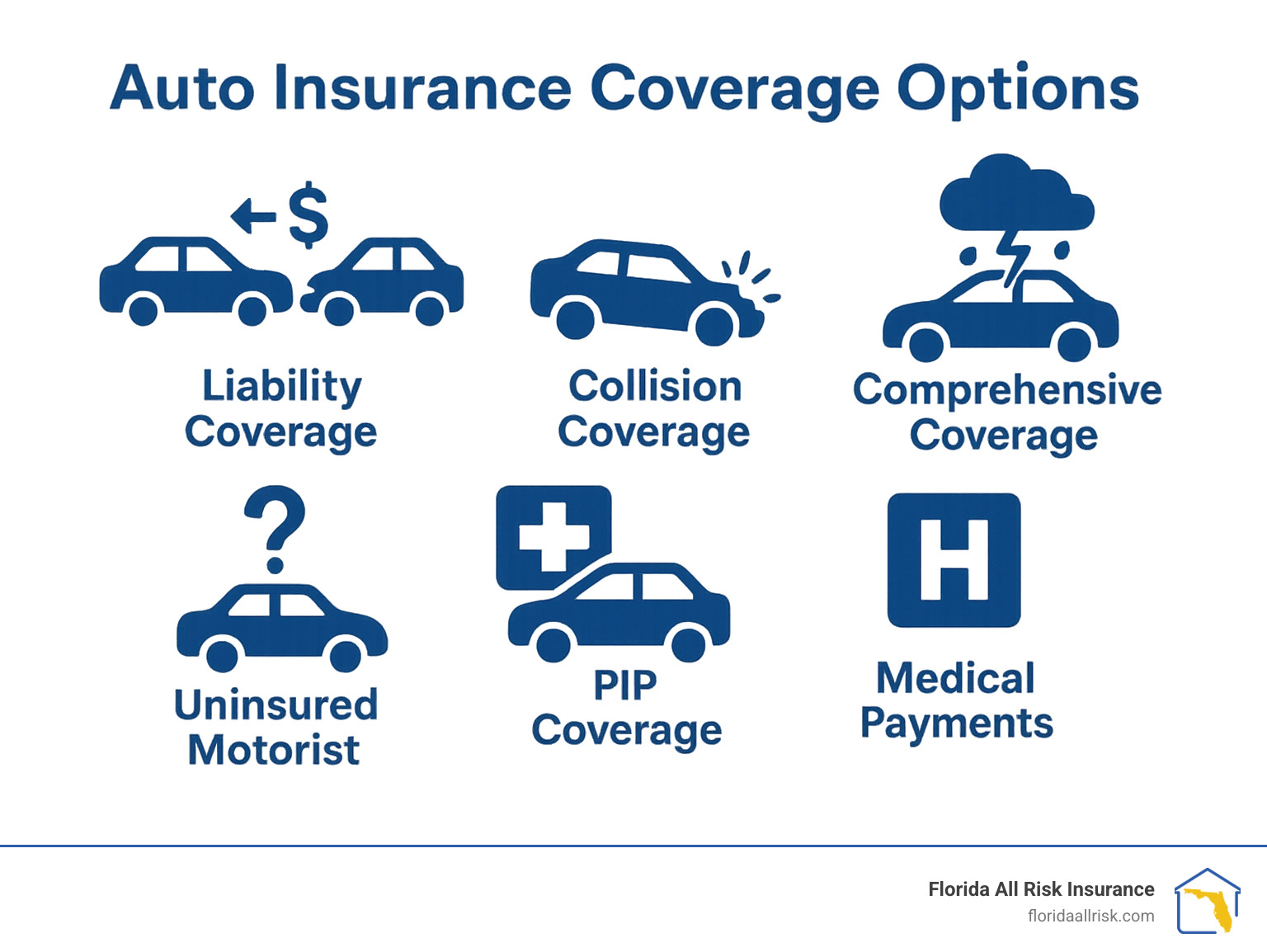
To build an optimal policy, drivers must understand the main building blocks of auto insurance and how each contributes to overall protection versus cost.
- OPTIMAL POLICY STRUCTURE
- LIABILITY COVERAGE (100/300/100): Shields Personal Assets
- UNINSURED MOTORIST (UM/UIM): Protects Against Uninsured Drivers
- COMPREHENSIVE & COLLISION: Protects Vehicle Market Value
- OPTIONAL ENDORSEMENTS (Gap/Tow): Targeted Risk Mitigation
1. Bodily Injury and Property Damage Liability
Liability insurance pays for injuries and property damage you cause to other people. It is split into three standard figures (e.g., 100/300/100):
- $100,000 Bodily Injury per Person: Covers medical bills, lost wages, and legal defense costs for any single injured individual.
- $300,000 Bodily Injury per Accident: The maximum total payout for medical claims across all injured parties in a single incident.
- $100,000 Property Damage per Accident: Covers repairs or total replacement for damaged vehicles, structures, or public infrastructure.
Value Insight: Increasing liability limits from 25/50/25 to 100/300/100 typically increases annual premiums by a modest amount (often 10% to 20%), providing four times the financial protection.
2. Collision and Comprehensive Coverage
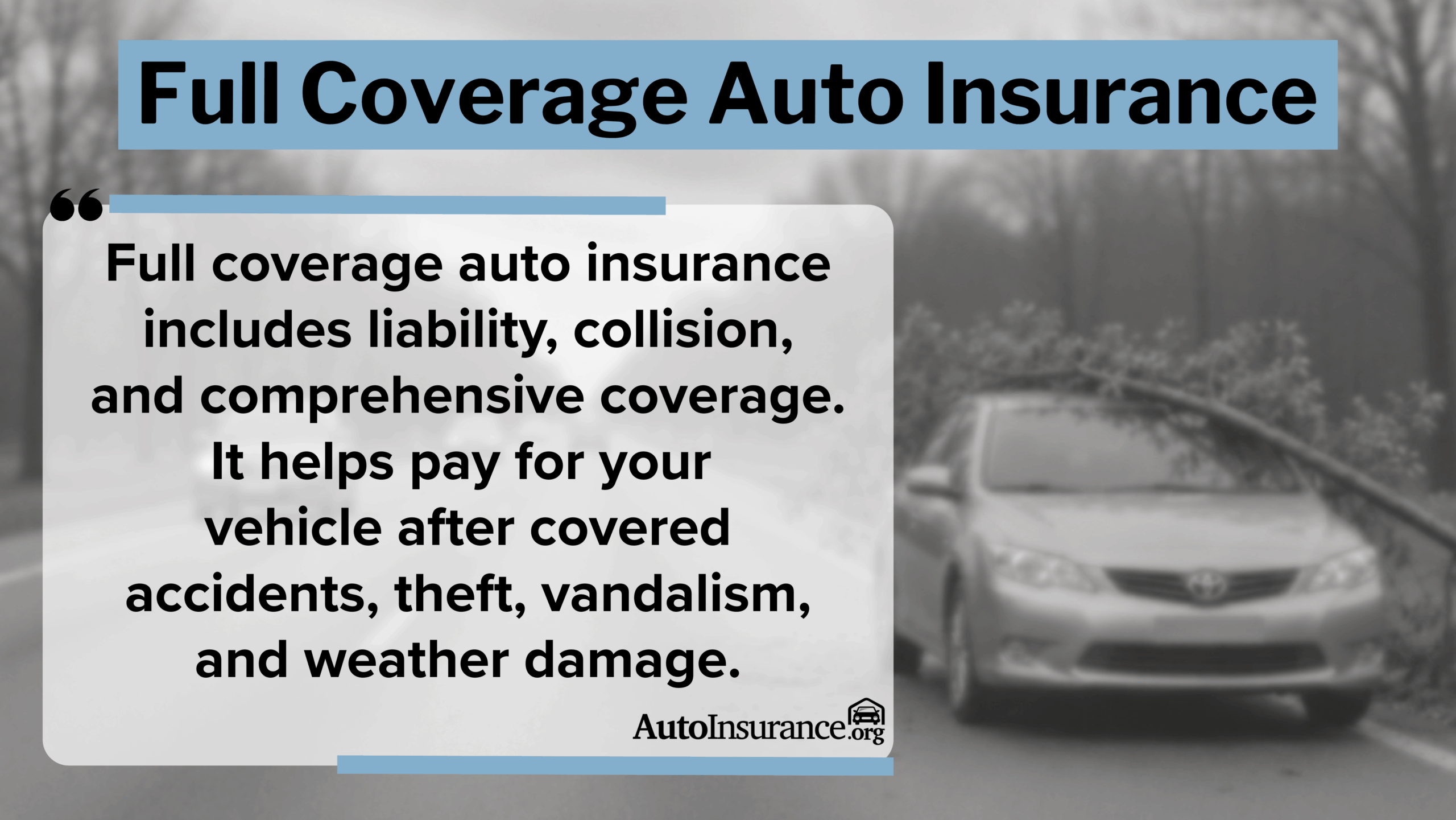
- Collision Coverage: Pays to repair or replace your vehicle after an accident involving another car, a tree, a guardrail, or a rollover—regardless of fault.
- Comprehensive Coverage: Pays for non-collision physical damage, including vehicle theft, vandalism, windshield cracks, falling objects, animal strikes (such as hitting a deer), and natural disasters.
Value Insight: Managing deductibles is key here. Raising your collision and comprehensive deductible from $250 to $500 or $1,000 can lower the physical damage portion of your premium by 15% to 30%.
3. Uninsured and Underinsured Motorist (UM/UIM)
According to data compiled by the Insurance Information Institute, roughly one out of every eight drivers on U.S. roads operates a vehicle without auto insurance. UM/UIM coverage steps in to cover your medical expenses, lost income, and physical damage if you are struck by a hit-and-run driver or a motorist carrying insufficient liability limits.
Value Insight: UM/UIM coverage is generally inexpensive compared to standard liability and provides essential protection against drivers who fail to carry required policies.
4. Personal Injury Protection (PIP) and Medical Payments (MedPay)
In states with no-fault insurance frameworks, Personal Injury Protection (PIP) covers immediate medical bills, replacement service costs, and lost wages for you and your passengers, regardless of who caused the crash. In tort states, Medical Payments (MedPay) provides a smaller, supplemental budget for initial healthcare costs following an accident.
Top National Providers Evaluated for Value
Evaluating insurance companies for value involves reviewing customer satisfaction metrics, financial stability ratings, available discounts, and broad pricing models. Data published by the National Association of Insurance Commissioners (NAIC) tracks consumer complaint patterns across major carriers, while financial strength ratings from agencies like A.M. Best indicate a carrier's long-term ability to pay out claims.
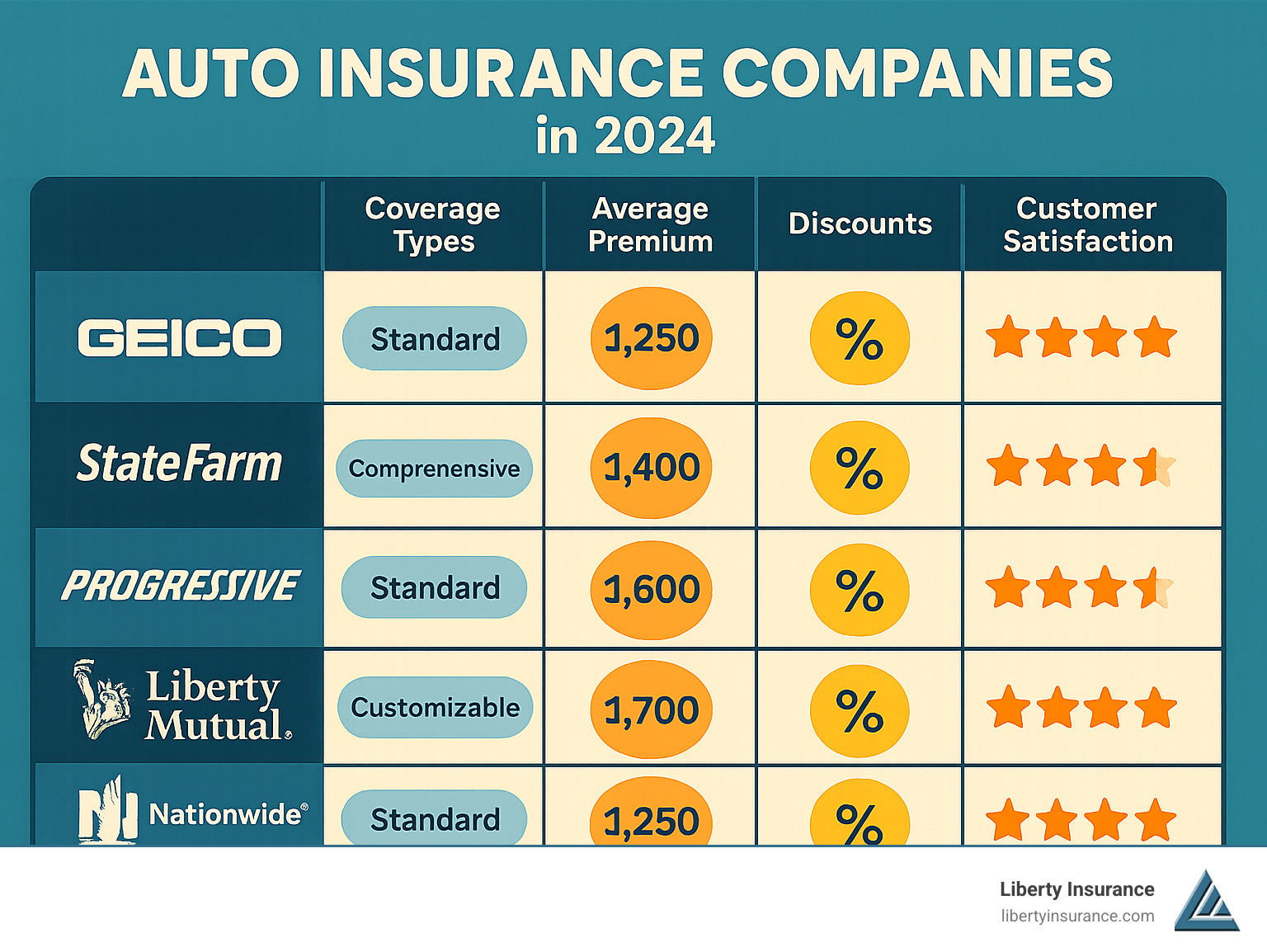
The following table summarizes top national and regional auto insurers that frequently deliver high coverage value:
| Insurance Provider | Average Cost Profile | Key Value Advantage | Ideal Driver Profile | Financial Rating (A.M. Best) |
|---|---|---|---|---|
| State Farm | Moderate | Superior multi-policy bundling discounts and broad local agent network. | Drivers seeking traditional agent service paired with strong discount stacking. | A++ (Superior) |
| Geico | Low to Moderate | Competitive direct rates, clean digital management, robust safety discounts. | Budget-focused drivers comfortable managing policies via web or mobile apps. | A++ (Superior) |
| Progressive | Moderate | Advanced telematics (Snapshot), dynamic rate customization (Name Your Price). | Drivers with prior minor infractions or high-mileage usage patterns. | A+ (Superior) |
| Erie Insurance | Low | Rate Lock technology prevents unexpected annual increases; high claim satisfaction. | Drivers located in supported Mid-Atlantic and Midwest operating states. | A+ (Superior) |
| Auto-Owners | Low to Moderate | Highest customer satisfaction ratings; exceptional local agency service. | Midwestern and Southeastern homeowners seeking comprehensive vehicle bundles. | A++ (Superior) |
| USAA | Exceptionally Low | Top-tier customer satisfaction scores, low average premiums, full-spectrum coverage. | Active-duty military members, veterans, and qualified immediate family members. | A++ (Superior) |
Step-by-Step Guide: Optimizing Policy Value
Maximizing auto insurance value requires adjusting policy structures, applying applicable discounts, and establishing routine price checks.
Step 1: Select Optimal Coverage Limits
Avoid buying bare minimum liability. Instead, target 100/300/100 limits. If your personal assets (savings, home equity, investments) exceed $300,000, consider pairing this baseline policy with an overarching personal umbrella policy. Umbrella coverage provides an additional $1 million or more in broad liability protection for a low annual fee.
Step 2: Recalibrate Your Deductibles
Align your deductibles with your emergency savings fund. If you maintain at least $1,000 in a liquid savings account, setting both your collision and comprehensive deductibles to $1,000 can generate substantial savings on your recurring monthly premium.
Step 3: Implement the "10x Vehicle Value Rule"
If the current retail market value of your vehicle falls below ten times your annual combined premium for comprehensive and collision coverage, maintaining physical damage insurance may no longer deliver good value.
For example:
- Vehicle resale value: $3,000
- Annual cost for Collision + Comprehensive: $500
- Annual deductible: $500
In this scenario, after paying a $500 deductible on a $3,000 vehicle payout, your net maximum recovery is $2,500. Paying $500 annually to protect a net $2,500 asset represents low financial value. Drop full coverage on older, paid-off vehicles and redirect those savings into personal emergency accounts.
Step 4: Utilize Usage-Based Telematics Programs
Most major carriers offer telematics programs that track driving behavior via a mobile phone app or onboard OBD-II device. Drivers who limit late-night travel, refrain from hard braking, avoid high speeds, and minimize active phone usage while driving can earn premium discounts ranging from 10% to 40%.
Step 5: Stack Strategy-Based Discounts
Ensure every policy discount for which you qualify is applied:
- Multi-Policy Discount: Combine auto insurance with home, renters, or condominium coverage with the same provider.
- Paperless & Automatic Pay: Opt into electronic billing and automated monthly bank transfers.
- Defensive Driving Certification: Complete an accredited state-approved driver safety course, particularly effective for young drivers or seniors.
- Vehicle Safety Features: Ensure the insurer tracks factory-installed anti-theft systems, automatic emergency braking, lane departure warnings, and adaptive headlights.
Common Pitfalls That Waste Money
- Over-Insuring Older Vehicles: Continuing to carry low deductibles or full collision/comprehensive coverage on vehicles worth less than $3,000 to $4,000.
- Under-Insuring High-Value Personal Assets: Choosing state liability minimums (e.g., $15,000/$30,000/$10,000) to save $15 per month while owning a home or holding substantial savings exposed to legal claims.
- Paying for Redundant Endorsements: Buying roadside assistance through an insurer when you already carry an active AAA membership, credit card roadside benefits, or a new vehicle manufacturer warranty.
- Failing to Shop Rates Periodically: Remaining auto-enrolled with the same provider for years without obtaining competitive quotes. Insurers use pricing algorithms that can gradually raise rates over time (a practice known as price optimization). Re-evaluating rates every 12 to 18 months ensures your policy stays competitive.
Frequently Asked Questions
What liability limits offer the best value for average drivers?
For most drivers owning personal assets or a home, liability limits of 100/300/100 ($100,000 bodily injury per person / $300,000 bodily injury per accident / $100,000 property damage) provide the optimal baseline balance of financial security and affordable premiums.
Is full coverage auto insurance always worth the money?
Full coverage is required by lenders on leased or financed vehicles. For paid-off vehicles, full coverage is worth the money as long as the vehicle retains substantial market value (typically over $4,000 to $5,000) and the owner cannot easily afford to replace the vehicle out of pocket following a total loss.
Does raising auto insurance deductibles really cut costs?
Yes. Moving your comprehensive and collision deductibles from $250 or $500 up to $1,000 can lower the physical damage portion of your insurance premium by 15% to 30%. However, you should only select a deductible amount that you can comfortably pay on short notice in the event of an accident.
How often should quotes be compared to maintain the best rate?
Comparing quotes every 12 to 18 months or after major life events—such as moving to a new ZIP code, buying a home, getting married, or experiencing an improved credit score—helps ensure you continue receiving the best rate for your coverage level.
Will participating in a telematics program raise auto insurance rates?
With most major insurance carriers, telematics usage-based insurance programs (like Progressive Snapshot or State Farm Drive Safe & Save) only reward safe driving with discounts. However, in select states and with certain insurance brands, consistently high-risk driving habits (such as frequent sudden braking, high speeds, or late-night driving) can lead to rate adjustments or loss of initial enrollment discounts. Always review your carrier's specific telematics terms before enrolling.
Next Steps to Optimize Your Auto Coverage
- Review Current Policy Declarations: Open your latest auto insurance policy declarations page and verify your current liability limits, physical damage deductibles, and annual cost breakdown.
- Determine Vehicle Market Value: Use trusted automotive valuation services (such as Kelley Blue Book or Edmunds) to ascertain the realistic resale value of your covered vehicles.
- Adjust Deductibles and Drop Redundant Add-Ons: Raise collision and comprehensive deductibles to $500 or $1,000 if your emergency fund allows, and cancel duplicate roadside assistance or rental car coverage if covered elsewhere.
- Gather Competitive Quotes: Collect quotes from at least three major insurance providers using identical coverage parameters (e.g., 100/300/100 liability with matching deductibles) to evaluate true baseline costs.
- Enroll in Usage and Bundling Discounts: Combine auto policies with your home or renters coverage, and consider enrolling in a telematics discount program to maximize your total annual savings.
Image Gallery