Understanding Live Tennis Rankings: Structure, Calculations, and Real-Time Tracking
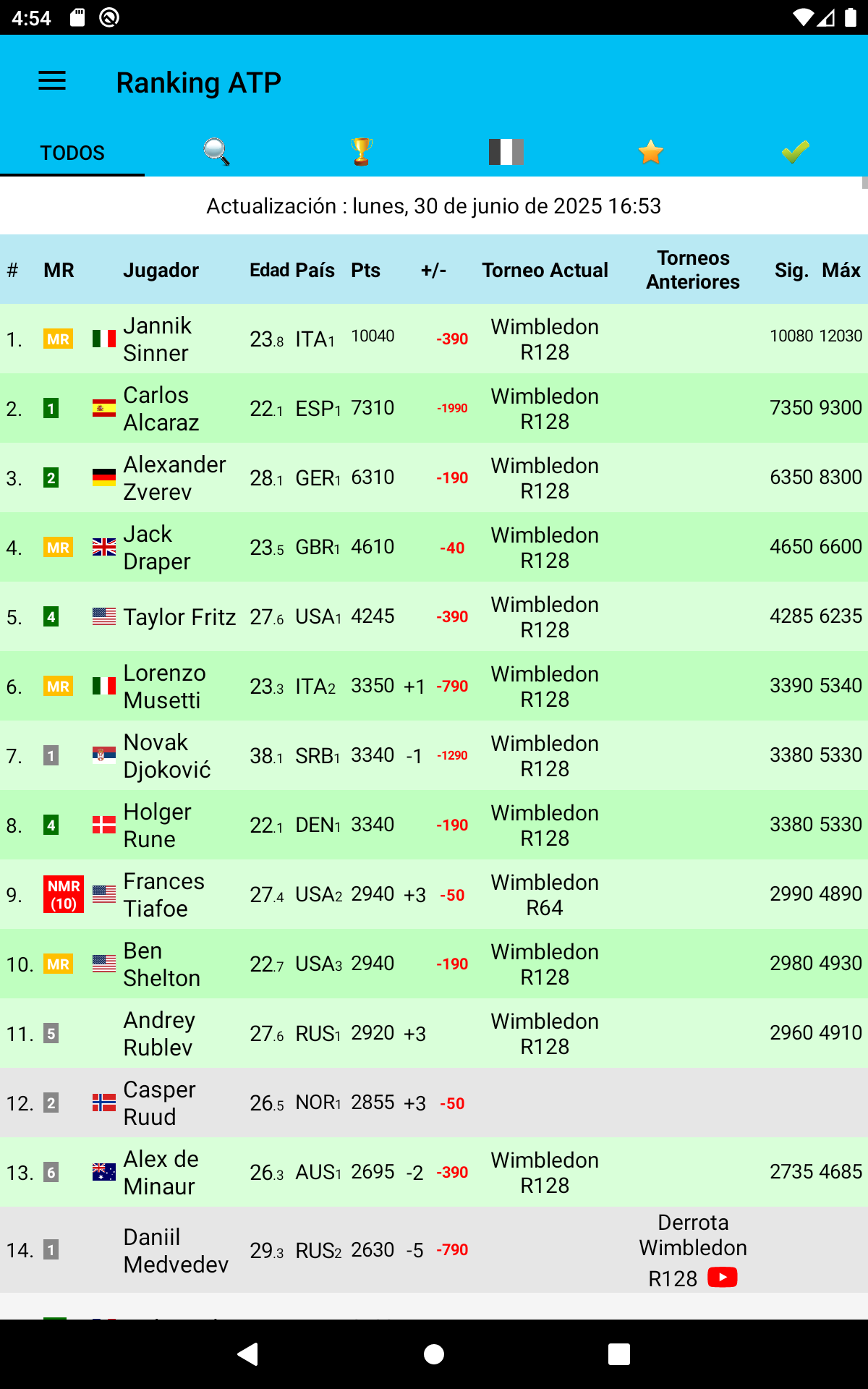
Live tennis rankings provide an instantaneous, round-by-round projection of professional tennis players' standings on the ATP and WTA tours, capturing the dynamic movement of points before official weekly updates occur. For tennis fans...
Live tennis rankings provide an instantaneous, round-by-round projection of professional tennis players' standings on the ATP and WTA tours, capturing the dynamic movement of points before official weekly updates occur.
Contents
For tennis fans, analysts, and bettors alike, keeping track of how matches impact a player’s position requires an understanding of how points are defended, earned, and dropped on a rolling 52-week basis. Unlike official rankings published at the start of each week, live rankings fluctuate the moment a match concludes, reflecting points won or lost in real time. This mechanism forms the backbone of how players qualify for elite tournaments, secure coveted seedings in Grand Slams, and battle for year-end championships. Navigating this system demands a clear look at how points accumulate across different tournament tiers, the mechanics of the 52-week rolling cycle, and the distinction between standard rankings and race standings.
The Mechanics of Professional Tennis Rankings
The Association of Tennis Professionals (ATP) and the Women's Tennis Association (WTA) maintain official computerized ranking systems designed to measure a player's merit over a sustained period. Every tournament a player enters offers a specific allotment of ranking points corresponding directly to the prestige and category of the event.
When a player steps onto the court, they are not merely fighting for a match victory or prize money; they are defending points earned at the exact same tournament during the previous calendar year. If a player reaches the semifinals of a Masters 1000 event one year, they receive a specific number of points. When that same tournament rolls around the next year, those points temporarily drop off the player's total on the eve of the tournament, leaving them with a clean slate to defend or improve upon their previous performance.
This rolling system ensures that rankings remain a fair reflection of current form combined with long-term consistency. However, it also means that players can experience sharp drops in the rankings simply due to inactivity caused by injuries or scheduling choices. Understanding this baseline is essential for interpreting why a player might plummet in the standings despite winning matches, or conversely, why a first-round exit can sometimes result in a net gain if the player is defending a worse result from the prior year.
Official Rankings Versus the Live Race Standings
A common point of confusion among followers of the sport is the difference between standard live rankings and the year-to-date race standings, such as the ATP Race to Turin or the WTA Race to the WTA Finals.
The standard live ranking calculates a player's total points accumulated over the immediate past 52 weeks. It is the definitive list used for determining overall world standing, entry lists for standard tournaments, and general seeding guidelines.
The race standings, on the other hand, start fresh on the first Monday of each calendar year. They count only the points earned since January 1st of the current season. This metric serves a singular purpose: determining which eight singles players and doubles teams qualify for the prestigious season-ending championships. While a player might hold a high standard ranking due to points defended from the previous autumn, their race ranking exposes their immediate competitive output for the current year.
| Feature | Standard Live Rankings | Live Race Standings |
|---|---|---|
| Timeframe | Rolling 52-week period | Current calendar year only (from January 1st) |
| Primary Purpose | Tournament entry, general seedings, and overall status | Qualification for season-end championships (ATP/WTA Finals) |
| Point Behavior | Points from the prior year drop off as new rounds progress | Points accumulate continuously without historical drop-offs until year-end |
| Main Audience | Broad fans, statisticians, and tournament directors | Players and analysts tracking year-end qualification |
Tournament Tiers and Point Distribution
The magnitude of ranking point shifts depends heavily on the category of the tournament being contested. Both the ATP and WTA structure their tours into distinct tiers, each carrying an escalating scale of points and prize money.
Grand Slam tournaments—the Australian Open, Roland Garros, Wimbledon, and the US Open—offer the maximum reward, granting 2,000 points to the singles champion. Below the majors sit the ATP Masters 1000 events and WTA 1000 tournaments, where champions earn 1,000 points. The hierarchy continues down through ATP 500 and WTA 500 events, followed by ATP 250 and WTA 250 tournaments, as well as the lower-tier ITF Challenger and ITF World Tennis Tours.
Because the point differential between early rounds and late rounds is substantial, a deep run at a high-tier tournament can instantly transform a player's live ranking. For example, advancing from the third round to the quarterfinals of a Grand Slam can inject hundreds of new points into a player's ledger, bypassing players who rely on accumulating points through consistent lower-tier appearances.
The Impact of Mandatory Tournaments and Penalties
Professional tennis features a complex structure of mandatory events, particularly at the elite levels of the ATP and WTA tours. Top-tier players are generally required to enter all four Grand Slam tournaments and a designated slate of Masters 1000 or WTA 1000 events, provided they are healthy and ranked high enough for direct acceptance.
Failure to enter or play a mandatory event without a valid medical exemption can result in a zero-point penalty being factored into the player's ranking breakdown. These penalties remain on a player's 52-week record, effectively blocking them from utilizing their best lower-tier results to pad their score. Live ranking platforms account for these commitments, showing how a player's projected total shifts if they incur a zero-point penalty or if they successfully fulfill their commitment obligations.
Furthermore, players subject to ranking commitment rules must often navigate the "best-of" validation system. For ATP players, the ranking is calculated using their results from the four Grand Slams, eight mandatory Masters 1000 tournaments, and their best seven results from lower-tier events (ATP 500, ATP 250, and Challengers). Understanding these complex inclusion and exclusion rules helps clarify why a player's live ranking might differ slightly from a simple sum of all points earned over the past year.
How to Read and Verify Live Rankings Data
Tracking live rankings requires attention to detail, as real-time updates depend entirely on accurate match data feeds from ongoing events around the globe. When viewing a live rankings table during a tournament day, several indicators determine a player's movement:
- Live Points: The exact numerical sum of a player's points accounting for matches completed up to the current minute.
- Projected Rank: The position the player currently holds based on live points relative to their peers.
- Points Defended: The number of points the player is scheduled to lose or has already lost from the corresponding week of the previous year.
- Points Gained: The new points secured through ongoing tournament progression that have not yet been officially added to the official Monday rankings release.
Because multiple tournaments occur simultaneously across different time zones, live ranking calculations are in a constant state of flux. A player resting in Europe might see their live ranking drop several spots simply because a rival playing in an overseas event has advanced to a semifinal and secured enough points to surpass them.
Frequently Asked Questions
What is the difference between official rankings and live rankings?
Official rankings are frozen and published once a week, usually on Mondays, after all tournament play for the week concludes. Live rankings are dynamic, updating instantly as matches finish to project where players stand based on points earned and defended in real time.
Do live rankings affect tournament seedings?
Live rankings are frequently monitored by tournament officials, but official seedings are locked in using the official rankings released on the specific cutoff date designated by the tournament committee, not the real-time live standings.
Why does a player's live ranking drop even when they win a match?
This occurs when a player is defending a massive haul of points from a deep run at the same tournament the previous year. If they win an early-round match but fail to reach the deeper round they achieved last year, their net points total decreases, causing their live ranking to drop.
How are ranking points calculated for players who lose in the first round?
Players who lose their opening match at a tournament typically receive zero ranking points for that event, though they may still receive prize money. If they defended points from the previous year at that same tournament, those points are simply deducted from their total.
Are live rankings official?
No. Live rankings are unofficial statistical projections compiled by tennis data analysts and specialized websites. They serve as an accurate preview of what the official rankings will look like when the governing bodies process them on the following Monday.
To stay fully informed on player movements and tournament trajectories, consult dedicated real-time tennis tracking portals during major tournament weeks to observe how individual match results reshape the global standings.
Image Gallery