How to Start a Not for Profit Organization in the US
Starting a not-for-profit organization in the United States involves incorporating at the state level, obtaining a federal Employer Identification Number (EIN), and applying for tax-exempt status—most commonly under Section 501(c)(3) o...
Starting a not-for-profit organization in the United States involves incorporating at the state level, obtaining a federal Employer Identification Number (EIN), and applying for tax-exempt status—most commonly under Section 501(c)(3) of the Internal Revenue Code. This multi-stage legal process requires formalizing your mission, appointing a board, and establishing rigorous governance policies.
Contents
Establishing a nonprofit is a significant legal and administrative undertaking that transforms a charitable vision into a structured corporate entity. Unlike a for-profit business, a not-for-profit (NPO) is dedicated to a specific social cause or public benefit, where any surplus revenue is reinvested into the mission rather than distributed to owners or shareholders. As of 2026, the regulatory environment for NPOs continues to emphasize transparency, digital filing, and strict adherence to the "private inurement" prohibition, which prevents organization insiders from unfairly benefiting from the nonprofit’s assets.
Phase 1: Foundational Planning and Mission Development
Before filing any paperwork, the organizers must define the fundamental purpose of the entity. The IRS requires that a 501(c)(3) organization be organized and operated exclusively for exempt purposes, such as charitable, religious, educational, scientific, or literary goals.
Defining the Mission Statement
A mission statement is more than a marketing slogan; it is a legal boundary. When you apply for tax-exempt status, the IRS evaluates whether your activities align with this statement. A well-drafted mission statement should be concise but broad enough to allow for future growth. For example, rather than saying "providing school supplies to Lincoln Elementary," a stronger mission might be "enhancing educational opportunities for under-served youth in the Greater Chicago area."
Conducting a Needs Assessment
The nonprofit sector is competitive, particularly regarding grant funding and individual donations. A needs assessment helps determine if your proposed organization duplicates existing services. If another NPO is already fulfilling the mission effectively, the IRS or state regulators may scrutinize your application more closely, and donors may be less inclined to provide support. In 2026, many founders are opting for "fiscal sponsorship" as an alternative to starting a new entity, allowing them to test their programs under the umbrella of an existing 501(c)(3).
Phase 2: Building the Board of Directors
The board of directors is the governing body of a nonprofit. They hold the legal and fiduciary responsibility for the organization's actions.
Fiduciary Duties of the Board
Board members are held to three primary legal standards:
- Duty of Care: Directors must act with the competence and drive that a reasonably prudent person would exercise in a similar position. This includes attending meetings and staying informed about the NPO’s finances.
- Duty of Loyalty: Directors must act in the best interest of the organization, putting its needs above their own personal or professional interests. This is why a robust Conflict of Interest policy is mandatory.
- Duty of Obedience: Directors must ensure the organization remains faithful to its stated mission and complies with all state and federal laws.
Board Composition Requirements
While state laws vary, most require at least one director. However, to satisfy IRS requirements for public support and oversight, a minimum of three unrelated individuals is standard. As of 2026, transparency groups recommend a diverse board with expertise in law, finance, and the specific field the nonprofit serves.
Phase 3: State-Level Incorporation and Legal Structure
To become a legal entity, you must incorporate in a specific state. While you can incorporate in any state, most founders choose the state where the organization will primarily operate to avoid the costs of registering as a "foreign" entity in their home state.
Drafting the Articles of Incorporation
This is the formal document filed with the Secretary of State. To qualify for 501(c)(3) status later, the Articles must contain specific IRS-mandated language:
- Purpose Clause: Limits the organization’s goals to those described in Section 501(c)(3).
- Dissolution Clause: States that if the organization closes, its assets will be distributed to another tax-exempt organization or a government entity for public purposes.
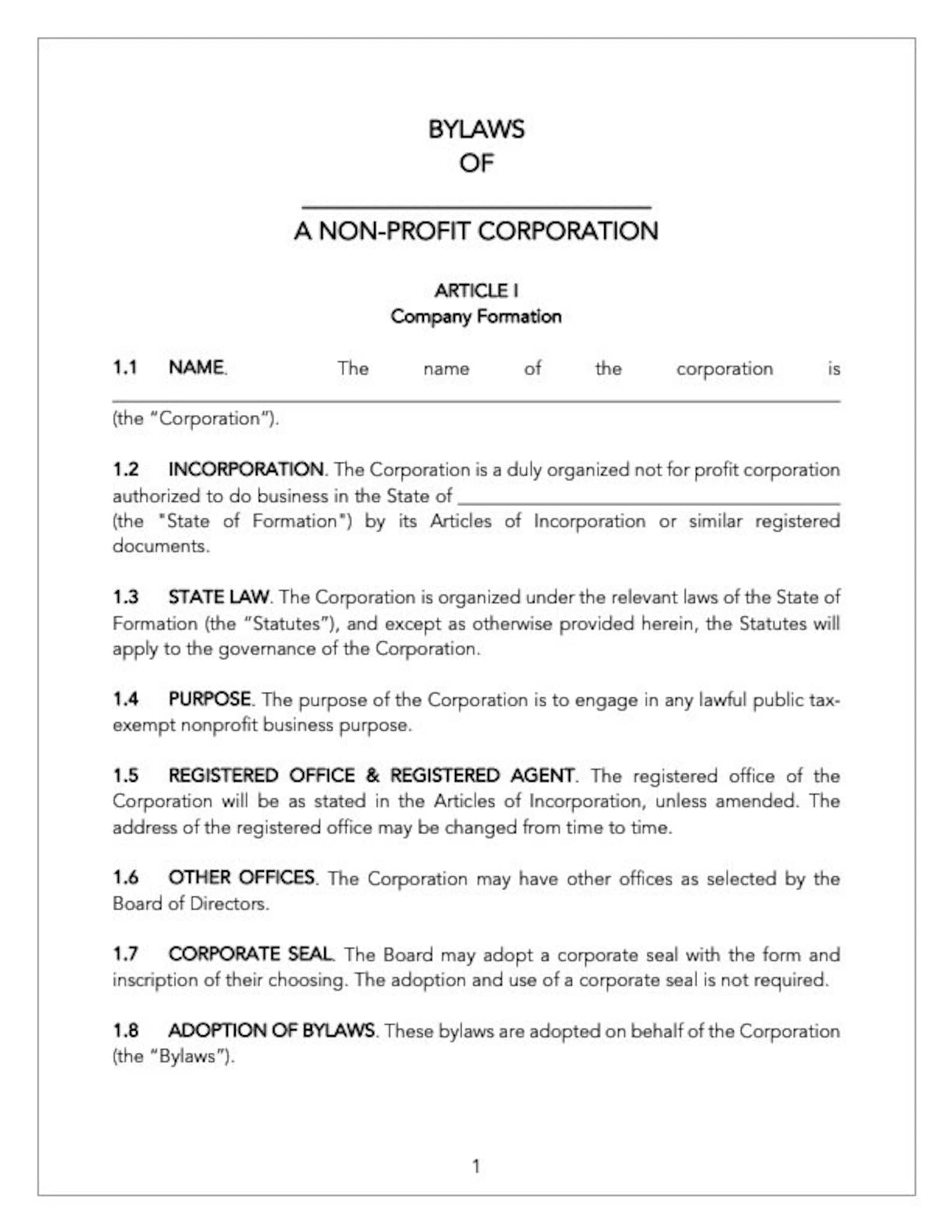
Developing Corporate Bylaws
Bylaws are the internal "operating manual" for the nonprofit. They dictate how the board is elected, how meetings are conducted, and how officers (President, Secretary, Treasurer) are appointed. Bylaws are not typically filed with the state but are required for the IRS tax-exemption application.
Phase 4: Federal Requirements and Tax-Exempt Status
Once incorporated at the state level, the organization must interface with the federal government to secure its tax-exempt status and its identity as a taxpayer.
Obtaining an Employer Identification Number (EIN)
Every nonprofit needs an EIN, regardless of whether it plans to hire employees. This nine-digit number acts like a Social Security number for the business and is required to open a bank account and file IRS forms. You can apply for an EIN online through the IRS website.
Applying for 501(c)(3) Status
The most critical step is filing Form 1023 or Form 1023-EZ with the IRS. This application asks for a detailed narrative of your activities, financial projections, and information about your board members.
| Feature | Form 1023-EZ (Streamlined) | Form 1023 (Standard) |
|---|---|---|
| Eligibility | Annual gross receipts < $50,000; Assets < $250,000 | All organizations, including those exceeding EZ limits |
| User Fee (2026) | Approximately $275 | Approximately $600 |
| Submission Method | Electronic via Pay.gov | Electronic via Pay.gov |
| Review Time | Usually 2–4 weeks | Usually 3–6 months (or longer) |
| Detail Required | Attestations and brief descriptions | Comprehensive history and multi-year financial data |
Phase 5: Post-Incorporation Compliance and Maintenance
Securing tax-exempt status is only the beginning. Ongoing compliance is necessary to maintain that status and avoid "automatic revocation."
Charitable Solicitation Registration
Most states require nonprofits to register with the Attorney General or Secretary of State before they can ask the public for donations. This is a separate step from incorporation. If you fundraise online and receive donations from multiple states, you may technically be required to register in each of those states, though laws vary regarding "de minimis" thresholds.
Annual IRS Filings (Form 990)
Nonprofits must file an annual information return known as Form 990. The specific version (990-N, 990-EZ, or 990) depends on the organization's annual revenue. These forms are public documents, and donors often review them to check the organization’s financial health and "program service ratio" (the percentage of money spent on the mission versus administration).
State Sales and Property Tax Exemptions
Federal 501(c)(3) status does not automatically exempt an organization from state sales tax or local property tax. You must apply for these exemptions separately with your state’s Department of Revenue or local tax assessor’s office.
Common Mistakes to Avoid
- Private Inurement: Paying a founder or board member an excessive salary or giving them favorable contracts. This can lead to heavy fines (intermediate sanctions) or loss of tax-exempt status.
- Substantial Lobbying: While nonprofits can engage in some advocacy, they cannot dedicate a "substantial" part of their activities to lobbying or participate in any political campaign on behalf of a candidate.
- Unrelated Business Income (UBI): If a nonprofit earns significant income from activities unrelated to its mission (e.g., a charity selling commercial software), it may have to pay "Unrelated Business Income Tax" (UBIT).
- Failure to Record Minutes: Board meetings must be documented. If the IRS audits an NPO and there are no meeting minutes, the organization may struggle to prove that its decisions were made with due diligence.
Frequently Asked Questions
How long does it take to start a nonprofit?
The entire process usually takes between four and ten months. State incorporation and EIN acquisition can happen in a few weeks, but the IRS review of Form 1023 often takes several months. If you are eligible for the 1023-EZ, the federal timeline can be shortened significantly.
Can I be the CEO and a board member of my own nonprofit?
Yes, but it is a potential conflict of interest. While many founders serve as the Executive Director (CEO) and sit on the board, they should usually be a "non-voting" member or recuse themselves from votes regarding their own compensation. Good governance suggests having a majority of the board be independent, non-paid individuals.
Do I need a lawyer to start a nonprofit?
While not strictly required, it is highly recommended, especially for drafting bylaws and the Articles of Incorporation. Nonprofit law is specialized; a mistake in the dissolution clause or purpose statement can lead to the IRS rejecting your application, causing costly delays.
What is the difference between a nonprofit and a not-for-profit?
In common usage, they are often interchangeable. However, "nonprofit" usually refers to a business entity that serves the public good (an NPO), while "not-for-profit" can sometimes refer to social clubs or trade associations (like a 501(c)(7) hobby club) that do not necessarily have a charitable mission but also do not operate for profit.
Can a nonprofit make a profit?
Yes. A nonprofit can have a surplus of revenue at the end of the year. The distinction is that the profit cannot be distributed to individuals or shareholders. It must be retained by the organization to further its mission or cover future operating expenses.
Final Recommendation
If you are ready to proceed, your first action should be to consult your state’s Secretary of State website for specific incorporation forms and fees. Simultaneous to this, recruit at least two other dedicated individuals to serve as your initial board. Because the legal requirements for tax-exempt status are stringent, consider utilizing a legal service or a specialized nonprofit consultant to review your Form 1023 before submission to ensure all IRS "safe harbor" language is included.
Image Gallery