Why Life Insurance Is Usually Cheaper and Better Than Mortgage Insurance in 2026
Life insurance is generally cheaper than mortgage insurance because life insurance premiums remain level while providing a constant death benefit. In contrast, mortgage insurance premiums typically stay the same even as the coverage am...
Life insurance is generally cheaper than mortgage insurance because life insurance premiums remain level while providing a constant death benefit. In contrast, mortgage insurance premiums typically stay the same even as the coverage amount decreases alongside your loan balance. This creates a higher cost-per-dollar of protection over time for mortgage insurance.
Contents
When purchasing a home in 2026, one of the most common financial crossroads is deciding how to protect that debt. Lenders often present "mortgage life insurance" (sometimes called creditor insurance) as a convenient add-on during the closing process. However, independent term life insurance almost always provides superior value, more flexibility, and lower long-term costs. Understanding the structural differences between these two products is essential for protecting your family’s solvency without overpaying for coverage.
The Structural Cost Disadvantage of Mortgage Insurance
The primary reason life insurance is more cost-effective lies in the "declining benefit" model used by most mortgage insurance policies. When you sign up for mortgage insurance through a bank or lender, the policy is designed to pay off the remaining balance of your mortgage if you pass away. As you make monthly mortgage payments, your principal balance decreases, meaning the insurance company’s potential liability shrinks every month.
However, the premiums for mortgage insurance are usually calculated based on the original loan amount and do not decrease as the balance drops. By the middle of your mortgage term, you may be paying the same premium for $200,000 of coverage that you initially paid for $500,000 of coverage. This effectively doubles your cost per thousand dollars of protection.
In 2026, term life insurance remains the standard for cost-efficiency. With a level term policy, if you buy $500,000 of coverage, that benefit remains $500,000 for the entire duration of the term (e.g., 20 or 30 years). If you pass away in year 19 of a 20-year term, your beneficiaries still receive the full $500,000, even if the mortgage is nearly paid off. The excess funds can be used for property taxes, home maintenance, or education—needs that mortgage insurance simply ignores.
Beneficiary Control and Financial Flexibility
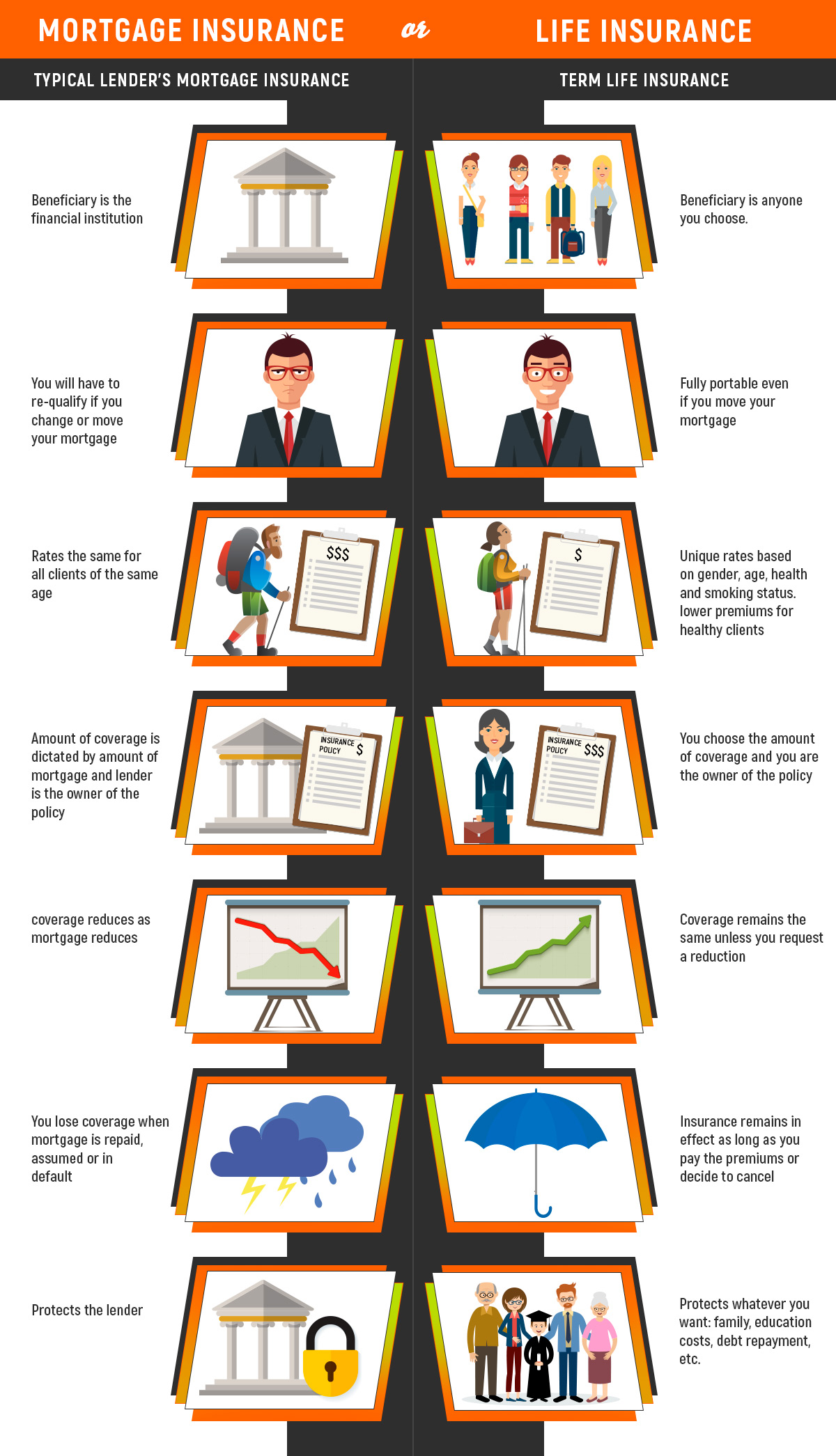
A critical distinction between these two products is who receives the payout. In a mortgage insurance policy, the lender is the primary beneficiary. If the insured person passes away, the insurance company sends the check directly to the bank to clear the debt. While this removes the mortgage, it leaves the surviving family members with no liquid cash to handle other immediate expenses.
Individual life insurance allows the policyholder to name their own beneficiaries, such as a spouse or children. This provides the family with total control over the funds. They can choose to pay off the mortgage, or they might decide that keeping the low-interest mortgage from a previous year is more advantageous, using the insurance proceeds instead to invest or cover daily living costs.
In the economic climate of 2026, where interest rate fluctuations and inflation impact household liquidity, having access to a lump sum of cash is significantly more valuable than having a specific debt retired automatically. Life insurance provides a "safety net" rather than just a "debt eraser."
Portability and Policy Ownership
Mortgage insurance is generally tied to the specific loan and the specific lender. If you decide to refinance your home to take advantage of better rates or if you move to a new property, your mortgage insurance policy usually terminates. To stay protected, you must apply for a new policy at your current age, which will inevitably result in higher premiums because you are older.
Life insurance is portable. The policy is owned by you, not the lender. It follows you regardless of whether you refinance, pay off your mortgage early, or move to a different province or state. As long as you continue to pay the premiums, the coverage remains in force. This ownership is vital for long-term financial planning. If you develop a health condition later in life, you may find it difficult or expensive to get new coverage; having a portable life insurance policy secured while you are healthy protects your insurability for the long haul.
Underwriting: Post-Claim vs. At-Front Verification
One of the most technical and often misunderstood aspects of mortgage insurance is the underwriting process. Many lender-provided mortgage insurance products use "post-claim underwriting." This means the insurance company asks very few health questions at the time of application and does not perform a deep dive into your medical records until a claim is actually made.
The danger of post-claim underwriting is that if a claim is filed after your death, the insurer may then scrutinize your medical history from the time you applied. If they find an unintentional error or a pre-existing condition that wasn't properly disclosed, they can deny the claim entirely, leaving your family with the debt they thought was covered.
Professional life insurance policies, particularly those sold by reputable brokers in 2026, utilize "up-front underwriting." The medical exam and history check happen before the policy is issued. While this makes the initial application process slightly more involved, it provides a much higher level of certainty. Once the policy is issued and the contestability period passes, the insurer is legally bound to pay the claim, provided premiums were paid.
Comparative Analysis: Term Life vs. Mortgage Insurance
The following table highlights the key differences that contribute to the cost and value gap between these two products.
| Feature | Term Life Insurance | Mortgage Insurance (Lender-Owned) |
|---|---|---|
| Death Benefit | Level (Remains the same) | Declining (Follows mortgage balance) |
| Premiums | Fixed for the term | Fixed (Despite declining benefit) |
| Beneficiary | Your chosen loved ones | The Bank/Lender |
| Portability | Stays with you if you move/refinance | Ends if you move or refinance |
| Underwriting | Done at the time of application | Often done at the time of claim |
| Flexibility | Funds can be used for any purpose | Funds MUST pay off the mortgage |
| Ownership | You own the policy | The lender owns the group policy |
Understanding PMI vs. Mortgage Protection Insurance
It is important to disambiguate "Mortgage Protection Insurance" (the subject of this comparison) from "Private Mortgage Insurance" (PMI). In 2026, many homeowners are still required to pay PMI if their down payment was less than 20%.
- PMI: Protects the lender if you default on your payments. It provides zero benefit to your family if you die.
- Mortgage Protection Insurance: A life insurance product that pays the loan if you die.
- Life Insurance: A broader financial tool that covers your life for any reason, providing funds to your family.
Life insurance is usually cheaper than mortgage protection insurance because insurance companies can price the risk more accurately for an individual than they can for a "group" policy offered through a bank. Banks often charge a flat rate based on broad age bands, which means healthy individuals end up subsidizing the cost for higher-risk individuals in the group.
When Mortgage Insurance Might Be the Only Option
While life insurance is usually the superior choice, there are specific scenarios in 2026 where mortgage insurance through a lender might be utilized. Because mortgage insurance often involves limited medical questions and no physical exam, it can be a "fallback" for individuals who are otherwise uninsurable.
If a person has a severe chronic illness or a medical history that results in a denial from traditional life insurance providers, the simplified issue nature of some mortgage insurance plans might be the only way to get any coverage at all. However, even in these cases, it is advisable to consult with a high-risk life insurance specialist first, as "rated" life insurance policies (policies with a higher premium due to health) may still offer better value than a bank's mortgage product.
Frequently Asked Questions
Can I replace my mortgage insurance with life insurance at any time?
Yes. In most cases, you can apply for an individual life insurance policy at any time. Once the new policy is in force and you have confirmed the coverage, you can contact your mortgage lender to cancel the mortgage insurance portion of your monthly payment. It is vital to never cancel existing coverage until the new policy is officially active.
Is life insurance more expensive if I have a high-risk hobby or job?
It can be. Life insurance underwriting considers lifestyle factors like scuba diving, piloting private planes, or high-risk occupations. Mortgage insurance through a bank often ignores these factors in favor of a simplified "yes/no" health questionnaire. If you have a particularly dangerous lifestyle, you should compare the "rated" life insurance quote against the bank's flat rate to see which is more affordable.
What happens to my life insurance if I pay off my mortgage early?
If you pay off your mortgage early, your life insurance policy remains active and unchanged. Since the policy is not tied to the debt, you continue to have the full death benefit. This can then be used as a legacy for your heirs, to pay for final expenses, or to cover estate taxes. Mortgage insurance, conversely, would simply end once the balance reaches zero, providing no further value for the premiums paid.
Does mortgage insurance cover disability or critical illness?
Some lender policies offer "riders" for disability or critical illness, which will cover your mortgage payments if you cannot work. However, these are often more expensive and more restrictive than independent disability insurance or critical illness insurance policies. Standard life insurance does not automatically cover these unless you add specific riders to the policy.
Why do banks push mortgage insurance so aggressively?
Lenders often receive commissions or administrative fees for enrolling borrowers in their group insurance plans. Furthermore, mortgage insurance protects the bank’s interest by ensuring the loan is repaid immediately upon the borrower's death. While it is presented as a service to the borrower, its primary function is risk mitigation for the financial institution.
Practical Recommendations
For the majority of homeowners in 2026, the recommendation is clear: prioritize a personal term life insurance policy over a lender-offered mortgage insurance product.
To ensure you are getting the best rate, follow these steps:
- Calculate your total need: Don't just look at the mortgage. Consider your income replacement needs, child education costs, and existing debts.
- Match the term to the debt: If you have a 25-year mortgage, a 25-year or 30-year term life policy provides the most logical alignment.
- Use an independent broker: Brokers can shop across multiple insurance carriers to find the lowest premium for your specific health profile, whereas a bank can only offer its own single product.
- Review coverage periodically: As your life changes—new children, career moves, or significant health improvements (like quitting smoking)—your insurance needs and rates may change.
By choosing life insurance, you secure a fixed cost for a fixed benefit, ensuring that every dollar you spend on premiums provides the maximum possible protection for your family's future.
Image Gallery