Why Cloud Security Financial Services Matter for Banks
Cloud security financial services matter for banks because financial institutions operate within one of the most heavily regulated, high-stakes environments in the global economy, where migrating sensitive customer assets, transactiona...
Cloud security financial services matter for banks because financial institutions operate within one of the most heavily regulated, high-stakes environments in the global economy, where migrating sensitive customer assets, transactional histories, and proprietary algorithms to external infrastructure introduces unique threat vectors that require specialized compliance, encryption, and continuous monitoring controls.
Contents
As traditional financial institutions shift away from legacy on-premises mainframes toward multi-cloud and hybrid environments, the imperative to secure these digital assets intensifies. Financial data represents a high-value target for sophisticated cybercriminals, nation-state actors, and organized ransomware syndicates. This environment demands that banks implement robust cloud security frameworks to protect non-public personal information, prevent unauthorized access, and maintain uncompromised business continuity. Understanding why cloud security financial services matter requires examining the intersection of modern scalable infrastructure, rigorous regulatory mandates, and the sophisticated threat landscape facing the banking sector today.
The Evolution of Banking Infrastructure and Cloud Adoption
For decades, commercial and investment banks relied on localized, on-premises data centers to process transactions, manage accounts, and store customer records. While physically controlled, these legacy systems are increasingly expensive to maintain, difficult to scale dynamically, and limited in their ability to integrate modern machine learning analytics or real-time digital banking applications. The migration to cloud service providers (CSPs) offers banks unprecedented agility, elastic scalability, and cost efficiencies, allowing them to launch mobile-first financial products rapidly and process millions of transactions per second.
However, moving workloads from a controlled corporate basement to cloud infrastructure fundamentally alters the shared responsibility model. While cloud providers secure the underlying hardware, physical facilities, and global network infrastructure, the bank remains entirely responsible for securing its data, managing identity and access management (IAM) policies, configuring network firewalls, and ensuring application-level security. Cloud security financial services provide the specialized architecture, tooling, and governance needed to bridge this gap, ensuring that banks reap the technological benefits of cloud computing without exposing themselves to catastrophic data breaches.
Regulatory Compliance and Governance Mandates
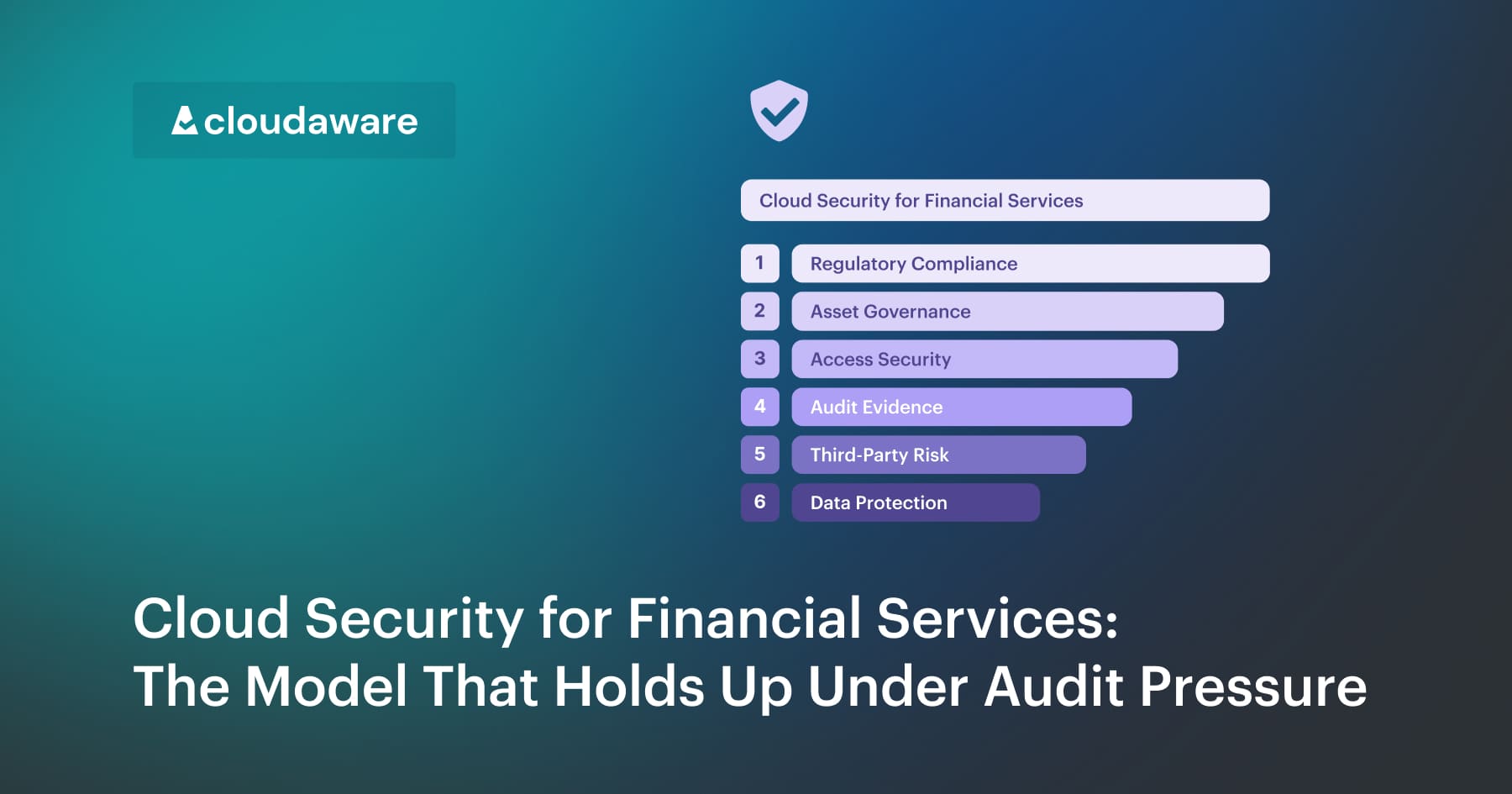
Financial institutions do not operate in a regulatory vacuum. They are subject to stringent oversight by domestic and international regulatory bodies that hold boards of directors and executive leadership personally accountable for data protection and operational resilience. Regulatory frameworks dictate strict guidelines for how customer data is processed, transmitted, and stored, regardless of whether it resides on a physical server or in a public cloud region.
Regulatory compliance in the cloud requires continuous auditing, automated compliance monitoring, and immutable logging. Failure to meet these standards can result in crippling financial penalties, public censure, and mandatory operational restrictions. Key regulatory frameworks governing cloud usage in financial services include:
- The Federal Financial Institutions Examination Council (FFIEC): Establishes rigorous standards for assessing information security, risk management, and outsourced cloud services in United States financial institutions.
- The Digital Operational Resilience Act (DORA): Mandates uniform requirements for the security of network and information systems of financial entities operating within the European Union, specifically addressing third-party ICT risk providers.
- The Payment Card Industry Data Security Standard (PCI DSS): Imposes strict technical controls for securing cardholder data, requiring encryption-at-rest and in-transit for all cloud-hosted payment processing environments.
- General Data Protection Regulation (GDPR) and Regional Privacy Laws: Dictate how consumer PII (Personally Identifiable Information) must be handled, including strict provisions for data residency and the right to be forgotten.
Core Pillars of Financial Cloud Security Architecture
Implementing effective cloud security for banks goes far beyond basic password protection and standard perimeter defenses. It requires a defense-in-depth strategy built upon several foundational pillars designed to mitigate internal and external risks.
| Security Pillar | Primary Function | Operational Implementation in Banking |
|---|---|---|
| Identity and Access Management (IAM) | Enforces strict authentication and authorization protocols. | Utilizing Multi-Factor Authentication (MFA), role-based access control (RBAC), and Privileged Access Management (PAM) to restrict access to core ledgers. |
| Data Encryption | Protects data confidentiality both at rest and in transit. | Implementing hardware-managed encryption keys (Bring Your Own Key models) and advanced cryptographic protocols for all customer databases. |
| Cloud Workload Protection (CWPS) | Secures virtual machines, containers, and serverless functions. | Scanning container images for vulnerabilities prior to deployment and monitoring runtime behavior for anomalous execution patterns. |
| Security Information and Event Management (SIEM) | Centralizes log collection and threat detection. | Aggregating telemetry across multi-cloud environments to feed AI-driven anomaly detection models and automated incident response playbooks. |
Identity and Access Management as the New Perimeter
In a modern cloud architecture, the traditional network perimeter has dissolved. Employees, automated microservices, and third-party vendors access banking resources from diverse geographic locations and devices. Consequently, Identity and Access Management (IAM) has become the primary line of defense. Banks must implement zero-trust security architectures, a framework predicated on the principle of "never trust, always verify."
Under a zero-trust model, no user or device is trusted by default, even if they are already inside the corporate network or authenticated to a cloud tenant. Continuous validation of user identity, device health, and behavioral context is required before granting access to sensitive financial databases. Privileged accounts—those belonging to system administrators and database managers—are subject to rigorous monitoring, session recording, and time-bound access windows to prevent lateral movement by malicious actors.
Data Protection, Cryptography, and Residency
Financial data is a prime target for exfiltration. To render stolen data unreadable and unusable, banks rely on advanced cryptographic controls. Encryption must be applied universally: data at rest within cloud storage buckets, databases, and backup archives must be encrypted using robust algorithms such as AES-256. Data in transit across public networks or between internal microservices must utilize Transport Layer Security (TLS 1.3 or higher).
Furthermore, financial institutions must contend with complex data residency requirements. Many jurisdictions legally mandate that the financial data of local citizens must remain stored within physical data centers located inside national borders. Cloud security financial services utilize geo-fencing and regional resource deployment policies to ensure that cross-border data transfers do not inadvertently violate sovereign banking laws.
Major Threat Vectors Targeting Cloud-Based Banking
Cloud environments present unique attack surfaces that malicious actors actively exploit. Understanding these vulnerabilities is essential for designing resilient security controls.
Misconfigurations and Human Error
The single greatest cause of cloud security incidents in financial services is configuration error. Complex cloud environments offer thousands of configurable parameters. A single misconfigured cloud storage bucket, an overly permissive API permission, or an unpatched open port can expose millions of customer records to the public internet. Financial institutions mitigate this risk through Infrastructure as Code (IaC) scanning, automated configuration posture management tools, and continuous compliance checks that flag and automatically remediate deviations from established baseline security policies.
Supply Chain and Third-Party API Risks
Modern banking applications are rarely built entirely from scratch; they integrate numerous third-party software libraries, open-source dependencies, and external Application Programming Interfaces (APIs). Compromises within the software supply chain can allow attackers to inject malicious code into trusted banking applications. Securing cloud financial services requires exhaustive software bill of materials (SBOM) tracking, automated dependency scanning, and strict rate-limiting and authentication checks on all public-facing APIs to prevent injection attacks and unauthorized data harvesting.
Operational Benefits and Risk Mitigation
Investing in robust cloud security financial services is not merely an exercise in regulatory compliance; it provides tangible business and operational advantages. By establishing a secure, scalable cloud foundation, banks can accelerate digital transformation initiatives safely. Automated security tooling reduces the manual burden on internal IT and compliance teams, allowing security professionals to focus on proactive threat hunting rather than reactive firefighting.
Moreover, enhanced cloud security directly protects brand reputation and customer trust. In the banking sector, trust is a foundational currency. A high-profile data breach can result in immediate customer churn, severe drops in market valuation, and long-term reputational damage that far outweighs the initial cost of implementing comprehensive cloud security infrastructure.
Frequently Asked Questions
Why can banks not use standard commercial cloud security tools?
Standard commercial cloud security tools are often too generic to meet the strict auditing, residency, and real-time fraud detection requirements mandated by banking regulators. Financial institutions require specialized tooling that understands banking-specific data schemas, regulatory reporting standards like FFIEC or DORA, and ultra-low latency transaction monitoring.
What is the Shared Responsibility Model in cloud banking?
The Shared Responsibility Model outlines security obligations between the cloud service provider and the financial institution. The provider is responsible for securing the physical infrastructure, data centers, and global network hardware, while the bank remains responsible for securing its data, user access controls, application code, and customer configurations.
How does Zero Trust architecture apply to cloud security in banks?
Zero Trust architecture eliminates the concept of implicit trust based on network location. In a cloud-based bank, every access request—regardless of whether it originates from inside or outside the corporate network—must be authenticated, authorized, and encrypted based on continuous verification of user identity and device posture.
What happens if a bank fails to meet cloud compliance standards?
Failure to meet regulatory compliance standards in cloud environments can result in severe financial penalties, formal enforcement actions, mandated operational restructuring, public reputational damage, and, in extreme cases, the revocation of banking charters or licenses by regulatory authorities.
How do banks secure data while it is moving across cloud environments?
Banks secure data in transit by enforcing modern cryptographic protocols, such as TLS 1.3, tunneling traffic through secure virtual private clouds (VPCs), and utilizing dedicated, encrypted interconnect lines that bypass the public internet when moving data between on-premises facilities and cloud regions.
Conclusion and Next Actions
Cloud security financial services are indispensable for modern banks navigating digital transformation while safeguarding sensitive consumer and institutional assets. To maintain uncompromised operational resilience, executive leadership and security teams must audit existing multi-cloud architectures, enforce rigorous zero-trust identity policies, and deploy automated posture management tools to eliminate misconfigurations. Begin by conducting a comprehensive third-party risk assessment of all current cloud workloads and establishing continuous monitoring protocols aligned with relevant regulatory mandates.
Image Gallery