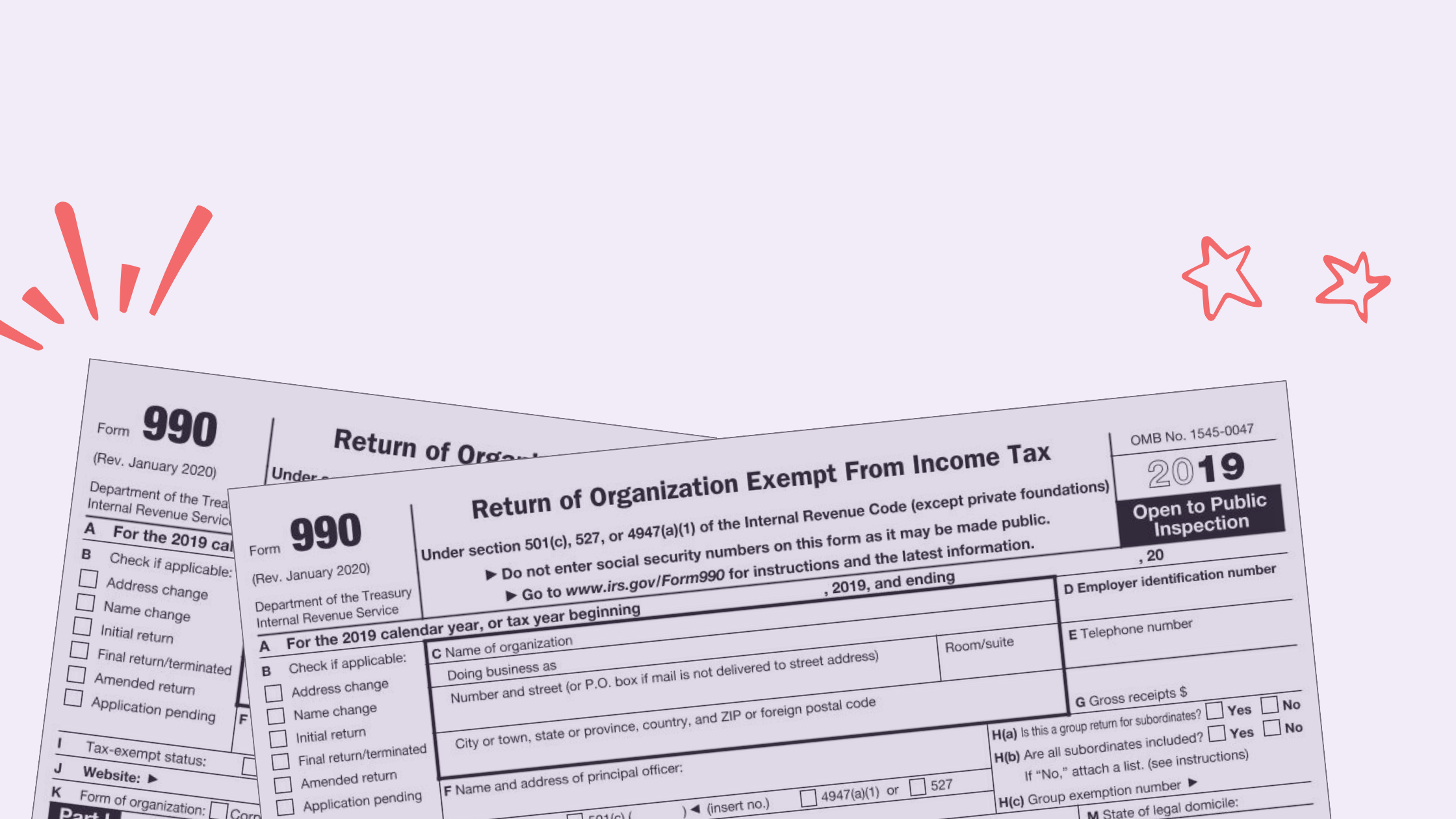
Understanding Charity 990 Forms: Filing Requirements, Thresholds, and Public Access Guide
IRS Form 990 is an annual informational return that tax-exempt non-profit organizations file with the U.S. Internal Revenue Service (IRS). It evaluates a charity's financial health, executive compensation, operational programs, and gov...
IRS Form 990 is an annual informational return that tax-exempt non-profit organizations file with the U.S. Internal Revenue Service (IRS). It evaluates a charity's financial health, executive compensation, operational programs, and governance policies. Form 990 filings also serve as public records, allowing donors, regulators, and analysts to verify tax-exempt compliance and organizational integrity.
Contents
Disclaimer: This guide provides general informational coverage of federal tax filings for tax-exempt organizations. Tax regulations and reporting standards can vary based on organizational structure and jurisdiction. Nonprofit board members and financial officers should consult a qualified Certified Public Accountant (CPA) or tax attorney for specific filing and legal advice.
What Is IRS Form 990 and Why Is It Required?
Under Section 501 of the Internal Revenue Code (IRC), non-profit organizations that receive tax-exempt status are relieved from federal income tax obligations on revenue related to their exempt mission. In exchange for this significant financial benefit, federal law requires these organizations to maintain transparency regarding their operations, revenue, expenses, and internal leadership structure.
Form 990 acts as the primary regulatory tool through which the IRS verifies that a non-profit continues to satisfy the legal criteria for its tax-exempt classification. Unlike individual or corporate tax returns, which remain strictly confidential, Form 990 filings are public documents under IRC Section 6104. This legal requirement permits donors, journalists, researchers, and grantmakers to evaluate how efficiently a charity allocates its contributions toward program services versus administrative overhead and fundraising expenses.
Form 990 also enforces corporate governance standards across the non-profit sector. By requiring organizations to disclose board composition, independent voting members, conflict-of-interest policies, and insider financial transactions, the IRS deters private inurement—the unlawful transfer of charitable assets for personal gain by insiders or key employees.
The Form 990 Series: Identifying Which Return Your Nonprofit Must File
The IRS divides Form 990 returns into four main variants based on an organization's gross receipts and total assets at the end of its fiscal year. Filing the wrong form variant can result in rejected submissions or compliance penalties.
- Is the organization a private foundation?
- Yes: Form 990-PF (All sizes)
- No: Check Gross Receipts & Assets
- Gross Receipts ≤ $50,000 AND Small Nonprofit Status: Form 990-N (e-Postcard)
- Gross Receipts < $200,000 AND Total Assets < $500,000: Form 990-EZ
- Gross Receipts ≥ $200,000 OR Total Assets ≥ $500,000: Full Form 990
1. Form 990-N (e-Postcard)
Designed for small non-profits that normally have annual gross receipts of $50,000 or less. The e-Postcard is an abbreviated electronic filing that asks for basic organization details, including legal name, employer identification number (EIN), official address, principal officer names, and confirmation that gross receipts remain below the threshold.
2. Form 990-EZ (Short Form)
Available to mid-sized organizations with annual gross receipts under $200,000 and total assets below $500,000 at the close of the tax year. It requires more detailed financial reporting than the 990-N but demands less detailed narrative disclosures than the standard Form 990.
3. Full Form 990 (Standard Return)
Mandatory for non-profits with gross receipts equal to or exceeding $200,000, or total assets equal to or exceeding $500,000. This 12-page core form, along with mandatory supporting schedules, requires complete reporting of financial transactions, compensation, program metrics, and governance practices.
4. Form 990-PF (Private Foundations)
All private foundations exempt under Section 501(c)(3)—regardless of financial size or gross income—must file Form 990-PF. This document calculates investment income taxes, monitors mandatory distribution minimums, and tracks grantmaking activities.
| Form Variant | Gross Receipts Threshold | Total Asset Threshold | Primary Target Group | Filing Method |
|---|---|---|---|---|
| Form 990-N (e-Postcard) | Normally $\le $50,000$ | N/A | Small charities and community groups | Online portal only |
| Form 990-EZ | $<$200,000$ | $<$500,000$ | Mid-sized non-profit entities | Mandatory Electronic Filing |
| Form 990 (Full) | $\ge $200,000$ | $\ge $500,000$ | Large public charities and institutions | Mandatory Electronic Filing |
| Form 990-PF | Any amount | Any amount | All 501(c)(3) Private Foundations | Mandatory Electronic Filing |
| Form 990-T | Gross UBI $\ge $1,000$ | N/A | Exempt orgs with Unrelated Business Income | Mandatory Electronic Filing |
Note: Religious institutions, such as churches, synagogues, and mosques, along with certain state-integrated entities, are generally exempt from filing annual Form 990 returns under IRC Section 6033.
Key Filing Deadlines, Extensions, and Revocation Risks
Non-profit organizations must track filing deadlines carefully to maintain good standing with the federal government and state regulatory authorities.
Standard Filing Deadline
The annual Form 990 filing deadline is the 15th day of the 5th month following the end of the organization’s accounting fiscal year.
- Calendar Year Organizations (Fiscal year ending December 31): Filing deadline is May 15.
- Fiscal Year Organizations (e.g., Fiscal year ending June 30): Filing deadline is November 15.
If the deadline falls on a weekend or legal holiday, the due date shifts to the next business day.
Requesting an Extension
Non-profits that need extra time to complete their returns can request an automatic six-month filing extension by submitting Form 8868 (Application for Automatic Extension of Time To File an Exempt Organization Return) before the original due date. For calendar-year organizations, submitting Form 8868 extends the submission deadline to November 15.
Late Filing Penalties and Automatic Revocation
Failing to submit Form 990 on time carries severe legal and financial penalties:
- Daily Financial Fines: Small non-profits (gross receipts under $1,208,000) face daily penalties of $20 per day for each day the return is late, up to a maximum of $12,000 or 5% of gross receipts. Larger organizations face penalties of $120 per day, up to $60,500 per return.
- Automatic Revocation of Exempt Status: Under IRC Section 6033(j), any tax-exempt organization that fails to file a required 990-series return for three consecutive years automatically loses its federal tax-exempt status on the due date of the third unfiled return.
- Year 1: Form 990 Missed: IRS Sends Warning / Daily Fines Accumulate
- Year 2: Form 990 Missed: Continued Penalties / Risk Classification
- Year 3: Form 990 Missed: AUTOMATIC REVOCATION of Tax-Exempt Status
If tax-exempt status is revoked, the non-profit becomes a taxable entity subject to corporate income taxes. It can no longer accept tax-deductible charitable contributions and must undergo a formal reinstatement process with the IRS.
Essential Sections and Schedules of the Standard Form 990
Understanding how a standard Form 990 is structured helps board officers complete filings accurately and allows donors to evaluate organizational integrity.
Critical Parts of the Core Form
- Part I (Summary): A snapshots of the organization's mission, governance structure, total revenue, expenses, net assets, and employee headcount for both the current and prior tax year.
- Part III (Statement of Program Service Accomplishments): Details the charity’s top three program achievements, including total expenses incurred and revenue generated directly by those activities.
- Part IV & V (Checklists of Required Schedules & Compliance): Asks series of operational questions to determine whether specific supplemental schedules must be attached, while verifying compliance with payroll taxes, foreign bank reporting, and donor acknowledgment rules.
- Part VI (Governance, Management, and Disclosure): Evaluates board independence, conflict-of-interest policies, whistleblower protections, document retention rules, and executive compensation oversight procedures.
- Part VII (Compensation of Officers, Directors, Key Employees): Discloses total compensation paid to current and former board members, executive directors, key management, and employees earning more than $100,000.
- Part VIII–X (Financial Statements): Provides detailed reporting of functional revenue (Part VIII), functional expenses divided into program services, management/general, and fundraising (Part IX), and the ending balance sheet (Part X).
Key Supplemental Schedules
Depending on the complexity of the non-profit's operations, the IRS requires attached schedules:
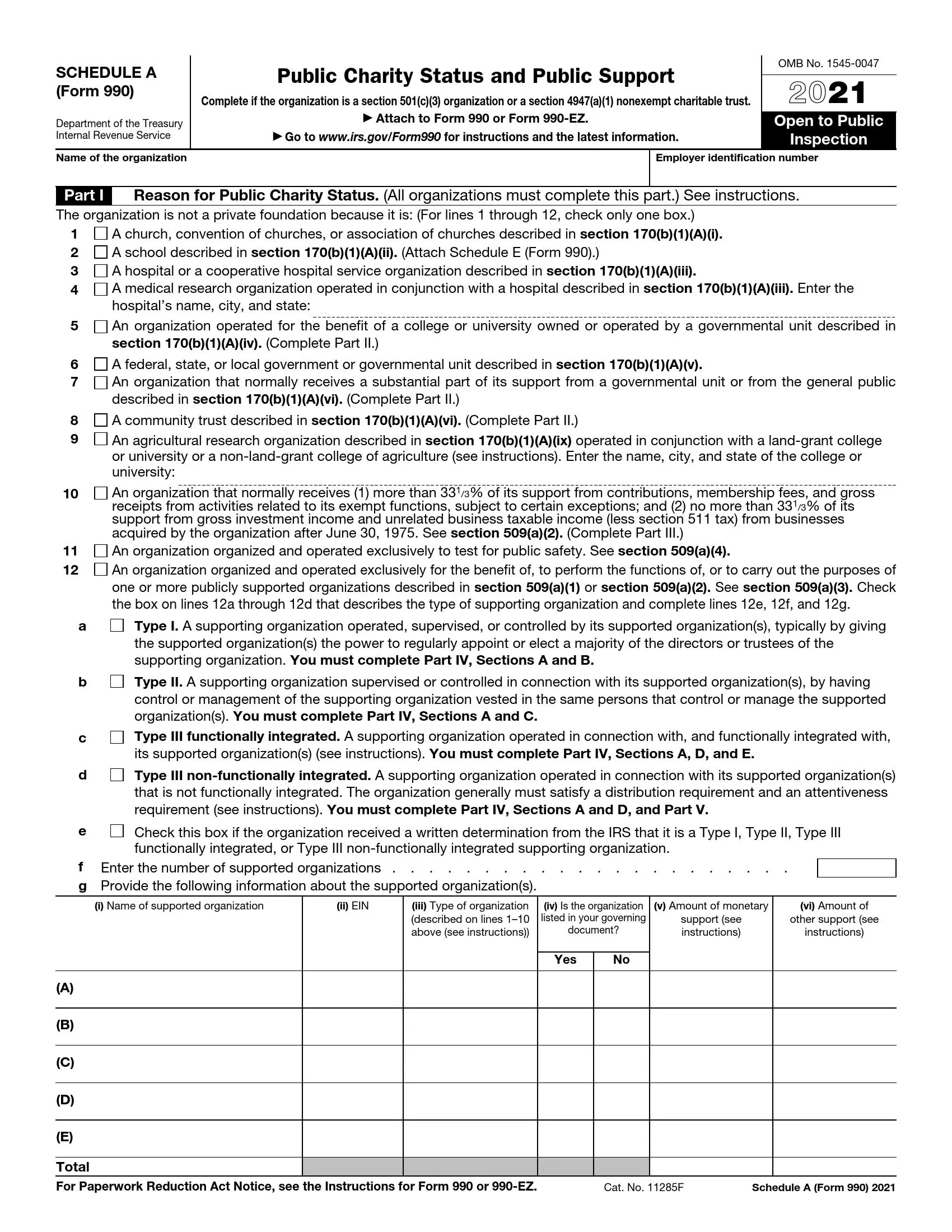
- Schedule A (Public Charity Status and Public Support): Verifies that a Section 501(c)(3) entity qualifies as a publicly supported charity rather than a private foundation, using mathematical public support tests over a rolling five-year window.
- Schedule B (Schedule of Contributors): Lists contributors who donated $5,000 or more (or 2% of total revenue) during the tax year. Note: While filed with the IRS, donor identities on Schedule B are protected from public inspection for public charities.
- Schedule C (Political Campaign and Lobbying Activities): Reports legislative lobbying expenses and political activity undertaken by 501(c)(3), 501(c)(4), or other exempt entities.
- Schedule J (Compensation Information): Expands on Part VII to disclose detailed executive compensation arrangements, such as first-class travel allowances, severance payments, bonus structures, and deferred compensation plans.
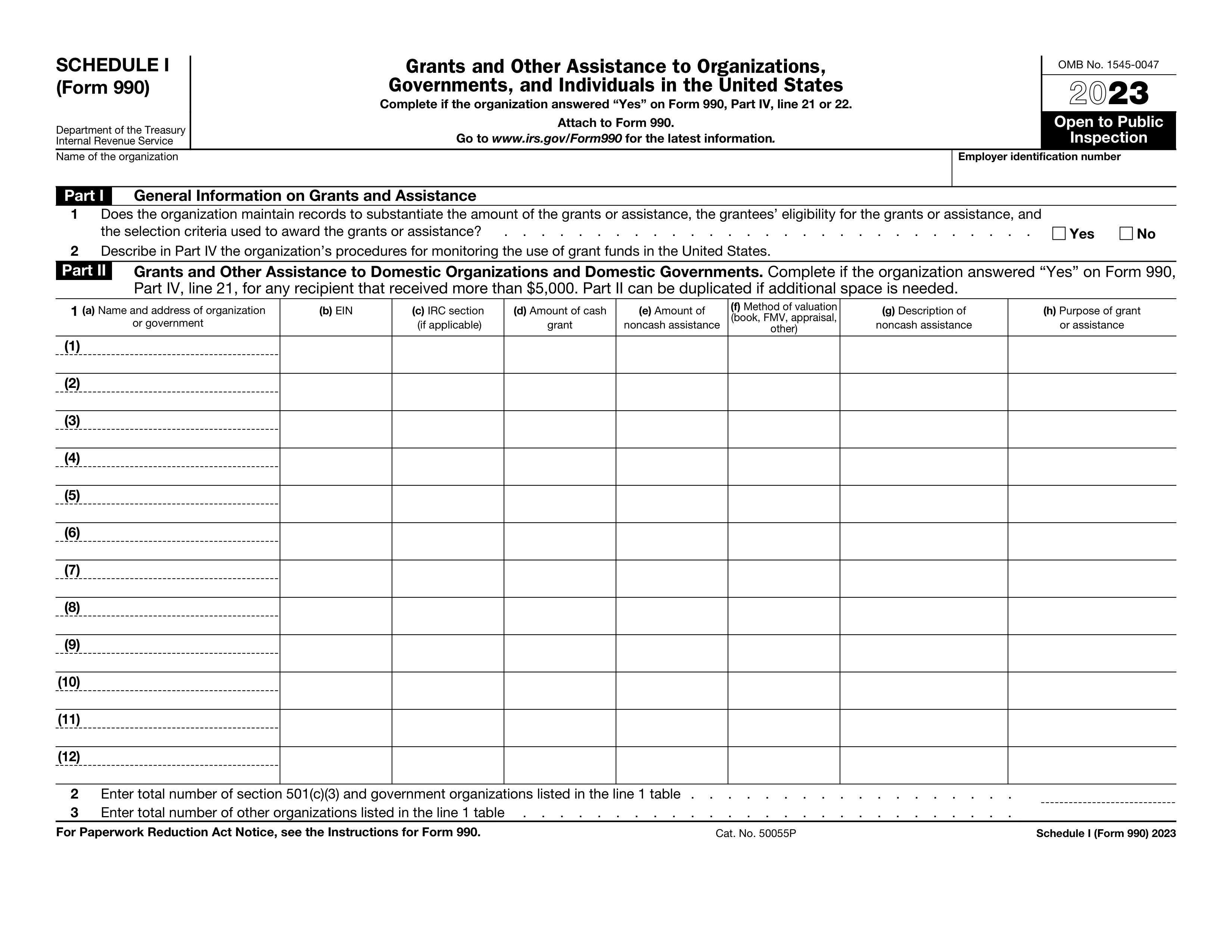
- Schedule L (Transactions with Interested Persons): Discloses financial transactions, loans, grants, or business contracts between the charity and board members, key executives, or immediate family members.
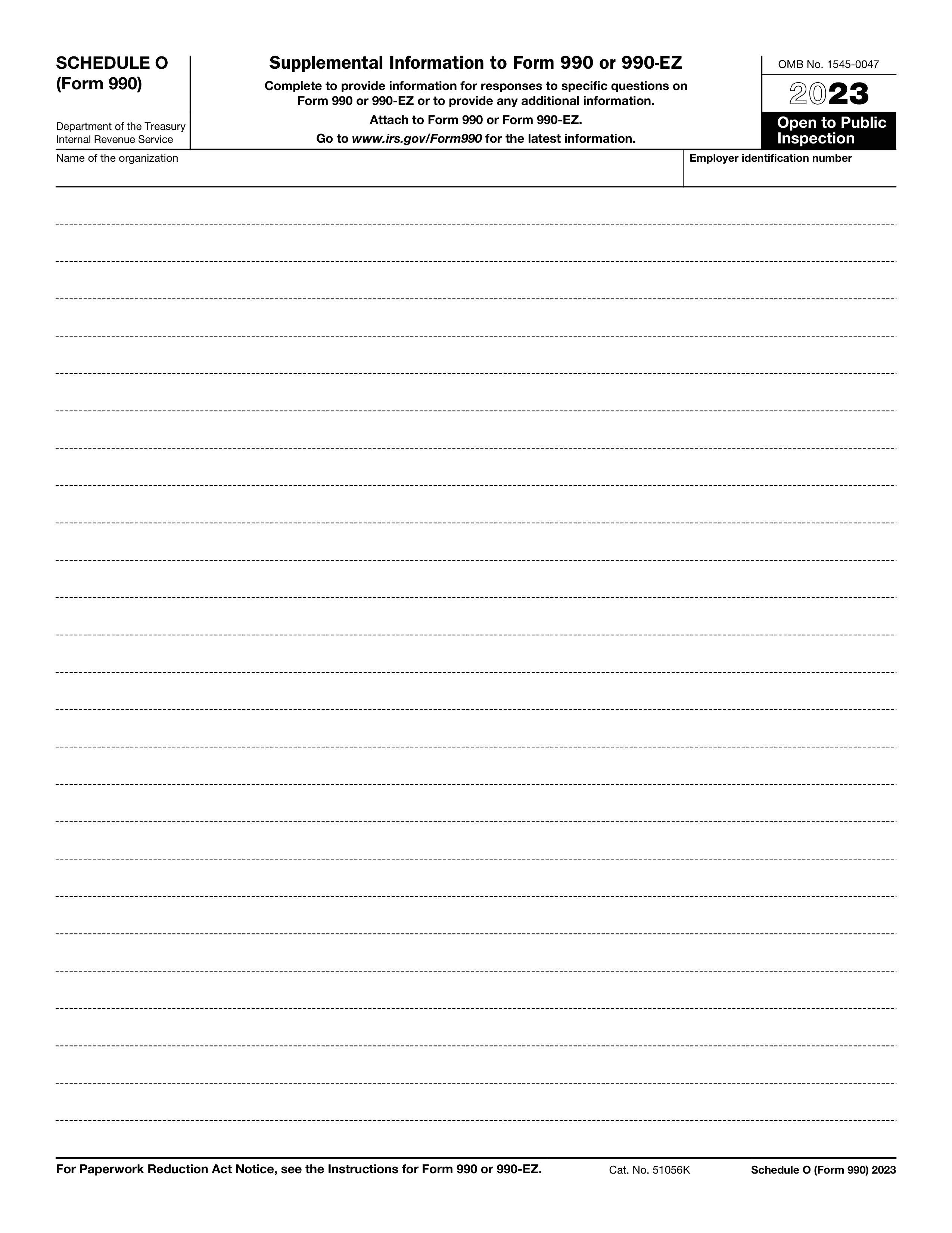
- Schedule O (Supplemental Information): Contains written narrative responses explaining board governance policies, program changes, and context for specific line items across the core return.
How Donors and Analysts Research Charity 990 Forms
Because Form 990 is a public document, evaluating these forms is a standard practice for grantmakers, institutional funders, watchdog groups, and prospective individual donors.
Public Form 990 Data Sources:
- IRS TEOS Database
- Official IRS records
- Revocation history check
- ProPublica Explorer
- Searchable raw PDFs
- Program cost distributions
- Candid / GuideStar
- Detailed financial ratings
- Transparency Seals
Official Public Access Channels
- IRS Tax Exempt Organization Search (TEOS): The primary government portal for verifying tax-exempt status, retrieving historical Form 990 filings, and viewing automatic revocation listings via the IRS TEOS Tool.
- ProPublica Nonprofit Explorer: Provides searchable databases of digital raw tax data and downloadable PDF copies of Form 990 filings submitted to the IRS, accessible at ProPublica Nonprofit Explorer.
- Candid (GuideStar): Aggregates public Form 990 filings alongside voluntary information uploaded directly by non-profit administrators, displaying operational efficiency metrics and transparency seals.
Key Financial Ratios Evaluated on Form 990
Analysts examine specific line items in Parts VIII and IX to assess financial health:
$$\text{Program Expense Ratio} = \frac{\text{Total Program Service Expenses (Part IX, Line 25, Col B)}}{\text{Total Expenses (Part IX, Line 25, Col A)}}$$
- Program Expense Ratio: Measures how much of every donor dollar goes directly to mission activities rather than administration. Watchdog agencies generally look for a ratio of 65% to 75% or higher.
- Fundraising Efficiency: Compares total fundraising expenses (Part IX, Column D) against total contributions received (Part VIII, Line 1h) to determine the cost required to generate charitable contributions.
- Working Capital & Reserves: Evaluates net assets (Part X, Line 33) against total monthly operational budgets to determine whether the organization holds sufficient cash reserves to survive temporary funding declines.
Common Form 990 Filing Mistakes and Compliance Best Practices
Filing an accurate Form 990 requires coordination between an organization's accounting staff, executive leadership, and board of directors.
Common Reporting Errors
- Mismatching Revenue and Expense Classifications: Confusing functional expense allocations between administrative operations and direct program services on Part IX, which distorts public efficiency ratings.
- Omitting Mandatory Schedules: Failing to attach Schedule A or Schedule O, resulting in the IRS processing the filing as incomplete.
- Improper Compensation Reporting: Reporting compensation on a cash basis rather than the calendar-year W-2/1099-MISC amounts required in Part VII, or omitting taxable fringe benefits provided to executives.
- Inaccurate Governance Disclosures: Claiming an active conflict-of-interest policy or annual review process on Part VI without having formally documented policies and board meeting minutes to back up those claims.
Operational Best Practices for Nonprofits
- Mandatory Electronic Filing: Under federal law, non-profit entities are required to submit 990-series returns electronically through an approved IRS Modernized e-File (MeF) provider, as outlined in the IRS Mandatory E-Filing Guidelines.
- Prior Board Review: Distribute the complete draft of Form 990, including all schedules, to every voting member of the board of directors prior to submission, as tracked on Part VI, Line 11a.
- Formal Policy Adoption: Implement clear, written governance policies—including conflict of interest, whistleblower, document retention, and executive compensation review policies—to confirm compliance on Part VI.
- Maintain Public Inspection Copies: Keep copies of the organization's Form 990 returns for the past three tax years and the original Form 1023/1024 tax-exemption application available for public inspection upon request.
Frequently Asked Questions
Do small non-profits with no income still need to file Form 990?
Yes. Tax-exempt non-profits with zero income or low gross receipts ($50,000 or less) must still file Form 990-N (e-Postcard) annually. Failing to submit the e-Postcard for three consecutive years results in automatic revocation of tax-exempt status, even if the non-profit had no financial activity.
Are church returns available to the public via Form 990?
No. Churches, synagogues, mosques, integrated auxiliaries, and conventions or associations of churches are exempt from filing annual Form 990 returns under IRC Section 6033(a)(3)(A)(i). Consequently, public Form 990 data is not generated for these religious institutions unless they voluntarily choose to file.
Can a donor view individual donor lists on a charity's Form 990?
For public charities, individual donor identities listed on Schedule B (Schedule of Contributors) are redacted from public inspection copies by law. However, donor information on Schedule B for private foundations and political organizations remains fully open to public inspection.
What happens if a non-profit files the wrong Form 990 variant?
If an organization files Form 990-EZ when its financial limits required the full Form 990, the IRS will reject the filing or issue a notice declaring the return incomplete. The organization must file the correct return immediately; failure to correct the submission can trigger late-filing daily fines.
How far back can I inspect a non-profit’s Form 990 filings?
Under federal law, tax-exempt non-profits must make their returns for the past three tax years available for public inspection immediately upon in-person request or within 30 days for written requests. Historical filings going back further can often be retrieved online via IRS TEOS or digital archives such as ProPublica Nonprofit Explorer.
Next Actions for Nonprofit Leaders and Donors
- For Non-Profit Officers and Board Members: Review your organization's accounting fiscal year end and verify your upcoming filing deadline. If filing a standard Form 990 or 990-EZ, schedule a formal board review of the draft return prior to submission. Confirm that your e-filing software or external CPA is utilizing approved IRS MeF channels.
- For Donors and Researchers: Use the IRS Tax Exempt Organization Search to verify an organization’s current 501(c)(3) standing. Inspect Part VII for executive compensation levels and evaluate Part IX functional expenses to confirm that a high percentage of donor contributions directly support mission programs.
Image Gallery