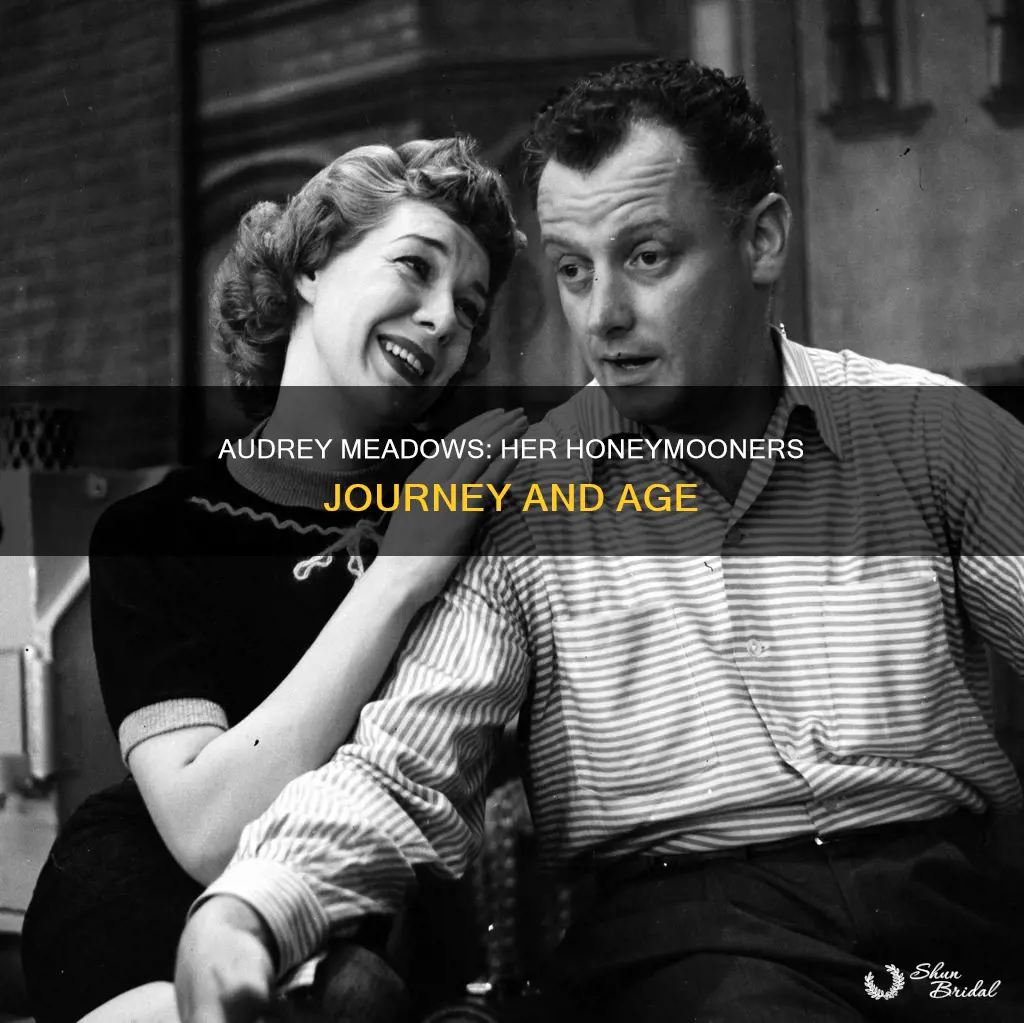
Audrey Meadows: The Legacy and Career of a Television Icon
Audrey Meadows, the legendary actress best known for her portrayal of Alice Kramden on The Honeymooners, died on February 3, 1996, at the age of 73. She passed away at Cedars-Sinai Medical Center in Los Angeles following a private batt...
Audrey Meadows, the legendary actress best known for her portrayal of Alice Kramden on The Honeymooners, died on February 3, 1996, at the age of 73. She passed away at Cedars-Sinai Medical Center in Los Angeles following a private battle with lung cancer. While historical records occasionally face digital indexing errors or confusion with other classic stars who passed in the early 2000s, Meadows’ death occurred in the mid-1990s.
Contents
The Early Years and the Path to Broadway
Audrey Meadows was born Audrey Cotter on February 8, 1922, in Wuchang, China, where her parents were serving as Episcopal missionaries. The youngest of four children, she spent her early childhood in an environment far removed from the glitz of Hollywood. Her family returned to the United States and settled in New England when she was a young girl, eventually moving to New York City. It was here that Audrey and her older sister, Jayne Meadows, began to cultivate their interests in the performing arts.
Unlike many of her contemporaries who sought out film roles immediately, Meadows began her career as a singer. She possessed a strong, disciplined soprano voice and performed in light opera before transitioning to the Broadway stage. Her early theater work provided her with a foundation in comedic timing and live performance—skills that would later become essential when working alongside a volatile and improvisational talent like Jackie Gleason. Her stage credits in the late 1940s and early 1950s showcased her versatility, but it was the emerging medium of television that would eventually define her career.
The Alice Kramden Era: A Cultural Shift
The role of Alice Kramden is one of the most recognizable in the history of American media. However, Meadows was not the first choice for the part. Originally, Pert Kelton played Alice in the early sketches of The Honeymooners on The Cavalcade of Stars. When the show moved to CBS and Kelton was blacklisted during the McCarthy era (officially cited as leaving due to health issues), Jackie Gleason began the search for a replacement.
Casting the Perfect Alice
Initially, Gleason rejected Audrey Meadows for being "too pretty" and "too young" to play the wife of a bus driver in a gritty, one-room Brooklyn apartment. Meadows, demonstrating the same tenacity that would characterize the role of Alice, hired a photographer to take pictures of her without makeup, wearing a plain housecoat, and with her hair unstyled. She sent these photos to Gleason with a note. Reportedly, Gleason looked at the photos and said, "That’s Alice."
Meadows understood that Alice needed to be the "rock" of the Kramden household. While Ralph Kramden was a man of "get-rich-quick" schemes and explosive frustration, Alice was the voice of reason. Her ability to stand toe-to-toe with Gleason’s physical comedy—often with a simple, deadpan delivery or a folded-arm stance—changed the dynamic of the "sitcom wife" forever. She was not a subordinate figure; she was an equal partner who often held the intellectual upper hand.
The "Classic 39" and the Electronicam System
The most famous episodes of The Honeymooners are known as the "Classic 39," which aired during the 1955–1956 season. These episodes were filmed using the Electronicam system, a hybrid technology developed by DuMont that allowed live television cameras to simultaneously record onto high-quality 35mm film. This technical innovation is the reason why the show remains in high-quality syndication in 2026, over 70 years after its original broadcast.
During the filming of these episodes, Meadows was known for her incredible memory. Jackie Gleason notoriously disliked rehearsing, preferring the raw energy of a live performance. This meant that Meadows, along with Art Carney (Ed Norton) and Joyce Randolph (Trixie Norton), often had to compensate for Gleason’s improvisations. Meadows memorized not only her lines but everyone else's, often subtly nudging Gleason toward his marks or feeding him cues when he drifted off-script.
The Truth About Her Passing: February 3, 1996
There is sometimes confusion regarding the exact date of Audrey Meadows’ death, with some digital queries erroneously suggesting July 8, 2001. However, the historical and medical record is clear. Audrey Meadows died in the early evening of February 3, 1996.
A Private Battle with Lung Cancer
Meadows was a lifelong smoker, a habit common among her generation of performers. She was diagnosed with lung cancer approximately one year before her death but chose to keep the diagnosis entirely private. Even her closest friends and colleagues were unaware of the severity of her condition until the very end. She did not want the public to see her as a victim, preferring to maintain the image of the vibrant, strong woman she had always been.
She spent her final days at Cedars-Sinai Medical Center in Los Angeles. Her husband, Robert Six, the former CEO of Continental Airlines, had passed away a decade earlier in 1986. She was survived by her sister, Jayne Meadows, and her brother, Edward Cotter. Audrey Meadows is interred at Holy Cross Cemetery in Culver City, California, in a crypt alongside her husband.
Addressing the 2001 Date Discrepancy
The date of July 8, 2001, is frequently associated with the deaths of other notable figures in the entertainment industry, but not Audrey Meadows. For instance, the legendary actress Dorothy McGuire died on July 11, 2001. It is common for "Golden Age" Hollywood stars to be grouped together in retrospective searches, which can lead to date conflation in automated search suggestions. In terms of factual accuracy, 1996 remains the definitive year for Meadows' passing.
A Business Pioneer: Beyond the Television Screen
One of the least discussed but most significant aspects of Audrey Meadows’ life was her success in the corporate world. Meadows was not just an actress; she was a shrewd and formidable businessperson.
In 1971, she became the first woman ever appointed to the board of directors of First National Bank of Chicago. This was an extraordinary achievement at a time when corporate boards were almost exclusively male. She was not a "celebrity figurehead" on the board; she was an active participant in high-level financial decisions and strategy for over a decade.
Additionally, due to her marriage to Robert Six, she became deeply involved in the aviation industry. She served as an advisory director for Continental Airlines, where she was instrumental in redesigning flight attendant uniforms and improving the aesthetics of aircraft interiors. Her eye for detail and her understanding of consumer psychology made her a valuable asset in the boardroom, proving that her "no-nonsense" persona as Alice Kramden was rooted in her real-life intellect.
The Residuals Strategy: Audrey’s Financial Legacy
Perhaps Audrey Meadows’ greatest contribution to the professional lives of actors was her foresight regarding residuals. In the 1950s, the concept of being paid for reruns was virtually non-existent. Most actors were paid a flat fee for their work, and the studios or networks owned the content in perpetuity.
Meadows’ brother, Edward Cotter, was a lawyer and helped her negotiate her contract for The Honeymooners. Together, they insisted on a clause that guaranteed her payments if the show was ever rebroadcast. At the time, CBS executives agreed, thinking the show would have little life beyond its initial run. This decision turned out to be one of the most lucrative contract negotiations in television history. When The Honeymooners became a staple of late-night syndication and "marathons" in the 1970s and 80s, Meadows was the only cast member—other than Gleason—who received significant royalty checks. This financial independence allowed her to be selective about her later roles.
| Feature/Aspect | Audrey Meadows (Alice Kramden) | Significance in TV History |
|---|---|---|
| Contract Innovation | Negotiated residuals in 1952 | Set the precedent for modern actor royalties. |
| Character Archetype | The "Strong Wife" | Departed from the "subservient 50s wife" trope. |
| Technical Skill | Mastery of Electronicam | Enabled high-quality 35mm preservation of sitcoms. |
| Business Achievement | First woman on First National Bank board | Broke the glass ceiling in corporate finance. |
| Literary Contribution | Author of Love, Alice (1994) | Provided a definitive insider history of The Honeymooners. |
Later Career and "Love, Alice"
After The Honeymooners, Meadows continued to work steadily. She appeared in several films, such as That Touch of Mink (1962) with Cary Grant and Doris Day, and Take Her, She's Mine (1963) with James Stewart. In the 1980s, she found a new generation of fans by playing the mother of Ted Knight’s character on the sitcom Too Close for Comfort.
In 1994, just two years before her death, she published her memoir, "Love, Alice: My Life as a Honeymooner." The book was a critical and commercial success, offering a warm and candid look at her relationship with Jackie Gleason. She debunked rumors of animosity on the set, describing Gleason as a "troubled genius" whom she respected immensely. The book served as a final gift to her fans, cementing her version of the show's history before her illness took hold.
Legacy in 2026: 70 Years of The Honeymooners
As of 2026, Audrey Meadows remains a cultural touchstone. The "Classic 39" episodes of The Honeymooners are still studied in film schools for their minimalist set design and masterclass performances in blocking and timing. Meadows’ influence can be seen in nearly every domestic sitcom that followed, from The Flintstones (where Wilma Flintstone was a direct homage to Alice) to modern working-class comedies.
Her ability to portray a woman who was financially strapped but rich in dignity, intelligence, and love remains her greatest acting achievement. She proved that a woman could be the "straight man" in a comedy duo and still be the most interesting person on the screen.
Frequently Asked Questions
What was the official cause of Audrey Meadows' death? Audrey Meadows died from lung cancer. She was a heavy smoker for most of her life and was diagnosed about a year prior to her death in February 1996. She kept her illness a secret from the public and her colleagues until her passing.
Did Audrey Meadows have any children? No, Audrey Meadows did not have any children from her marriages. She was married twice: first to Randolph Rouse in 1956 (divorced in 1958) and later to Robert Six from 1961 until his death in 1986.
Was Audrey Meadows related to Jayne Meadows? Yes, Audrey Meadows was the younger sister of actress Jayne Meadows. Jayne was also a prominent star of the era and was married to the legendary entertainer and Tonight Show creator Steve Allen. Jayne lived a long life, passing away in 2015 at the age of 95.
Where is Audrey Meadows buried? She is interred in the Holy Cross Cemetery in Culver City, California. Her crypt is located in the same section as several other notable Hollywood figures, and she rests beside her husband, Robert Six.
How much did Audrey Meadows make from Honeymooners residuals? While the exact cumulative figure is not public record, it is well-documented that her residual payments were substantial. Because of her unique contract, she earned hundreds of thousands of dollars over the decades as the show became a hit in syndication, a feat her co-stars Art Carney and Joyce Randolph did not achieve to the same degree.
Recommendation for Further Research
To truly understand the impact of Audrey Meadows, fans and historians should view the "Classic 39" episodes with a focus on her non-verbal reactions. Her autobiography, Love, Alice, remains the most authoritative source for understanding the production of The Honeymooners and is highly recommended for those interested in the evolution of 1950s television.
Image Gallery